
Every December, a familiar drama unfolds: tinsel vanishes, ornaments shatter, and a wide-eyed feline perches triumphantly atop a lopsided fir—tail twitching, claws embedded in boughs, as if claiming sovereignty over the entire holiday display. It’s not mischief for mischief’s sake. It’s instinct, curiosity, stress, or unmet needs wearing festive camouflage. Understanding *why* your cat targets the Christmas tree is the first step toward resolving it—not with punishment, but with empathy, environmental design, and behavioral science.
Cats don’t see “holiday centerpiece.” They see a towering, textured, unpredictable structure teeming with movement (swaying branches), novel scents (resin, pine oil, stored decorations), reflective surfaces (ornaments), and dangling objects that trigger deep-seated predatory wiring. When we misinterpret their behavior as defiance or boredom, we miss the biological and psychological drivers at play—and risk escalating conflict instead of resolving it.
The Science Behind the Sabotage: 4 Core Reasons Cats Target Trees
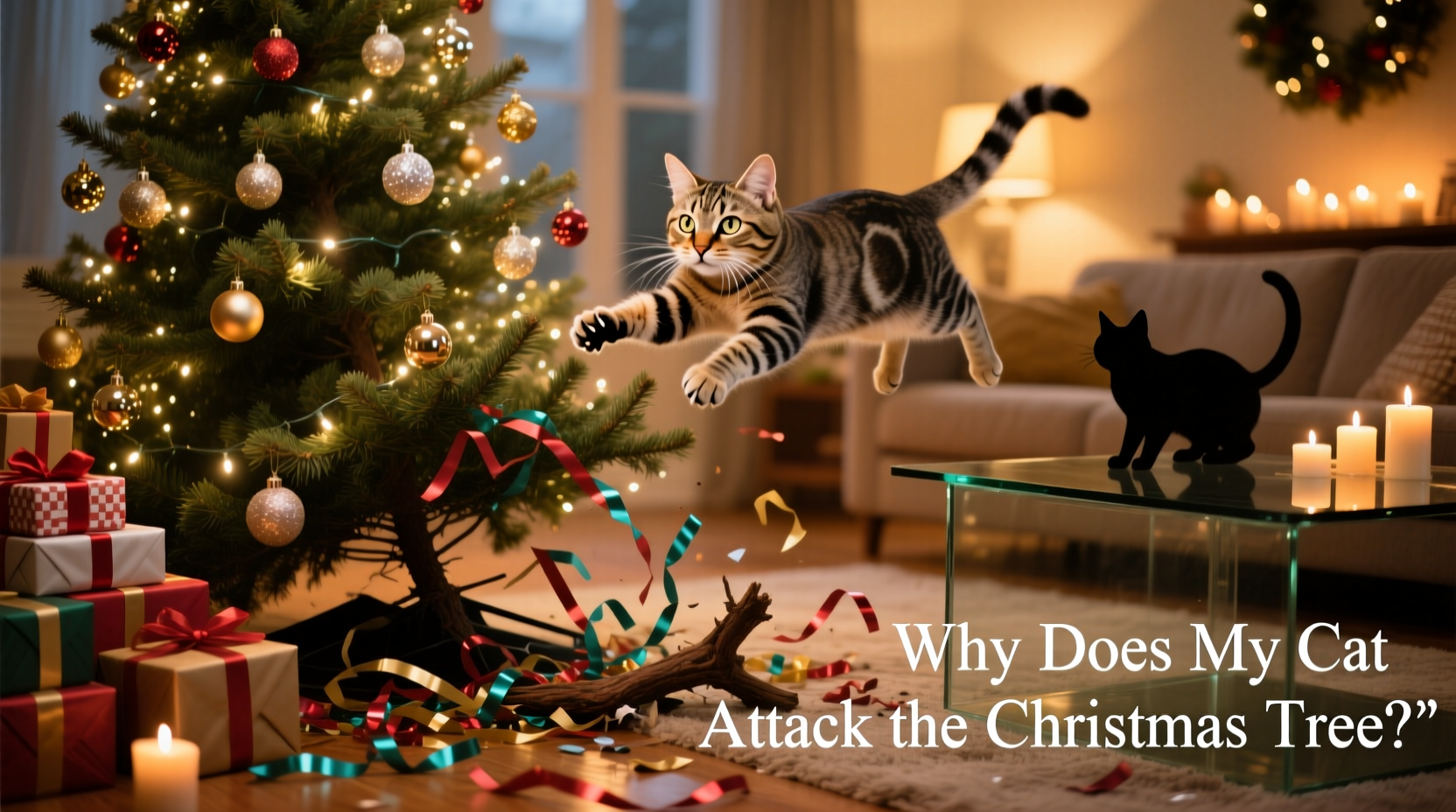
Cats aren’t plotting holiday mayhem. Their actions stem from evolutionary imperatives and immediate environmental cues. Here’s what’s really happening:
- Prey Drive Activation: Hanging ornaments, twinkling lights, and swaying ribbons mimic the motion of birds, insects, or small mammals. A cat’s visual system detects even subtle flicker (especially LED lights pulsing at 50–60 Hz) and lateral movement far more acutely than ours. This isn’t play—it’s rehearsal.
- Vertical Territory Expansion: In multi-cat households—or even in homes where cats feel uncertain about their status—a tall, stable structure like a Christmas tree becomes an ideal vantage point. Climbing offers surveillance, safety from perceived threats (e.g., vacuum cleaners, guests), and a way to assert spatial control.
- Sensory Overload & Stress Relief: The holiday season brings noise, new people, altered routines, and unfamiliar smells. For sensitive cats, the tree becomes both a stressor (its scent is foreign; its presence disrupts normal pathways) and a coping mechanism (scratching bark releases endorphins; batting ornaments provides predictable sensory feedback amid chaos).
- Novelty-Driven Exploration: Unlike furniture or bookshelves, the Christmas tree appears only once a year. Its combination of texture (rough bark, soft needles), temperature (cooler than room air), scent (terpenes like pinene and limonene), and instability makes it irresistibly novel—even for senior or sedentary cats.
A 2022 study published in Applied Animal Behaviour Science observed 87 indoor cats during holiday setup. Researchers found that 68% showed increased investigative behavior toward the tree within 24 hours of installation—and that cats with access to alternative vertical spaces (cat trees, wall shelves) were 3.2× less likely to target the Christmas tree. Context matters more than character.
What NOT to Do: Common Mistakes That Backfire
Well-intentioned interventions often worsen the problem—either by increasing anxiety or reinforcing the very behaviors you’re trying to stop. Avoid these approaches:
| Action | Why It Fails | Better Alternative |
|---|---|---|
| Spraying water or shouting “No!” | Startles the cat without teaching an alternative; associates you—and the tree—with fear. May increase avoidance or redirected aggression. | Redirect calmly to a toy; reward calm proximity with treats. |
| Using citrus sprays or vinegar around the base | Strong scents overwhelm a cat’s olfactory system, causing stress or aversion to the entire room—not just the tree. | Use unscented physical barriers (see Step-by-Step Guide) and enrich elsewhere. |
| Tying the cat’s collar to the tree stand | Extremely dangerous—risk of strangulation, panic, or injury. Violates basic welfare standards. | Supervise, restrict access when unattended, or use safe, vet-approved deterrents. |
| Removing all toys or playtime to “punish” tree interaction | Deprives the cat of essential outlets, increasing frustration and making the tree *more* appealing as the only stimulating object. | Double down on interactive play *away* from the tree, especially before peak activity windows (dawn/dusk). |
A Step-by-Step Plan to Protect Your Tree (and Your Cat)
This 5-phase approach prioritizes prevention, enrichment, and consistency—not confrontation. Implement all steps for best results.
- Phase 1: Secure the Foundation (Day 1)
Anchor the tree firmly using a commercial tree stabilizer or DIY method (e.g., L-brackets screwed into wall studs + nylon straps). Fill the stand with water mixed with 1 tsp apple cider vinegar (safe for cats, deters chewing without strong odor). Place the tree away from furniture, curtains, or shelves that could serve as launchpads. - Phase 2: Create a “No-Go” Zone (Day 1–2)
Use a low-profile, 30-inch-diameter baby gate or a freestanding pet barrier arranged in a semi-circle around the tree base. Alternatively, lay down a non-slip yoga mat covered with aluminum foil (crinkly texture deters most cats) or place inverted plastic carpet runners (nubby side up) along the perimeter. Remove immediately if your cat shows signs of distress (panting, flattened ears, hiding). - Phase 3: Redirect the Urge (Ongoing)
Place a sturdy, tall cat tree or wall-mounted shelf *within 3 feet* of—but not touching—the Christmas tree. Drape it with a fleece blanket and add a few pine-scented catnip toys (research shows many cats enjoy natural conifer scents). Rotate toys daily to sustain interest. - Phase 4: Control the Stimuli (Before Decorating)
Skip tinsel, loose ribbon, and lightweight glass ornaments. Opt for shatterproof, matte-finish ornaments hung *only* on upper branches (above 3 feet). Use ornament hooks with locking mechanisms. Keep lights on a timer—6 hours on, 18 off—to reduce constant visual stimulation. Avoid plug-in scent diffusers near the tree. - Phase 5: Reinforce Calm (Daily)
Twice daily, sit near the tree with your cat on your lap (if tolerated) or nearby. Offer high-value treats (freeze-dried chicken, tuna flakes) *only* when they look at—not paw at—the tree. If they walk past calmly, mark with a quiet “yes” and treat. Never reward attention *after* swatting.
Mini Case Study: Luna, the “Tree General”
Luna, a 4-year-old spayed domestic shorthair in Portland, OR, had attacked every Christmas tree since she was 6 months old. Her owners tried everything: lemon spray, motion-activated air cans, even moving the tree to the garage (which she accessed via cat door). By December 2023, her attacks escalated—she’d knock over the entire tree twice, once injuring her hind leg on broken glass.
Her veterinarian referred her to a certified feline behaviorist, who observed Luna’s routine for three days. Key findings: Luna slept under the bed during daytime guest visits, paced at night, and spent 40+ minutes daily scratching the baseboard near the living room door—a known stress hotspot. The tree wasn’t the problem; it was the symptom.
The plan shifted: First, they installed floor-to-ceiling curtains to buffer hallway noise. Second, they added two elevated perches near windows (with bird feeders outside) to fulfill her need for surveillance. Third, they placed a sisal-wrapped pole *next to* the tree—sprinkled daily with silvervine—and rewarded calm sitting there with lickable salmon paste. Within 11 days, Luna stopped approaching the tree. By New Year’s Eve, she napped peacefully 5 feet away, tail curled around her paws.
As Dr. Sarah Wilson, board-certified veterinary behaviorist and author of Cat Sense: Decoding Feline Behavior, explains:
“Cats don’t ‘misbehave’—they communicate unmet needs through behavior. Attacking the tree is rarely about the tree itself. It’s about safety, predictability, and opportunity. When we address those foundations, the tree stops being a target—and becomes just another piece of furniture.” — Dr. Sarah Wilson, DACVB
Practical Checklist: Your Pre-Tree Prep List
- ✅ Schedule a vet wellness check (rule out pain or hyperthyroidism—both increase agitation)
- ✅ Audit your home for vertical space: Add at least one new perch or shelf *before* tree setup
- ✅ Stock up on interactive toys: Wand toys with feathers, motorized mice, treat puzzles
- ✅ Test all deterrents (foil, mats, barriers) in a neutral area first—observe your cat’s reaction
- ✅ Set calendar reminders: 10-minute play session at 5:30 a.m. and 6:00 p.m. daily (mimics dawn/dusk hunting peaks)
- ✅ Choose ornaments: Shatterproof > glass; matte > reflective; heavy > light; upper branches only
- ✅ Designate a “quiet zone”: A low-traffic room with bedding, food, water, and litter—away from holiday bustle
FAQ: Real Questions From Real Cat Owners
Will getting a second cat solve the tree problem?
No—and it may worsen it. Introducing a new cat increases household stress, territorial uncertainty, and competition for resources. Most tree-targeting stems from individual needs, not social deficiency. Focus on enriching the environment for your current cat first. If considering a second cat, consult a feline behaviorist *before* adoption—not as a fix for tree behavior.
Is it safe to use fake snow or flocking on the tree?
No. Most artificial snow contains zinc chloride or other chemicals toxic if ingested. Even licking paws after contact poses risk. Flocking often contains formaldehyde-based binders. Both can cause vomiting, lethargy, and kidney stress. Skip them entirely—your cat’s health outweighs aesthetic novelty.
My cat only attacks the tree at night. What’s different then?
Nighttime brings reduced human activity, lower light levels (enhancing contrast of ornaments), and increased natural feline alertness. It’s also when ambient sounds change—HVAC cycles, distant traffic, or even rodent activity in walls may draw your cat toward the tree as a vantage point. Try leaving a low-wattage nightlight near the tree (reduces contrast) and placing a white-noise machine nearby to mask subtle sounds.
Conclusion: Reframe the Problem, Reclaim the Peace
Your cat isn’t declaring war on tradition. They’re responding—honestly, consistently, biologically—to an environment that feels novel, stimulating, unstable, or threatening. Solving “tree sabotage” isn’t about winning a battle of wills. It’s about listening to your cat’s body language, honoring their instincts, and designing a holiday space where safety, choice, and engagement coexist with tinsel and tradition.
Start small: Pick one step from the 5-phase plan and commit to it for five days. Notice how your cat’s posture shifts. Watch where they choose to rest. Track whether the number of “near-misses” decreases. Progress isn’t always dramatic—but consistency rewires behavior faster than any quick fix.
This season, let your Christmas tree stand not as a symbol of feline defiance, but as proof of your commitment to understanding the quiet, complex, deeply intelligent creature sharing your home. You’ve already taken the hardest step: asking “why?” Now act—not from frustration, but from insight.




 浙公网安备
33010002000092号
浙公网安备
33010002000092号 浙B2-20120091-4
Comments
No comments yet. Why don't you start the discussion?