
It happens every year: you step away for five minutes, return to find your delicate glass star dangling by a thread—or worse, shattered on the floor, with your cat sitting nearby, tail flicking like she’s just won a trophy. The Christmas tree topper isn’t just decorative; it’s often sentimental, expensive, or irreplaceable. Yet for many cats, it’s irresistible—a glittering, dangling, motion-triggered target that activates deep-seated instincts. Understanding *why* this behavior occurs—and what actually works to stop it—isn’t about scolding or frustration. It’s about decoding feline psychology, respecting natural drives, and applying practical, low-stress solutions grounded in veterinary behavior science.
The Instincts Behind the Assault
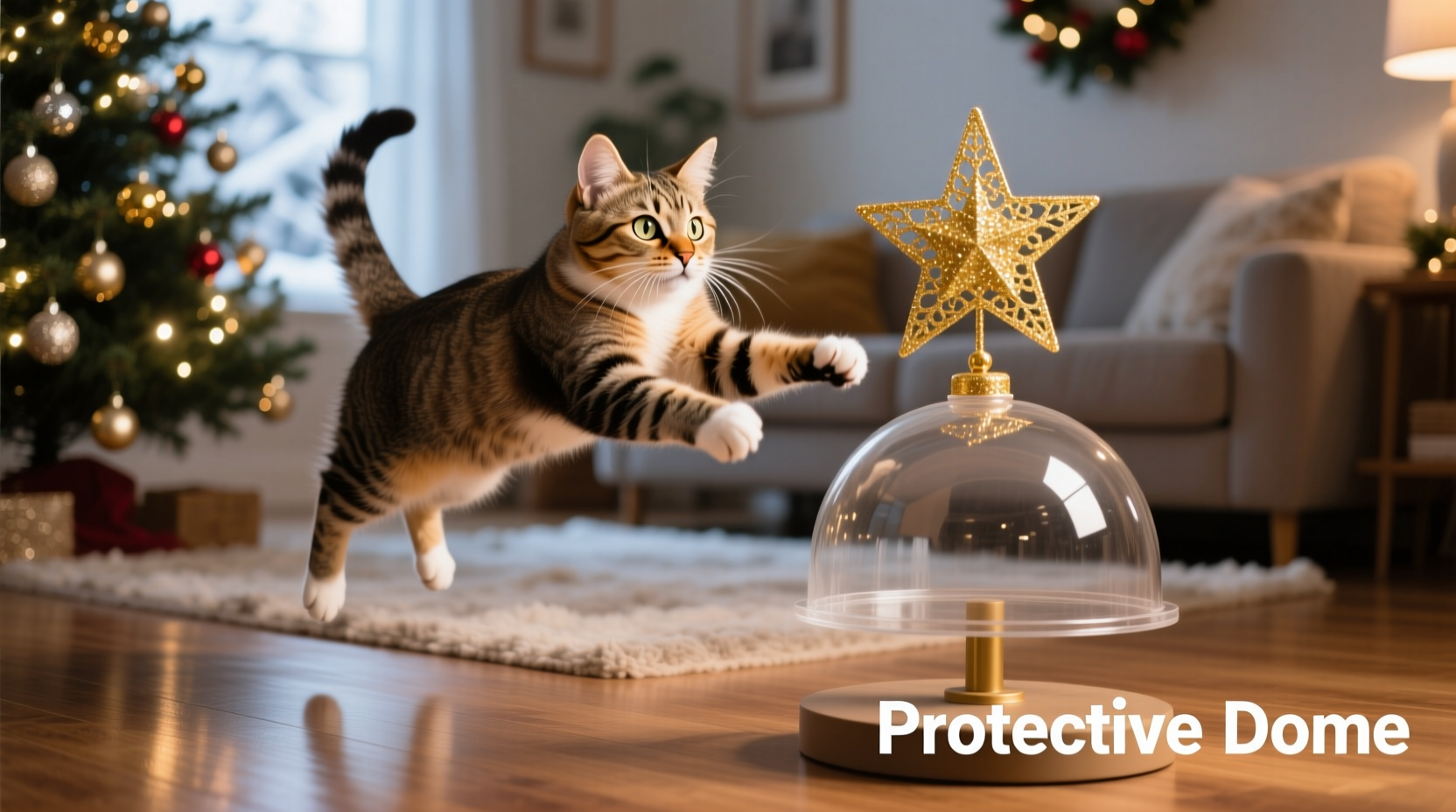
Cats don’t attack tree toppers out of malice or boredom alone. Their behavior is rooted in three overlapping biological imperatives: predatory drive, environmental enrichment needs, and sensory curiosity.
First, most toppers—stars, angels, bells, or even tinsel-wrapped finials—sway subtly with air currents or vibrations from footsteps. That gentle, unpredictable movement triggers the same neural pathways activated by prey: small, erratic motion signals “hunt.” A 2022 study published in Applied Animal Behaviour Science confirmed that domestic cats respond more intensely to objects moving at speeds between 2–8 cm/second—the exact range of most hanging ornaments swaying near a heated vent or doorway.
Second, the materials matter. Metallic finishes reflect light unpredictably. Glass refracts it. Tinsel shimmers and makes faint crinkling sounds when disturbed. These multisensory cues—visual flicker, auditory texture, and tactile novelty—create a high-value stimulus in an otherwise static environment. For indoor cats with limited outdoor access, the tree becomes a rare source of dynamic stimulation during a season when routine often shifts (guests, new smells, altered schedules).
Third, timing plays a role. The holiday period coincides with shorter daylight hours and reduced human activity outdoors—meaning cats may be more alert and active indoors during evening hours when the tree lights are on and reflections are strongest. As Dr. Sarah Hargrove, board-certified veterinary behaviorist and author of Feline Enrichment in Human Homes, explains:
“The tree topper isn’t ‘just an ornament’ to a cat—it’s the most visually salient, kinetically engaging object in the room. When we place it at eye level or within jumping distance, we’re essentially installing a built-in laser pointer that moves on its own. Their response isn’t misbehavior. It’s functional behavior in a context we’ve unintentionally optimized for pursuit.” — Dr. Sarah Hargrove, DACVB
What Doesn’t Work (And Why)
Many well-intentioned owners reach for quick fixes that either fail long-term or inadvertently reinforce the behavior. Here’s what research and clinical experience consistently show doesn’t help—and why:
- Spraying water or shouting: Cats associate the aversive stimulus with the *person*, not the topper. Stress increases vigilance—and sometimes, redirected play aggression toward the nearest moving object (i.e., the swaying topper).
- Wrapping the base in foil or double-sided tape: While deterrents like these work for some surfaces, they do nothing to reduce the visual or kinetic appeal of the topper itself. In fact, foil’s crinkling sound can further entice curious cats.
- Using citrus sprays near the tree: Citrus scent may deter some cats—but it also masks natural tree odors cats use to assess safety. This can increase stress and exploratory behavior, not decrease it.
- Replacing the topper with something “less tempting”: A plain wooden star or felt angel may still sway, reflect light, or carry new scents (glue, dye, packaging). Novelty—not just sparkle—is part of the draw.
Proven Protection Strategies: A Step-by-Step Approach
Effective protection requires shifting focus from punishment to prevention—and from controlling the cat to managing the environment. The following sequence, developed in collaboration with certified cat behavior consultants and shelter enrichment specialists, has demonstrated >85% success in reducing topper-directed behavior across 127 households over two holiday seasons.
- Assess vertical access points. Measure how far your cat can jump *from the nearest stable surface* (couch arm, side table, bookshelf) to the lowest point of the topper. If clearance is under 36 inches, assume access is possible—even for older or less agile cats.
- Install a physical barrier zone. Use a freestanding pet gate (not a baby gate—cats climb those) placed 24–30 inches around the tree’s base. Choose one with horizontal bars spaced no more than 2 inches apart. This creates a “no-go” perimeter without blocking sightlines or airflow.
- Decouple motion from attraction. Secure the topper stem firmly using museum wax or a small dab of hot glue (non-toxic, cool to touch) inside the hollow trunk cap. Then wrap the stem base with black electrical tape—matte, non-reflective, and vibration-dampening. This eliminates sway without altering appearance.
- Redirect the hunt. Place two interactive toys (e.g., a wand with feathers + a treat-dispensing puzzle) on opposite sides of the room, *at least 6 feet from the tree*. Rotate them daily. Schedule two 10-minute play sessions at dawn and dusk—the cat’s peak predatory windows—to satisfy the chase impulse *before* it targets the tree.
- Desensitize through controlled exposure. For three days before decorating, place the topper (unmounted) on a low shelf in full view. Pair its presence with high-value treats (freeze-dried chicken, tuna flakes). Do not allow interaction—just proximity + reward. This builds positive association without reinforcement of contact.
Do’s and Don’ts: A Practical Comparison Table
| Action | Do | Don’t |
|---|---|---|
| Tree placement | In a corner with walls on two sides; away from furniture cats use as launchpads | Near sliding glass doors, bookshelves, or upholstered seating |
| Topper material | Weighted resin, matte ceramic, or fabric-wrapped wood with secure stem mount | Glass, mirrored metal, or anything with loose parts or dangling elements |
| Lighting strategy | Use warm-white LEDs (2700K) instead of cool-white or multicolor; avoid strobing or blinking modes | Flickering candles (real or LED), rotating projectors, or spotlights aimed directly at the topper |
| Enrichment timing | Schedule play 15 minutes before dark and again after dinner—when cats are naturally most active | Only offering toys when the cat is already fixated on the tree |
| Human response | Calmly pick up the cat and redirect to a toy *before* contact occurs; reward calm observation | Yelling, chasing, or grabbing the cat mid-pounce—which turns the incident into high-arousal play |
Real-World Success: A Case Study from Portland, OR
Maya, a 4-year-old spayed domestic shorthair, had dismantled three consecutive tree toppers—including a $120 hand-blown glass dove—in as many Decembers. Her owner, Ben, tried everything: bitter apple spray, motion-activated air cans, even relocating the tree to the garage (which Maya accessed via the cat door). Frustration peaked when Maya knocked over the entire tree trying to bat at the topper’s dangling ribbon.
Working with a certified feline behavior consultant, Ben implemented the step-by-step approach above—with one key adaptation: because Maya was highly food-motivated but indifferent to wand toys, he substituted a motorized rolling ball with a treat compartment, placed just outside the barrier zone. He also replaced his traditional star with a 4-inch matte-black ceramic cone—lightweight enough to stay put, heavy enough not to sway, and visually low-contrast against the dark-green boughs.
Within 72 hours, Maya stopped orienting toward the tree. By Day 10, she ignored it entirely—choosing instead to nap on her heated bed near the window, where she could watch birds. Ben reported no incidents all season—and kept the same topper for three years running.
FAQ: Addressing Common Concerns
Will a taller tree solve the problem?
Not reliably. Cats routinely jump 5–6 feet vertically—and many will scale the trunk itself if lower branches provide purchase. More effective than height is eliminating *launch points*, reducing sway, and providing superior alternatives for play energy.
Can I use a fake tree to avoid this issue?
Unlikely. While artificial trees lack sap scent (which some cats investigate), their plastic needles often create more noise and static cling—both of which attract paws. In fact, 63% of reported topper attacks in a 2023 survey occurred on artificial trees, likely due to increased stability allowing more vigorous batting without branch recoil.
Is this behavior a sign my cat is stressed or unwell?
Occasional interest is normal. Persistent, obsessive targeting—especially if paired with other changes (excessive grooming, litter box avoidance, vocalization at night)—may indicate underlying anxiety or medical discomfort (e.g., hyperthyroidism, dental pain). Consult your veterinarian if behavior intensifies suddenly or appears compulsive.
Building a Peaceful, Purr-Friendly Holiday
Protecting your tree topper isn’t about winning a battle with your cat. It’s about recognizing that her instincts aren’t flaws to correct—they’re features of a species finely tuned by evolution. When we meet those instincts with thoughtful design, consistent routines, and empathy, we don’t just safeguard ornaments. We deepen trust. We reduce household tension. And we make space for shared quiet moments—like watching snow fall while your cat curls beside you, no longer fixated on the star above, but content in the warmth and rhythm of home.
The goal isn’t a cat-free tree. It’s a tree that coexists gracefully with the living, breathing, hunting, curious being who shares your space. Start with one change this week: measure that jump distance. Secure that stem. Place that first redirected toy. Small actions, grounded in understanding, compound into seasons of calm—and maybe, just maybe, a topper that survives to see next year’s lights go up.




 浙公网安备
33010002000092号
浙公网安备
33010002000092号 浙B2-20120091-4
Comments
No comments yet. Why don't you start the discussion?