
It’s December. You’ve just strung up your favorite string of warm-white LED lights—soft, festive, and utterly mesmerizing. Then you notice: your cat is crouched low, pupils dilated, tail flicking like a metronome set to “hunt.” With surgical precision, she swipes at a flickering shadow dancing across the wall—a phantom mouse made of light and refraction. She misses. She resets. She strikes again. This isn’t mischief. It’s biology in action.
What looks like playful whimsy is actually a tightly conserved survival mechanism—one that hasn’t evolved much since your cat’s wild ancestors stalked desert rodents under moonlight. Understanding why your cat reacts so intensely to those shimmering, darting shadows helps you respond with empathy—not frustration—and even enrich her daily life in meaningful ways.
The Feline Visual System: Built for Motion, Not Detail
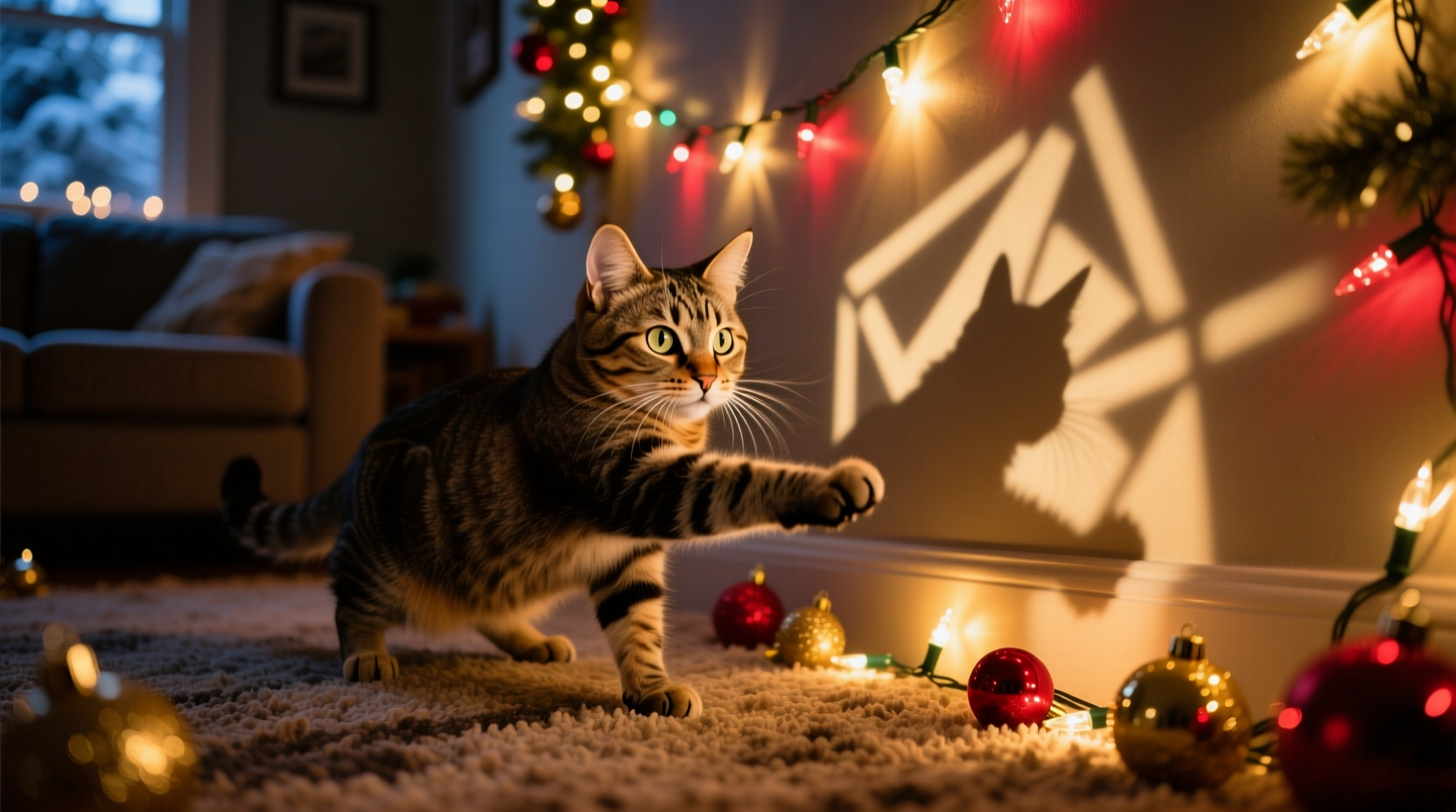
Cats don’t see the world the way we do. Their retinas contain far more rod photoreceptors than humans—roughly six to eight times as many—which makes them exceptionally sensitive to low light and rapid movement. But this comes at a cost: reduced visual acuity. While humans resolve fine detail at 20/20, the average cat sees at approximately 20/100 to 20/200. That means they can’t clearly identify a static ornament on your tree—but they *can* detect a millisecond shift in luminance half a room away.
This hyper-sensitivity to motion is governed by specialized cells in the superior colliculus, a midbrain region that prioritizes movement over form or color. When Christmas lights twinkle—especially older incandescent strings with subtle voltage fluctuations, or cheaper LEDs with inconsistent pulse-width modulation—they generate micro-variations in brightness and position. These translate into unpredictable, high-contrast shadow patterns that glide, pulse, and stutter across walls and floors. To your cat, that isn’t “light reflection”—it’s prey behavior: erratic, fleeting, and biologically irresistible.
Importantly, cats lack a fovea—the central retinal pit responsible for sharp, focused vision in primates. Instead, they rely on a broad “visual streak” packed with motion-detecting ganglion cells. This architecture favors panoramic surveillance over scrutiny. So while you’re admiring the symmetry of your garland, your cat is tracking the faintest tremor in a shadow’s edge—processing it as potential movement in her peripheral field, where detection speed matters most.
Instinct Over Intellect: Why “It’s Just Light” Doesn’t Compute
You know the shadow isn’t real. Your cat doesn’t—or rather, her brain doesn’t *process* that knowledge in real time. Predatory sequences in felids are largely hardwired and triggered automatically by specific visual stimuli: small size, rapid direction change, contrast against background, and unpredictable timing. A bouncing light pattern hits all four criteria.
Neuroethologist Dr. John Bradshaw, author of Cat Sense, explains:
“The predatory motor pattern in cats isn’t ‘decided’—it’s released. Once the right sensory threshold is crossed, the sequence unfolds: orient → stalk → chase → pounce. Conscious inhibition is possible, but it requires significant cognitive load—and most cats aren’t wired to suppress instinct for abstract concepts like ‘this is artificial light.’”
This explains why even well-fed, indoor-only cats exhibit intense hunting behaviors. Hunger isn’t the driver; neural readiness is. In fact, studies show that cats who receive insufficient physical and mental stimulation display *more* repetitive, shadow-directed activity—not less. The behavior isn’t boredom per se, but an unmet need for sensorimotor engagement that their environment fails to satisfy in species-appropriate ways.
Light Quality Matters: Why Some Strings Trigger More Than Others
Not all Christmas lights provoke equal responses. The intensity and character of the shadow play depend heavily on bulb type, power source, fixture placement, and ambient lighting. Below is a comparison of common light configurations and their typical impact on feline behavior:
| Light Type | Motion Pattern Produced | Feline Response Likelihood | Why It Triggers Strongly |
|---|---|---|---|
| Older incandescent mini-lights (AC-powered) | Subtle 60Hz flicker + gentle sway from heat convection | High | Flicker rate aligns closely with optimal motion detection thresholds; warmth creates air currents that subtly move cords and cast drifting shadows |
| Low-cost PWM-controlled LEDs | Staccato pulses, uneven brightness jumps | Very High | Pulse-width modulation introduces irregular, high-contrast transients—mimicking insect wing beats or rodent scurrying |
| High-quality constant-current LEDs | Steady glow, minimal shimmer | Low to Moderate | Consistent output reduces temporal contrast; fewer false-positive triggers for motion-sensitive neurons |
| Projected light (e.g., starry-night projectors) | Slowly rotating constellations, gentle drift | Moderate | Slower motion engages stalking more than pouncing—but sustained attention still depletes mental energy |
| Fiber-optic trees or static LED panels | Even illumination, no moving shadows | Low | Lacks the critical element: dynamic contrast change over time |
Placement also plays a key role. Lights hung near ceiling fans, HVAC vents, or windows with breezes create amplified shadow movement. Strings draped loosely over furniture generate more sway—and thus more unpredictable shadow trajectories—than taut, wall-mounted strands.
When Shadow-Batting Crosses Into Concern: Recognizing Red Flags
Occasional, joyful swiping at light patterns is normal, healthy, and even beneficial—it burns calories, sharpens coordination, and satisfies deep-seated behavioral needs. But certain patterns warrant closer observation:
- Obsessive repetition: More than 3–4 focused sessions per day, lasting over 10 minutes each, especially if accompanied by vocalization or agitation.
- Self-directed behavior: Biting at paws or flanks immediately after missing a shadow, or chasing reflections off windows/glass tabletops to the point of exhaustion.
- Sleep disruption: Stalking shadows late at night, interfering with household sleep cycles or causing your cat to appear chronically fatigued.
- Loss of interest in other enrichment: Ignoring toys, food puzzles, or interactive play in favor of light-chasing—even when alternatives are novel or highly rewarding.
A real-world example illustrates this distinction: Maya, a 3-year-old domestic shorthair in Portland, began fixating on the rhythmic pulse of her kitchen’s smart-strip lights after her owner installed them in October. Within weeks, she’d stopped using her window perch, ignored treat-dispensing toys, and began vocalizing plaintively at 3 a.m. when the lights cycled to “night mode.” Her veterinarian ruled out pain or neurological issues, but a certified feline behavior consultant observed that Maya’s environment offered zero alternative outlets for predatory sequence completion. After introducing daily simulated hunts with feather wands and hiding kibble in cardboard tunnels, Maya’s light fixation decreased by 80% within 10 days—and she resumed napping on her perch.
Practical Strategies: Balance Enrichment Without Sacrificing Festivity
You don’t need to dismantle your decorations—or deprive your cat of natural expression. Instead, redirect, regulate, and reinforce healthier outlets. Here’s how:
Step-by-Step: Building a Shadow-Smart Holiday Routine
- Assess your current lights: Turn them on in a dim room and observe shadow movement for 90 seconds. Note frequency, speed, and unpredictability of patterns.
- Introduce “preemptive play”: Conduct a full predatory sequence (stalk-chase-pounce-bite) with a wand toy 20 minutes before turning on decorative lights. Use treats to reward calm disengagement afterward.
- Modify light behavior: Add a diffuser (e.g., white linen draped loosely over strings) or switch to constant-current LEDs. Avoid placing lights near airflow sources.
- Create competing enrichment: Place a puzzle feeder or snuffle mat near—but not directly under—the light zone. Cats rarely engage in two high-focus activities simultaneously.
- Establish “light-free zones”: Designate one quiet room (e.g., bedroom or laundry room) with zero decorative lighting where your cat can retreat for undisturbed rest.
Also consider environmental design: vertical space reduces perceived threat from unpredictable stimuli. A tall cat tree placed opposite the main light display gives your cat observational distance and control—she can watch the shadows without feeling compelled to intercept them.
FAQ
Is it harmful for my cat to chase lights all day?
Physically, occasional chasing poses little risk—but chronic, unrewarded pursuit can lead to frustration, redirected aggression, or compulsive tendencies. More concerning is the *lack of completion*: cats need to “catch” something to reset their nervous system. Without bite-and-kill resolution (even symbolic, like crunching a treat), dopamine and cortisol levels remain elevated.
Can I train my cat to ignore the shadows?
Direct suppression rarely works—and may increase anxiety. Instead, use classical conditioning: pair the onset of lights with something highly positive (e.g., opening a favorite treat pouch or starting a gentle brushing session). Over 5–7 consistent pairings, many cats begin associating light patterns with relaxation rather than prey urgency.
My kitten does this constantly—is it normal developmentally?
Yes—and it’s vital. Kittens refine motor skills, depth perception, and impulse control through exactly this kind of practice. As long as they also engage with littermates, toys, and human-led play, shadow-chasing supports healthy neurodevelopment. However, if it’s their *only* observed play behavior past 16 weeks, consult a feline behavior specialist to assess socialization and enrichment balance.
Conclusion
Your cat isn’t “confused” by the lights. She isn’t “broken” or “needing correction.” She’s responding with the same precision, focus, and evolutionary wisdom that allowed her species to survive millennia of ecological change. That flickering shadow isn’t noise to her—it’s data. A signal. A call to action written in the language of survival.
So this holiday season, meet that instinct not with dismissal, but with intention. Swap reactive frustration for proactive enrichment. Replace “Why won’t she stop?” with “How can I help her fulfill this need well?” Small adjustments—choosing steadier lights, scheduling daily hunts, honoring her need for vantage points and quiet zones—don’t diminish the magic of the season. They deepen it. They invite you into a richer understanding of who your cat truly is: not a furry accessory to your décor, but a sentient, sensory-driven being sharing your home on her own ancient, elegant terms.




 浙公网安备
33010002000092号
浙公网安备
33010002000092号 浙B2-20120091-4
Comments
No comments yet. Why don't you start the discussion?