
If you've ever walked into a room to find a crumpled sock proudly deposited at your feet by your cat, you're not alone. This seemingly odd behavior is more common than many realize, and while it might appear random or even comical, it's rooted in deep-seated feline instincts, social dynamics, and emotional expression. Cats don’t act without reason—even when their actions baffle us. Understanding why your cat brings you socks requires peeling back layers of evolutionary history, domestication patterns, and individual personality traits.
This behavior often reflects a blend of instinctual hunting drives, learned associations, and a desire for connection. Rather than dismissing it as mere mischief, recognizing the meaning behind the gesture can deepen your relationship with your cat and improve how you respond to their needs.
The Instinctual Roots: Hunting and Provisioning
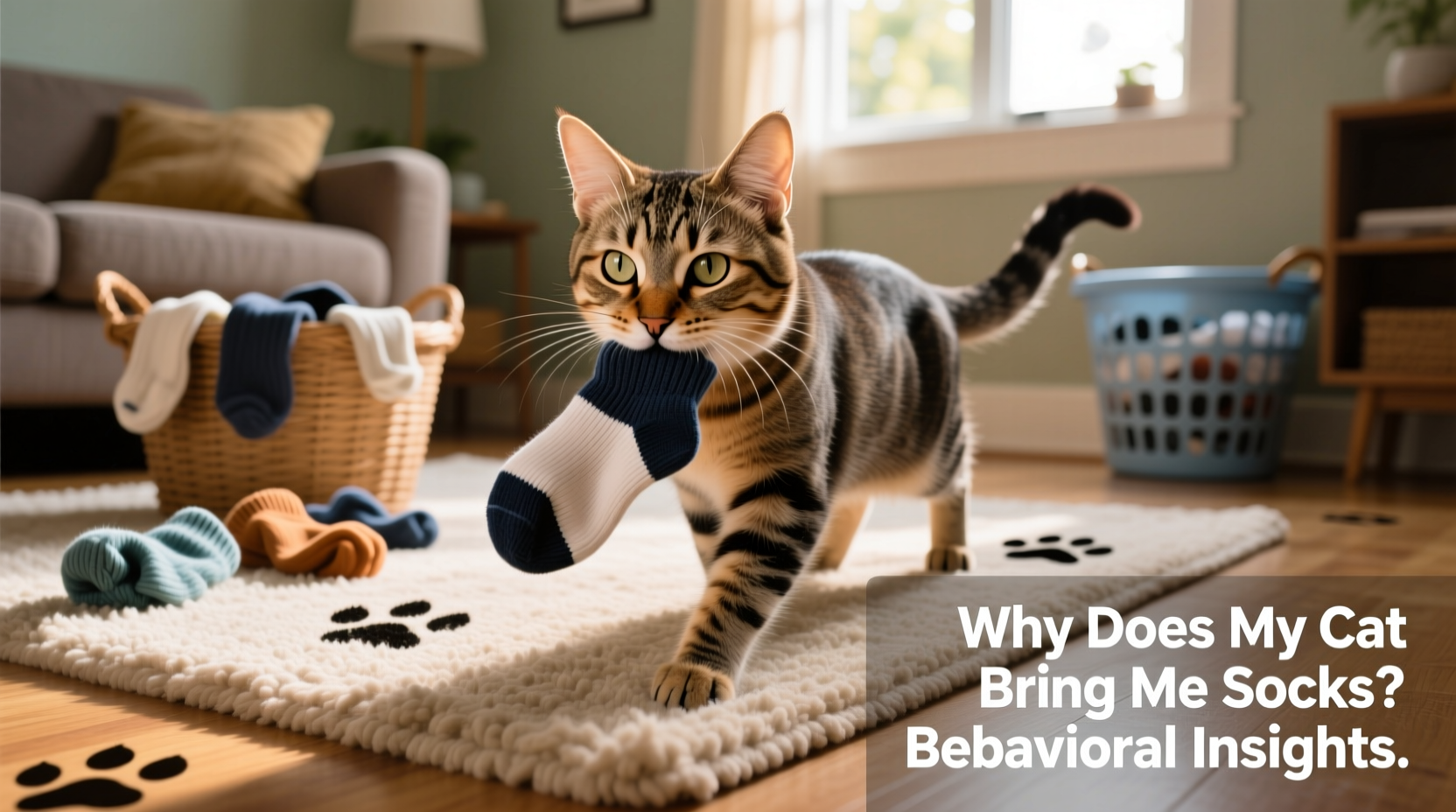
Cats are natural predators. Even well-fed indoor cats retain strong hunting instincts shaped over thousands of years of evolution. In the wild, mother cats teach their kittens to hunt by bringing them live prey or dead animals. Over time, they transition from eating the catch themselves to presenting it to their offspring—a form of instruction and care.
When your cat brings you a sock, they may be treating you as part of their social group—possibly even as an inept member who needs help learning how to “hunt.” The sock becomes a stand-in for prey: it’s soft, movable, and carries your scent, making it both familiar and stimulating to carry around.
“Cats don’t distinguish between ‘real’ prey and objects that mimic the size and texture of small animals. A rolled-up sock looks like a captured rodent to a cat’s brain.” — Dr. Lena Torres, Feline Behavior Specialist
This behavior isn't limited to socks. Cats have been known to present hair ties, bottle caps, toys, and even shoes. What matters is the act of retrieval and presentation, which satisfies their predatory sequence: stalk, pounce, capture, and deliver.
Social Bonding and Trust Expression
In multi-cat households or feral colonies, cats sometimes share kills with trusted members of their group. This sharing reinforces social bonds and signals cooperation. When your cat brings you a sock, they may be doing the same—offering you a “gift” as a sign of inclusion and trust.
Your cat likely sees you as part of their inner circle. By bringing you an object, they’re acknowledging your role in their life, possibly even attempting to strengthen the bond through ritualistic behavior. It’s not about utility; it’s about relationship-building.
Interestingly, cats often choose items that carry strong human scents—like worn socks, gloves, or scarves. These objects smell like you, which makes them emotionally significant to the cat. Delivering something personal may be their way of reciprocating the care you provide.
Attention-Seeking and Learned Reinforcement
While instinct plays a major role, learned behavior also contributes. If your cat has brought you a sock in the past and received attention—whether positive (petting, talking) or negative (yelling, chasing)—they’ve learned that the action produces a reaction.
Cats are highly observant and quickly associate actions with outcomes. If you consistently respond when they drop a sock at your feet, they’ll repeat the behavior to initiate interaction. Some cats become so tuned in to this pattern that they’ll retrieve the same sock multiple times in a single day just to engage you.
This doesn’t mean the behavior is “manipulative” in a negative sense—it simply shows that your cat understands cause and effect and uses it to maintain connection with you.
How to Respond Constructively
Instead of ignoring the behavior or reacting with frustration, consider redirecting it in ways that satisfy your cat’s instincts while minimizing household clutter.
- Provide appropriate alternatives: Offer plush toys designed to mimic prey—small, soft, and easy to carry.
- Engage in daily play sessions: Use wand toys to simulate hunting, ending with the cat “catching” and carrying the toy away.
- Use treat-dispensing puzzles: After a successful “hunt,” reward your cat with food to close the predatory loop.
- Acknowledge the gesture calmly: Say “thank you” or gently pet your cat without overstimulating them.
Object Preference and Scent Attachment
Not all household items are equally appealing to cats. Socks, particularly cotton or wool blends, tend to be ideal because they’re lightweight, flexible, and absorbent—perfect for gripping and dragging. But beyond physical properties, scent plays a critical role.
Feet emit a complex mix of pheromones, bacteria, and sweat compounds that are highly interesting to cats. Your unique odor profile, concentrated in a sock, acts as a powerful attractant. To your cat, the sock isn’t dirty—it’s rich with information about you.
Some cats develop preferences for specific types of socks—argyle, striped, fuzzy, or even mismatched pairs. This suggests individual taste and possibly associative memories (e.g., you wore those socks during a walk or play session).
| Object Type | Why Cats Like It | What It Might Mean |
|---|---|---|
| Worn Socks | Strong human scent, soft texture | Bonding, familiarity-seeking |
| Shoelaces or Ribbons | Movement mimics prey | Hunting simulation |
| Children’s Toys | Bright colors, small size | Play-driven retrieval |
| Paper Balls | Crumpling sound, light weight | Exploratory behavior |
Mini Case Study: Bella and the Midnight Sock Ritual
Sarah, a graphic designer from Portland, noticed her tabby cat Bella began leaving socks near her bed every night. At first, she assumed Bella was knocking them out of the laundry basket accidentally. But after observing the pattern—Bella would fetch a sock from the hamper, carry it down the hall, and place it beside Sarah’s slippers—she realized it was intentional.
Concerned, Sarah consulted a feline behaviorist. She learned that Bella had been rescued as a kitten and never had the chance to interact with other cats. Her “gift-giving” was a combination of instinct and attachment. Since Sarah worked long hours, Bella likely felt under-stimulated and used the sock ritual to reconnect each evening.
With guidance, Sarah introduced structured play sessions before bedtime using a feather wand and a mouse toy. She also gave Bella a designated “prey” toy to carry and “hide” each night. Within three weeks, the sock deliveries decreased significantly, replaced by healthier outlets for Bella’s instincts.
The case highlights how environmental enrichment and understanding motivation can transform puzzling behaviors into opportunities for better care.
When Is This Behavior a Sign of Stress?
While most sock-bringing is harmless, excessive or obsessive object collection can indicate underlying stress. Cats experiencing anxiety, boredom, or changes in routine may over-rely on ritualistic behaviors to self-soothe.
Warning signs include:
- Bringing the same object repeatedly in a short timeframe
- Hoarding items in one location (e.g., under the bed)
- Exhibiting other compulsive actions (over-grooming, tail-chasing)
- Becoming agitated if the object is removed
If these patterns emerge, assess your cat’s environment. Are they getting enough mental stimulation? Do they have safe spaces to retreat? Have there been recent changes—new pets, moving, visitors—that could be disruptive?
Step-by-Step Guide: Managing and Redirecting the Behavior
If sock deliveries are becoming overwhelming, follow this five-step approach to guide your cat toward more appropriate outlets:
- Observe the Pattern: Note when and where your cat retrieves socks. Is it after meals? At night? From a specific drawer?
- Secure High-Risk Items: Keep dirty laundry in closed hampers or closets. Use baskets with lids to limit access.
- Introduce Prey-Simulating Toys: Choose small, soft toys that can be carried easily. Encourage interaction with catnip or silver vine.
- Simulate the Full Hunt Sequence: Play for 10–15 minutes daily using a wand toy. End with a “kill” moment—let your cat bite the toy—and follow with a treat to mimic eating.
- Reward Desired Behavior: Praise or offer a treat when your cat interacts with its toy instead of household items.
Consistency is key. It may take several weeks for your cat to shift focus, but with patience, most cats adapt well to redirected hunting rituals.
Frequently Asked Questions
Is it normal for my cat to bring me socks every day?
Yes, it’s normal as long as it’s not obsessive. Daily sock delivery often indicates a strong bond and active predatory drive. If your cat seems otherwise healthy and happy, this behavior is typically nothing to worry about.
Should I discourage my cat from bringing me socks?
Not directly. Instead of discouraging the act, redirect it. Punishment can create fear or confusion. Focus on providing acceptable alternatives and enriching your cat’s environment.
Why does my cat only bring me certain socks?
Cats often prefer socks with stronger odors, particular textures, or colors. Darker socks may stand out visually, while wool blends might feel more satisfying to carry. Individual preference plays a big role.
Conclusion: Embracing the Quirks of Feline Communication
Your cat bringing you socks isn’t random—it’s communication. Whether driven by instinct, affection, or a bid for attention, this behavior reveals how deeply your cat perceives you as part of their world. Far from being a nuisance, it’s a window into their mind, showing trust, care, and the enduring legacy of their wild ancestry.
By responding with empathy and offering constructive outlets, you honor your cat’s nature while maintaining harmony in your home. Celebrate the quirks. They’re not just habits—they’re expressions of love in a language all their own.




 浙公网安备
33010002000092号
浙公网安备
33010002000092号 浙B2-20120091-4
Comments
No comments yet. Why don't you start the discussion?