
If you've ever been jolted awake at 3 a.m. by a soft nudge and found your cat proudly dropping a crumpled mouse toy at your feet, you're not alone. This peculiar ritual—part endearing, part exhausting—is more than just random feline mischief. Behind that bleary-eyed delivery lies a complex web of instinct, communication, and emotional connection. Cats don’t gift without reason, and when they choose the middle of the night to do it, there’s always a story unfolding in their silent language.
Understanding why your cat brings you toys at 3 a.m. requires stepping into their world—a world shaped by predatory rhythms, social bonds, and subtle expressions of trust. While humans might interpret this as a request for play or attention, cats operate on deeper biological and psychological levels. Decoding this behavior isn't about correcting it outright but learning to appreciate its roots and respond in ways that benefit both you and your feline companion.
The Evolutionary Roots of Feline Gifting
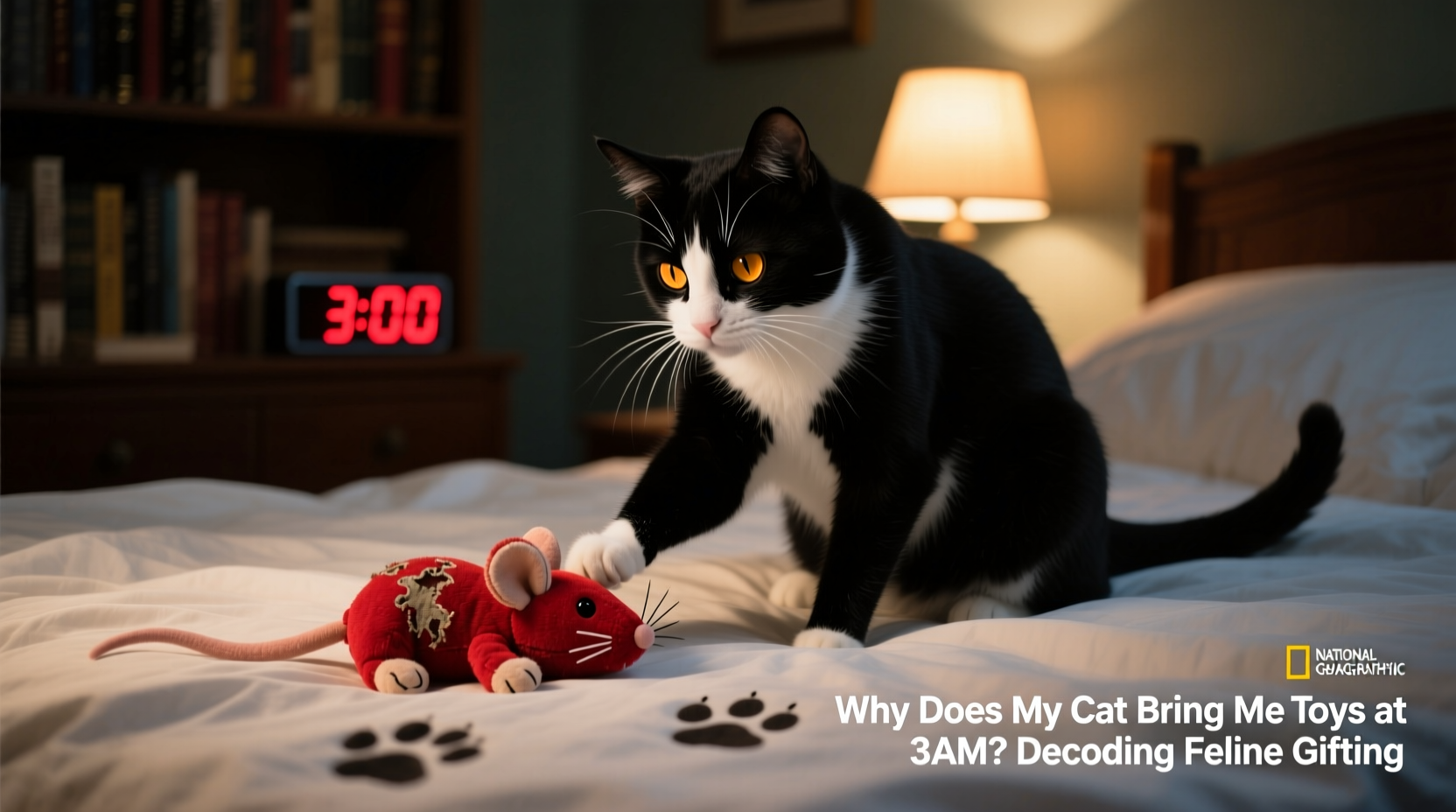
Cats are crepuscular by nature, meaning they’re most active during dawn and dusk. However, many domestic cats shift toward nocturnal activity patterns, especially when left alone during the day. At 3 a.m., your cat is likely riding a peak in their natural hunting cycle. Even well-fed indoor cats retain strong predatory instincts. These drives aren’t diminished by regular meals—they’re redirected.
In the wild, mother cats teach their kittens how to hunt by bringing them live prey, then later dead animals. Over time, the kittens learn through observation and practice. When your cat brings you a toy at 3 a.m., they may be exhibiting a modified version of this teaching behavior. You, as their trusted human, become the “apprentice” in their eyes.
“Cats often view their owners as clumsy members of their social group who need help learning survival skills—even if those skills involve batting around a stuffed bird.” — Dr. Sarah Thompson, Feline Behavior Specialist
This act of gifting mirrors what biologists call *alloparenting*—where non-parent individuals participate in rearing young. In multi-cat households, experienced hunters may bring prey to younger or less skilled cats. Your cat may see you as someone who needs guidance, protection, or inclusion in their inner circle.
Communication Through Objects: What the Toy Really Means
The toy itself is symbolic. Whether it’s a feather wand, a crinkly ball, or a plush squirrel missing an eye, it represents something valuable in your cat’s mind. The selection isn’t arbitrary. Many cats favor toys that mimic the size, texture, and movement of real prey. By presenting it to you, they’re sharing a success—like showing off a trophy.
This gesture can carry multiple meanings:
- Acknowledgment of trust: Only cats that feel safe with their humans will bring prized possessions near them.
- An invitation to engage: Some cats drop the toy and immediately sit back, waiting for interaction—play, praise, or even a pretend chase.
- A sign of bonding: Just as cats groom each other to strengthen social ties, sharing objects can reinforce attachment.
- Seeking approval: After placing the toy down, some cats watch intently, almost expecting a reaction—as if awaiting a nod of recognition.
Interestingly, studies have shown that cats form secure attachments to their caregivers similar to those seen in dogs and infants. A 2019 study published in *Current Biology* found that over 60% of cats exhibited secure attachment behaviors, including checking in with their owner after exploration—exactly the kind of behavior seen before and after toy deliveries.
Why 3 a.m.? Aligning With Your Cat’s Internal Clock
The timing is no accident. Three in the morning sits squarely within the window when cats naturally transition from rest to high-alert activity. Their senses sharpen; their muscles twitch with anticipation. If your cat spends the day napping in sunbeams or watching birds from the windowsill, nighttime becomes prime time for mental and physical stimulation.
Several factors contribute to the 3 a.m. phenomenon:
- Reduced household noise: With fewer distractions, your cat feels freer to roam, play, and perform rituals like toy delivery.
- Leftover energy: Indoor cats often lack sufficient daytime enrichment, leading to pent-up energy released overnight.
- Attention economy: If past toy drops were met with response—even scolding—you’ve inadvertently reinforced the behavior. To your cat, any reaction is better than none.
- Light cycles: Artificial lighting can disrupt melatonin production, altering sleep-wake patterns in both humans and pets.
Decoding the Types of Toy Gifts and Their Meanings
Not all toy deliveries are equal. The type of object brought—and how it’s presented—can reveal nuances in your cat’s intent. Below is a breakdown of common scenarios:
| Type of Toy | Delivery Style | Potential Meaning |
|---|---|---|
| Feather wand or bird-like toy | Dropped dramatically, followed by chirping sounds | Pride in mimicking successful bird capture; possible attempt to teach hunting techniques |
| Mice or rodent-shaped toy | Brought gently, placed close to your pillow | Strong bond signal; treated like a cherished offering |
| Squeaky toy | Shaken vigorously before delivery | Simulating killing bite; may indicate frustration if no follow-up play occurs |
| Multiple toys in succession | Repeated trips between hiding spot and bed | High arousal state; desire for sustained interaction or environmental enrichment |
| No toy, but mouth movements | Miming carrying something, pacing | Dreaming or remembering past hunts; could suggest need for more tactile play |
Pay attention to body language accompanying the gift. Ears forward, tail upright, and slow blinks usually mean affection and confidence. Flattened ears, darting glances, or rapid retreats may suggest anxiety or overstimulation.
How to Respond: Balancing Respect and Routine
While it’s tempting to shoo your cat away or ignore the gesture entirely, doing so may damage the social bridge they’re trying to build. On the flip side, engaging every time reinforces early-morning disruptions. The key is consistent, thoughtful responses that honor the bond without encouraging unwanted timing.
Step-by-Step Guide: Managing Midnight Toy Drops
- Stay calm: Avoid yelling or sudden movements. Even negative attention fuels repetition.
- Acknowledge quietly: Use a soft voice to say, “Thank you,” or give one gentle pet. This validates the gesture without escalating excitement.
- Redirect gently: Pick up the toy and place it aside. Then guide your cat to a designated sleeping area with a cozy bed or blanket.
- Introduce a wind-down routine: Ten minutes before bed, engage in calming play using slow-moving toys to simulate a full “hunt-eat-groom-sleep” cycle.
- Use automatic feeders or puzzle toys: Set a timed feeder for 2–3 a.m. with dry food or treats. The sound and reward can distract from toy retrieval.
Mini Case Study: Luna and the 3 a.m. Mouse Parade
Luna, a 4-year-old Siamese mix, began waking her owner, Mark, nearly every night at 3:15 a.m. with a different toy mouse. Initially, Mark would yell, “Not again!” and toss the toy across the room. Within weeks, Luna escalated—bringing three or four toys per night, sometimes meowing insistently until acknowledged.
After consulting a veterinary behaviorist, Mark changed his approach. He started ending evenings with a 10-minute interactive session using a wand toy, followed by a small meal. He also installed a timed treat dispenser set for 2:50 a.m. When Luna brought a toy now, he softly said, “Good job,” placed it on a shelf, and guided her back to her heated bed.
Within two weeks, the 3 a.m. visits decreased by 70%. Luna still occasionally brings a toy—but only once or twice a week, and she returns to sleep quickly after acknowledgment.
Do’s and Don’ts of Feline Gift Management
| Do | Don’t |
|---|---|
| Respond calmly and consistently | Yell, punish, or throw the toy aggressively |
| Provide alternative outlets (puzzle feeders, climbing shelves) | Leave all toys accessible 24/7—rotate instead |
| Reinforce daytime activity | Encourage rough play late at night |
| Treat the toy as meaningful | Ignore the gesture completely |
| Use scheduled feeding to anchor sleep cycles | Give in to demands for food during gifting episodes |
“When a cat brings you a toy, they’re saying, ‘I trust you. I want to include you.’ Our job isn’t to stop it, but to shape when and how it happens.” — Dr. Elena Ruiz, Clinical Ethologist
FAQ: Common Questions About Nocturnal Toy Gifting
Is my cat trying to feed me?
Not literally, but symbolically, yes. In feline logic, bringing food—or toy substitutes—to a vulnerable member of the group is an act of care. Your cat may believe you’re incapable of hunting and are therefore dependent on their generosity.
Should I discourage this behavior completely?
No. Complete discouragement risks weakening your bond. Instead, redirect the timing and context. Encourage play earlier in the evening and acknowledge gifts with quiet appreciation rather than energetic engagement.
What if my cat brings real prey?
This is a more intense version of the same behavior. It reflects strong hunting instincts and deep trust. While unsettling, it’s normal for outdoor or indoor-outdoor cats. Consider keeping your cat indoors at night or using a bell collar to reduce hunting success if wildlife conservation is a concern.
Final Thoughts: Embracing the Mystery of Feline Love
The 3 a.m. toy drop is one of the most misunderstood acts of feline affection. It’s easy to view it as inconvenient, disruptive, or silly. But beneath the surface lies a profound expression of kinship—one rooted in millennia of evolution, social intelligence, and emotional depth.
Your cat doesn’t operate on human schedules or expectations. They live in a world of scent, motion, and instinctual rhythm. When they place that worn-out plush bird beside your hand in the dark, they’re not being annoying. They’re saying, “You’re part of my world. I share my victories with you.”
Instead of resisting these moments, consider reframing them. Let them remind you that you’re loved in a language older than words. And with a few strategic adjustments—timed feeders, enriched days, calm responses—you can preserve the meaning while restoring your sleep.




 浙公网安备
33010002000092号
浙公网安备
33010002000092号 浙B2-20120091-4
Comments
No comments yet. Why don't you start the discussion?