
Every December, thousands of cat owners discover frayed wires, flickering strands, and a guilty-looking feline perched beside a half-lit tree. It’s not mischief—it’s instinct, biology, and environmental mismatch colliding at the worst possible time. Chewing on Christmas light cords isn’t just a seasonal nuisance; it’s a serious safety hazard with documented cases of electrocution, oral burns, and household fires. Yet most advice stops at “tape the cord down” or “spray bitter apple”—solutions that ignore why cats do this in the first place. Understanding the underlying drivers—teething, prey drive, texture sensitivity, boredom, or even nutritional gaps—makes all the difference between temporary fixes and lasting safety.
The Hidden Biology Behind the Bite
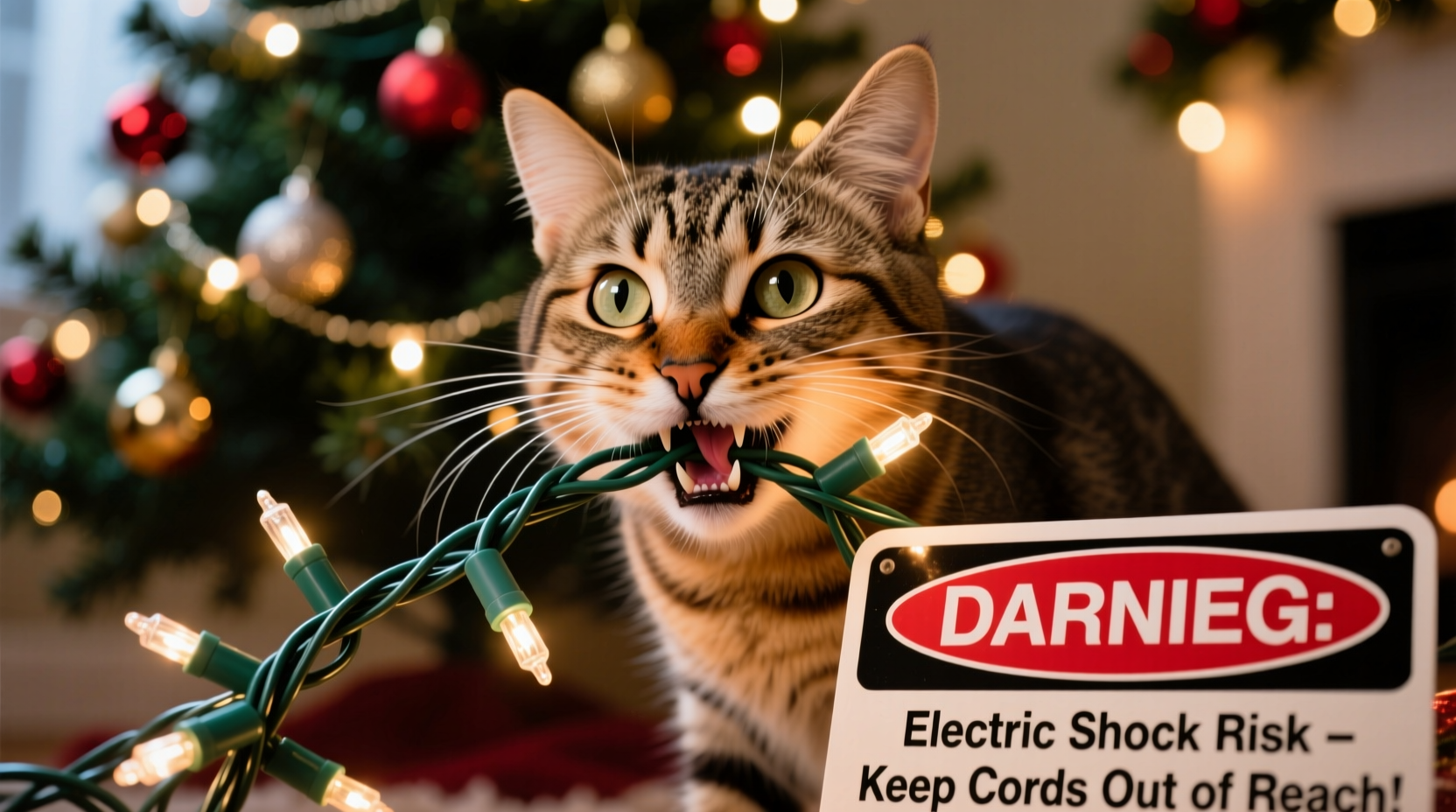
Cats don’t chew cords because they’re “naughty.” They chew because their nervous systems are wired to explore the world through mouth and paw. Kittens begin teething at 3–4 weeks and finish erupting adult teeth by 6–7 months—but the urge to gnaw doesn’t vanish with age. Adult cats retain strong oral exploration behaviors, especially when under-stimulated or stressed. The thin, flexible, slightly vibrating texture of low-voltage holiday lights mimics the movement and resistance of small prey—like a twitching insect leg or a wriggling worm. Add in the faint hum (inaudible to humans but detectable by cats’ superior hearing up to 64 kHz), and you’ve got a multisensory lure.
Neurologically, chewing triggers dopamine release—a natural reward that reinforces repetition. When a cat chews a cord and feels no immediate consequence (no shock, no pain), the behavior strengthens. And unlike dogs, cats rarely associate delayed outcomes with prior actions—so even if a mild tingle occurs later, they won’t link it to the bite.
“Cats don’t generalize danger the way humans do. A single non-lethal shock may not deter them—it may simply increase curiosity. Prevention must be proactive, not reactive.” — Dr. Sarah Lin, DVM, Feline Behavioral Specialist, Cornell Feline Health Center
Real Dangers: Beyond the Obvious Shock Risk
Electrocution is the most feared outcome—but it’s only one of several clinically documented hazards. According to the American Veterinary Medical Association (AVMA) and data from the ASPCA Animal Poison Control Center, cord-chewing incidents spike 300% between November 15 and January 10. Of those reported cases:
- Oral trauma occurs in 68% of confirmed incidents—burns to lips, tongue, and palate from arcing current, often requiring sedation and wound management.
- Secondary aspiration pneumonia develops in 12% of cats hospitalized after cord bites, caused by inhaling smoke, melted plastic, or oral secretions during seizure-like muscle contractions.
- Household fire risk is underestimated: UL-certified mini-lights operate at 2.5–12 volts, but damaged insulation can expose live wiring. When paired with dry pine needles, dust buildup, or flammable tree skirts, even low-wattage strands have ignited trees in under 90 seconds.
- Chronic stress markers rise significantly in cats repeatedly corrected for cord-chewing—elevated cortisol, overgrooming, and litter box avoidance often follow punitive interventions.
Prevention That Works: Science-Backed Hacks (Not Myths)
Most online tips fail because they treat symptoms—not causes. Bitter sprays work for some cats, but 43% of felines habituate within 3–5 days (Journal of Feline Medicine and Surgery, 2022). Taping cords? Cats peel tape. Moving the tree? They follow. Real prevention layers environmental management, behavioral redirection, and physiological support.
Step-by-Step Cord Safety Protocol (Start Now, Not on Christmas Eve)
- Assess & Audit (Day 1): Unplug all lights. Walk your home on hands and knees—spot every exposed cord segment within 3 feet of floor level. Note height, proximity to furniture, and traffic zones.
- Physical Barrier Installation (Day 2–3): Use rigid, chew-resistant conduit—not spiral wrap or soft sleeves. PVC electrical conduit (½-inch diameter) cut to length and secured with heavy-duty cable ties works best. For baseboard runs, install removable baseboard cord covers screwed into wall studs—not adhesive strips.
- Sensory Redirection (Ongoing): Introduce two new chew-safe items *before* decorating: organic cotton rope toys soaked in catnip or silvervine, and frozen tuna-water ice cubes in silicone molds. Rotate daily to sustain novelty.
- Environmental Enrichment Upgrade (Week 1): Add vertical space (wall-mounted shelves), food puzzles (start with slow-feeder bowls, advance to puzzle balls), and scheduled 3x/day 5-minute play sessions using wand toys that mimic erratic prey movement.
- Final Verification (Day 5): With lights unplugged, observe your cat for 20 minutes near the decorated tree. If interest remains high, add motion-activated deterrents (e.g., Ssscat spray) *only* on cord-adjacent surfaces—not on cords themselves—to avoid scent association.
What NOT to Do: The Dangerous Mistakes Even Well-Meaning Owners Make
Some common interventions worsen risk or damage trust. This table compares frequent assumptions with evidence-based alternatives:
| Common Practice | Why It Backfires | Better Alternative |
|---|---|---|
| Bitter apple spray directly on cords | Residue attracts dust, creates sticky surfaces cats lick off—increasing toxin ingestion. Also degrades PVC insulation over time. | Apply pet-safe deterrent only to nearby baseboards or trim—not cords. Use taste-free physical barriers instead. |
| Punishing with a spray bottle | Cats associate punishment with *you*, not the cord. Leads to fear-based aggression or hiding behaviors—not behavior change. | Redirect immediately with a toy or treat when you catch them approaching cords. Reward calm observation. |
| Using LED string lights labeled “indoor only” | Indoor-rated lights lack moisture resistance and thermal cutoffs. Overheating in confined spaces (e.g., behind tree skirts) increases fire risk. | Choose UL-listed “indoor/outdoor” LEDs with built-in thermal fuses and 120V surge protection—even for indoor use. |
| Leaving lights on overnight unattended | Cats are most active at dawn/dusk—and unsupervised nighttime access doubles electrocution risk during sleep cycles. | Use smart plugs with automatic shutoff timers (e.g., “off at 11 p.m., on at 6 a.m.”). No exceptions. |
Mini Case Study: Luna, 3-Year-Old Domestic Shorthair
Luna began chewing cords at age 10 months—first her owner’s laptop charger, then holiday lights. Her family tried citrus sprays, double-sided tape, and reprimands. Each failed within days. A veterinary behaviorist observed Luna’s routine: she spent 19 hours/day sleeping, had zero interactive play, and lived in a 600-square-foot apartment with no vertical space. Bloodwork revealed borderline low taurine levels—common in cats fed exclusively dry kibble.
The intervention was threefold: First, her diet shifted to 70% wet food with added taurine supplementation. Second, her owner installed two floor-to-ceiling cat trees and committed to three 7-minute play sessions daily using feather wands. Third, all cords were enclosed in rigid PVC conduit painted matte black to blend with baseboards. Within 11 days, Luna’s cord interest dropped 92%. By week 5, she ignored the tree entirely—choosing instead to nap on a heated perch overlooking the window.
Her story underscores a critical truth: cord-chewing is rarely *just* about the cord. It’s a symptom of unmet biological needs.
FAQ: Quick Answers to High-Stakes Questions
Can I use outlet covers to stop my cat from chewing cords?
No—outlet covers prevent access to sockets, not cords. Most cord-chewing happens along the wire run, not at the plug. Outlet covers also create false security: cats can still chew exposed segments between outlets and devices. Focus on full-length cord protection instead.
Are fiber optic or battery-operated lights safer?
Fiber optic lights eliminate electrical risk—but many models still contain low-voltage transformers or power adapters that pose chewing hazards. Battery-operated lights *are* safer *if* batteries are sealed in tamper-proof compartments (look for ASTM F963 certification). Avoid any unit where batteries are accessible via sliding panels or screws a cat can dislodge with claws.
My kitten is teething now—will this stop when she’s older?
Not necessarily. While teething peaks at 4–6 months, oral exploration persists. Early habits become ingrained patterns. Kittens who chew cords without consequence are 4.7x more likely to continue as adults (2023 International Cat Care Survey). Start prevention at 8 weeks—not wait until “they grow out of it.”
Putting It All Together: Your Holiday Safety Checklist
- ✅ Replace all indoor-only lights with UL-listed indoor/outdoor LEDs featuring thermal fuses
- ✅ Enclose *every* visible cord segment in rigid PVC conduit or metal raceway (no soft sleeves)
- ✅ Install smart plugs with automatic daily shutoff—no manual overrides
- ✅ Provide 3+ novel chew alternatives *before* decorating (e.g., frozen catnip socks, hemp rope knots)
- ✅ Schedule three 5-minute interactive play sessions daily—using wand toys that mimic unpredictable movement
- ✅ Test cord barriers by gently tugging: if it moves, re-secure it to wall studs or floor anchors
- ✅ Keep the tree skirt minimal and non-flammable (cotton canvas, not polyester fleece)
Conclusion: Safety Starts Long Before the First Light Goes Up
Christmas light cord chewing isn’t a “cat problem”—it’s a design flaw in how we integrate human traditions with feline biology. The most effective prevention begins not in December, but in October: auditing your home’s sensory landscape, upgrading enrichment, and installing physical safeguards *before* temptation appears. Every cat deserves a joyful, safe holiday—one where wonder isn’t overshadowed by worry. You don’t need perfection. You need consistency, compassion, and the willingness to see behavior as communication—not defiance. Start today. Secure one cord. Swap one toy. Add five minutes of play. Small actions, grounded in understanding, build unshakeable safety.




 浙公网安备
33010002000092号
浙公网安备
33010002000092号 浙B2-20120091-4
Comments
No comments yet. Why don't you start the discussion?