
It’s a familiar holiday scene: tinsel glitters, lights twinkle, and your cat is perched precariously on the lowest bough—teeth sunk into a pine branch. You gently pry their jaws apart, only to find them circling back five minutes later. This isn’t mischief for mischief’s sake. It’s communication—subtle, instinctual, and deeply rooted in feline biology and lived experience. Understanding *why* your cat chews on Christmas tree branches isn’t about assigning blame or enforcing holiday discipline. It’s about recognizing unmet needs, mitigating real health and safety risks, and responding with empathy grounded in science—not superstition.
The Biological Roots: Why Pine Smells Like Opportunity
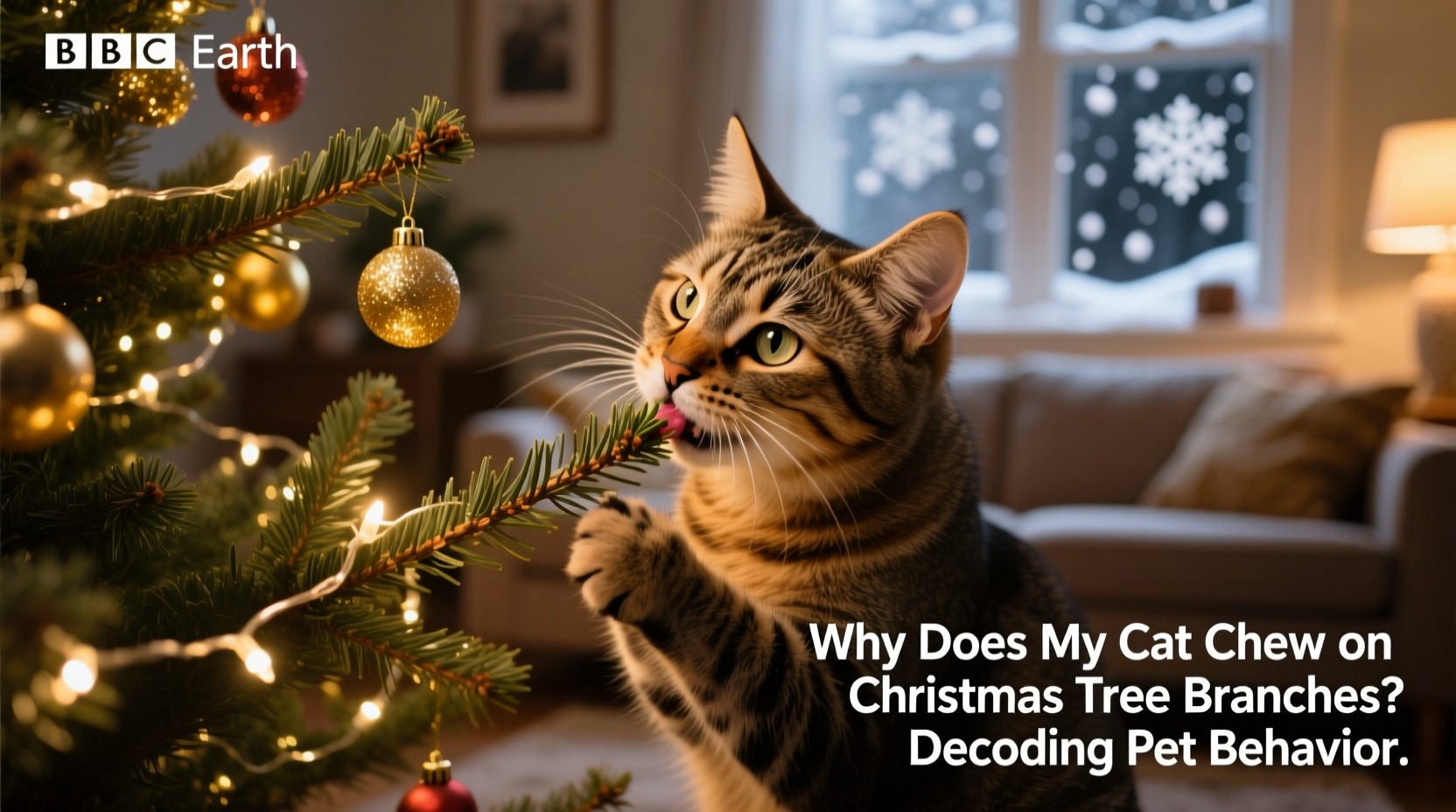
Cats don’t perceive Christmas trees the way humans do. To us, it’s tradition and nostalgia. To them, it’s a complex sensory event—an unfamiliar, towering object emitting volatile organic compounds (VOCs) from its sap, needles, and bark. Pine, fir, and spruce trees release terpenes like alpha-pinene and limonene—compounds that, in low concentrations, closely resemble the chemical signature of catnip (Nepeta cataria) and silver vine (Actinidia polygama). These plants trigger a harmless, euphoric response in roughly 50–70% of cats via olfactory receptors linked to the vomeronasal organ.
But scent is only part of the story. The texture of fresh conifer needles offers tactile novelty—crisp, slightly resistant, and yielding with a satisfying snap. For indoor cats deprived of natural foraging stimuli, the tree becomes an accidental enrichment device: vertical, unpredictable, and rich in micro-movements (swaying boughs, falling needles, shifting light patterns). A 2022 study published in Applied Animal Behaviour Science observed that cats spent up to 43% more time investigating novel plant-based objects when those objects combined olfactory intrigue with textural variability—exactly what a live Christmas tree delivers.
Safety Risks: Beyond the “Cute” Photo
That viral photo of your kitten gnawing a spruce tip may get likes—but it masks serious hazards. Real Christmas trees pose three distinct categories of risk:
- Toxicity: While true pine toxicity in cats is rare, the sap contains phenols and turpentine derivatives that can irritate the mouth, esophagus, and stomach. Ingestion may cause drooling, vomiting, lethargy, or—in severe cases—tremors. Fir and spruce are less toxic but still carry risk due to needle sharpness and potential pesticide residues.
- Physical injury: Conifer needles are rigid and barbed at the microscopic level. They can embed in gums, puncture the soft palate, or migrate into the intestinal wall if swallowed. Vets report seasonal spikes in oral foreign-body removals between December 15 and January 10.
- Secondary dangers: Chewing often escalates to climbing or batting. Unstable stands, overloaded lower branches, or poorly secured trees increase fall risk—for both cat and ornaments. Tinsel, ribbon, and battery-operated lights compound entanglement and electrocution hazards.
Crucially, artificial trees aren’t a safe alternative. PVC and flame-retardant coatings contain phthalates and brominated compounds known to disrupt endocrine function in mammals. When chewed, these materials leach into saliva—and studies show cats groom over 90% of what contacts their fur or paws, creating a secondary ingestion pathway.
Decoding the Behavior: What Your Cat Is Really Trying to Say
Chewing isn’t monolithic. The context, timing, and physical presentation reveal underlying drivers. Here’s how to interpret common patterns:
| Behavior Pattern | Most Likely Driver | Supporting Clues |
|---|---|---|
| Chews only lower branches, especially near base | Stress or territorial insecurity | Increased vocalization near tree, hiding more than usual, urine marking nearby |
| Chews after meals or during quiet hours | Dental discomfort or oral hypersensitivity | Excessive lip licking, pawing at mouth, dropping food mid-chew |
| Chews while staring intently, then drops branch without swallowing | Sensory seeking / mild stimulation | No signs of distress; repeats with other novel textures (cardboard, sisal) |
| Chews aggressively, with growling or flattened ears | Frustration or redirected arousal | Recent changes (new pet, visitor, renovation); high energy before episode |
| Chews exclusively at night or dawn | Instinctive foraging rhythm | Also hunts shadows, pounces on dust motes, brings “prey” (toys, socks) to tree base |
This table reflects clinical observations compiled by the American Association of Feline Practitioners’ Behavioral Task Force. As Dr. Lena Torres, board-certified veterinary behaviorist, explains:
“Chewing isn’t a ‘bad habit’ to break—it’s a functional behavior. If we suppress it without offering alternatives that meet the same need, the cat will redirect that impulse elsewhere: your sofa, your cables, or worse, something truly dangerous.”
A Proven 5-Step Intervention Plan
Effective intervention requires consistency, observation, and layered solutions—not one-off deterrents. Follow this evidence-informed sequence:
- Rule out medical causes. Schedule a veterinary dental exam within 72 hours of first observed chewing. Request intraoral imaging—even cats with clean-looking teeth commonly hide painful resorptive lesions below the gumline.
- Modify the tree’s sensory profile. Wipe lower branches weekly with diluted apple cider vinegar (1 part vinegar to 10 parts water). Its mild acidity neutralizes terpene odors without harming the tree. Avoid citrus sprays—they’re stressful to cats and ineffective long-term.
- Introduce targeted enrichment. Place two interactive feeders near the tree (not under it): one filled with kibble, another with freeze-dried salmon. Rotate daily. This redirects foraging energy toward safe, rewarding outlets.
- Create physical barriers that respect feline autonomy. Install a 24-inch-wide “no-go” zone using double-sided tape on the floor around the tree stand, paired with a low-profile, weighted barrier (e.g., a 3-foot-long, 6-inch-tall wooden plank stained to match flooring). Unlike netting or plastic, this doesn’t trigger claustrophobia but clearly defines boundaries.
- Reinforce alternative behaviors. When your cat approaches the tree calmly—without chewing—immediately reward with a single high-value treat (e.g., tuna sliver) and 10 seconds of gentle chin scritches. Never reward chewing, even accidentally.
Real-World Case Study: The Oslo Family’s Spruce Situation
In December 2023, the Oslo family adopted Leo, a 2-year-old domestic shorthair, just before selecting a 6-foot Fraser fir. Within 48 hours, Leo was stripping lower branches, ignoring toys, and refusing his usual evening play sessions. His owners tried bitter apple spray, aluminum foil collars, and even moving the tree to the garage—nothing stuck.
After consulting their veterinarian, they discovered Leo had two stage-2 tooth resorptions. Post-extraction, chewing decreased by 70%, but he still approached the tree intently. Using the 5-step plan above, they introduced timed puzzle feeders and repositioned Leo’s favorite perch (a window-facing cat tree) 4 feet from the tree—creating a “viewing zone” rather than an “access zone.” Within 10 days, Leo stopped chewing entirely. He now spends evenings watching birds from his perch while the tree remains intact—and fragrant—for the full season.
FAQ: Addressing Common Concerns
Is it safe to use pet-safe “bitter apple” sprays on the tree?
No. Most commercial bitter sprays rely on denatonium benzoate, which dehydrates mucous membranes. Applied to porous pine bark, it concentrates in sap pockets and can cause oral ulceration upon repeated chewing. Safer alternatives include diluted vinegar (as noted) or placing lemon peels (non-toxic, mildly aversive scent) in the tree stand water reservoir—replacing daily.
Will getting a second cat stop the chewing?
Not reliably—and potentially dangerously. Introducing a new cat increases household stress exponentially. Studies show inter-cat aggression spikes 300% during holiday periods due to disrupted routines and resource competition. Chewing may decrease temporarily as the cats establish hierarchy, but new behavioral issues (urine marking, hiding, aggression) often emerge instead.
What if my cat only chews artificial trees?
This strongly suggests texture-seeking or dental discomfort—not scent attraction. Artificial trees lack VOCs but offer uniform, grippable plastic needles. Switch to a fabric-based tree skirt (canvas or burlap) placed directly around the base. Its rough weave satisfies tactile needs without toxicity risk, and its flat surface discourages climbing.
Conclusion: Honor the Instinct, Protect the Life
Your cat isn’t defying tradition. They’re expressing ancient wiring—scent-driven curiosity, oral exploration, vertical territory mapping, and rhythmic foraging—all converging on a singular, seasonal object. Dismissing it as “just a phase” or punishing the behavior ignores the biological reality of feline cognition. But neither should you resign yourself to a shredded tree or compromised safety.
The most compassionate response lies in informed action: listening to what the chewing reveals, addressing physical needs first, and designing your environment to support natural feline expression—not suppress it. That means choosing non-toxic alternatives, prioritizing dental health year-round, and investing in enrichment that satisfies instinct without risk. When you respond with understanding—not frustration—you transform a holiday headache into a meaningful opportunity to deepen your bond.




 浙公网安备
33010002000092号
浙公网安备
33010002000092号 浙B2-20120091-4
Comments
No comments yet. Why don't you start the discussion?