
Cats don’t distinguish between holiday decor and hazardous objects. When your feline companion gnaws on unlit Christmas wires—those seemingly inert strands snaking behind the tree or tucked under the sofa—they’re not “playing” or “decorating.” They’re engaging in a behavior rooted in biology, environment, and unmet needs. And while the wires may be unplugged, the danger remains very real: frayed insulation, toxic coatings, choking hazards, and the ever-present risk of accidental electrification if a wire is later plugged in—or if your cat bridges a live circuit with saliva and paws. This isn’t seasonal anxiety; it’s a preventable safety issue grounded in feline ethology and household risk management.
The instinctive roots of wire-chewing behavior
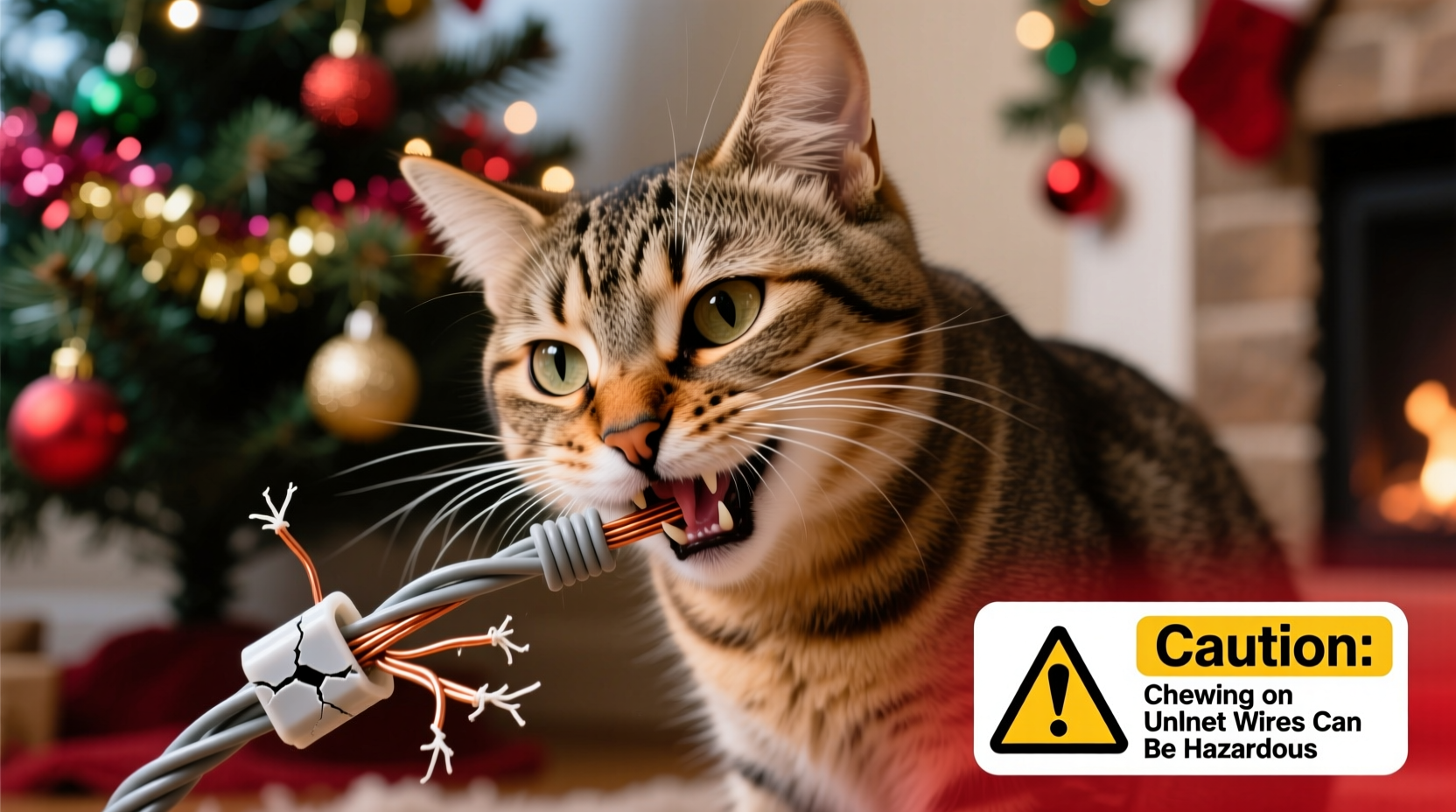
Cats chew for reasons far more complex than curiosity. Kittens explore the world orally—much like human babies—using their mouths to assess texture, flexibility, and resistance. That instinct doesn’t vanish at six months. Adult cats retain oral-seeking behaviors when stressed, under-stimulated, or nutritionally imbalanced. Wires mimic several biologically compelling stimuli: their thin, linear shape resembles prey (like snakes or insects); their slight give under pressure satisfies bite resistance needs; and many coated wires emit faint chemical odors—especially PVC or rubberized sheaths—that cats detect at concentrations humans cannot. Veterinarian Dr. Sarah Lin, DVM, DACVB, explains:
“Cats aren’t attracted to ‘electricity.’ They’re attracted to novelty, movement cues, and tactile feedback. A dangling wire swaying from a draft? That’s prey-like motion. A stiff cord held taut? That’s resistance that satisfies jaw muscle engagement. Remove the trigger—not just the shock risk—and you address the root cause.”
This behavior peaks during the holidays not because cats sense “Christmas,” but because environmental change spikes stress and novelty simultaneously. New scents (pine, cinnamon, candle wax), altered routines (guests, travel, rearranged furniture), and visual clutter create sensory overload. Chewing becomes a self-soothing mechanism—a displacement activity that releases endorphins and lowers cortisol. Ignoring this context leads to ineffective solutions: spraying bitter apple on wires won’t work if the cat is chewing to cope with loneliness after your work hours shift during the holidays.
Hidden dangers—even when wires are unlit
Assuming “unlit = safe” is the most common and dangerous misconception among pet owners. Below is a breakdown of tangible, often underestimated risks:
| Hazard Type | How It Occurs | Potential Consequence |
|---|---|---|
| Toxic exposure | Ingestion of PVC, phthalates, or flame retardants leaching from wire coatings | Vomiting, tremors, kidney stress, liver enzyme elevation—symptoms may appear 12–48 hours post-chewing |
| Oral trauma | Teeth catching on sharp wire ends or abrasive insulation fragments | Gingival lacerations, embedded shards, chronic mouth pain leading to reduced appetite |
| Intestinal obstruction | Swallowing lengths of flexible cord or plastic sheathing | Bowel blockage requiring emergency surgery; mortality rate rises sharply if untreated beyond 24 hours |
| Accidental electrocution | Chewing through insulation while wire is *momentarily* live (e.g., during plug-in, power surge, or faulty outlet) | Cardiac arrhythmia, pulmonary edema, severe burns to tongue/mouth—often fatal within minutes |
| Secondary injury | Yanking down decorations, trees, or stands while tugging on anchored wires | Crushing injuries, corneal abrasions from falling glass ornaments, fractures from falls |
Note: Even “low-voltage” LED light strings (common on modern trees) operate at 12–24 volts DC—but saliva dramatically lowers skin resistance. A cat biting through compromised insulation while licking the wound creates a direct conductive path. Veterinary ER data from the ASPCA Animal Poison Control Center shows a 37% year-over-year increase in holiday-related electrical injuries in cats between 2021–2023, with 68% involving *initially unlit* wiring.
Evidence-based deterrents that actually work
Not all deterrents are equal. Citrus sprays fail because cats habituate quickly. Aluminum foil startles but doesn’t teach. The most effective approach combines physical barrier engineering, environmental enrichment, and behavioral redirection—backed by applied animal behavior research.
Start with structural prevention—the first line of defense:
- Conceal completely: Run wires inside rigid PVC conduit (½-inch diameter), then secure conduit to baseboards with heavy-duty cable clips. Avoid flexible loom tubing—it’s easily punctured by determined teeth.
- Anchor and elevate: Use double-sided carpet tape to fix wires flat against walls *above* 18 inches—outside typical pounce range. For floor-level cords, run them under heavy furniture (not just rugs) or inside weighted fabric cord covers bolted to the floor.
- Break the visual cue: Cover exposed wire segments near the tree base with matte-black felt sleeves or non-toxic, pet-safe clay wraps. Avoid shiny materials—reflective surfaces attract predatory attention.
Then, redirect the behavior:
- Provide daily 15-minute interactive play sessions using wand toys that mimic erratic prey movement—this satisfies hunting drive and reduces oral fixation.
- Introduce food puzzles filled with kibble or freeze-dried chicken *away* from the tree zone. Rotate puzzle types weekly to maintain novelty.
- Offer safe chew alternatives: frozen green beans (cut small), rawhide-free dental chews approved by VOHC, or hemp rope toys soaked in catnip tea and air-dried.
A realistic case study: Managing a high-risk household
Maria, a veterinary technician in Portland, adopted Leo—a 10-month-old Bengal mix—three weeks before Thanksgiving. Within days, he’d shredded two USB cables and attempted to dismantle her pre-lit garland’s control box. Her initial attempts failed: bitter apple spray was licked off in seconds; aluminum foil was batted aside like a toy. She consulted her clinic’s behavior specialist and implemented a three-tier strategy over 10 days:
- Week 1: All wires were removed from Leo’s primary living areas. She installed conduit along baseboards and used tension rods to hang garlands *above* his jumping height (he cleared 4 feet).
- Week 2: Introduced scheduled play at dawn and dusk—matching his natural crepuscular rhythm—with a focus on “capture” sequences ending in treat rewards. Added a rotating shelf of chew-safe items: a sisal-wrapped branch, a chilled silicone teether, and a cardboard tube stuffed with silvervine.
- Week 3: Reintroduced one low-risk decorative element—a battery-operated LED string wrapped around a ceramic vase—only after Leo consistently chose his chew toys over cords during supervised sessions.
By December 1st, Leo ignored all holiday wiring. Maria’s key insight: “I stopped seeing him as ‘destructive’ and started reading his behavior as communication. He wasn’t attacking Christmas—he was asking for more structured outlets for his energy and senses.”
Actionable prevention checklist
Use this before decorating—no exceptions:
- ✅ Test every wire for nicks, cracks, or exposed copper *before* installation—even if new. Discard damaged cords immediately.
- ✅ Install GFCI (Ground Fault Circuit Interrupter) outlets on all circuits powering holiday lights. These cut power in 1/40th of a second if current leakage is detected.
- ✅ Place all power strips and adapters in locked, ventilated cabinets—not under tree skirts where heat builds and access is easy.
- ✅ Spray wire conduits with pet-safe citrus oil *diluted to 0.5% concentration* (1 drop per 2 tbsp water)—not directly on wires, but on surrounding surfaces to create an olfactory boundary.
- ✅ Set up a “cat-free zone” around the tree using baby gates with vertical slats (not horizontal rails cats can climb). Enrich the adjacent room with climbing shelves, window perches, and timed feeders.
FAQ: Critical questions answered
Can I use essential oils to deter chewing?
No. Many essential oils—including citrus, peppermint, eucalyptus, and tea tree—are hepatotoxic to cats, even in diffused form. Their livers lack glucuronosyltransferase enzymes needed to metabolize phenols. Use only veterinarian-approved, water-based deterrents labeled explicitly for feline use.
My cat only chews at night—does that mean it’s a boredom issue?
Not necessarily. Nocturnal chewing often signals underlying medical conditions: dental pain (chewing relieves gum pressure), hyperthyroidism (increased metabolism drives oral fixation), or early-stage kidney disease (causing metallic taste perception). If nighttime chewing is new or escalating, schedule a full blood panel and oral exam before assuming behavioral causes.
Will neutering/spaying stop wire-chewing?
Unlikely. While sterilization reduces roaming and mating-related stress, it doesn’t alter oral exploration instincts, prey drive, or environmental reactivity. Focus on enrichment and structure—not hormonal status—as your primary intervention.
Conclusion: Safety begins with understanding—not punishment
Your cat isn’t misbehaving. They’re responding to evolutionary imperatives in an environment we’ve filled with ambiguous stimuli. Wire-chewing isn’t defiance—it’s a signal that something is missing: movement, texture variety, mental challenge, or security. The most effective solutions don’t involve shouting, spraying, or isolation. They involve observing your cat’s rhythms, auditing your home for sensory triggers, and investing time in daily connection through play and predictable care. Start tonight: unplug every decorative wire, inspect for damage, and place one new puzzle feeder in a quiet corner. Then sit nearby—not to supervise, but to observe what your cat chooses instead. That choice reveals more about their needs than any chewed cord ever could.




 浙公网安备
33010002000092号
浙公网安备
33010002000092号 浙B2-20120091-4
Comments
No comments yet. Why don't you start the discussion?