
Cats and Christmas trees have a complicated relationship. One moment, your feline is calmly observing the twinkling lights from across the room. The next, they’re scaling the branches like an alpine climber, sending ornaments tumbling and risking a painful fall. If you’ve ever woken up to a toppled tree or a startled cat mid-ascent, you’re not alone. Millions of pet owners face this seasonal challenge each year. But understanding the behavior behind the climb—and how modern lighting solutions can mitigate risk—can transform a chaotic holiday into a safer, more peaceful celebration.
The instinct to climb is deeply rooted in a cat’s nature. In the wild, elevated positions offer security, visibility, and control over territory. Your living room may not resemble a forest canopy, but to a curious cat, a Christmas tree is an irresistible vertical playground. It’s covered in dangling objects, emits new scents, and glows with flickering lights that mimic movement—essentially, it’s a feline dream come true. Unfortunately, this dream often ends in disaster: broken decorations, spilled water, and worst of all, injuries from falling branches or collapsing trees.
This article explores the behavioral reasons behind tree climbing, evaluates the risks involved, and highlights how upgrading to secure, low-risk lighting systems can significantly reduce accidents. From expert insights to real-life scenarios, you’ll gain actionable strategies to protect both your pet and your holiday decor.
Why Cats Are Drawn to Christmas Trees
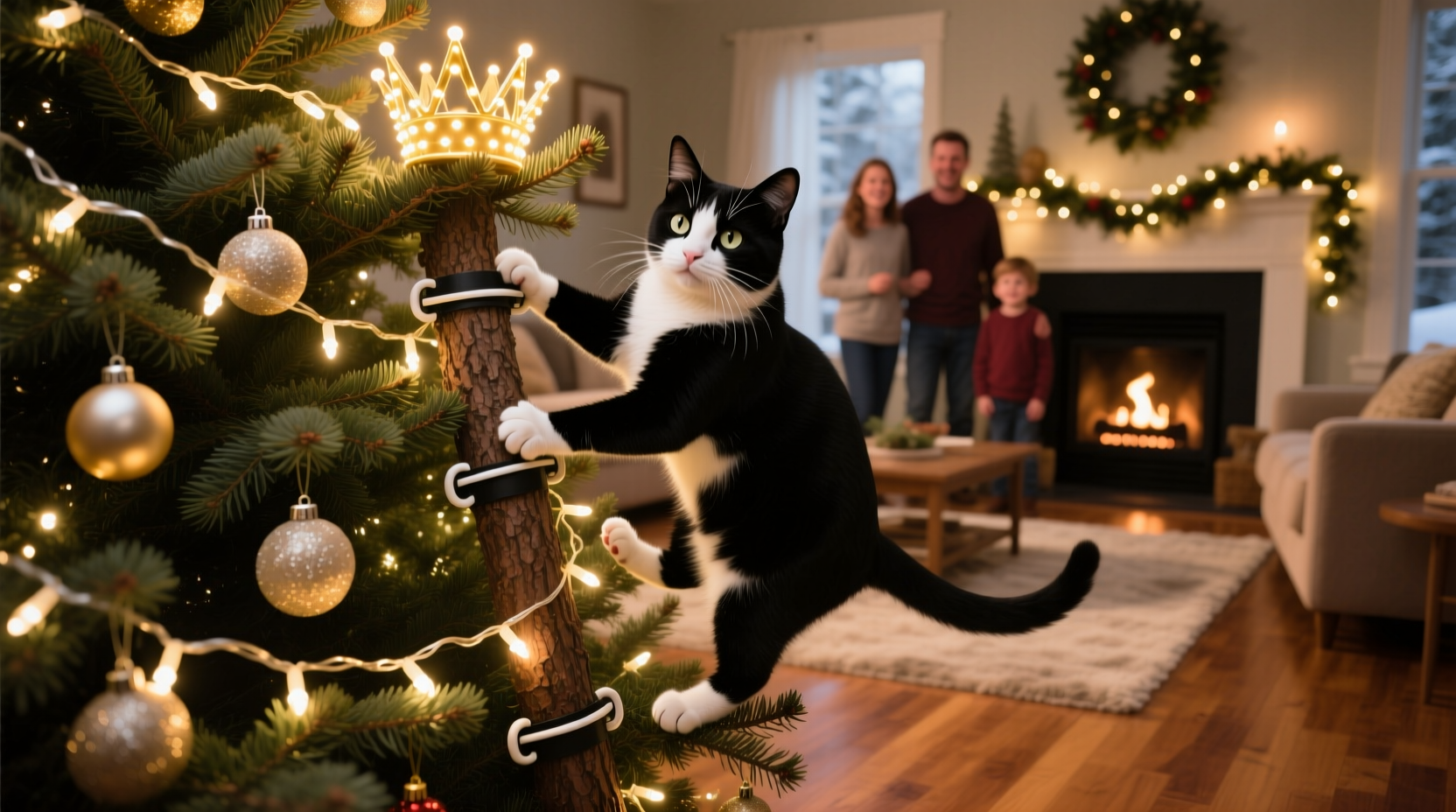
Cats don’t climb Christmas trees out of mischief—they do so because their instincts tell them it’s the right thing to do. Understanding the motivations behind this behavior is the first step toward prevention.
- Height-seeking instinct: Cats are natural climbers. Elevated spaces provide safety from perceived threats and a vantage point to survey their environment. A Christmas tree, especially when placed near a window or in a central room, becomes the highest accessible structure.
- Sensory stimulation: The combination of tinsel, ornaments, and blinking lights creates visual and tactile excitement. Lights that flicker or change color simulate prey-like movement, triggering predatory instincts.
- New scent introduction: Real trees emit pine resin; artificial ones carry packaging odors. Both are novel and intriguing to a cat’s sensitive nose, encouraging investigation.
- Play and exploration: Cats explore through physical interaction. Swatting at hanging balls or batting at ribbons is play behavior, even if it destabilizes the entire tree.
While these behaviors are normal, they become problematic when the tree isn’t secured properly. A cat doesn’t understand that its actions could lead to injury—it simply follows its instincts.
The Hidden Dangers of Unsecured Trees and Lighting
A climbing cat isn’t just a nuisance—it poses real safety risks. When a cat ascends a poorly anchored tree, several hazards emerge:
- Tree collapse: Most standard tree stands are not designed to support additional weight. Even a 10-pound cat can destabilize a tall tree, leading to a sudden fall that can injure the animal or damage furniture.
- Electrical hazards: Traditional incandescent lights generate heat and often have exposed wiring. If a cat chews on a cord or knocks over a strand, it risks burns, shocks, or even fire.
- Ingestion risks: Small ornaments, tinsel, or broken bulb fragments can be swallowed during play, leading to intestinal blockages—a common reason for emergency vet visits during December.
- Water contamination: Tree stands hold standing water, sometimes treated with preservatives. Cats drinking from them may ingest harmful chemicals.
A 2022 report from the American Veterinary Medical Association (AVMA) noted a 30% increase in feline trauma cases during the weeks between December 15 and January 5, many linked to Christmas tree incidents. Veterinarians commonly treat lacerations from glass ornaments, electrical burns from chewed cords, and internal injuries from ingested materials.
“Cats see the Christmas tree as an extension of their territory. Without proper precautions, what seems like festive decoration becomes a high-risk obstacle course.” — Dr. Lena Peterson, DVM, Feline Behavior Specialist
How Secure Lighting Reduces Fall Risks
Modern LED lighting technology plays a crucial role in making Christmas trees safer for cats. Unlike older lighting systems, secure lighting options are engineered with safety, durability, and stability in mind. Here’s how they help prevent accidents:
- Cool-to-touch operation: LEDs produce minimal heat, reducing burn risk if a cat brushes against them or lies near the base.
- Low voltage and energy efficiency: Many LED strands operate on battery power or low-voltage adapters, minimizing electrical hazards.
- Durable, chew-resistant cords: High-quality LED sets use thicker insulation and braided wiring that resist gnawing—some even include bitter coatings to deter chewing.
- Even light distribution: Instead of clustering bright bulbs at intervals, LEDs provide consistent illumination, eliminating “hot spots” that attract attention.
- Secure mounting options: Magnetic clips, adhesive mounts, and pre-lit trees eliminate loose strands that dangle within paw’s reach.
When lights are safely installed and distributed evenly, the tree becomes less stimulating. There are fewer tempting flickers, no hot surfaces, and no dangling wires to pull. As a result, cats are less likely to initiate a climb.
| Lighting Type | Heat Output | Chew Risk | Fall Prevention Benefit |
|---|---|---|---|
| Traditional Incandescent | High (burn hazard) | High (thin, exposed wires) | Low – increases curiosity and danger |
| Standard LED | Low (safe to touch) | Moderate (improved insulation) | Moderate – cooler, less attractive |
| Heavy-Duty LED (Chew-Resistant) | Negligible | Low (reinforced casing) | High – reduces temptation and risk |
| Battery-Operated String Lights | None | Very Low (no wall plug) | High – eliminates tripping and shock |
Step-by-Step: Creating a Cat-Safe Christmas Tree
Preventing climbs isn’t about restricting your cat—it’s about designing an environment where the tree is uninviting and physically stable. Follow this timeline to set up a safe display before the holidays begin.
- Week 1: Choose the right tree and location
Select a sturdy artificial tree with a wide base. Avoid placing it near furniture that a cat could use to jump onto the branches. Keep it away from curtains, shelves, or sofas that enable access. - Week 2: Anchor the tree securely
Use a heavy-duty stand filled with water or weights. For extra stability, attach the top of the tree to a wall anchor using nearly invisible fishing line or a discreet bracket. Ensure the tree doesn’t wobble when gently pushed. - Week 3: Install secure lighting
Opt for LED lights with reinforced cords. Use clips to fasten strands tightly to branches—no sagging. Consider pre-lit trees or internal lighting to minimize external exposure. - Week 4: Decorate strategically
Place fragile or valuable ornaments in the upper third of the tree, beyond typical paw reach. Use soft, fabric-based decorations on lower branches. Avoid tinsel, ribbons, and anything small enough to swallow. - Ongoing: Monitor and redirect
Provide alternative climbing structures nearby—cat trees, shelves, or perches. When your cat shows interest in the Christmas tree, gently redirect them to their own space with toys or treats.
This proactive approach reduces temptation while ensuring that even if a cat attempts a climb, the structure won’t collapse and the lighting won’t cause harm.
Real Example: The Thompson Family’s Near-Miss
The Thompsons in Portland, Oregon, learned the hard way during the 2023 holiday season. They set up a 7-foot real tree in their living room, decorated with family heirloom glass ornaments and traditional incandescent lights. On Christmas Eve, their 2-year-old tabby, Milo, leapt onto the sofa and then onto the lower branches.
Within seconds, he was halfway up—paws batting at a swinging star ornament. The tree tilted, lights sparked as a cord snapped, and Milo lost his grip. He fell sideways, knocking over the stand and spilling water across the hardwood floor. The family rushed to check on him; luckily, only minor scratches were found. But the incident prompted immediate changes.
For the following year, they switched to a pre-lit artificial tree with internal LED lighting, anchored it to the wall, and replaced all glass ornaments with felt and wood. They also added a tall cat tree beside the fireplace. According to Sarah Thompson, “Milo still looks at the tree like it’s a challenge, but now he has his own tower to climb. Peace of mind is the best gift we gave ourselves.”
Essential Checklist for a Pet-Friendly Holiday Display
Use this checklist to ensure your Christmas tree setup prioritizes safety without sacrificing style.
- ✅ Anchor the tree to a wall or ceiling with invisible support lines
- ✅ Use LED lights only—avoid incandescent bulbs
- ✅ Choose chew-resistant or battery-operated lighting
- ✅ Keep cords taped down or concealed in cord covers
- ✅ Place breakable ornaments above 6 feet
- ✅ Avoid tinsel, ribbons, and small decorative items
- ✅ Provide an alternative climbing structure for your cat
- ✅ Cover the tree stand with a decorative skirt or barrier
- ✅ Supervise initial interactions between cat and tree
- ✅ Use pet-safe water additives—or switch to artificial trees to eliminate standing water
Frequently Asked Questions
Can I train my cat not to climb the Christmas tree?
While you can’t completely eliminate instinctual behavior, you can redirect it. Consistent positive reinforcement—rewarding your cat for using its own climbing structures—can reduce interest in the tree. Avoid punishment, which can create fear or anxiety. Environmental management (like anchoring and secure lighting) is more effective than training alone.
Are there specific LED lights marketed for pet safety?
Yes. Brands like GE Reveal, Philips Hue, and John Lewis Pet-Safe Lights offer LED strings with reinforced insulation, low heat output, and anti-chew technology. Some include timers and remote controls to limit exposure hours, further reducing risk.
Is it safer to use an artificial tree instead of a real one?
In terms of pet safety, yes. Artificial trees eliminate water hazards, sap exposure, and needle shedding (which can irritate paws or digestive tracts). They’re also easier to anchor permanently and often come pre-lit with integrated, secure lighting systems.
Conclusion: A Safer, Happier Holiday Starts with Smart Choices
Your Christmas tree doesn’t have to be a battleground between festivity and feline instincts. By understanding why cats climb—and leveraging modern solutions like secure lighting—you can enjoy a beautiful display without compromising your pet’s safety. The goal isn’t to eliminate the tree, but to coexist with it in a way that respects your cat’s nature while protecting your home.
Start early, plan carefully, and invest in quality materials. A well-anchored tree with cool, durable LED lighting does more than prevent falls—it gives you peace of mind. And when your cat chooses to nap beneath the softly glowing branches instead of scaling them, you’ll know you’ve created a holiday environment that works for everyone.




 浙公网安备
33010002000092号
浙公网安备
33010002000092号 浙B2-20120091-4
Comments
No comments yet. Why don't you start the discussion?