
Every December, a familiar scene repeats itself in homes across the country: a glittering tree, festive lights, and—inevitably—a determined feline scaling its branches like a tiny, furry mountaineer. It’s equal parts adorable and alarming. You brace for the crash, the tinsel avalanche, the broken ornament shrapnel—and wonder, not for the first time: *Why does my cat do this?* And more urgently: *How do I stop it—without making my cat miserable or turning my living room into a fortress?*
This isn’t just about holiday aesthetics. Unchecked tree climbing poses real risks: falls that can injure joints or spines, electrocution from chewed cords, ingestion of toxic pine needles or decorative elements, and chronic stress for both pet and owner. The good news? This behavior is entirely understandable—and highly preventable. With insight into feline instincts, environmental psychology, and practical, compassionate interventions, you can protect your tree *and* honor your cat’s natural needs.
The Instinct Behind the Ascent: Why Cats Climb Trees (Especially Yours)
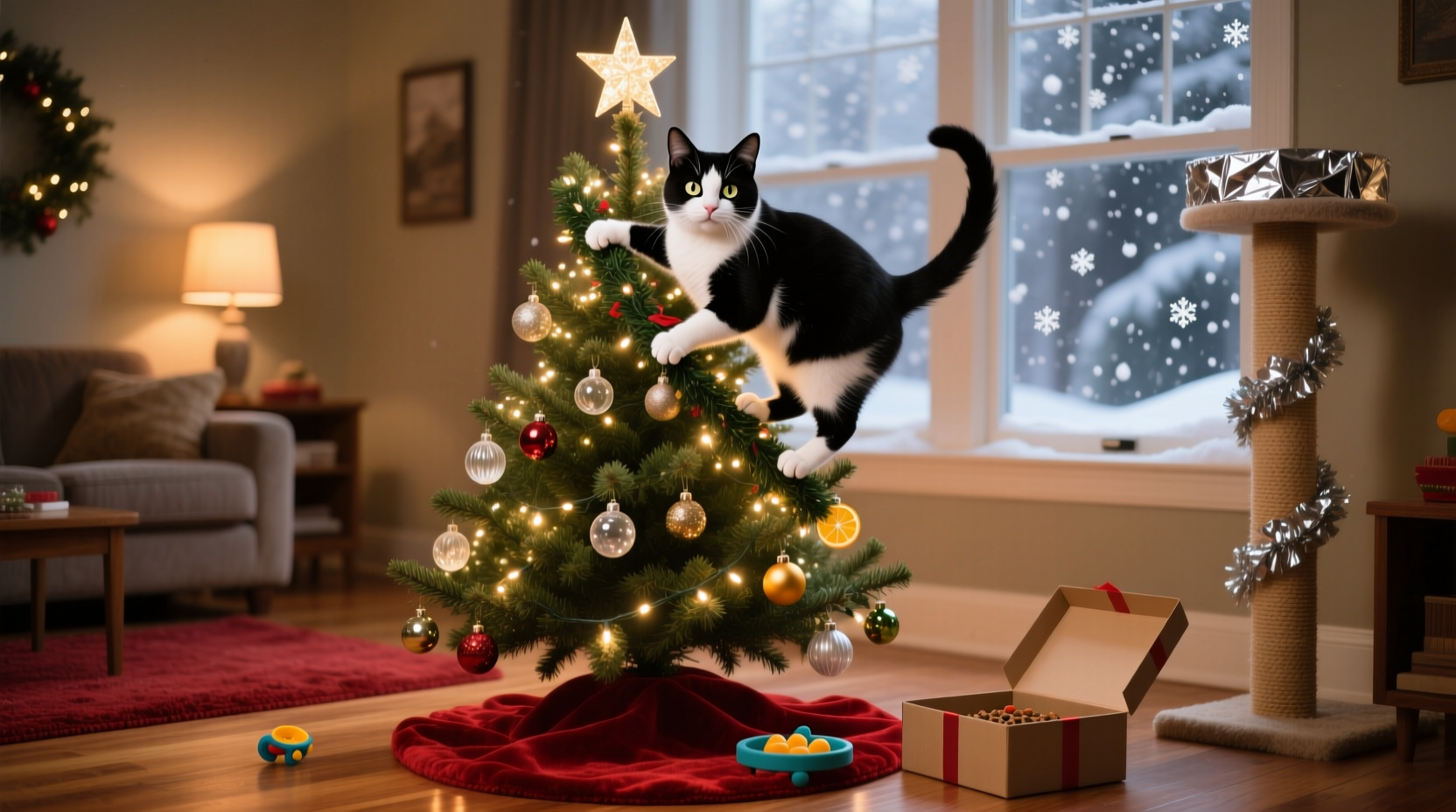
Cats don’t climb Christmas trees because they’re “naughty” or “testing boundaries.” They climb because their biology, neurology, and evolutionary history make vertical space irresistible. Domestic cats retain nearly all the behavioral wiring of their wild ancestors—creatures who used height for surveillance, escape, and territorial assertion.
Christmas trees amplify these instincts in three powerful ways:
- Novelty and Movement: A freshly erected tree is a dramatic environmental shift—tall, textured, swaying slightly with drafts or foot traffic, and adorned with reflective ornaments and dangling ribbons. To a cat, it’s a dynamic sensory playground that triggers curiosity and predatory focus.
- Elevated Vantage Point: Height equals safety and control. From above, cats monitor household activity, spot potential “prey” (like flickering lights or drifting tinsel), and assert spatial dominance—especially important in multi-cat homes or when new people or pets are present.
- Texture and Grip: Fir, spruce, and pine boughs offer ideal traction for claws. Unlike smooth furniture or walls, tree branches provide natural purchase—making climbing feel effortless, rewarding, and physically reinforcing.
Importantly, this behavior peaks during the holiday season not because cats suddenly develop new impulses—but because their environment changes dramatically. Remove the tree, and the urge subsides. But simply removing the opportunity without addressing the underlying drivers often leads to redirected behaviors: scratching doorframes, jumping on bookshelves, or knocking over lamps.
Vet-Approved Prevention: What Works (and What Doesn’t)
Many well-intentioned owners reach for quick fixes—citrus sprays, aluminum foil under the tree skirt, or even punishment-based corrections. These rarely work long-term and can damage trust. According to Dr. Sarah Wooten, DVM and certified feline specialist, “Cats don’t associate delayed consequences with their actions. Spraying a cat after it climbs the tree teaches it only that *you* are unpredictable—not that the tree is off-limits.”
“Redirecting a cat’s energy toward appropriate outlets is far more effective—and humane—than trying to suppress natural behavior. Think of it as interior design for instinct.” — Dr. Sarah Wooten, DVM, CVJ, Veterinary Consultant for the International Cat Care Foundation
Effective prevention rests on two pillars: reducing appeal and increasing alternatives. Below is a comparative summary of common tactics—validated by veterinary behaviorists and certified cat trainers.
| Strategy | Effectiveness (0–5★) | Key Risk or Limitation | Professional Recommendation |
|---|---|---|---|
| Aluminum foil or double-sided tape around base | ★★☆☆☆ | Creates negative association; may generalize to other surfaces (e.g., hardwood floors) | Use only short-term and pair with positive alternatives |
| Citrus or bitter apple spray on branches | ★☆☆☆☆ | Inconsistent coverage; many cats ignore scent; risk of inhalation or eye irritation | Avoid—especially near lights or electrical cords |
| Tree stabilizer + wall anchor system | ★★★★★ | Requires installation; aesthetic compromise | Non-negotiable first step for safety |
| Dedicated vertical spaces (cat trees, wall shelves, window perches) | ★★★★★ | Requires consistent placement and enrichment | Essential—place within 3 feet of the tree initially |
| Interactive play sessions (2x daily, 15 mins each) | ★★★★☆ | Only works if timed before peak activity windows (dawn/dusk) | Most underutilized, highest ROI intervention |
Your 7-Day Tree-Safe Transition Plan
Don’t wait until December 23rd to act. Start preparation at least one week before erecting the tree. This timeline builds security, predictability, and positive associations—reducing anxiety-driven climbing.
- Day 1: Audit & Anchor — Secure your chosen tree stand to the wall using heavy-duty L-brackets and lag bolts. Test stability by gently pushing the top branch—it should move less than 1 inch. Place a non-slip rug pad beneath the stand.
- Day 2: Introduce Vertical Alternatives — Set up a tall, sturdy cat tree or install floating shelves *before* bringing the tree in. Position them so your cat can see the tree from their perch—but not easily jump *to* it.
- Day 3: Enrichment Reset — Rotate toys, hide treats in puzzle feeders, and place new cardboard boxes near the future tree location. This redirects investigative energy away from novelty-seeking.
- Day 4: Play & Tire — Conduct two 15-minute interactive play sessions using wand toys that mimic prey movement (zigzagging, darting, hiding). End each session with a small meal or treat—mimicking the hunt-eat-groom-sleep cycle.
- Day 5: Tree Setup (Without Decor) — Erect the bare tree. Let your cat explore it freely for 30 minutes while you supervise. Reward calm observation with soft praise and treats—never for climbing.
- Day 6: Strategic Decoration — Hang ornaments *only* on upper two-thirds of the tree. Keep lower branches bare or lightly draped with wide, stiff ribbon (harder to grip). Avoid tinsel, glass balls below 3 feet, and anything scented or edible.
- Day 7: Monitor & Refine — Observe your cat’s behavior for 2 hours post-decoration. Note where they linger, what draws attention, and when they attempt ascent. Adjust perches or add deterrents (e.g., a motion-activated air canister *behind* the tree) only if needed—and always paired with redirection.
Real-Life Success: The Miller Family’s Tree Transformation
When the Millers brought home their 2-year-old rescue, Jasper, he immediately fixated on their 7-foot Fraser fir. Within days, he’d knocked over three ornaments, tangled himself in lights, and once lodged his head between branches—requiring gentle coaxing and a vet call for minor neck strain. Frustrated but committed, they followed the 7-day plan—not as rigid rules, but as flexible principles.
They installed a 6-foot cat tree angled diagonally toward the tree, placed a heated cat bed on a nearby shelf, and began dawn/dusk play sessions using a feather wand shaped like a bird. Crucially, they removed *all* low-hanging decorations and anchored the tree to a stud in the wall. By Day 5, Jasper was napping on his new perch, watching the tree sway. By Christmas Eve, he’d climbed it once—briefly—and then chose instead to bat at a hanging toy attached to his own tree. “It wasn’t about stopping him,” says mom Lena Miller. “It was about giving him something better to do—and somewhere safer to be.”
FAQ: Your Top Questions—Answered by Experts
Will a fake tree solve the problem?
Not necessarily. While artificial trees lack sap and needles (reducing some hazards), many still offer excellent claw grip—especially PVC or PE branch tips. More importantly, the novelty and visual stimulation remain. A fake tree still needs anchoring, strategic decoration, and environmental enrichment. In fact, some cats prefer the stiffer, more predictable texture of plastic branches.
Is it safe to use a tree skirt—or should I skip it entirely?
A tree skirt is safe *if* it’s rigid, non-frilly, and secured flat to the floor (e.g., a woven basket, wooden tray, or weighted fabric panel). Avoid loose fabric, lace, or crinkly materials—these invite digging, chewing, and entanglement. A skirt also helps conceal the base hardware and creates a clear visual boundary. Just ensure it doesn’t obstruct airflow to the tree stand or trap heat from lights.
What if my cat is senior or has arthritis? Do I still need to worry?
Yes—even more so. Older cats may climb seeking warmth (lights generate heat) or comfort (soft branches cushion joints), but their balance and coordination decline. A fall from even 2–3 feet can fracture bones or worsen degenerative joint disease. Prioritize low-height perches near the tree, warm beds with orthopedic support, and avoid any decor that encourages upward movement. Consult your vet about joint supplements or pain management—comfort reduces compensatory behaviors.
Building a Holiday That Honors Both Species
At its core, this isn’t about “training your cat to behave.” It’s about cohabitation—with empathy, science, and respect. Your cat isn’t defying you; it’s expressing deeply encoded survival strategies in an environment we’ve reshaped for human ritual. When we respond with understanding—not frustration—we deepen trust, reduce conflict, and create space where both species thrive.
The most successful households don’t eliminate climbing—they redirect it. They don’t punish curiosity—they satisfy it. They don’t build barriers—they build bridges: between instinct and safety, novelty and routine, celebration and calm. Your Christmas tree doesn’t have to be a battleground. It can be a shared landmark—where twinkling lights reflect in watchful eyes, and quiet moments unfold side-by-side, grounded in mutual care.




 浙公网安备
33010002000092号
浙公网安备
33010002000092号 浙B2-20120091-4
Comments
No comments yet. Why don't you start the discussion?