
Every holiday season, families gather around the Christmas tree—its lights glowing, ornaments sparkling, and the scent of pine filling the air. But for many cat owners, this festive scene quickly turns into a battleground. One moment the tree stands tall and proud; the next, it’s toppled, tinsel scattered, and your cat perched triumphantly atop the wreckage. If this sounds familiar, you're not alone. Thousands of pet owners face the same annual struggle. The good news is that cats don’t destroy trees out of malice—they act on instinct. Understanding why they do it is the first step toward finding humane, lasting solutions.
The Instinct Behind the Wreckage
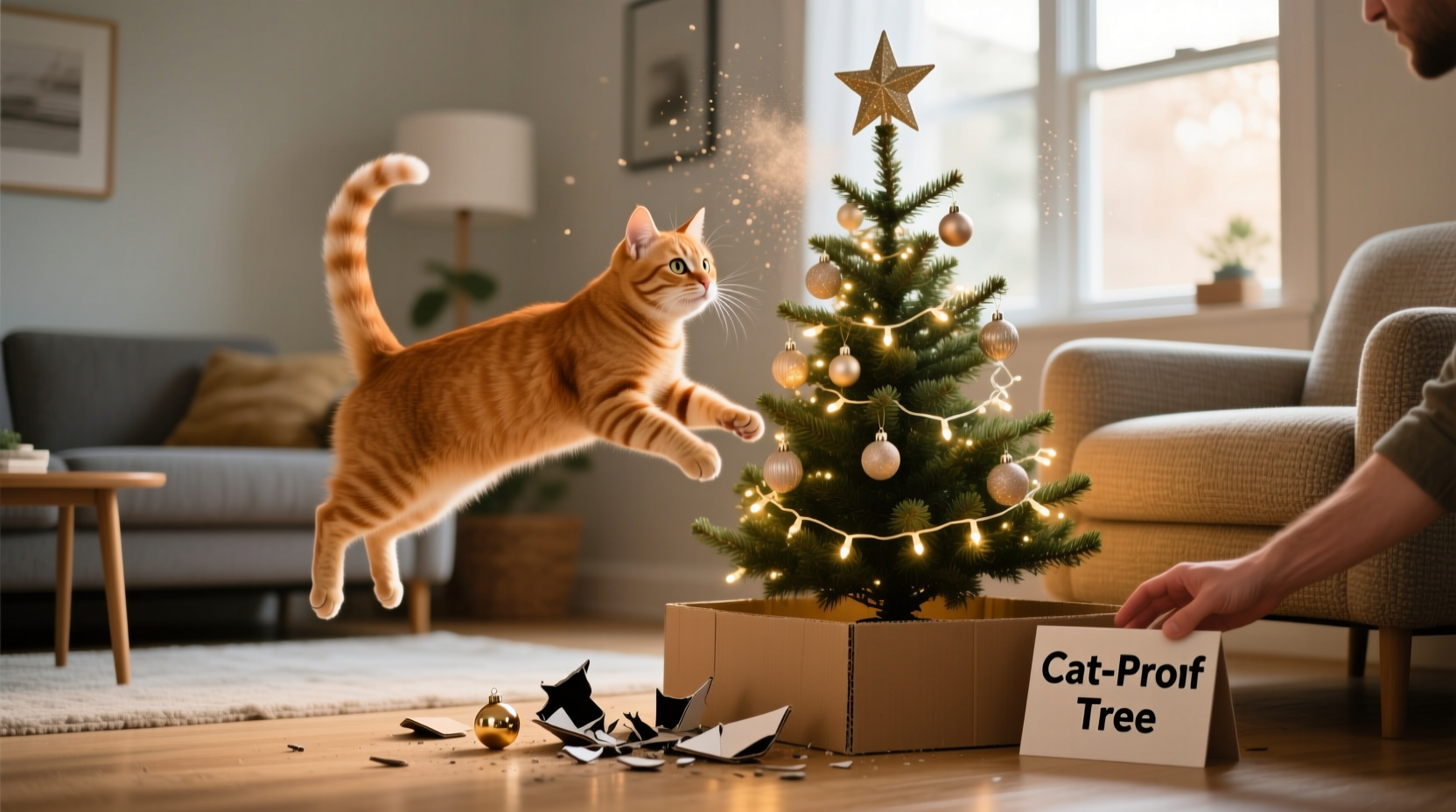
Cats are natural climbers, hunters, and explorers. A Christmas tree, with its dangling decorations, flickering lights, and crinkling tinsel, is essentially a giant vertical playground designed by feline standards. From a cat’s perspective, the tree isn’t sacred—it’s an irresistible target.
Vertical space is crucial for cats. In the wild, climbing allows them to survey their territory, escape threats, and stalk prey from above. Indoors, they seek high vantage points like bookshelves, door frames, and yes—Christmas trees. When your cat climbs or bats at ornaments, it’s not being destructive; it’s fulfilling deeply rooted behavioral needs.
Additionally, novelty plays a role. The sudden appearance of a new object in the home triggers curiosity. Cats investigate with their paws, mouths, and bodies. Ornaments that dangle or spin mimic prey movement, activating hunting instincts. Even the smell of a real tree can be stimulating—evergreen resins resemble certain plant scents cats find intriguing, like catnip or silver vine.
“Cats don’t see the Christmas tree as decoration. They see it as an interactive toy, a climbing structure, and sometimes even a scratching post.” — Dr. Sarah Thompson, Feline Behavior Specialist
Humane Strategies to Protect Your Tree
Punishing a cat for interacting with the tree is ineffective and harmful. Instead, focus on redirection, environmental enrichment, and structural safeguards. The goal isn’t to suppress natural behavior but to channel it appropriately.
1. Choose Cat-Safe Decorations
Start with what goes on the tree. Avoid items that pose health risks or encourage play:
- Avoid tinsel and ribbon: These can cause intestinal blockages if ingested.
- No glass or sharp ornaments: Breakable items risk injury to paws and mouths.
- Keep food-based decor out: Popcorn strings or candy canes attract both cats and hazards.
- Use lightweight, unbreakable ornaments: Especially on lower branches.
2. Stabilize the Tree Physically
A wobbly tree invites disaster. Secure it so even determined climbers can’t bring it down.
- Use a heavy, stable base filled with water and weighted stones or sandbags.
- Anchor the top of the tree to a wall hook or ceiling bracket using clear fishing line or thin wire.
- Place the tree in a corner where two walls provide additional support.
This doesn’t prevent climbing but reduces the risk of collapse and injury.
3. Make the Tree Less Appealing
Deterrence works best when combined with positive alternatives. You can discourage interaction without harming your cat.
- Aluminum foil around the base: Most cats dislike the texture and sound.
- Double-sided tape: Apply to the trunk or nearby floor to create an unpleasant surface.
- Citrus peels or sprays: Cats generally avoid citrus scents (use sparingly and non-toxic formulas).
- Unplug lights when unsupervised: Moving lights attract attention—remove the stimulus when you’re not around.
Provide Competitive Alternatives
The most effective long-term solution is giving your cat better options. If the tree is the only vertical space or source of stimulation, your cat will keep returning to it.
Create a Feline-Friendly Holiday Zone
Designate a separate area with cat trees, perches, and toys—especially during the holidays.
| Feature | Purpose | Holiday Upgrade Idea |
|---|---|---|
| Cat tree or condo | Satisfies climbing instinct | Add battery-powered twinkling lights (safe distance) |
| Window perch | Provides bird-watching entertainment | Hang small, safe holiday-themed decals outside |
| Interactive toys | Engages hunting drive | Introduce a \"gift box\" filled with crinkle balls |
| Scratching post | Redirects clawing behavior | Wrap in red/green sisal for seasonal flair |
Rotate toys weekly to maintain interest. Introduce puzzle feeders or treat-dispensing balls to keep your cat mentally engaged when the family is distracted.
Enrichment Timeline: 4 Weeks Before Christmas
Start early to establish new habits before the tree arrives.
- Week 1: Set up the cat zone and let your cat explore it freely. Reward visits with treats or praise.
- Week 2: Begin rotating in holiday-themed toys. Use feather wands or laser pointers near the area to build positive associations.
- Week 3: Assemble the tree—but without decorations or lights. Let your cat sniff and inspect it while supervised. Gently redirect if climbing occurs.
- Week 4: Add ornaments gradually, starting with the top. Continue reinforcing the cat zone with daily play sessions.
This gradual exposure reduces novelty-driven obsession and gives your cat time to adapt.
Real-Life Example: The Thompson Family’s Turnaround
The Thompsons had given up on real trees after three consecutive years of disasters. Their Bengal cat, Luna, would scale the tree within hours of setup, knocking it over twice and swallowing a small ornament (thankfully expelled naturally). Desperate, they consulted a certified cat behaviorist.
The solution wasn’t punishment or keeping Luna in another room—it was redesigning their living space. They installed a tall cat tree near the window, added a heated perch, and introduced a rotation of puzzle toys. They also anchored their new tree to the ceiling and used foil around the base.
The first few days were tense. Luna approached the tree repeatedly. But each time she jumped onto her own tower instead, she was rewarded with playtime or treats. Within a week, she stopped approaching the tree altogether. By Christmas morning, the tree stood intact—and Luna was curled up beneath her own “cat tree,” now decorated with safe, dangling ribbons just for her.
“We realized we were asking her to resist temptation with no reward,” said Maria Thompson. “Once we gave her a better option, she chose it every time.”
Common Mistakes to Avoid
Well-meaning owners often make errors that worsen the problem:
- Spraying water: This damages trust and doesn’t teach alternatives.
- Yelling or startling: Increases stress and may escalate anxiety-related behaviors.
- Leaving the tree unsecured: Risk of injury to both cat and humans.
- Using toxic deterrents: Essential oils, mothballs, or chemicals can be dangerous if ingested.
- Isolating the cat: Confinement during holidays increases frustration and loneliness.
Step-by-Step Guide: Cat-Safe Christmas Setup
Follow this checklist to set up a tree that survives the season—with harmony intact.
- Choose location wisely: Avoid high-traffic zones or areas near furniture your cat uses to jump onto the tree.
- Secure the tree: Anchor it to a wall or ceiling and use a heavy base.
- Prep the perimeter: Cover the floor around the base with aluminum foil or textured mats.
- Install safe lighting: Use shatterproof LED lights and check for frayed wires. Unplug when away.
- Decorate strategically: Start bare, then add ornaments from the top down. Avoid lower third.
- Set up the cat zone: Position a cat tree or perch nearby with engaging toys.
- Supervise initial interactions: Redirect gently with toys or treats if your cat approaches the tree.
- Maintain routine: Keep feeding, play, and cuddle times consistent to reduce stress.
Frequently Asked Questions
Can I train my cat not to go near the tree?
You can’t eliminate curiosity, but you can redirect it. Training relies on consistency and positive reinforcement. Reward your cat for staying near its own toys or perch. Over time, the tree becomes less interesting when better rewards come from elsewhere.
Are fake trees safer than real ones?
Artificial trees are generally safer because they don’t shed needles (which can irritate digestion) and are often more stable. However, some cats chew plastic branches, which can still pose risks. Always supervise and secure any tree type.
What if my cat is obsessed with the lights?
Moving lights trigger predatory instincts. Try using steady, non-blinking LEDs. Alternatively, reserve blinking lights for times when you’re present to supervise. Provide alternative light-based toys, such as a battery-powered flickering fish or a light-projecting toy.
Final Thoughts: Harmony Over Control
The Christmas tree doesn’t have to be a war zone. With empathy and planning, you can coexist with your curious feline while preserving holiday traditions. Remember, your cat isn’t trying to ruin your celebration—it’s responding to an environment full of exciting stimuli. By understanding its instincts and providing better outlets, you create a home where both humans and cats feel fulfilled.
Instead of viewing your cat as the enemy of holiday cheer, see them as a reminder to design spaces that work for all family members—pawed and otherwise. A little foresight, some creativity, and a lot of patience can transform a recurring disaster into a peaceful, joyful season.




 浙公网安备
33010002000092号
浙公网安备
33010002000092号 浙B2-20120091-4
Comments
No comments yet. Why don't you start the discussion?