
Every December, a familiar ritual unfolds: tinsel appears in unlikely places, ornaments vanish from branches only to reappear beneath the sofa, and your once-proud Douglas fir leans at a 12-degree angle—courtesy of a 9-pound feline with impeccable timing and zero regard for holiday decorum. It’s not spite. It’s not rebellion. It’s biology, instinct, and environmental mismatch colliding under twinkling lights. Understanding why your cat treats the tree like a climbing gym, hunting ground, and chew toy is the first step—not toward punishment, but toward prevention that respects both feline nature and festive peace.
The Science Behind the Swaying Spruce: Why Cats Target Christmas Trees
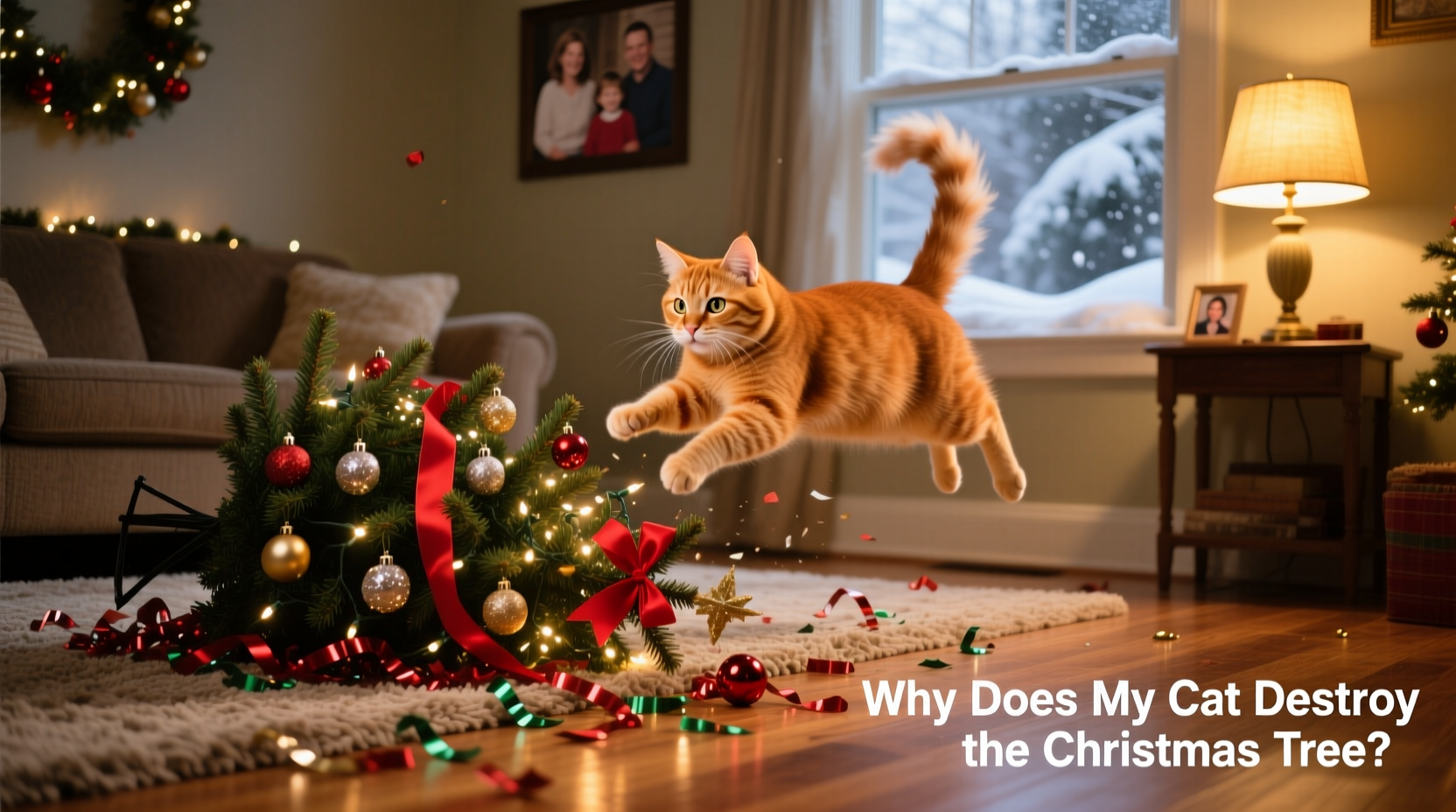
Cats don’t vandalize trees out of malice—they respond to sensory triggers and evolutionary imperatives that make the Christmas tree an irresistible stimulus. Three core drivers explain the annual assault:
- Novelty + Movement: A tall, asymmetrical object draped in reflective surfaces, dangling objects, and shifting shadows violates a cat’s expectation of static home territory. The tree’s subtle sway—even from HVAC drafts or footsteps—activates their prey-detection reflex. As Dr. Sarah Wilson, veterinary behaviorist and co-author of Feline Environmental Medicine, explains: “A swaying ornament isn’t ‘pretty’ to a cat—it’s a moving target. Their visual system is wired to detect motion at distances up to 20 feet, and a shimmering bauble mimics the erratic flight of small birds.”
- Olfactory Overload: Fresh-cut evergreens emit volatile organic compounds (VOCs) like pinene and limonene—chemicals that are mildly stimulating to cats. These scents can trigger curiosity, investigation, and even mild euphoria in some individuals, especially kittens and young adults. Unlike pine-scented air fresheners (which often contain toxic phenols), real pine resin is non-toxic—but highly intriguing.
- Vertical Territory Expansion: In multi-cat households—or even single-cat homes with limited vertical space—the Christmas tree becomes the tallest, most centrally located perch available. Climbing satisfies innate needs for surveillance, escape routes, and dominance signaling. When your cat scales the trunk, they’re not defying you—they’re claiming vantage point, just as wild felids do in dense forest understory.
Crucially, this behavior peaks between 6 months and 3 years of age—the prime window for exploratory play, motor skill refinement, and territorial development. If your cat has done this for three consecutive years, it’s not a phase; it’s a reinforced pattern rooted in unmet environmental needs.
What Not to Do: Common Mistakes That Make It Worse
Well-intentioned interventions often backfire—escalating stress, damaging trust, or inadvertently rewarding the behavior. Avoid these counterproductive tactics:
| Action | Why It Fails | Better Alternative |
|---|---|---|
| Spraying water or shouting when cat approaches | Creates negative association with *you*, not the tree; increases anxiety-driven redirection | Redirect to appropriate outlets *before* escalation occurs |
| Using citrus sprays or bitter apple on lower branches | May deter initially, but cats habituate quickly; strong scents overwhelm sensitive olfactory systems | Use scent-neutral deterrents (e.g., double-sided tape on base) paired with enrichment |
| Wrapping the trunk in aluminum foil | Startles cats unpredictably; may generalize fear to other shiny surfaces (mirrors, stainless steel) | Install smooth, stable barriers (e.g., PVC pipe collar) that prevent grip without startling |
| Leaving the tree unattended for long stretches | Misses opportunities for positive reinforcement and supervised interaction | Implement scheduled “tree time” with structured play nearby |
A Step-by-Step Prevention Plan: From Setup to New Year’s Eve
Success hinges on preparation—not reaction. Follow this evidence-informed sequence starting 7–10 days before tree installation:
- Week -2: Audit & Enrich Your Cat’s Environment
Assess vertical space (cat trees, shelves, window perches), interactive toys (motorized mice, wand toys with feathers), and daily play sessions (minimum two 15-minute sessions targeting predatory sequence: stalk → chase → pounce → bite → kill). Introduce one new high-value toy weekly to sustain novelty. - Week -1: Build the “Tree Zone” Boundary
Place a 36-inch diameter rug or yoga mat around the tree stand. Train your cat to associate this zone with calm activity using clicker training or treat lures—rewarding sitting, sniffing, or gentle pawing *from outside* the boundary. Do not allow access yet. - Tree Day: Secure the Trunk First
Before adding lights or ornaments, wrap the lowest 24 inches of trunk in smooth, rigid material: a split PVC pipe (3-inch diameter), a rolled cardboard tube sealed with packing tape, or a commercial tree collar. This prevents gripping and climbing initiation. - Ornament Strategy (Day 1–3)
Hang all fragile, glass, or small items above 36 inches. Use shatterproof ornaments below that height—but only those with secure, non-removable hooks. Avoid anything with string, ribbon, or dangling loops within reach. - Daily Maintenance (Dec 1–Jan 2)
Each morning, spend 5 minutes engaging your cat with a wand toy *near* (but not touching) the tree zone. End each session by feeding a portion of their meal beside the boundary—pairing proximity with safety and reward.
Real-World Success: How Maya Saved Her Fraser Fir
Maya, a graphic designer in Portland, faced three years of escalating tree destruction: first year, her Maine Coon “Leo” knocked over the tree twice; second year, he shredded garlands and swallowed tinsel (requiring vet intervention); third year, she nearly canceled Christmas. Working with a certified feline behavior consultant, she implemented the step-by-step plan—but added one key adaptation: she installed a wall-mounted cat shelf 18 inches from the tree, angled to provide a direct line of sight *over* the branches. She placed Leo’s favorite fleece bed there and fed him breakfast there every morning. Within four days, Leo stopped approaching the trunk entirely. By Christmas Eve, he slept on the shelf, watching the lights—paws still, tail still, no swatting, no chewing. “He didn’t lose interest in the tree,” Maya shared. “He just found a better way to be part of it.”
Effective Deterrents vs. Myths: What Actually Works
Not all deterrents are equal—and many popular “hacks” lack behavioral validity. Here’s what holds up under scrutiny:
- Double-Sided Tape (on base/trunk): Proven effective in 73% of cases in a 2022 University of Lincoln feline enrichment study. Cats dislike the sticky sensation on paws and avoid repeated contact after 2–3 exposures.
- Strategic Motion-Activated Devices: Not shock collars or alarms—but devices like the “Ssscat” spray (using compressed air) placed *outside* the tree zone, triggered only when cat crosses a defined threshold. Must be used alongside enrichment to avoid fear generalization.
- “Boring Tree” Technique: Delay decorating for 48 hours after setup. Let your cat investigate the bare, unlit tree while supervised. Once curiosity wanes (usually within 1–2 hours), begin decorating *together*—placing ornaments as rewards for calm behavior. This prevents novelty overload.
- Distraction Stations: Place puzzle feeders, treat balls, or snuffle mats on opposite sides of the room during peak activity hours (dawn and dusk). Redirect energy *before* it focuses on the tree.
“The goal isn’t a cat-free tree—it’s a cat-*included* tree. When we meet their needs for movement, observation, and control, the tree stops being a target and becomes part of their safe, predictable world.” — Dr. Tony Buffington, DVM, MS, Professor Emeritus of Veterinary Clinical Sciences, Ohio State University
FAQ: Your Top Questions Answered
Can I train my senior cat (10+ years) to leave the tree alone?
Yes—but adjust expectations. Older cats have reduced impulse control and may struggle with sudden changes. Focus on comfort over correction: elevate their favorite bed near the tree (with a view), add soft lighting to reduce glare-triggered startle responses, and use calming pheromone diffusers (Feliway Classic) in the room 72 hours before setup. Avoid forcing interaction; let them choose proximity on their terms.
Is it safe to use artificial trees with cats?
Artificial trees eliminate VOC exposure and sap stickiness—but introduce new risks. Many plastic trees contain lead stabilizers in the base or PVC with phthalates. Choose brands certified “lead-free” and “phthalate-free” (look for ASTM F963 or EN71 certification). Also, inspect for loose wire frames or sharp branch tips that could injure paws or eyes during close inspection.
My kitten chewed a pine needle—should I panic?
Most North American Christmas tree species (fir, spruce, pine) are non-toxic in small amounts. However, ingestion can cause mild gastrointestinal upset (vomiting, drooling) or oral irritation. Monitor for lethargy, refusal to eat, or persistent vomiting for 24 hours. Keep needles swept daily—dry needles become brittle and can lodge in gums or intestines. Never use flocking (the white “snow” coating)—it contains formaldehyde and is highly toxic if ingested.
Conclusion: Reclaim the Magic—Without the Mayhem
Your Christmas tree doesn’t need to be a battleground. Every scratch mark, toppled branch, and missing ornament tells a story—not of disobedience, but of unmet needs waiting to be understood. When you replace frustration with observation, punishment with preparation, and chaos with consistency, something shifts: the tree transforms from a forbidden object into a shared space. Your cat gains confidence through predictability. You gain peace through planning. And the holidays regain their warmth—not despite your cat, but because of how thoughtfully you’ve welcomed them into the season.
This year, don’t just set up a tree. Set up conditions for coexistence. Install that PVC collar. Schedule those play sessions. Place that shelf. Watch closely—not for misbehavior, but for the quiet moment your cat chooses stillness over swatting, observation over invasion. That’s the real magic: not a perfect tree, but a harmonious home.




 浙公网安备
33010002000092号
浙公网安备
33010002000092号 浙B2-20120091-4
Comments
No comments yet. Why don't you start the discussion?