
Every December, a familiar scene unfolds in homes across the Northern Hemisphere: a glittering Christmas tree stands proudly in the living room—until a blur of fur launches itself at the branches, sending ornaments clattering, tinsel unraveling, and pine needles scattering like confetti. You sigh, reset the garlands, and brace for round two. This isn’t mischief for mischief’s sake. It’s instinct, curiosity, and unmet needs converging under the glow of holiday lights. Understanding *why* your cat targets the tree—not just how to deter them—is the first step toward a peaceful, joyful, and truly feline-friendly holiday season.
The Instinctive Roots: Why the Tree Is Irresistible
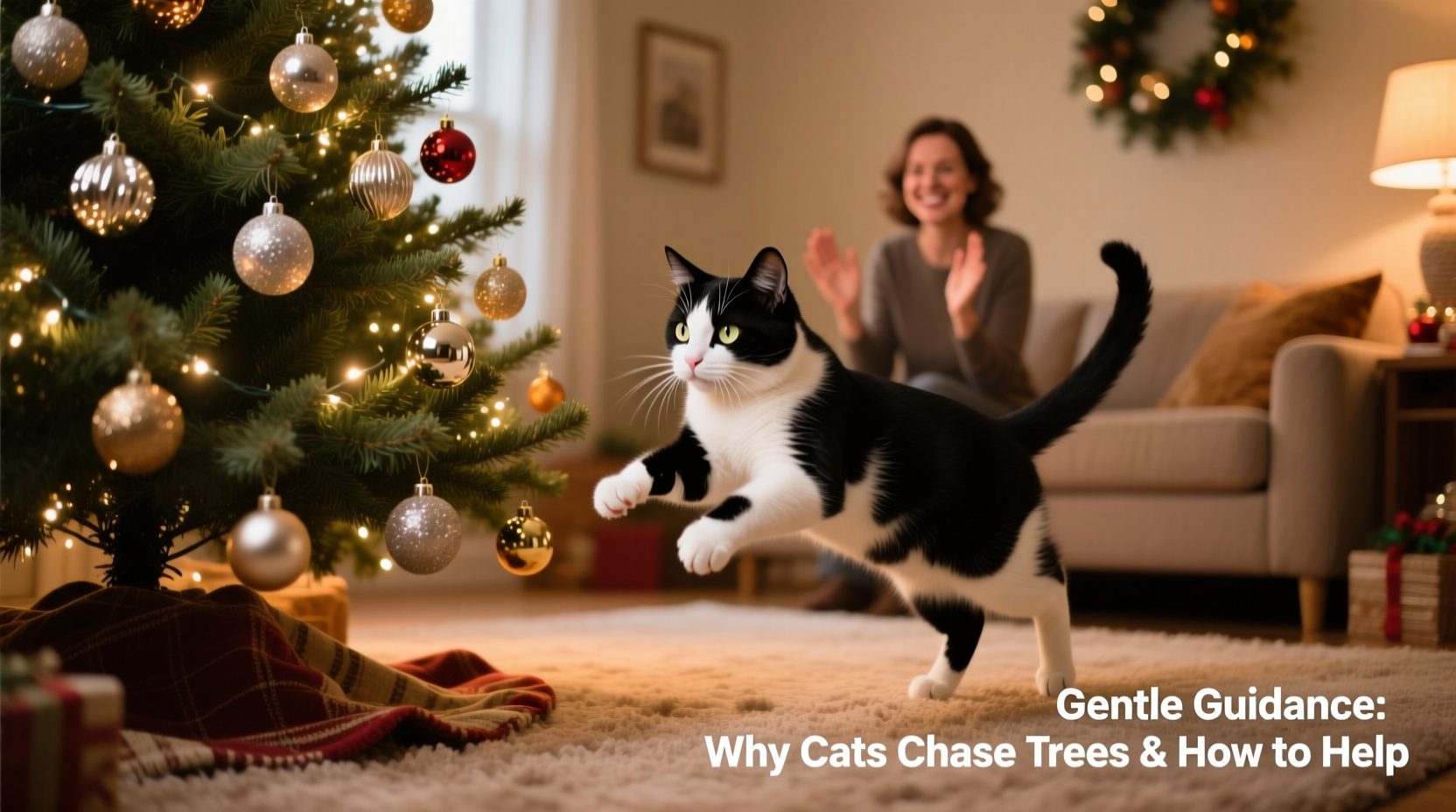
Cats don’t see a Christmas tree as festive décor. They perceive it as a dynamic, multi-sensory environmental anomaly—a vertical jungle gym that moves, glitters, dangles, smells faintly of resin and soil, and occasionally emits soft chimes or rustles. From an evolutionary standpoint, this triggers three core behavioral systems:
- Hunting drive: Swinging ornaments mimic prey movement; flickering lights simulate insect flight; dangling ribbons evoke snakes or birds. Even static branches offer texture-rich surfaces ideal for pouncing practice.
- Exploratory urge: Cats investigate novel objects with their paws, mouths, and noses. A tall, textured, evergreen-scented structure introduced suddenly into their territory is irresistible sensory input.
- Vertical territory assertion: In multi-cat households—or even in single-cat homes with outdoor stimuli visible through windows—the tree becomes a high-value perch. Climbing it signals confidence, control, and vantage-point dominance.
Crucially, punishment—yelling, spraying water, or startling your cat—does not address these drivers. It only teaches your cat that *you*, not the tree, are unpredictable and threatening. That erodes trust and often intensifies attention-seeking or displacement behaviors elsewhere.
Gentle, Evidence-Informed Prevention Strategies
Effective prevention focuses on redirection, environmental enrichment, and subtle boundary reinforcement—not suppression. Veterinarian behaviorists emphasize that successful interventions reduce motivation *and* increase alternative outlets simultaneously. Here’s what works, backed by feline ethology research and clinical behavior practice:
Step-by-Step Holiday Prep Timeline (Start 7–10 Days Before Decorating)
- Days 7–5: Enrich the Environment Install or refresh vertical spaces *away* from the tree: wall-mounted shelves, sturdy cat trees near windows, or hammocks. Add interactive toys (e.g., treat-dispensing balls, feather wands) to rotate daily. The goal: saturate your cat’s environment with better options *before* the tree arrives.
- Day 4: Introduce the Bare Tree Set up the undecorated tree in its final location. Let your cat sniff, paw, and circle it freely. Place a favorite blanket or bed nearby—associating the space with safety, not excitement.
- Day 3: Add Low-Risk Elements First Attach only non-breakable, non-toxic, securely fastened items to the *lower third* of the tree: wooden beads, fabric bows, or felt stars. Avoid anything that dangles below knee-height where paws can easily snag.
- Day 2: Install Deterrents—Invisibly Place double-sided tape or aluminum foil around the tree’s base (cats dislike sticky or crinkly textures). Use citrus-scented cotton balls *under* the tree skirt (not on visible branches)—cats naturally avoid citrus odors. Ensure all cords are fully concealed in cord covers or taped flat to the wall.
- Day 1: Final Decor & Supervised Transition Add lights and ornaments *only after* dark, when your cat is relaxed or sleeping. Then spend 15 minutes playing vigorously with your cat *near* (but not at) the tree using a wand toy—reinforcing proximity without interaction. End with a meal or treat puzzle to anchor calm association.
Do’s and Don’ts: A Practical Comparison Table
| Action | Do | Don’t |
|---|---|---|
| Tree Placement | Position away from furniture your cat uses to launch jumps; ensure at least 3 feet of clear floor space around the base. | Put it near bookshelves, sofas, or window sills that act as springboards. |
| Ornaments | Use shatterproof acrylic, wood, or fabric ornaments hung *high* (above 3 feet) and secured with twist-ties—not hooks. | Hang glass, mercury, or small plastic ornaments within paw’s reach; avoid tinsel entirely (choking/intestinal blockage risk). |
| Lighting | Choose LED lights (cooler, safer), wrap cords tightly with spiral cord organizers, and plug into a surge protector with auto-shutoff. | Use older incandescent lights (heat risk), leave cords loose or coiled, or plug into overloaded power strips. |
| Tree Water | Cover the reservoir with a rigid, weighted tree skirt or mesh guard; add a drop of lemon juice to deter drinking (non-toxic, mildly aversive). | Leave water open and accessible—especially if treated with preservatives, fertilizers, or sugar, which are toxic to cats. |
| Response to Attacks | Redirect immediately with a toy tossed *away* from the tree; praise calm observation with quiet verbal praise and a treat. | Shout, clap, spray water, or grab your cat—these escalate anxiety and associate you with fear. |
Real-Life Example: Maya’s Maine Coon and the “Tinsel Tornado”
Maya adopted Leo, a 2-year-old Maine Coon, in November. When she brought home her first real Christmas tree, Leo spent hours circling it, then launched himself upward—toppling the entire 6-foot Fraser fir onto her sofa. She tried citronella spray, a motion-activated air canister, and even moved the tree to the dining room. Nothing stuck. On day four, frustrated but determined, she consulted a certified feline behavior consultant. Together, they redesigned Leo’s environment: installing a 5-foot wall-mounted shelf system beside a sunlit window, rotating three types of food puzzles daily, and introducing a new “tree routine.” They set up the bare tree on a Saturday morning. By Sunday, Leo was napping on his new shelf, watching the tree from above. On Monday, Maya added low-hanging felt stars—Leo batted one once, then lost interest. By Wednesday, he’d chosen the shelf over the tree 9 out of 10 times. The key shift? Maya stopped trying to make the tree “boring”—she made Leo’s world *more interesting elsewhere*.
Expert Insight: What Veterinary Behaviorists Emphasize
“Cats rarely ‘misbehave’—they communicate unmet needs through behavior. Attacking the tree isn’t defiance; it’s a request for play, exploration, or security. The most effective solutions don’t ask the cat to suppress instinct—they give them richer, safer ways to fulfill it.” — Dr. Sarah Lin, DACVB, Board-Certified Veterinary Behaviorist and Director of Feline Wellness at the Pacific Animal Behavior Institute
Dr. Lin’s team analyzed over 200 cases of “tree aggression” between 2020–2023. Their findings confirmed that households implementing environmental enrichment *before* tree setup saw a 78% reduction in climbing attempts within 72 hours—compared to only 22% reduction in homes relying solely on deterrents like sprays or noise devices. The takeaway: enrichment isn’t optional—it’s foundational.
Frequently Asked Questions
Is it safe to use citrus sprays directly on the tree?
No. While diluted citrus oil sprays (e.g., orange or lemon) applied *around the base* or *under the skirt* are generally safe and aversive, spraying essential oils directly on pine branches risks respiratory irritation for cats—and many citrus oils (like bergamot or grapefruit) contain phototoxic compounds that become harmful when exposed to light. Stick to cotton balls or diffusers placed several feet away, never on foliage.
My cat only attacks at night—what’s different then?
Nighttime attacks often reflect circadian rhythm alignment. Cats are naturally crepuscular (most active at dawn/dusk) and may experience pent-up energy if under-stimulated during daylight hours. Nighttime also brings quieter surroundings—making subtle tree movements (swaying from HVAC drafts, settling sounds) more noticeable. Increase daytime play sessions to 3–4 short bursts (5 minutes each) using wand toys that mimic prey trajectories. End each session with a meal to trigger post-hunt relaxation.
Can I train my cat to ignore the tree using clicker training?
Yes—but not by rewarding absence. Instead, use positive reinforcement to build a new association: click and treat *every time your cat looks calmly at the tree from 3+ feet away*, then gradually increase distance requirements. Never reward proximity *to* the tree unless the cat is stationary and relaxed. This builds a conditioned emotional response: “tree = calm focus = good things happen.” Consistency matters more than duration—2–3 minutes, twice daily, yields stronger results than one long session weekly.
Long-Term Mindset Shifts for Lasting Peace
Stopping tree attacks isn’t about achieving perfect stillness—it’s about cultivating mutual understanding. Your cat isn’t “ruining” the holidays; they’re expressing species-normal behavior in a human-designed context. The most resilient solutions emerge when you stop asking, “How do I stop this behavior?” and start asking, “What need is this meeting—and how can I meet it better elsewhere?”
This means rethinking play not as a chore, but as daily mental hygiene. It means viewing vertical space not as clutter, but as essential real estate. It means recognizing that a cat who spends 20 minutes per day engaged in predatory play (stalking, pouncing, biting, shaking) is far less likely to redirect that energy toward tinsel. And it means honoring your own limits: if your cat remains persistently drawn to the tree despite consistent effort, consider a live, potted tree *outside* your main living area—or a high-quality artificial tree stored safely in a closet until New Year’s Eve. Flexibility isn’t failure—it’s stewardship.
Conclusion: Celebrate With Compassion, Not Control
Your Christmas tree doesn’t need to be a battleground. Neither does your relationship with your cat. With thoughtful preparation, grounded in how cats truly think and feel, you can create a holiday season where wonder isn’t diminished by worry—and where your cat isn’t an obstacle to joy, but a quiet, curious participant in the warmth and light. Start small: tonight, place a new perch near a window. Tomorrow, swap one old toy for a puzzle feeder. By next week, your tree won’t just be decorated—it will be integrated, respected, and peacefully shared.




 浙公网安备
33010002000092号
浙公网安备
33010002000092号 浙B2-20120091-4
Comments
No comments yet. Why don't you start the discussion?