
It happens every year: You’ve spent hours trimming the tree—twinkling lights, heirloom ornaments, the perfect scent of pine—and within minutes of stepping away, there’s a crash, a rustle, and your feline accomplice sitting calmly beside a lopsided, leaning, or fully toppled tree. This isn’t mischief for mischief’s sake. It’s instinct, curiosity, stress, or unmet needs playing out in slow-motion chaos. And while it’s easy to laugh—or groan—in the moment, repeated toppling risks injury to your cat (from falling branches or broken glass), fire hazards (if lights overheat or cords are chewed), and emotional exhaustion for you. The good news? You don’t need to choose between a festive home and a peaceful one. With grounded understanding of feline behavior—and strategies tested in real homes—you can resolve this before December 24th.
Why cats target the Christmas tree: beyond “they just like chaos”
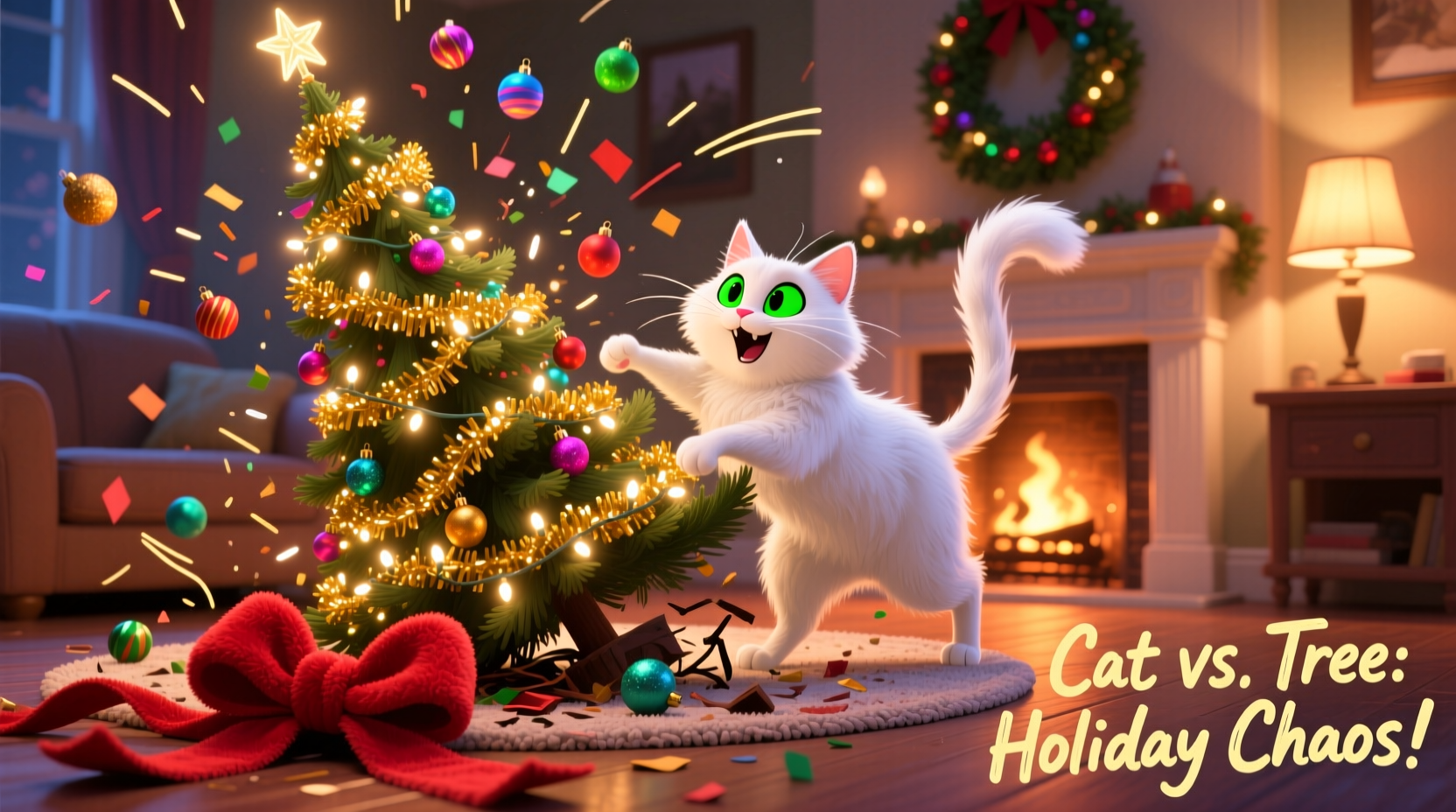
Cats don’t knock trees down because they’re plotting holiday sabotage. Their actions follow predictable behavioral drivers rooted in evolution, neurology, and domestic context. Understanding the *why* transforms frustration into targeted intervention.
First, the tree is an irresistible environmental anomaly. In your cat’s daily landscape—where furniture is stable, surfaces are predictable, and movement is controlled—the Christmas tree introduces novelty, verticality, texture, and motion (swaying boughs, flickering lights, dangling objects). To a predator wired to investigate change, it’s not decoration—it’s a live stimulus field.
Second, many cats engage in what ethologists call “object play with predatory sequencing.” That means batting, pouncing, climbing, and shaking—behaviors that mimic hunting small prey. A lightweight, slightly unstable tree with hanging ornaments satisfies multiple stages of that sequence at once. The more responsive it is (i.e., the more it wobbles or drops things), the more reinforcing the behavior becomes.
Third, seasonal stressors often coincide with tree setup: guests arriving, routines disrupted, new scents, rearranged furniture, and increased household noise. For sensitive or anxious cats, the tree may become both a source of uncertainty *and* a focal point for displaced energy—a physical outlet for emotional static.
Finally, some cats learn very quickly that tree-related activity draws intense human attention—even if it’s reprimanding. For attention-seeking individuals, a toppled tree is a guaranteed reaction. As veterinary behaviorist Dr. Sarah Heath explains:
“Cats aren’t ‘bad’ when they interact with the tree—they’re responding to unmet needs: enrichment, security, or appropriate outlets for natural behaviors. Punishment doesn’t teach alternatives; it only teaches fear or secrecy.” — Dr. Sarah Heath, RCVS Specialist in Veterinary Behavioral Medicine
Immediate stabilization: 5-minute fixes to prevent tonight’s collapse
You don’t need to wait until tomorrow to protect your tree. These interventions work *tonight*, require no special tools, and prioritize safety for both cat and decor.
- Anchor the base securely: Use heavy, low-profile weights (like sandbags, bricks wrapped in cloth, or filled water jugs) placed flat against the tree stand on all four sides—not stacked, but flush and immovable. Avoid decorative stones alone; they shift and offer minimal resistance.
- Reinforce the stand: Most standard stands rely on screw-tightened clamps. Loosen the screws, insert a folded towel or rubber grip pad between the clamp and trunk, then retighten firmly. This increases friction and reduces slippage.
- Secure the trunk to wall anchors: Use two 3M Command™ Heavy-Duty Picture Hanging Strips (rated for 16 lbs each) or similar damage-free adhesive anchors. Attach one strip to the back of the trunk (mid-height, on bare bark or a smooth section of trunk wrap) and one to a wall stud (not drywall alone). Connect with sturdy, flat nylon webbing—not rope or string—to avoid snagging fur.
- Remove the “trigger zone”: Clear a 3-foot radius around the base of the tree. Remove rugs, toys, or furniture that gives your cat a springboard. If your cat jumps from the sofa, move the sofa back 18 inches—or place double-sided tape on its front edge (cats dislike the stickiness and will avoid launching from there).
- Install temporary visual barriers: Drape a lightweight, opaque tablecloth or folding screen around the lower third of the tree (secured with binder clips to the trunk). This blocks access without obstructing light or airflow—and removes the visual invitation of dangling lower ornaments.
Behavioral redirection: turning tree interest into safe, satisfying play
Stopping the behavior is only half the solution. The other half is giving your cat something *better* to do—one that satisfies the same drives (hunting, climbing, exploring) without risking your Fraser fir.
Start by mapping your cat’s peak activity windows. Most cats have surges of energy at dawn and dusk (“crepuscular peaks”). Schedule dedicated 10–15 minute interactive play sessions *just before* those times using wand toys that mimic erratic prey movement—never laser pointers alone (they create unsatisfied hunting frustration). End each session with a high-value treat or meal to simulate the “kill-and-eat” completion.
Next, build vertical alternatives *near—but not too near—the tree.* Install a tall, stable cat tree (minimum 60 inches) or wall-mounted shelves within 6 feet of the tree’s location. Cover shelves with soft fleece or cork for grip, and place a favorite toy or treat puzzle on the highest platform. The goal isn’t to distract *away* from the tree, but to provide a parallel, superior option that fulfills the same need for height and observation.
For tactile curiosity, replace breakable ornaments with safe, engaging alternatives on the lower third of the tree: large felt balls with bells, knotted cotton ropes tied loosely to boughs (check daily for fraying), or pinecone-shaped plush toys stuffed with silvervine or catnip. Rotate these weekly to maintain novelty.
| Problem Behavior | Underlying Need | Safe, Effective Alternative |
|---|---|---|
| Batting at low-hanging ornaments | Hunting sequence initiation | Daily wand-play + treat-dispensing ball placed on floor nearby |
| Climbing the trunk | Vertical exploration & vantage point | Sturdy cat tree with perch at eye-level, positioned 4 ft from tree |
| Chewing lights/cords | Oral stimulation or teething (especially kittens) | Cool, damp washcloth frozen for 15 min + cord covers infused with bitter apple spray |
| Staring intently + tail flicking | Heightened arousal or anxiety | Calming pheromone diffuser (Feliway Optimum) placed 3 ft from tree, activated 48 hrs prior |
| Bringing toys to base of tree | Resource guarding or nesting instinct | Dedicated “nest box” nearby: open carrier lined with soft blanket, placed in quiet corner |
A real-world success: How Maya stopped her Maine Coon from toppling three trees in one week
Maya, a graphic designer in Portland, faced exactly this scenario last December. Her 3-year-old Maine Coon, Atlas, had knocked down three different trees in rapid succession—two artificial, one real—despite using “cat-proof” stands and deterrent sprays. She’d tried citrus sprays (he licked them off), aluminum foil (he walked on it), and even a motion-activated air canister (which startled him so badly he began hiding for hours).
Working with a certified feline behavior consultant, Maya shifted focus from punishment to pattern analysis. She filmed Atlas for 48 hours and discovered two key triggers: he always approached the tree after returning from the sunroom window (where birds gathered), and he consistently targeted the tree within 90 seconds of Maya sitting on the couch to check email.
The solution was layered. First, she installed a bird feeder *outside* the sunroom window—shifting his predatory focus outward. Second, she placed a tall, fleece-covered cat tower directly beside the couch, stocked with a rotating selection of food puzzles. Third, she anchored the tree with wall straps and removed all ornaments below 36 inches—replacing them with dangling wool pom-poms on elastic loops (easy to replace, impossible to swallow).
Within 36 hours, Atlas stopped approaching the tree entirely. By Day 7, he was napping on the tower’s top perch—facing the tree, but relaxed and disengaged. “It wasn’t about making the tree boring,” Maya shared. “It was about making everything else *more* interesting—and safer—for him.”
Your 72-hour action plan: step-by-step stabilization and behavior reset
This timeline assumes your tree is already up—and possibly already compromised. It prioritizes immediate safety, then sustainable habit change.
- Hour 0–1 (Tonight): Execute the 5-minute stabilization fixes above. Remove all breakables from the bottom 3 feet. Place Feliway Optimum diffuser in adjacent room (do not place directly under tree—heat from lights degrades pheromones).
- Hour 1–24: Observe your cat silently for 15 minutes, three times per day. Note: What precedes the approach? (e.g., hearing wrapping paper, seeing you decorate, post-nap restlessness). Record location, time, and body language (tail position, ear angle, pupil size).
- Day 2: Introduce one alternative per observed trigger. Example: If he approaches after bird-watching, place a bird feeder outside his favorite window. If he targets the tree after naps, set up a cozy perch near a sunny window *before* he wakes.
- Day 3: Begin scheduled interactive play at dawn and dusk—10 minutes minimum, ending with food. Simultaneously, start offering novel, safe tree “toys” (felt balls, knotted ropes) on lower boughs.
- Day 4–5: Gradually reintroduce non-breakable ornaments to mid-level boughs (24–48 inches), *only* after he’s engaged with alternatives for 3 consecutive sessions.
- Day 6–7: Assess progress. If no toppling occurs and he ignores the tree for >90% of observation windows, add one fragile ornament per day—always placing it higher than previous day’s addition.
- Ongoing: Maintain daily play, rotate tree accessories weekly, and inspect anchors every 48 hours. Never leave lights on unattended if your cat is unsupervised.
FAQ: quick answers to urgent questions
Can I use citrus or vinegar sprays to deter my cat?
No—these are ineffective long-term and potentially harmful. Cats have highly sensitive olfactory systems; strong irritants like vinegar or concentrated citrus oils can cause respiratory distress, oral ulceration, or skin irritation. More importantly, they don’t address motivation. If your cat is driven by play or stress, smell-based deterrents simply get ignored—or worse, provoke investigation.
Is it safe to use tinsel or glass ornaments if my cat seems “gentle”?
No. Even seemingly calm cats experience sudden bursts of predatory energy. Tinsel causes life-threatening intestinal blockages if ingested. Glass shards pose laceration risks to paws and mouth. According to the ASPCA Animal Poison Control Center, tinsel ingestion ranks among the top five holiday-related feline emergencies annually. Opt for large, shatterproof ornaments made of wood, thick felt, or silicone.
What if my cat is still obsessed—even after trying everything?
Consult your veterinarian *before* assuming it’s behavioral. Hyperactivity, excessive vocalization, or fixation near the tree can signal underlying issues: hyperthyroidism (common in cats over 10), dental pain (chewing cords for relief), or early-stage cognitive dysfunction. A full exam—including bloodwork and oral assessment—rules out medical causes first.
Conclusion: reclaim your holidays, respectfully
Your cat isn’t defying tradition. He’s expressing biology, emotion, and need—in the only language he knows. The fastest, most lasting fix isn’t stronger tape or louder deterrents. It’s meeting him where he is: as a hunter, climber, observer, and sometimes-stressed companion sharing your space during a season of upheaval. When you anchor the tree *and* anchor your cat’s sense of security, when you redirect energy *and* honor instinct, the chaos settles—not because the tree is off-limits, but because it’s no longer the most compelling thing in the room. This year, let your decorations shine without constant vigilance. Let your cat explore, climb, and play—safely, joyfully, and without consequence. Start tonight. Your tree, your peace, and your cat will all thank you.




 浙公网安备
33010002000092号
浙公网安备
33010002000092号 浙B2-20120091-4
Comments
No comments yet. Why don't you start the discussion?