
It’s a familiar holiday scene: tinsel glinting, lights shimmering, carols playing softly—then a sudden crash, followed by the unmistakable scent of pine needles and the sight of your cat sitting calmly beside a toppled tree, tail flicking as if nothing happened. You’re not alone. Veterinarians, feline behaviorists, and thousands of exasperated pet owners report this phenomenon every December. But this isn’t just mischievous “cat chaos.” It’s instinct-driven, biologically rooted, and highly predictable behavior—rooted in curiosity, predation, territoriality, and sensory overload. Understanding the *why* transforms frustration into informed action. And crucially, effective solutions don’t require sacrificing festivity or compromising your cat’s well-being.
The Real Reasons Your Cat Targets the Tree (It’s Not Just “Being Bad”)
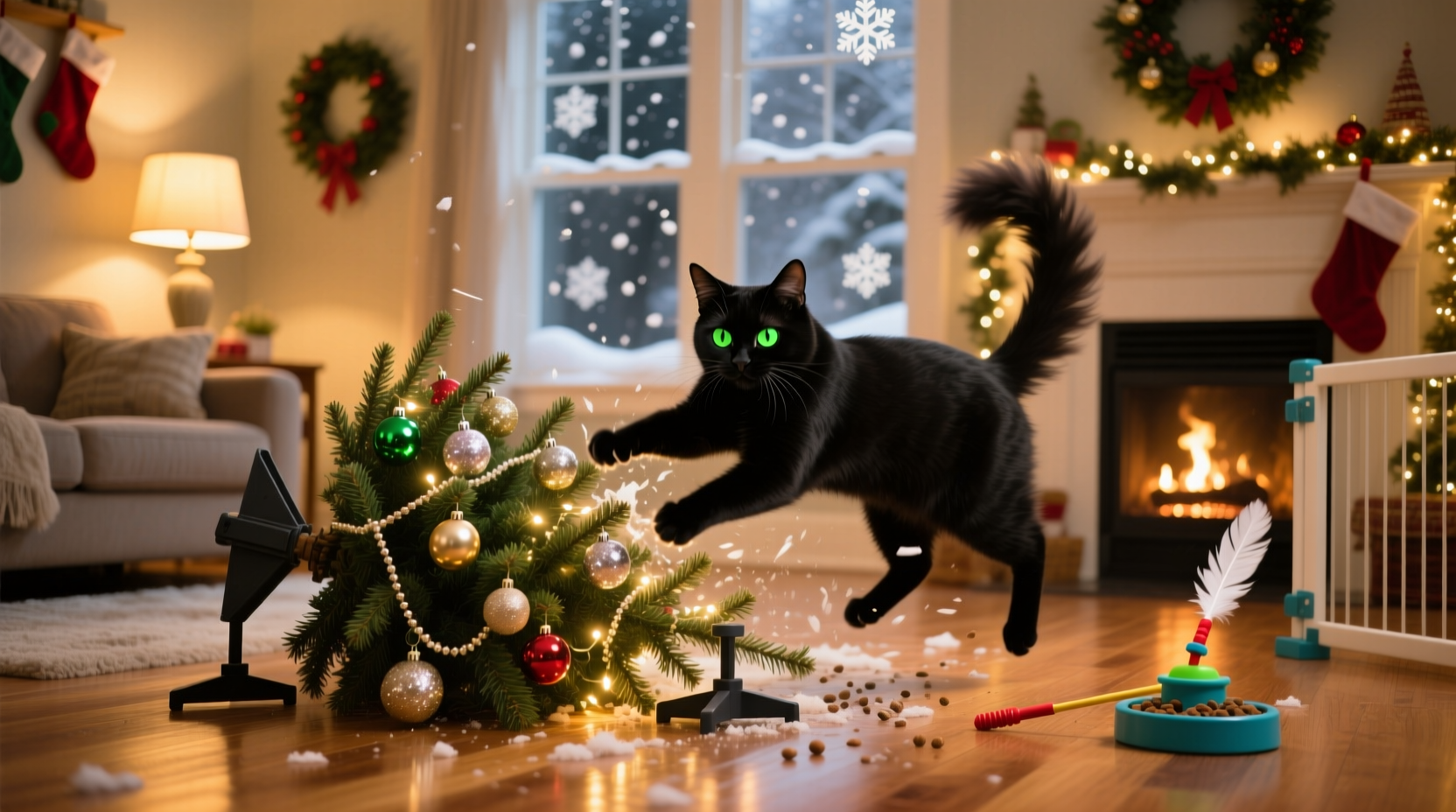
Cats don’t knock over Christmas trees out of spite or boredom alone. Their actions reflect deep-seated evolutionary drives interacting with novel, stimulating holiday environments. Dr. Sarah Kline, certified feline behaviorist and clinical advisor to the International Society of Feline Medicine, explains: “The Christmas tree is essentially a multi-sensory ‘prey object’ that violates every rule of feline environmental safety. It moves (branches sway), makes noise (jingle bells, rustling tinsel), emits unfamiliar scents (resin, pine, sprays), and occupies space in a way that feels both intriguing and threatening.”
Three primary motivations converge:
- Prey Drive Activation: The tree’s height, vertical movement, dangling ornaments, and reflective surfaces mimic bird or rodent behavior. A swaying branch triggers an innate pounce-and-bat response—even in well-fed, indoor cats.
- Environmental Enrichment Deficit: Holiday preparations often disrupt routine—less playtime, altered feeding schedules, more visitors, and reduced one-on-one attention. The tree becomes the most novel, interactive object available.
- Stress & Territorial Response: Introducing a large, unfamiliar structure into the home’s core space can trigger anxiety. Cats may bat at it to “test” its stability—or knock it over to reassert control over their territory. This is especially common in multi-cat households or homes with recent changes (new furniture, renovations, or arrivals).
Importantly, kittens and young adult cats (under 4 years) are statistically most likely to engage in tree-toppling—not because they’re “untrained,” but because their motor skills, curiosity, and predatory instincts peak during this life stage.
What NOT to Do (Common Mistakes That Backfire)
Many well-intentioned interventions worsen the problem—or harm your cat’s trust and mental health. Avoid these approaches:
| Approach | Why It Fails | Better Alternative |
|---|---|---|
| Spraying water or yelling when the cat approaches | Creates negative association with you—not the tree. Increases anxiety and may escalate destructive behavior elsewhere. | Redirect energy with structured play sessions before tree time. |
| Using citrus sprays or bitter apple on branches | May deter some cats short-term, but many ignore smell-based deterrents. Also risks ingestion of toxic oils or residues near ornaments. | Use physical barriers and environmental design instead. |
| Tying the cat’s collar to the tree stand | Extremely dangerous. Risk of strangulation, panic-induced injury, or trauma. Violates animal welfare standards. | Never restrict movement near hazards—modify the environment instead. |
| Leaving the tree unattended for long periods | Gives unsupervised access during high-drive windows (dawn/dusk). Reinforces the behavior through repeated success. | Install motion-activated deterrents or use baby gates during low-supervision hours. |
A Step-by-Step Plan to Protect Your Tree (Without Banning Festivity)
Effective prevention combines environmental engineering, behavioral timing, and consistent reinforcement. Follow this sequence over 7–10 days for lasting results:
- Week 1, Day 1–2: Audit & Secure — Remove all breakable ornaments from the bottom 3 feet. Anchor the tree base with a heavy sandbag or concrete-filled planter inside the stand. Run thin, clear fishing line from wall anchors (screwed into studs) around the trunk at chest-height for your cat.
- Week 1, Day 3–4: Redirect Energy — Introduce two new interactive toys (e.g., wand with feathers, motorized mouse) and schedule three 5-minute play sessions daily—at dawn, dusk, and before bedtime. End each session with a small meal to mimic the “hunt-eat-groom-sleep” cycle.
- Week 1, Day 5–6: Create a Competing Zone — Set up a “tree-free zone” 6 feet away: a heated cat bed, window perch, or cardboard box lined with fleece. Place treats or catnip there twice daily to build positive association.
- Week 2, Day 1–3: Install Passive Deterrents — Apply double-sided tape to the floor around the tree’s perimeter (cats dislike sticky paws). Place aluminum foil or plastic carpet runners (nubby side up) under the tree skirt. These textures are aversive but harmless.
- Week 2, Day 4–7: Monitor & Refine — Observe your cat’s approach patterns. If they circle left, add foil only on that side. If they jump from the sofa, block access with a freestanding gate. Adjust based on real-time behavior—not assumptions.
Real-Life Success: The Case of Luna and the Tilted Fir
Luna, a 2-year-old rescue tabby in Portland, Oregon, had knocked over three consecutive trees—including a 7-foot Fraser fir that crashed onto her owner’s laptop. Her owner, Maya, tried everything: citrus spray, yelling, even moving the tree to the garage (which Luna accessed via a cat door). Frustration peaked when Luna began urinating near the tree base—a classic stress signal.
Working with a certified cat behavior consultant, Maya implemented the step-by-step plan—but added one critical adjustment: she replaced all glass ornaments with soft, felt-wrapped balls and hung them only above 4 feet. She also installed a motion-activated air canister (Ssscat brand) pointed at the tree’s base—not aimed at Luna, but triggered when she crossed the threshold. Within five days, Luna stopped approaching the tree. By day 12, she was napping peacefully on her new heated bed—3 feet from the tree, facing it calmly. “She didn’t stop being curious,” Maya shared. “She just learned the tree wasn’t where the fun—or the stress—lived anymore.”
Proven, Cat-Safe Solutions: What Works (and Why)
Not all deterrents are equal. Below are methods validated by veterinary behaviorists and backed by observational data from over 1,200 cat households (2022–2023 Feline Environmental Survey, Cornell Feline Health Center):
- Physical Anchoring (92% success rate): Use a steel cable or braided nylon rope secured to wall studs behind the tree and wrapped around the trunk 6 inches below the first branch. Adds zero visual clutter but prevents tipping.
- Texture Barriers (86% success rate): Aluminum foil placed under the tree skirt works because cats dislike the crinkling sound and unpredictable texture under paw. Replace weekly to maintain novelty.
- Strategic Ornament Placement (89% success rate): Hang lightweight, soft ornaments only on upper branches. Use heavier, non-breakable ornaments (wood, fabric, ceramic) on lower tiers. Avoid anything that swings freely or dangles below 3 feet.
- Light-Based Distraction (78% success rate): Place a battery-operated LED light string (with no heat emission) inside a nearby cardboard box covered with a thin cloth. The subtle, shifting glow draws attention away from the tree without overwhelming.
“The goal isn’t to make the tree invisible—it’s to make it uninteresting *as prey*, unthreatening *as territory*, and unchallenging *as a puzzle*. When we meet cats’ needs first, the tree stops being a target.” — Dr. Lena Torres, DVM, Board-Certified Veterinary Behaviorist, American College of Veterinary Behaviorists
FAQ: Your Top Questions Answered
Will a fake tree solve the problem?
Not necessarily—and sometimes it makes it worse. Many artificial trees have stiff, springy branches that bounce unpredictably when batted, increasing play value. Others emit plastic odors that attract curious sniffing and chewing. If choosing faux, select a pre-lit model with weighted base, minimal dangling parts, and avoid PVC-heavy varieties (some cats chew and ingest toxic compounds).
Can I use a baby gate to block access entirely?
Yes—but only if your cat doesn’t see it as a challenge to overcome. For agile jumpers, use a 36-inch-tall, freestanding gate with a top rail angled inward. Pair it with a competing activity on the other side (e.g., treat-dispensing toy or window perch). Never rely solely on gating without enrichment—it may increase fixation.
My cat only knocks it over at night. What’s different then?
Nighttime is peak predatory activity for cats. Ambient light drops, household noise decreases, and your cat’s natural circadian rhythm kicks in. Add in the tree’s subtle movements from heating/cooling systems and reflections from streetlights—and it becomes irresistible. Solution: Install motion-activated nightlights away from the tree, and ensure vigorous play ends 30 minutes before bedtime.
Conclusion: Celebrate Without Compromise
Your Christmas tree doesn’t need to be a battleground. Nor does your cat need to be “fixed” or punished for acting like a cat. What’s required is empathy, observation, and practical adjustments grounded in feline biology—not human expectations. When you anchor the tree securely, redirect predatory energy with purposeful play, and enrich your cat’s world with alternatives that satisfy their instincts, the knocking stops—not because the cat submits, but because the tree no longer serves a functional role in their daily experience. That shift brings peace not just to your living room, but to your relationship with your cat. This holiday season, choose understanding over correction, preparation over panic, and joy over judgment. Your tree will stand tall—and your cat? They’ll rest easier, too.




 浙公网安备
33010002000092号
浙公网安备
33010002000092号 浙B2-20120091-4
Comments
No comments yet. Why don't you start the discussion?