
It’s a holiday tradition few pet owners anticipate with joy: the soft rustle of pine needles, the jingle of ornaments—and then, the sickening crash. One moment your tree stands tall and festive; the next, it’s listing sideways, lights tangled, tinsel strewn across the floor, and your cat sitting calmly nearby, tail flicking, as if nothing happened. You’re not imagining things—this isn’t random mischief. It’s instinct, curiosity, and environmental mismatch colliding in your living room. Veterinarians and feline behavior specialists confirm that tree-toppling is one of the most common seasonal stressors reported by cat owners during December. And while it’s easy to blame “naughtiness,” the truth is far more nuanced—and far more solvable.
Cats don’t knock over Christmas trees to annoy you. They do it because the tree triggers deep-seated behavioral drives: hunting (swatting at dangling ornaments), climbing (seeking vertical territory), exploration (investigating novel scents and textures), and sometimes even anxiety relief (redirecting stress from holiday chaos). When those instincts meet an unsecured, glittering, fragrant evergreen placed squarely in their domain, physics—and patience—lose.
Why Cats Target the Tree: Beyond “Just Playing”
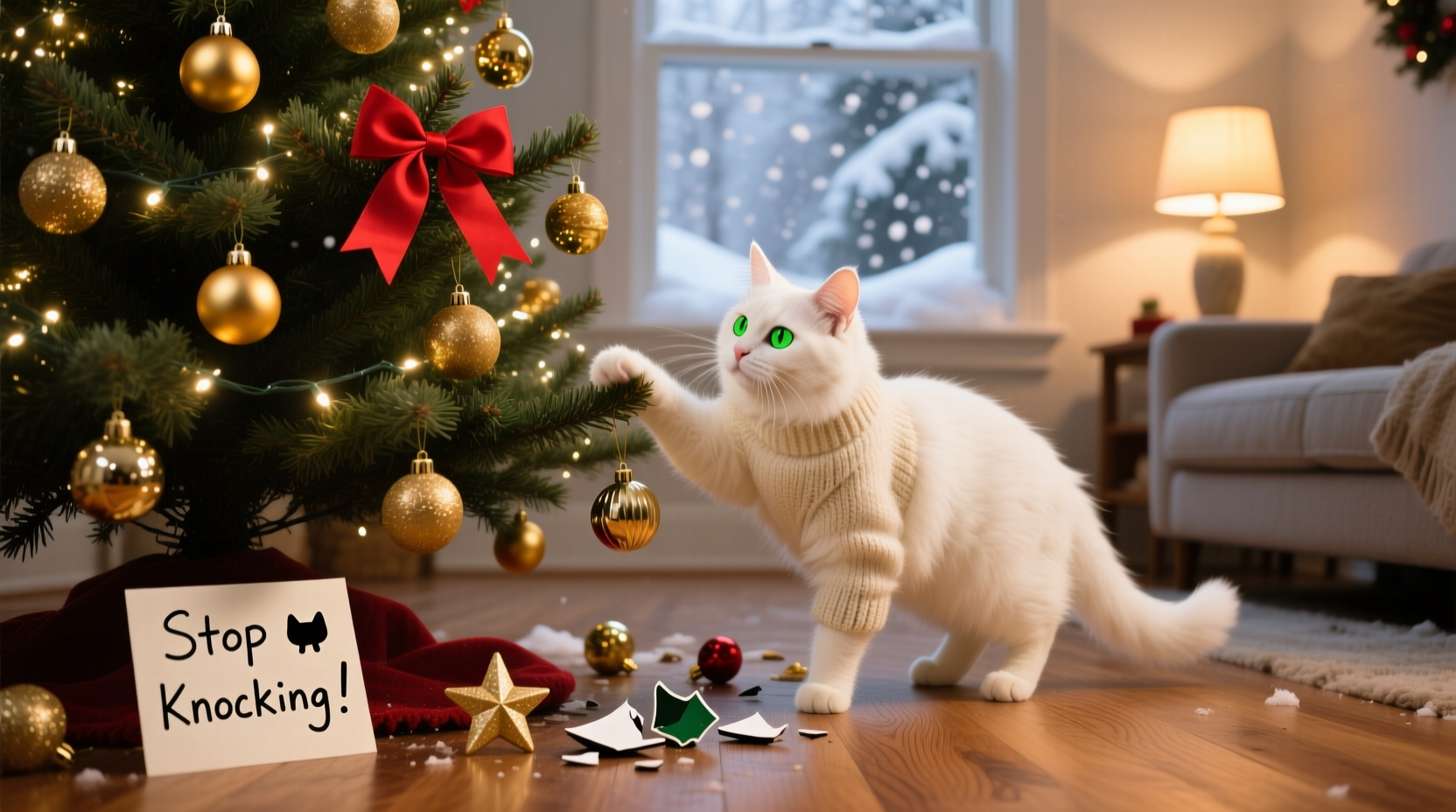
Feline ethology—the scientific study of cat behavior—shows that cats perceive the Christmas tree as a complex environmental stimulus. Its height mimics natural climbing structures like trees or shelves; its scent (especially real pine or fir) carries volatile organic compounds that can be stimulating or even mildly intoxicating to cats; and its movement (from air currents or pets brushing past) activates their prey-detection reflexes. Dr. Sarah Lin, DVM and certified feline behavior consultant with the International Association of Animal Behavior Consultants, explains:
“Cats aren’t ‘testing boundaries’ when they climb the tree—they’re fulfilling hardwired needs for vertical space, sensory engagement, and motor play. A Christmas tree, especially one placed in a high-traffic area, becomes the most compelling object in their world—not because it’s festive, but because it’s novel, textured, unstable, and full of motion.” — Dr. Sarah Lin, DVM, CABC
This isn’t misbehavior—it’s unmet need. Without appropriate outlets, cats will redirect energy toward whatever moves, dangles, or smells intriguing. The tree becomes both playground and target simply because no better alternative exists.
7 Practical, Vet-Backed Prevention Strategies That Work
Effective prevention doesn’t rely on punishment, sprays, or “cat-proof” gimmicks that ignore feline psychology. Instead, it combines environmental management, enrichment, and subtle deterrents—each grounded in how cats actually think and move. Here are seven strategies proven to reduce or eliminate tree-toppling, tested in homes with multiple cats, kittens, and senior felines alike.
1. Anchor the Tree Like a Structural Engineer
Most tree collapses begin at the base—not from climbing, but from leaning, pawing, or bumping into an unstable trunk. A wobbly tree invites investigation. Use a heavy-duty, low-profile tree stand rated for at least 2× your tree’s weight. Fill the reservoir with water *and* add 1–2 tablespoons of white vinegar (not bleach or sugar—vinegar deters insects without harming cats or plants). Then, secure the trunk to wall studs using two adjustable, non-marking tension straps—one near the top third of the tree, one midway down. Test stability by gently pushing the top branch: minimal sway is acceptable; any noticeable lean means re-anchoring is needed.
2. Create a “No-Climb Zone” With Texture & Height
Cats avoid surfaces that feel unpleasant under paw—but only if the alternative is equally appealing. Wrap the bottom 36 inches of the trunk in tightly secured aluminum foil or double-sided tape (sticky side out). These textures are aversive on contact but harmless. Pair this with a dedicated climbing structure *within 3 feet* of the tree: a tall, stable cat tree with platforms, sisal-wrapped posts, and a perch aligned at eye level with the tree’s midsection. This satisfies the vertical urge *without* requiring the tree itself.
3. Remove the “Lure Factor” From Ornaments
Ornaments are irresistible because they reflect light, swing, clink, and smell like glue, plastic, or metal. Replace fragile glass or metal baubles on the lower two-thirds of the tree with lightweight, matte-finish wooden, felt, or fabric ornaments. Hang them with short, rigid ornament hooks—not long ribbons or strings—that prevent swinging. Keep all shiny, reflective, or noisy items above 5 feet—out of swiping range. As a rule: if your cat can bat it without stretching upward, it’s too low.
4. Redirect Hunting Instincts With Scheduled Play
Unspent predatory energy fuels tree-pouncing. Cats need at least two 15-minute interactive play sessions daily—preferably before dawn and dusk, when their natural activity peaks. Use wand toys that mimic bird or rodent movement (never hands or feet). End each session with a small meal or treat to simulate the “hunt-eat-groom-sleep” sequence. Consistent play reduces spontaneous, high-energy bursts directed at environmental stimuli—including trees.
5. Block Access Without Isolation
Confining your cat to another room defeats the purpose of shared holiday joy—and increases stress. Instead, create a gentle barrier using a freestanding, 36-inch-tall baby gate with narrow slats (wide enough for airflow, narrow enough to prevent squeezing). Position it in an arc around the tree’s base, leaving a 3-foot clearance radius. Line the inside edge with a low row of potted rosemary or lavender (non-toxic herbs cats typically avoid due to strong scent). This discourages approach without trapping or excluding.
6. Neutralize the Scent Appeal
Real trees emit terpenes like pinene and limonene—compounds that stimulate feline olfactory receptors and may trigger mild euphoria or hyperactivity. While artificial trees lack this, they often carry manufacturing odors (plastic, flame retardants) that also attract curious noses. Wipe artificial branches with a damp microfiber cloth before decorating. For real trees, lightly mist the outer branches once daily with a solution of 1 cup water + 1 tsp unscented Epsom salt (magnesium sulfate)—it neutralizes volatile compounds without toxicity and leaves no residue cats can lick.
7. Monitor & Adjust Based on Your Cat’s Personality
A bold, athletic cat needs stronger anchoring and higher ornament placement than a cautious, older cat. Observe your cat’s first interaction with the tree: does she circle? Stare intently? Pounce from a distance? Crouch and twitch? Each pattern signals different motivation—and informs your response. Circle-and-stare = territorial assessment (add visual barriers); pounce-from-distance = prey drive (increase play); crouch-and-twitch = anticipation of movement (reduce hanging elements).
Do’s and Don’ts: A Quick-Reference Table
| Action | Do | Don’t |
|---|---|---|
| Tree Placement | In a low-traffic corner, away from furniture jump-off points | Near sofas, bookshelves, or windowsills that serve as launch pads |
| Water Safety | Use a covered tree stand or place a floating mesh screen over the reservoir | Add aspirin, soda, or sugar—these promote bacterial growth and are toxic if licked |
| Lighting | Use LED mini-lights with insulated, chew-resistant cords; secure with cord clips | Drape lights loosely or use older incandescent strands that heat up and attract licking |
| Enrichment | Rotate puzzle feeders and hide treats in cardboard boxes near—but not under—the tree | Leave food bowls directly under the tree (encourages lingering and pawing) |
| Discouragement | Use motion-activated air canisters placed *behind* the tree (cats associate sound with location) | Spray water directly at your cat—this damages trust and increases anxiety |
A Real Example: How the Chen Family Saved Their Fraser Fir
The Chen family adopted Luna, a 2-year-old tabby, in October. By early December, their 6-foot Fraser fir had been toppled three times—twice during overnight hours. Video monitoring revealed Luna wasn’t climbing; she was launching low, shoulder-first, from the arm of their loveseat, striking the trunk just above the stand. She’d then retreat, groom intensely, and return 20 minutes later. Their veterinarian identified this as redirected play aggression fueled by insufficient daytime stimulation—not territorial behavior.
They implemented a three-part fix: (1) moved the loveseat 4 feet away from the tree’s radius and added a 5-foot-tall cat tree beside it; (2) introduced two daily “predatory sequence” play sessions ending in kibble rewards; and (3) wrapped the lower trunk in foil and anchored the tree with dual-wall straps. Within 72 hours, Luna stopped approaching the tree. By Day 10, she used the new cat tree exclusively—and even began napping on its top platform, facing the tree like a silent, furry sentinel. No scolding. No sprays. Just understanding and adjustment.
Step-by-Step: Setting Up a Cat-Safe Tree in Under 90 Minutes
- Clear & Measure (10 min): Choose a corner spot at least 3 feet from furniture, windows, and foot traffic. Measure floor space for stand and barrier.
- Anchor & Secure (20 min): Assemble heavy-duty stand. Fill with water + vinegar. Drill two wall anchors into studs behind the tree location. Attach tension straps to trunk at 2 ft and 4 ft heights.
- Texture & Deter (15 min): Wrap bottom 36 inches of trunk in foil or double-sided tape. Place potted rosemary in a ring around the base.
- Decorate Strategically (25 min): Hang only non-reflective, lightweight ornaments below 5 ft. Use short, rigid hooks. String lights with cord clips—no loose ends.
- Enrich & Monitor (20 min): Set up adjacent cat tree or perch. Schedule first play session before dark. Install motion-activated air canister behind tree (pointed at trunk base). Review video footage after 24 hours and adjust.
FAQ: Common Concerns Answered
Will a fake tree solve the problem?
Not necessarily. While fake trees lack the enticing scent of real pine, many cats still target them for climbing, especially if they’re lightweight or placed near launch points. The key isn’t material—it’s stability, placement, and enrichment. In fact, some cats prefer the smoother texture of PVC branches for scratching. Always anchor artificial trees just as rigorously as real ones.
My cat only knocks it over at night—what’s happening?
Nighttime toppling usually indicates unmet nocturnal energy needs. Cats are naturally crepuscular (most active at dawn/dusk) but often shift activity to nighttime in quiet homes. Increase evening play, provide a timed feeder with dry food overnight, and ensure litter box access is unobstructed. Avoid reinforcing attention-seeking by rushing to the scene—use motion-activated deterrents instead.
Is it safe to use aluminum foil around the base?
Yes—when applied correctly. Wrap foil snugly around the trunk (not draped loosely on the floor where it could be balled up and swallowed). Foil poses no toxicity risk and is easily removed post-holiday. If your cat shows signs of chewing or ingesting foil, replace it with double-sided tape or a commercial pet-safe deterrent mat.
Conclusion: Peace, Not Perfection
You don’t need a “cat-proof” Christmas. You need a cat-informed one. Every toppled tree is feedback—not failure. It tells you your cat is healthy, curious, and wired to explore. The goal isn’t to suppress instinct, but to guide it toward safer, more satisfying outlets. With thoughtful anchoring, smart decoration, consistent play, and respectful observation, most households see dramatic improvement within days—not weeks. The tree stays upright. Your cat stays engaged. And the holidays regain their warmth, not their worry.
This season, give your cat what they truly need: predictability, vertical space, sensory variety, and the dignity of choice. When their environment supports their nature, the tree stops being a target—and becomes part of the backdrop to something calmer, kinder, and more joyful.




 浙公网安备
33010002000092号
浙公网安备
33010002000092号 浙B2-20120091-4
Comments
No comments yet. Why don't you start the discussion?