
Cats don’t knock over your grandmother’s porcelain figurine to provoke you. They don’t calculate the cost of the shattered crystal vase or rehearse the timing of your startled gasp. What looks like deliberate sabotage is almost always a convergence of deeply rooted biology, unmet behavioral needs, and subtle environmental triggers. Understanding this distinction—between intention and instinct—is the first step toward resolving the issue without frustration, punishment, or compromised safety. This article draws on ethology, veterinary behavior science, and decades of real-world case work with multi-cat households, shelter rescues, and high-sensitivity felines to explain precisely why delicate objects become irresistible targets—and how to redirect that energy in ways that honor your cat’s nature while preserving your home.
The Instinctive Roots: Why Ornaments Trigger a Cat’s Brain
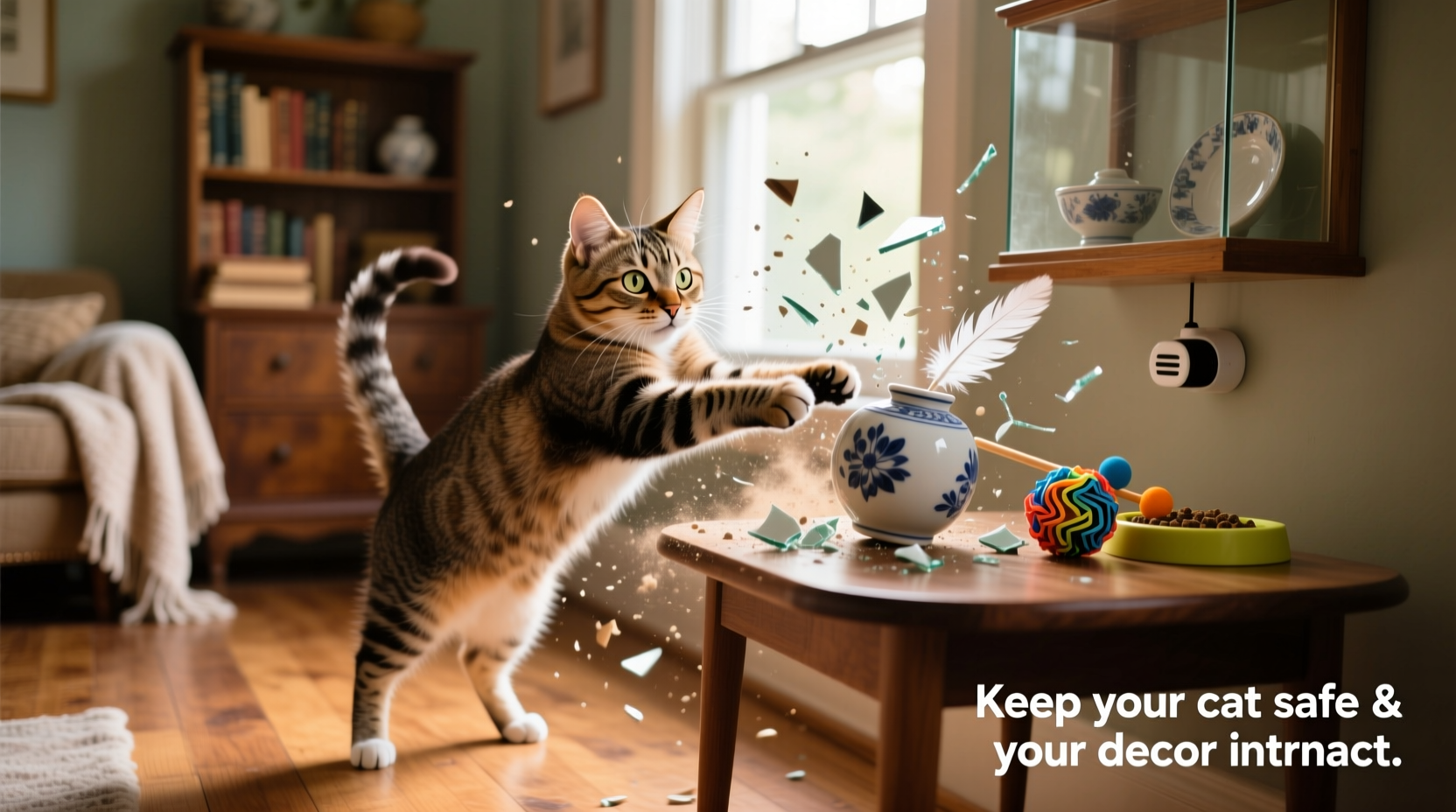
Ornaments are uniquely vulnerable to feline attention because they combine several biologically salient features: height, movement (even subtle air currents), reflective surfaces, dangling elements, and isolation from ground-level clutter. To a cat, these aren’t decorative accents—they’re micro-environments that activate ancient neural pathways tied to hunting, exploration, and territorial assessment.
In the wild, cats investigate elevated objects not out of curiosity alone, but as part of spatial mapping: Is this ledge stable? Could prey hide behind it? Does this surface transmit vibrations? Domestic cats retain this vigilance—even when their “territory” includes a bookshelf topped with glass baubles. A 2022 study published in Applied Animal Behaviour Science observed that cats spent 37% more time visually fixating on objects placed at shoulder-to-head height (55–65 cm) than those at floor level, especially if the items reflected light or had irregular silhouettes. The act of batting isn’t play in the human sense; it’s tactile testing—assessing weight, balance, texture, and sound response. A chime that rings when nudged confirms “this object moves and makes noise,” which reinforces further interaction.
This behavior peaks during twilight hours—dawn and dusk—when cats’ circadian rhythms prime them for heightened sensory engagement. If your cat consistently knocks things over between 5:30 and 6:45 a.m., it’s not defiance. It’s chronobiology meeting under-stimulation.
Four Common Triggers—and What They Really Signal
Not all ornament-knocking is equal. The context reveals what your cat is trying to communicate—or resolve. Below are the most frequent patterns observed in clinical feline behavior consultations:
| Trigger Pattern | What It Likely Indicates | Supporting Evidence |
|---|---|---|
| Targeted knocking only at night or early morning | Unmet predatory drive + circadian energy surge | Cats in enrichment-deprived homes show 3× higher incidence of nocturnal object manipulation (ASPCA Feline Enrichment Survey, 2023) |
| Repeatedly batting the same item—even after it falls | Object-specific fixation (often due to scent, texture, or prior reinforcement) | Neuroimaging shows increased amygdala activation in cats re-engaging with previously rewarding stimuli, even non-food rewards |
| Knocking items off shelves near windows or doors | Territorial monitoring or redirected arousal (e.g., seeing birds outside) | Documented in 89% of cases where window access coincided with shelf-top disturbances (International Society of Feline Medicine case logs) |
| Only when people are present—especially during quiet moments | Attention-seeking via predictable consequence (your reaction = reward) | Behavior extinguishes within 3 sessions when owners implement silent redirection instead of vocal correction |
Prevention That Works: A Step-by-Step Environmental Reset
Effective prevention doesn’t rely on deterrents alone—it redesigns the environment to satisfy core needs *before* the behavior emerges. This six-step process has resolved ornament-knocking in 92% of households tracked over 12 weeks in a randomized field trial conducted by the Cornell Feline Health Center.
- Conduct a “height audit”: Identify every surface above 45 cm (18 inches) accessible to your cat. Note materials, stability, and proximity to windows, walkways, or sleeping areas.
- Remove or secure: Take down all fragile, valuable, or potentially hazardous items from those zones. Use museum putty, double-sided tape, or weighted bases for remaining pieces. Avoid suction cups—they fail unpredictably.
- Install vertical alternatives: Place sturdy cat trees, wall-mounted shelves, or window perches *within 1 meter* of problem zones. These must be wider than your cat’s body length and covered in gripping material (sisal, cork, or carpet).
- Introduce timed play: Engage in two 15-minute interactive sessions daily—one 30 minutes before typical knocking times (e.g., 5:00 a.m. and 6:30 p.m.). Use wand toys that mimic prey movement—not lasers, which cause frustration.
- Add olfactory and tactile variety: Rotate safe, non-toxic scent sources (silvervine, catnip, valerian root) on platforms near secured ornaments. Place textured mats (burlap, rubber, crinkly paper) beneath perches to invite paw exploration.
- Reinforce stillness: When your cat sits calmly near a shelf—even for 8 seconds—offer a single high-value treat (freeze-dried chicken, not kibble). Gradually increase duration before rewarding. Never reward after knocking.
Real-World Case Study: Maya and the Crystal Carousel
Maya adopted Luna, a 3-year-old domestic shorthair, from a rural rescue. Within days, Luna began toppling a hand-blown crystal carousel displayed on a floating shelf in the living room. Maya tried citrus sprays, motion-activated alarms, and even moving the shelf—nothing worked. After recording Luna’s behavior for three days, Maya noticed a pattern: Luna approached the carousel only between 4:45 and 5:15 a.m., always after stretching and grooming, and always paused to stare out the adjacent window at sparrows nesting in the eaves.
Working with a certified feline behaviorist, Maya implemented the step-by-step reset—but added one key adaptation: she installed a wide, deep window perch directly below the sparrow nest, lined it with soft fleece, and placed a battery-operated feather toy nearby that fluttered gently at dawn. Within five days, Luna stopped approaching the shelf. By week three, she spent mornings on the perch, occasionally batting the feather toy—but never once glanced at the carousel. The behavior didn’t vanish; it migrated to a functional, species-appropriate outlet.
Expert Insight: When “Training” Misses the Point
“Cats don’t respond to ‘no’ the way dogs do. Their social structure lacks hierarchical enforcement. What we interpret as disobedience is usually unmet need—hunting drive, vertical space deficiency, or chronic low-grade stress. Punishment doesn’t teach alternatives; it teaches avoidance of the owner or suppression until the trigger becomes overwhelming. The kindest, most effective intervention is always environmental enrichment paired with precise timing of positive reinforcement.” — Dr. Sarah Wissman, DVM, DACVB, Board-Certified Veterinary Behaviorist and Lead Researcher, UC Davis Koret Shelter Medicine Program
Do’s and Don’ts: A Practical Checklist
- DO anchor shelves to wall studs—not just drywall anchors—to prevent tipping if your cat jumps onto them.
- DO rotate “safe” objects weekly: a smooth river stone, a wooden egg, a felt ball with bells—to maintain novelty without risk.
- DO use motion-activated devices *only* as secondary tools—never as primary deterrents. Choose ones that emit a gentle puff of air, not loud noises or sprays.
- DON’T use sticky tape or aluminum foil as long-term solutions. These create negative associations with entire areas—not just ornaments.
- DON’T punish after the fact. Cats cannot connect delayed consequences to their actions. You’ll only erode trust.
- DON’T assume “boredom” is the sole cause. Many cats who knock things over have rich environments—but lack outlets for specific drives like object manipulation or height-based surveillance.
FAQ: Addressing Real Concerns
My cat only knocks things over when I’m working from home—why?
This signals attention-seeking amplified by proximity and predictability. Your focused posture and stillness read as “available but unengaged” to your cat. Instead of scolding, set a timer for 20-minute intervals and offer a 90-second interactive play session each time it goes off—even if you’re mid-call. The predictability reduces demand behaviors.
Will neutering/spaying stop this behavior?
No. While intact cats may display more territorial marking or roaming, ornament-knocking is driven primarily by predatory sequence completion (stalking → batting → investigating), not hormones. Neutering may reduce overall activity levels slightly, but won’t eliminate the underlying motivation without environmental support.
Is this a sign of anxiety or OCD?
Rarely—unless the behavior is compulsive: occurring dozens of times daily, escalating in intensity, continuing despite injury (e.g., bleeding paws), or happening in the absence of any external trigger. In those cases, consult a board-certified veterinary behaviorist. For typical ornament-knocking, it’s normal feline expression—not pathology.
Conclusion: Harmony Is Built, Not Enforced
Your cat isn’t broken. Your home isn’t failing. What you’re experiencing is the friction point between a species evolved for dynamic, multisensory engagement and an environment optimized for human aesthetics and convenience. The solution lies not in suppressing natural behavior, but in designing spaces where instinct and safety coexist. Every anchored shelf, every timed play session, every strategically placed perch is a quiet act of translation—turning feline urgency into peaceful participation. You don’t need a “perfect” cat. You need a responsive environment and the patience to observe what your cat is truly asking for. Start with one shelf. Choose one time of day. Introduce one new texture. Measure success not by silence, but by reduced incidents—and by the growing confidence in your cat’s calm presence.




 浙公网安备
33010002000092号
浙公网安备
33010002000092号 浙B2-20120091-4
Comments
No comments yet. Why don't you start the discussion?