
It’s a familiar holiday paradox: your cat leaps with surgical precision to bat a glass bauble off the tree stand—shattering it on the hardwood—yet sits motionless, blinking slowly, as multicolored LED lights pulse inches from its nose. You’ve rehung the ornament three times. You’ve taped the cord. You’ve even tried “cat-proof” trees (they aren’t). Still, the pattern repeats—not out of malice, but because your cat is responding to deeply wired biological imperatives that have nothing to do with holiday decor and everything to do with 9,000 years of evolutionary refinement.
This isn’t random mischief. It’s targeted sensory engagement governed by neurology, predatory sequencing, and environmental affordance—the set of physical properties an object offers for interaction. Understanding *why* ornaments trigger action while lights don’t reveals far more than holiday survival tactics. It illuminates how cats perceive causality, assess risk, and prioritize stimuli in real time—insights that reshape how we design homes, choose toys, and interpret everyday behavior.
The Physics of Prey: Why Ornaments Invite Interaction
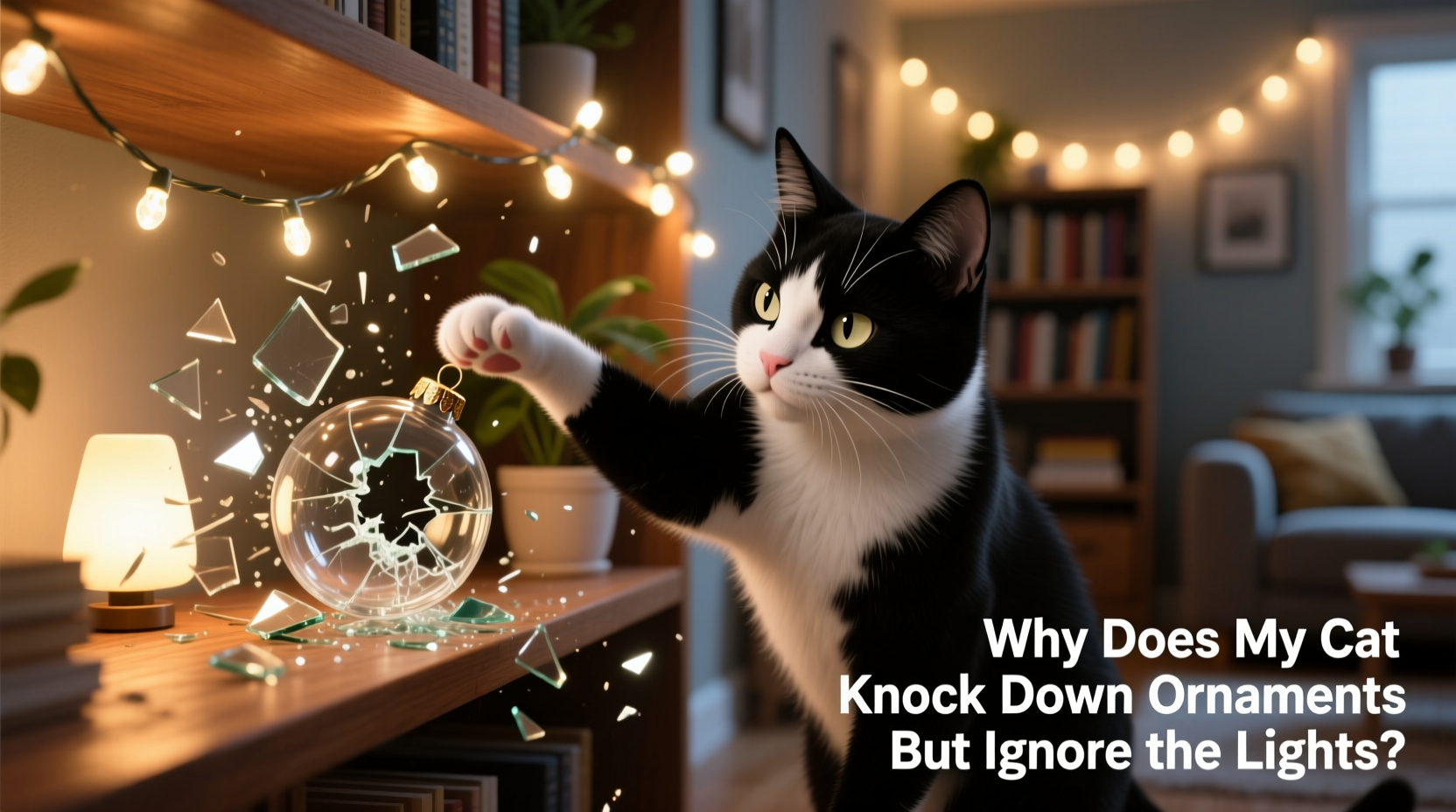
Cats don’t “play” in the human sense. They rehearse predation—a sequence involving detection, orientation, stalking, pouncing, and manipulation. Ornaments satisfy multiple stages of this sequence simultaneously.
First, their physical properties match ideal prey characteristics: small (under 3 inches), suspended (mimicking birds or rodents on branches), reflective (creating unpredictable light flashes), and loosely anchored (offering resistance and movement upon contact). When a cat taps one, it swings, rotates, and makes a soft chime—reinforcing the interaction with multisensory feedback. This isn’t destruction; it’s a successful motor trial. The brain registers: *I moved it. I caused change. That was useful.*
In contrast, lights lack key affordances. LEDs emit steady, diffuse illumination without flicker (most modern bulbs operate at >10,000 Hz, far above a cat’s critical flicker fusion threshold of ~70–80 Hz). They don’t move, make sound, or yield to pressure. To a feline visual system optimized for detecting motion against static backgrounds, stationary lights are functionally invisible—like wallpaper. As Dr. John Bradshaw, anthrozoologist and founding director of the University of Bristol’s Anthrozoology Institute, explains:
“Cats don’t see ‘lights’ as objects to interact with—they see them as ambient conditions, like daylight or shadow. What captures attention is *change*: movement, texture shift, unexpected sound. An ornament delivers all three. A string of LEDs delivers none.” — Dr. John Bradshaw, author of Cat Sense
Sensory Prioritization: How Cats Filter the World
A cat’s brain receives over 200 million neural impulses per second from its senses—but only about 5% reach conscious awareness. Prioritization is ruthless and automatic. Vision dominates initial detection, but touch and hearing drive engagement decisions.
| Sensory Modality | Ornament Response | Lights Response |
|---|---|---|
| Vision | High contrast, reflective surface creates dynamic highlights; pendulum motion triggers motion-detection neurons in the superior colliculus | Uniform brightness, no edge movement; processed as background illumination, not discrete object |
| Touch (via whiskers/paws) | Varied textures (glass, wood, metal); yields to pressure; produces vibration when struck | No tactile interface—light has no surface, mass, or resistance |
| Hearing | Chimes, clinks, or shatters create sharp, localized transients (2–8 kHz range)—ideal for feline auditory localization | No audible output unless faulty; even then, hums fall outside optimal detection band (cats hear best at 5–15 kHz) |
| Smell | Often carry residual human scent (fingers, packaging) or natural materials (wood, pine resin) that signal novelty or potential resource | No olfactory signature—plastic casings and electronics emit minimal volatile compounds |
This filtering explains why your cat may ignore a glittering light strand draped across the floor—but pounce on a single tinsel strand caught in a draft. Motion + texture + sound = “investigate.” Static light = “ignore.”
The Causality Gap: Why Knocking Is More Rewarding Than Watching
Cats possess what researchers call “causal cognition”—the ability to infer relationships between actions and outcomes. But unlike dogs or primates, they test causality through physical manipulation, not observation.
When a cat bats an ornament and it falls, the brain links paw movement → swing → sound → impact → scatter. This satisfies a core cognitive need: understanding agency in the environment. Lights offer no such loop. Pressing a paw against a bulb produces no response (unless it’s a smart bulb with touch controls—rare, and still not rewarding without audible/visual feedback). No cause-effect chain means no reinforcement.
A Real-World Case: Maya’s Tree and the Tinsel Paradox
Maya, a veterinary technician in Portland, adopted a 2-year-old domestic shorthair named Leo just before her first Christmas in a new apartment. She invested in a “cat-safe” artificial tree with reinforced branches and non-toxic ornaments. Within 48 hours, Leo had toppled six ornaments—including two she’d secured with museum putty—and batted a 3-foot tinsel garland into a 12-foot spiral across her living room floor. Yet he ignored the warm-white LED string wrapped around the trunk, even when Maya dangled it near his face.
What changed wasn’t Leo’s behavior—it was Maya’s interpretation. After consulting a certified feline behaviorist, she realized Leo wasn’t targeting “Christmas things.” He was targeting *anything* that met three criteria: (1) hung at shoulder height (his optimal pounce zone), (2) moved when disturbed (even by air currents), and (3) made a crisp acoustic signature upon contact. She swapped ornaments for hanging plush mice filled with silvervine, anchored tinsel to the wall with removable adhesive strips (removing the “unspooling” reward), and added a dedicated play session with wand toys every evening at 5 p.m.—precisely when household activity peaked and Leo’s predatory energy surged. In three weeks, ornament incidents dropped from 4–5 daily to zero. The lights remained untouched.
Practical Intervention: A 5-Step Environmental Reset
You can’t eliminate instinct—but you can redirect it. This step-by-step protocol addresses root causes, not symptoms. Implement all five steps for maximum effect.
- Remove the reward loop: Eliminate ornaments that make noise, swing freely, or scatter upon impact. Replace with static, floor-level decorations (e.g., ceramic animals on shelves) or wall-mounted art that can’t be dislodged.
- Control the height variable: Keep all dangling objects above 6 feet or below 12 inches. Cats rarely target items outside their vertical strike zone (roughly 18 inches to 5 feet from the floor).
- Introduce competing causality: Place interactive puzzle feeders or treat-dispensing balls near—but not under—the tree. When the cat chooses to manipulate those instead, reward with praise and a high-value treat (e.g., freeze-dried chicken).
- Disrupt the routine trigger: Most ornament-knocking occurs during low-stimulation periods (early morning, late afternoon). Schedule two 10-minute play sessions daily using wand toys that mimic bird flight patterns—ending each with a “kill” (letting the cat catch and hold the toy for 20 seconds).
- Neutralize scent cues: Wipe ornaments with unscented pet-safe wipes before hanging. Human scent lingers on glass and metal, signaling “recently handled by provider”—which increases investigative priority.
FAQ: Addressing Common Misconceptions
“Isn’t my cat just being destructive?”
No. Destruction implies intent to damage. Your cat is conducting targeted environmental assessment. Each knock tests material integrity, weight distribution, and acoustic properties—information vital for survival in the wild. In domestic settings, this manifests as “knocking,” but the underlying drive is data collection, not vandalism.
“Will getting another cat stop the behavior?”
Unlikely—and potentially harmful. Introducing a second cat doesn’t dilute predatory drive; it may increase competition for environmental control. Studies show multi-cat households often see *more* object-directed behavior as cats establish spatial boundaries. Redirected play and environmental enrichment are far more effective.
“Do laser pointers help?”
They can worsen frustration. Lasers provide visual stimulation without tactile payoff or consummation (“the kill”). This violates the predatory sequence, leading to redirected aggression or obsessive scanning. If used, always end the session by directing the dot onto a physical toy the cat can bite and shake.
Why This Matters Beyond the Holidays
Understanding why ornaments captivate while lights don’t isn’t about seasonal convenience—it’s about recognizing how profoundly cats experience reality differently than we do. Their world is built on kinetic consequence, textural nuance, and acoustic precision. What looks like chaos to us is a highly structured information-gathering process.
This insight transforms everyday interactions. That “random” swat at your water glass? It’s testing fluid dynamics and surface tension. The persistent batting of a crumpled receipt? It’s assessing paper’s rustle frequency and fold resilience. These aren’t quirks to suppress—they’re expressions of a sophisticated, adaptive mind navigating a human-designed world.
When you respond with curiosity instead of correction—when you replace breakables with biologically appropriate alternatives—you don’t just protect your decor. You honor the evolutionary legacy encoded in your cat’s nervous system. You build trust through predictability. And you turn potential conflict into shared understanding.




 浙公网安备
33010002000092号
浙公网安备
33010002000092号 浙B2-20120091-4
Comments
No comments yet. Why don't you start the discussion?