
It’s December. You’ve just stepped back to admire your freshly hung garland—only to hear a sharp *tink*, a soft thud, and the unmistakable scent of pine needles mingling with mild panic. There, tail high and pupils dilated, sits your cat, staring at the shattered glass bauble like it’s a personal triumph. You sigh, pick up the pieces, rehang the ornament—and within 90 seconds, it’s on the floor again. This isn’t sabotage. It’s not spite. It’s feline neurobiology, evolutionary instinct, and environmental mismatch converging in your living room.
Cats don’t “misbehave” during the holidays—they respond predictably to stimuli we unintentionally amplify: reflective surfaces, dangling objects, novel scents, and disrupted routines. Understanding why they target ornaments—not just that they do—is the first step toward peaceful coexistence. This article dissects the behavioral science behind the phenomenon, debunks common myths, and delivers field-tested strategies grounded in veterinary ethology and feline enrichment principles.
The Physics of Fascination: Why Ornaments Are Irresistible
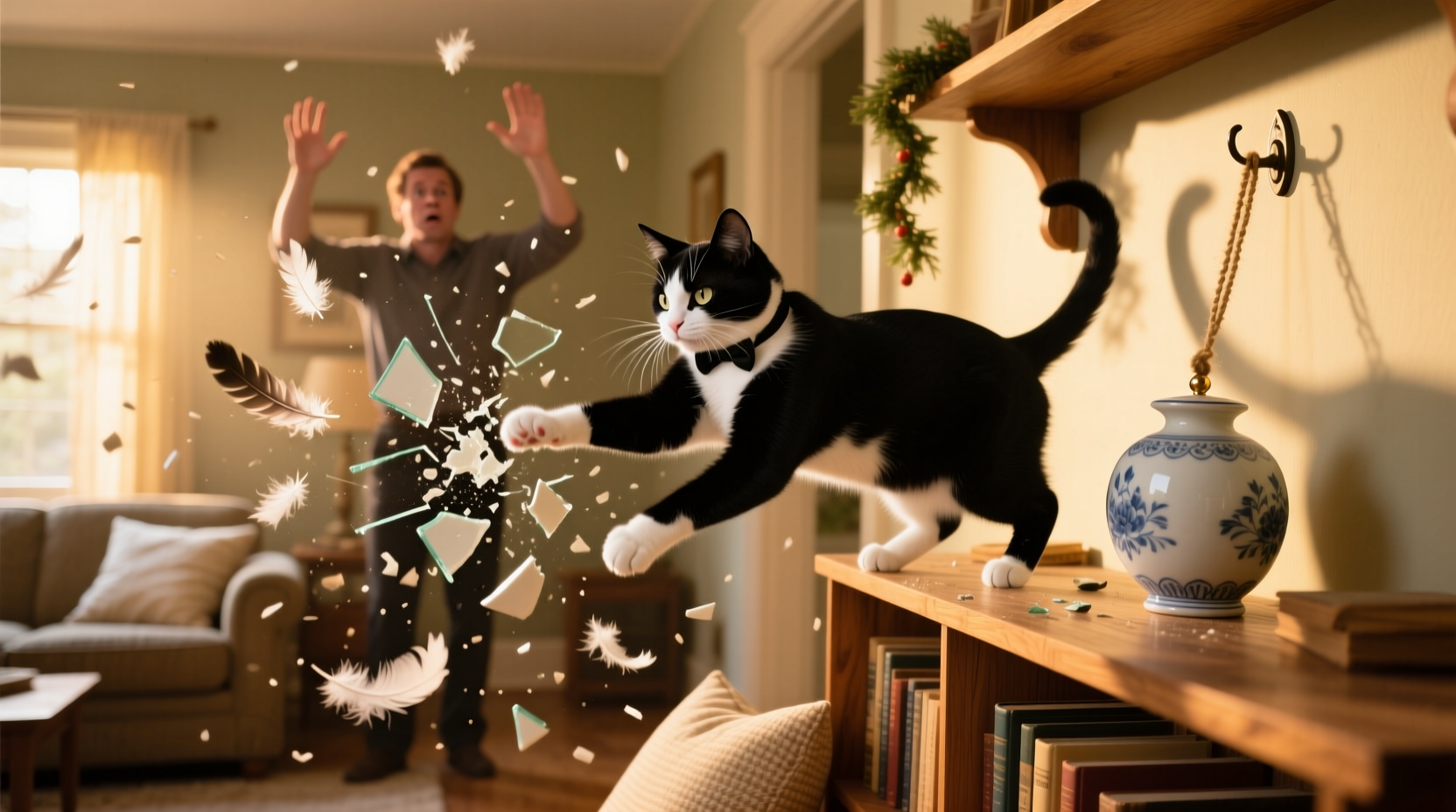
Cats are obligate predators whose visual, auditory, and tactile systems evolved to detect minute movement, high-contrast edges, and unpredictable trajectories. Ornaments—especially glass, metallic, or mirrored ones—tick every box:
- Motion capture: Even slight air currents cause ornaments to sway. To a cat’s visual system (which processes motion at 75+ frames per second—nearly double humans’), this is indistinguishable from prey behavior.
- Light play: Reflective surfaces scatter light into rapid, shifting patterns. These “light bugs” trigger innate orienting responses—the same reflex that makes cats chase sunbeams or laser dots.
- Textural novelty: Glass, wood, ceramic, and metal offer varied resistance, temperature, and sound upon contact—stimuli rarely found in domestic environments but highly rewarding to explore.
- Spatial ambiguity: Hanging ornaments occupy an ambiguous zone—neither fully grounded nor airborne. This violates a cat’s mental model of object permanence and stability, prompting investigation through pawing or batting.
Dr. Sarah S. Wilson, DVM, DACVB (Diplomate of the American College of Veterinary Behaviorists), explains:
“Cats don’t ‘knock things over’ to annoy us. They interact with their world through motor action—pawing, nudging, batting. An ornament that moves unpredictably is essentially a self-replenishing toy. When we repeatedly replace it, we’re reinforcing the behavior by providing consistent, high-value stimulation.”
The Holiday Stress Factor: When Routine Disruption Fuels Chaos
Ornament-knocking spikes during December not because cats suddenly develop seasonal malice—but because their environment undergoes radical, sustained change:
- Tree placement alters established territory boundaries and vertical pathways.
- Increased foot traffic, loud music, and unfamiliar scents (candles, baked goods, guests’ perfumes) elevate baseline stress.
- Reduced daylight hours shift circadian rhythms, often increasing nocturnal activity when ornaments are less supervised.
- Human attention shifts: You’re distracted, busy, or emotionally reactive—making your cat more likely to seek interaction (even negative attention) or self-soothe through play.
This confluence creates what veterinary behaviorists call “behavioral spillover”: normal exploratory or predatory behaviors intensify and redirect toward accessible, stimulating objects—like ornaments.
A Practical, Tiered Strategy: Prevention, Redirection, and Coexistence
Effective intervention requires moving beyond punishment (ineffective and damaging) or resignation (“just wait till January”). Instead, adopt a three-tiered approach rooted in environmental design and behavioral reinforcement.
1. Prevention: Make the Tree Zone Less Tempting
Remove the incentive—not the cat. Start before the tree goes up:
- Use sturdy, weighted bases and secure the trunk to wall anchors (not furniture—cats will climb the anchor straps).
- Hang heavier, less reflective ornaments on lower branches (within 3 feet of ground). Reserve delicate items for the top third only.
- Apply double-sided tape or aluminum foil to lower branches—cats dislike the texture and sound.
- Install a low-profile, clear acrylic barrier around the tree’s base (18–24 inches tall), creating a physical “no-paw zone” without blocking sightlines.
2. Redirection: Provide Better Alternatives
Never compete with an ornament’s allure—outshine it. Offer superior, species-appropriate enrichment:
- Targeted play sessions: Two 15-minute interactive play sessions daily (dawn and dusk) using wand toys that mimic erratic prey movement. End each with a food reward to simulate the “hunt-eat-groom-sleep” cycle.
- Novel textures on demand: Rotate weekly between crinkle balls, cork rings, and wool felt mice—storing them out of sight when not in use to maintain novelty value.
- Vertical enrichment: Install shelves or perches above the tree (not on it) so your cat observes from a safe, elevated vantage point—reducing the need to investigate from below.
3. Coexistence: Accept What’s Manageable
Some knocking may persist—and that’s okay. Focus on minimizing risk, not eliminating behavior:
- Choose shatterproof ornaments made of felt, wood, or thick acrylic.
- Use ribbon instead of hooks for hanging—easier to replace if chewed or loosened.
- Keep breakables off lower branches entirely; reserve those for pet-safe alternatives like dried orange slices or pinecone clusters.
Do’s and Don’ts: A Quick-Reference Table
| Action | Do | Don’t |
|---|---|---|
| When your cat bats an ornament | Immediately redirect with a wand toy or toss a treat away from the tree to break focus | Yell, spray with water, or physically remove the cat—it associates the tree (and you) with fear |
| Ornament selection | Prioritize matte, lightweight, non-reflective materials; avoid anything with loose strings or small detachable parts | Use tinsel, glass bells, or ornaments with glitter coatings—these pose ingestion or entanglement hazards |
| Tree lighting | Use warm-white LEDs (less flicker-sensitive); keep cords secured and covered | String lights that dangle loosely or blink rapidly—these mimic prey movement and attract swatting |
| Post-holiday cleanup | Gradually remove decorations over 3–5 days while increasing playtime to offset routine loss | Strip the tree overnight—this causes acute stress and may trigger redirected scratching or vocalization |
Real-World Case Study: The “Three-Cat Conundrum” in Portland
In November 2023, Maya R., a veterinary technician in Portland, faced near-daily ornament casualties across her household’s three cats: Luna (12, senior, arthritic), Jasper (4, high-energy male), and Pip (2, recently adopted rescue). Her tree stood in a sunlit corner of the living room—the exact path between Jasper’s favorite napping spot and Pip’s perch window.
She documented incidents for five days: 92% occurred between 4–6 p.m., coinciding with her return from work and pre-dinner activity. All involved Jasper initiating contact, with Pip joining in seconds later. Luna never touched ornaments—but consistently watched from her heated bed, tail twitching.
Instead of banning the tree, Maya implemented three changes:
- She installed a 20-inch-tall, transparent acrylic barrier around the base—unobtrusive but effective.
- She began two daily play sessions at 3:45 p.m. and 7:15 p.m., using feather wands with erratic movement patterns.
- She replaced all lower-branch ornaments with handmade wool-felt stars (non-toxic, silent on impact, no reflection).
Within 72 hours, knocking dropped by 85%. By Day 10, only one incident occurred—when a guest accidentally jostled a branch, triggering Jasper’s startle response. Maya kept the barrier and play schedule year-round, reporting improved overall calmness and reduced inter-cat tension.
FAQ: Addressing Common Concerns
Is my cat doing this out of jealousy or attention-seeking?
No—jealousy is a human social construct requiring complex theory of mind, which cats lack. What appears as “attention-seeking” is usually frustration, under-stimulation, or redirected arousal. Cats don’t understand “you’re ignoring me”—they understand “my environment changed and I don’t know how to cope.” Consistent play and predictable routines address the root cause far more effectively than assuming emotional intent.
Will getting another cat help “distract” mine from the tree?
Almost certainly not—and may worsen the problem. Introducing a second cat increases territorial stress, resource competition, and overall household arousal. Without careful, months-long introduction protocols, it often amplifies destructive behaviors rather than diffusing them. Enrichment for the existing cat is safer, faster, and more ethical.
Are certain breeds more prone to this behavior?
While individual temperament matters more than breed, cats with high prey drive (e.g., Abyssinians, Bengals, Siamese) or those with limited early-life exposure to novel objects (common in shelter cats) may show heightened interest. However, any cat—regardless of lineage—will investigate moving, shiny, dangling objects. Breed predisposition explains frequency, not causation.
Your Action Plan: A 5-Day Implementation Timeline
Don’t wait until Christmas Eve. Start now—even if your tree isn’t up yet. This timeline builds momentum while respecting feline learning curves:
- Day 1: Audit your current ornaments. Remove all tinsel, glass, string-based, or small-part items. Set aside shatterproof alternatives.
- Day 2: Purchase or build a simple acrylic barrier and secure tree anchoring hardware. Test stability.
- Day 3: Establish fixed play times: 15 minutes at dawn and 15 minutes at dusk. Use only wand toys—no hands, no laser pointers.
- Day 4: Introduce one new enrichment item (e.g., a cardboard tunnel or puzzle feeder) placed away from the tree area. Let your cat investigate voluntarily.
- Day 5: Hang the tree—using only lower-branch-safe ornaments—and activate the barrier. Observe quietly for 30 minutes. Note where your cat spends time and what draws initial interest.
Repeat Days 3–5 daily. Most cats show measurable reduction in targeting behavior within 3–5 days of consistent implementation.
Conclusion: Reclaiming the Magic—Without the Mayhem
The sound of breaking glass shouldn’t be your holiday soundtrack. Neither should guilt, frustration, or the impulse to ban trees altogether. Your cat isn’t broken. Your traditions aren’t incompatible. What you’re experiencing is a solvable interface problem—one rooted in biology, not rebellion.
By replacing assumptions with observation, punishment with redirection, and resignation with strategy, you transform the season from a battle of wills into an opportunity for deeper connection. Every time you choose to engage your cat’s instincts with respect—offering better games, safer spaces, and predictable rhythms—you reinforce trust. And that, more than any perfectly intact ornament, is the most enduring decoration of all.




 浙公网安备
33010002000092号
浙公网安备
33010002000092号 浙B2-20120091-4
Comments
No comments yet. Why don't you start the discussion?