
It’s a familiar holiday scene: the tree is perfectly dressed, lights glow softly, and just as you step away to pour cocoa—*crash*. A glass ball shatters on the hardwood. A felt reindeer tumbles from its branch. Your cat sits nearby, tail flicking, eyes bright with quiet satisfaction. You sigh—not in anger, but in weary recognition. This isn’t mischief for mischief’s sake. It’s instinct, curiosity, and unmet needs playing out in real time. Understanding the “why” behind this behavior is the first, essential step toward solving it—not by suppressing your cat, but by working *with* who they are.
The Instinctive Roots: Why Cats Target Ornaments
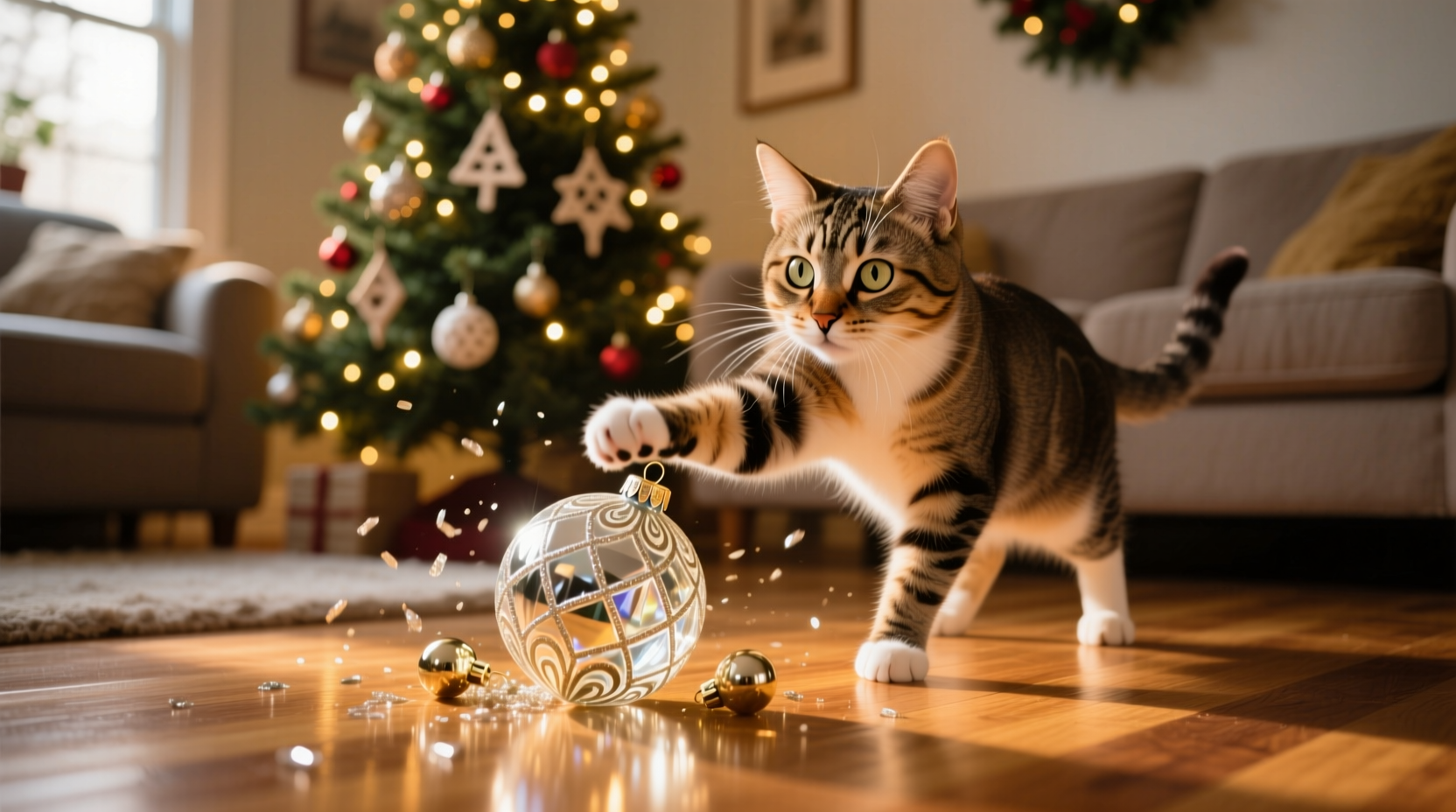
Cats don’t knock things over to annoy you. They do it because their biology hasn’t caught up with indoor living. Ornament-laden trees trigger multiple hardwired responses:
- Hunting drive: Hanging ornaments sway with air currents or vibrations from footsteps—mimicking prey movement. The reflective surfaces catch light like darting insects or glinting fish scales, activating the visual cortex pathways associated with pursuit.
- Exploratory play: Kittens learn about their world through pawing, batting, and releasing objects. Adult cats retain this impulse, especially when under-stimulated. A shiny bauble dangling at eye level is an irresistible physics experiment.
- Attention-seeking (often mislabeled as “demanding”): If knocking something down reliably earns a reaction—whether it’s your voice, movement, or even the sound of breaking glass—the behavior becomes reinforced. Not because the cat wants drama, but because it works.
- Stress displacement: Holiday changes—new scents, unfamiliar people, altered routines, or even the tree’s unfamiliar presence—can elevate baseline anxiety. Destructive play serves as a coping mechanism, much like pacing or over-grooming in other contexts.
Dr. Sarah Kinsella, veterinary behaviorist and co-author of Feline Enrichment in Multispecies Homes, explains: “Ornaments aren’t ‘toys’ to cats—they’re stimuli that tap into evolutionary imperatives. When we label the behavior as ‘bad,’ we miss the opportunity to address the underlying need: movement, control, safety, or engagement.”
What *Not* to Do: Common Mistakes That Backfire
Many well-intentioned interventions worsen the problem—or damage trust. Here’s what to avoid:
| Action | Why It Fails | Better Alternative |
|---|---|---|
| Spraying water or shouting when the cat approaches the tree | Associates you—not the ornament—with punishment. Increases anxiety and may redirect aggression elsewhere. | Redirect with a toy *before* the cat reaches the tree; reward calm proximity with treats. |
| Using citrus-scented sprays on ornaments or branches | Citrus can irritate sensitive nasal passages and may cause respiratory discomfort. Also teaches avoidance through aversion, not understanding. | Use scent-neutral deterrents (e.g., double-sided tape on lower branches) only if needed—and pair with enrichment. |
| Isolating the cat from the room with the tree | Removes choice and increases frustration. May lead to vocalization, scratching at doors, or redirected destruction elsewhere. | Create a parallel, equally engaging space *near* the tree (e.g., perch, puzzle feeder, window seat). |
| Assuming “getting used to it” will solve the issue | Cats rarely habituate to high-arousal stimuli without intervention. Unaddressed behavior often escalates (e.g., climbing the trunk, pulling lights). | Implement consistent environmental and behavioral support for 2–3 weeks minimum. |
A Humane, Step-by-Step Prevention Plan
Effective prevention isn’t about making the tree “cat-proof.” It’s about designing an environment where your cat chooses not to interact destructively—because their needs are met elsewhere, and the tree simply isn’t the most compelling option. Follow this evidence-informed sequence:
- Assess baseline enrichment (Days 1–2): Track your cat’s activity for 24 hours. Note: How many play sessions? How long do they last? What toys hold attention? When are they most active? Most cats need 3–4 interactive play sessions daily, each lasting 10–15 minutes and ending with a food reward (simulating the “hunt-catch-consume” sequence).
- Secure the lower third of the tree (Day 3): Use removable adhesive hooks to hang lightweight ornaments only above 3 feet. Wrap the trunk base with smooth, non-climbable material (e.g., aluminum foil or a wide band of plastic shelf liner). Avoid tinsel or ribbons below this zone—they’re ingestion hazards.
- Create competing zones (Day 4): Place a sturdy cat tree or perch *within 3 feet* of the Christmas tree—but angled slightly away. Add a heated pad, a soft bed, and rotate in novel toys (e.g., a cardboard box with holes cut in it, or a paper bag with crinkle balls inside). Proximity matters: if the alternative is across the house, it won’t compete.
- Introduce “ornament-safe” alternatives (Day 5): Hang a few large, lightweight, unbreakable ornaments (e.g., felt stars, wooden shapes with bells) on the *lowest safe branch*. Let your cat bat these freely—this satisfies the motor pattern without risk. Rotate them weekly to maintain novelty.
- Establish a predictable routine (Ongoing): Feed meals, conduct play sessions, and offer puzzle feeders at the same times daily. Consistency lowers stress and reduces the likelihood of displacement behaviors triggered by holiday chaos.
Real-Life Success: The Case of Luna and the Blue Glass Ball
Luna, a 4-year-old domestic shorthair in Portland, Oregon, had knocked down every ornament on her family’s tree for three consecutive Decembers. Her owners tried everything: bitter apple spray, motion-activated alarms, even moving the tree to the garage (which led to Luna scratching the doorframe relentlessly). Frustrated, they consulted a certified feline behavior consultant.
The consultant observed Luna for two hours. She noted that Luna spent 87% of her daytime hours sleeping near a sunbeam—but showed zero interest in toys unless actively engaged by a human. Her “ornament attacks” always occurred between 4:30–5:30 p.m., precisely when her owner returned home from work and was distracted by emails and dinner prep.
The plan focused on timing and redirection: • A 10-minute laser-pointer-and-feather session began *at 4:15 p.m.* daily, ending with a treat-dispensing puzzle. • A low platform with a fleece blanket was placed 2 feet left of the tree, facing a bird feeder outside the window. • Three large, hollow acrylic orbs (safe to bat, silent on impact) were hung on the lowest branch. • All fragile ornaments were moved above 4 feet—and replaced with handmade wool pom-poms Luna could nudge without consequence.
By December 12th, Luna hadn’t dislodged a single ornament. More significantly, her overall activity increased by 40%, and she began initiating play with her owner unprompted. As her consultant noted: “She wasn’t attacking the tree. She was asking, in the only language she knew, for engagement. Once we answered correctly, the ‘problem’ vanished.”
Practical Solutions by Ornament Type & Risk Level
Not all ornaments pose equal danger—or appeal. Match your prevention strategy to the object’s properties:
“Cats don’t generalize well. ‘Don’t touch the red ball’ doesn’t mean ‘don’t touch the silver star.’ Prevention must be object-specific and consistently applied.” — Dr. Elena Ruiz, Certified Cat Behavior Consultant, IAABC
FAQ: Answering Your Most Pressing Questions
Will neutering/spaying reduce this behavior?
Not directly. While sterilization can lower overall arousal and roaming tendencies, ornament-knocking is driven primarily by play motivation and environmental triggers—not hormones. A well-enriched intact cat is far less likely to engage than an under-stimulated neutered one.
Are certain breeds more prone to this?
Yes—but not due to temperament alone. Breeds with high prey drive (e.g., Abyssinians, Bengals, Siamese) or those bred for agility (e.g., Oriental Shorthairs) often show stronger interest in moving, reflective objects. However, individual history matters more than breed: a rescued adult cat with limited early play experience may be *more* reactive than a well-socialized purebred.
What if my cat climbs the tree?
Climbing signals escalating motivation—and potential danger. Immediately install a stable, tall cat tree *next to* the Christmas tree, topped with a cozy bed and dangling toys. Apply double-sided tape or aluminum foil to the lowest 18 inches of the trunk (cats dislike the texture). Never punish climbing attempts; instead, interrupt with a gentle “hey!” and redirect to the alternative structure *while offering a treat*. Consistency over 10–14 days typically shifts preference.
Conclusion: Reframe the Behavior, Respect the Cat
Your cat isn’t defacing your holiday display. They’re expressing vitality, curiosity, and a deep need for agency in a world increasingly designed for human convenience—not feline instinct. Every ornament knocked down is data: a clue about unmet play needs, insufficient vertical space, or subtle stressors you may not perceive. Prevention isn’t about control—it’s about collaboration. It’s choosing puzzle feeders over plastic-wrapped presents, perches over punishment, and observation over assumption. When you meet your cat’s biological imperatives with creativity and consistency, the tree stays upright—not because it’s guarded, but because it’s no longer the most interesting thing in the room.
Start tonight. Not with a spray bottle or a barricade—but with five minutes of focused play using a wand toy. Watch where your cat’s eyes go, how their shoulders tense, how their tail twitches. That’s not destruction waiting to happen. That’s life, fully lived—and an invitation to connect on terms that honor both your traditions and your cat’s nature.




 浙公网安备
33010002000092号
浙公网安备
33010002000092号 浙B2-20120091-4
Comments
No comments yet. Why don't you start the discussion?