
Cats are enigmatic creatures, often engaging in behaviors that leave their human companions puzzled—especially when a favorite mug suddenly meets the floor with a crash. One of the most common yet perplexing habits is knocking objects off tables, shelves, and countertops. While frustrating, this action isn’t random mischief. It’s deeply rooted in instinctual behaviors shaped by evolution, sensory exploration, and communication. Understanding the motivations behind this behavior allows pet owners to respond with empathy rather than frustration, and implement strategies that support both feline well-being and household peace.
The Evolutionary Roots of Object-Knocking
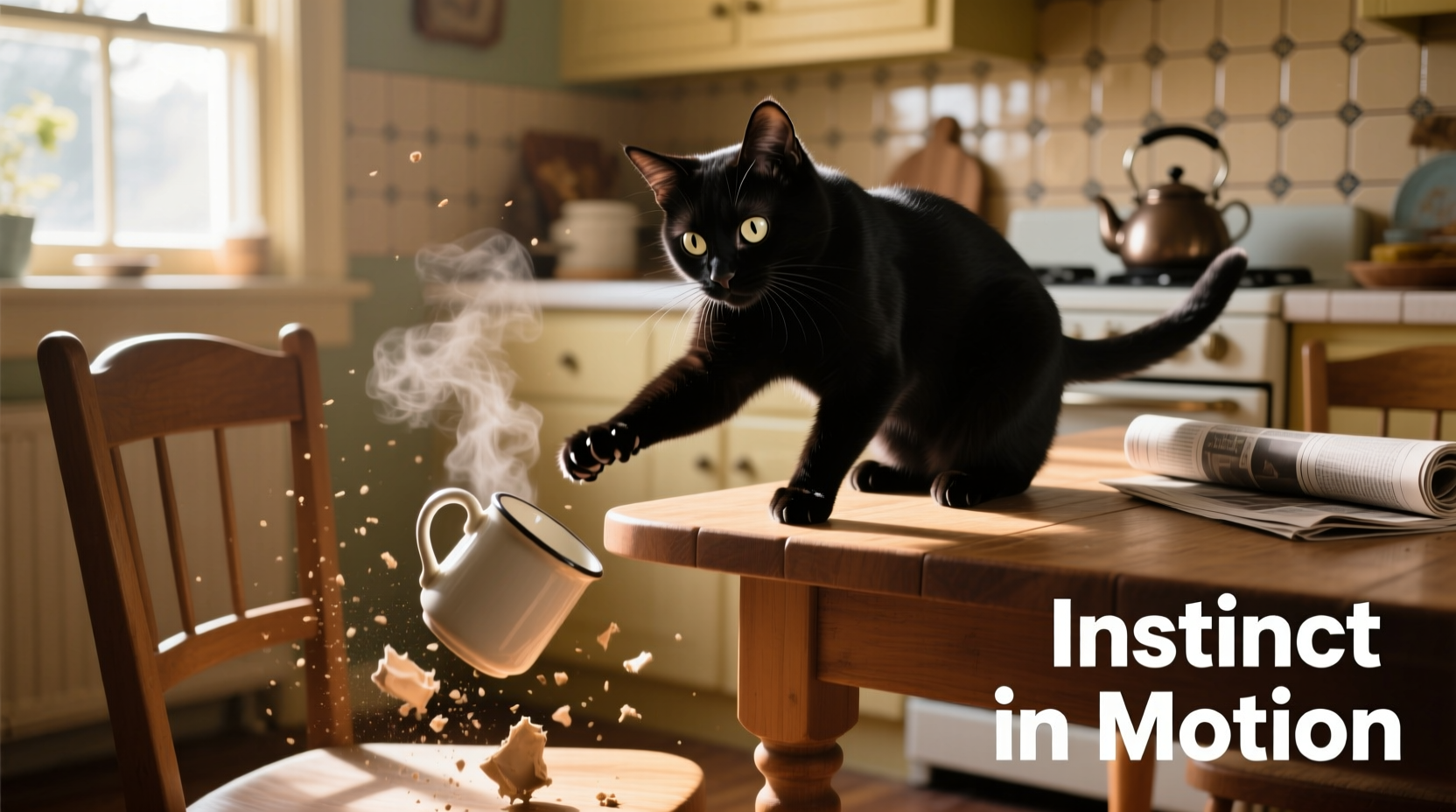
Domestic cats may live in homes with food bowls and soft beds, but their brains remain wired like those of wild hunters. The act of batting objects off elevated surfaces mirrors predatory behaviors seen in the wild. In nature, cats use paws to test, manipulate, and capture prey. A dangling leaf or a scurrying insect triggers an instinctive paw swipe—a motion nearly identical to what happens when a cat nudges a pen off your desk.
This instinct serves multiple survival purposes:
- Testing movement: Motion signals life. By knocking something down, a cat assesses whether it reacts like prey.
- Practicing coordination: Precision swipes refine motor skills critical for hunting.
- Controlling environment: In the wild, removing obstacles or testing terrain increases safety and success during hunts.
Even indoor cats retain these drives. Without real prey, everyday objects become proxies for instinctual engagement. The sound, movement, and unpredictability of a falling item provide mental stimulation that satisfies deep-seated needs.
Sensory Exploration and Curiosity
Cats experience the world through a blend of sight, sound, smell, and touch—but their sense of touch is particularly acute in their paws. These sensitive extremities are packed with nerve endings, making them ideal tools for investigation. When a cat taps or pushes an object, it gathers tactile feedback about texture, weight, and stability.
Additionally, visual curiosity plays a major role. Cats are drawn to movement and contrast. A shiny spoon, a swaying plant, or even a flickering shadow can trigger attention. Once engaged, the cat uses its paw to initiate motion, observing cause and effect. This is especially true in environments lacking enrichment—few toys, limited vertical space, or minimal interaction.
“Cats don’t knock things over to annoy us—they’re conducting experiments. Every fall teaches them something about physics, sound, and consequence.” — Dr. Sarah Thompson, Feline Behavior Specialist
This investigative tendency peaks in younger cats and kittens, who are in active learning phases. However, adult cats also engage in exploratory behavior when understimulated or when new objects appear in their territory.
Communication and Attention-Seeking
While instinct and curiosity are primary drivers, knocking things over can also be a calculated social signal. Cats are intelligent and quickly learn which actions elicit responses from humans. If a cat notices that pushing a glass off a table results in loud reactions, movement, or direct attention—even if negative—it may repeat the behavior.
In multi-pet households or busy homes, this can become a strategy for gaining focus. A cat that feels overlooked might develop object-knocking as a reliable way to interrupt routines and command attention. The behavior reinforces itself: action leads to reaction, reinforcing the cat’s understanding that “this gets results.”
It’s important not to reinforce the behavior unintentionally. Yelling or rushing toward the cat after an object falls can be interpreted as engagement, encouraging repetition. Instead, consistent, calm responses help reshape expectations.
Recognizing the Triggers
Not all cats knock things over equally. Certain factors increase the likelihood:
- Breed tendencies: Active breeds like Siamese, Bengals, and Abyssinians are more prone to manipulative behaviors.
- Age: Kittens and young adults exhibit higher levels of exploratory pawing.
- Environment: Sparse, unchanging spaces offer fewer outlets for natural behaviors.
- Routine disruptions: New furniture, visitors, or schedule changes can heighten curiosity or anxiety.
Managing the Behavior: A Practical Approach
Eliminating object-knocking entirely may not be realistic—or necessary. The goal should be harm reduction: protecting fragile items while allowing the cat healthy outlets for instinctual expression.
Step-by-Step Guide to Reducing Unwanted Knocking
- Secure valuable or dangerous items: Keep breakables, electronics, and toxic substances out of reach on high shelves or in closed cabinets.
- Designate safe zones: Create accessible areas with sturdy, cat-safe objects they’re allowed to interact with.
- Introduce interactive toys: Puzzle feeders, wand toys, and motion-activated gadgets satisfy hunting instincts.
- Use deterrents strategically: Double-sided tape or aluminum foil on surfaces discourages jumping without harming the cat.
- Reinforce positive alternatives: Reward the cat when playing appropriately with toys instead of household items.
Checklist: Cat-Friendly Surface Management
- ✅ Remove fragile or hazardous items from ledges and tables
- ✅ Anchor loose cords and cables out of reach
- ✅ Use non-slip mats under decor to prevent easy sliding
- ✅ Provide alternative climbing structures (cat trees, shelves)
- ✅ Schedule daily interactive play sessions (10–15 minutes, twice a day)
When Instinct Meets Environment: A Real Example
Maria, a software developer living in Chicago, adopted a two-year-old rescue cat named Milo. Within days, she noticed a pattern: every evening around 7 PM, Milo would leap onto her home office desk and deliberately push pens, notebooks, and even her wireless earbuds off the edge. Initially, she assumed he was misbehaving and tried scolding him. But the behavior escalated.
After consulting a veterinary behaviorist, Maria realized Milo wasn’t acting out—he was seeking stimulation after a long, quiet day while she worked. His knocking was a combination of boredom and a desire for interaction. Together, they developed a plan: introducing a rotation of puzzle toys, scheduling two short play sessions using a feather wand, and installing a cat shelf near the window for independent exploration.
Within three weeks, the desk-clearing incidents dropped by over 80%. Maria noted that Milo still occasionally tapped objects, but no longer with intent to dislodge them. “He just wants to be part of the rhythm of the house,” she said. “Now he has better ways to join in.”
Do’s and Don’ts: Managing Object-Knocking Behavior
| Do’s | Don’ts |
|---|---|
| Provide enrichment: Offer toys that mimic prey (feathers, crinkly sounds). | Ignore the behavior completely: Lack of response may allow unsafe habits to persist. |
| Redirect gently: Use a toy to shift attention when you catch the cat mid-swipe. | Punish physically or loudly: This damages trust and increases anxiety. |
| Create vertical space: Cats feel secure and engaged when they can climb and survey. | Leave tempting items unsecured: Avoid placing unstable or noisy objects within paw range. |
| Observe patterns: Note times, locations, and triggers to anticipate and prevent incidents. | Assume malice: Cats don’t act out of spite; their motives are instinctual or environmental. |
Frequently Asked Questions
Is my cat knocking things over because it’s angry?
No, cats do not knock objects off surfaces out of anger or revenge. While stress or anxiety can influence behavior, the act itself stems from instinct, curiosity, or learned attention-seeking—not emotional retaliation. If your cat seems unusually aggressive or withdrawn, consult a veterinarian to rule out medical or psychological issues.
Can I train my cat to stop this behavior completely?
Complete elimination is unlikely and possibly unnecessary. Instead, focus on redirection and environmental management. Training through positive reinforcement—rewarding desired behaviors like playing with toys—can significantly reduce unwanted knocking. Consistency and patience are key.
Are certain cats more likely to do this than others?
Yes. Highly intelligent, active, and curious breeds tend to engage in object manipulation more frequently. Younger cats and kittens are also more prone due to developmental exploration. However, any cat in an under-stimulating environment may resort to this behavior regardless of breed or age.
Conclusion: Embracing Feline Nature with Smart Solutions
The habit of knocking things off tables is not a flaw in your cat’s character—it’s a reflection of a rich, complex mind shaped by thousands of years of evolution. Rather than viewing it as defiance, consider it a window into your cat’s inner world: one driven by curiosity, sensory engagement, and a need for meaningful interaction.
By providing appropriate outlets—through play, environmental enrichment, and structured routines—you honor your cat’s instincts while protecting your belongings. The goal isn’t to suppress natural behavior, but to guide it constructively. A well-stimulated cat is less likely to seek entertainment in your coffee mug.




 浙公网安备
33010002000092号
浙公网安备
33010002000092号 浙B2-20120091-4
Comments
No comments yet. Why don't you start the discussion?