
If you’ve ever placed a glass on a coffee table only to return moments later to find it shattered on the floor—with your cat sitting nearby, tail flicking innocently—you’re not alone. This behavior is so common among domestic cats that it’s become a running joke in pet owner communities. But behind the humor lies a genuine question: Why does your cat deliberately knock things off tables? The answer isn’t as simple as mischief or malice. It’s rooted in biology, psychology, and subtle communication. Understanding the motivations behind this behavior can help you manage it effectively while respecting your cat’s natural instincts.
The Instinctual Roots of Object Knocking
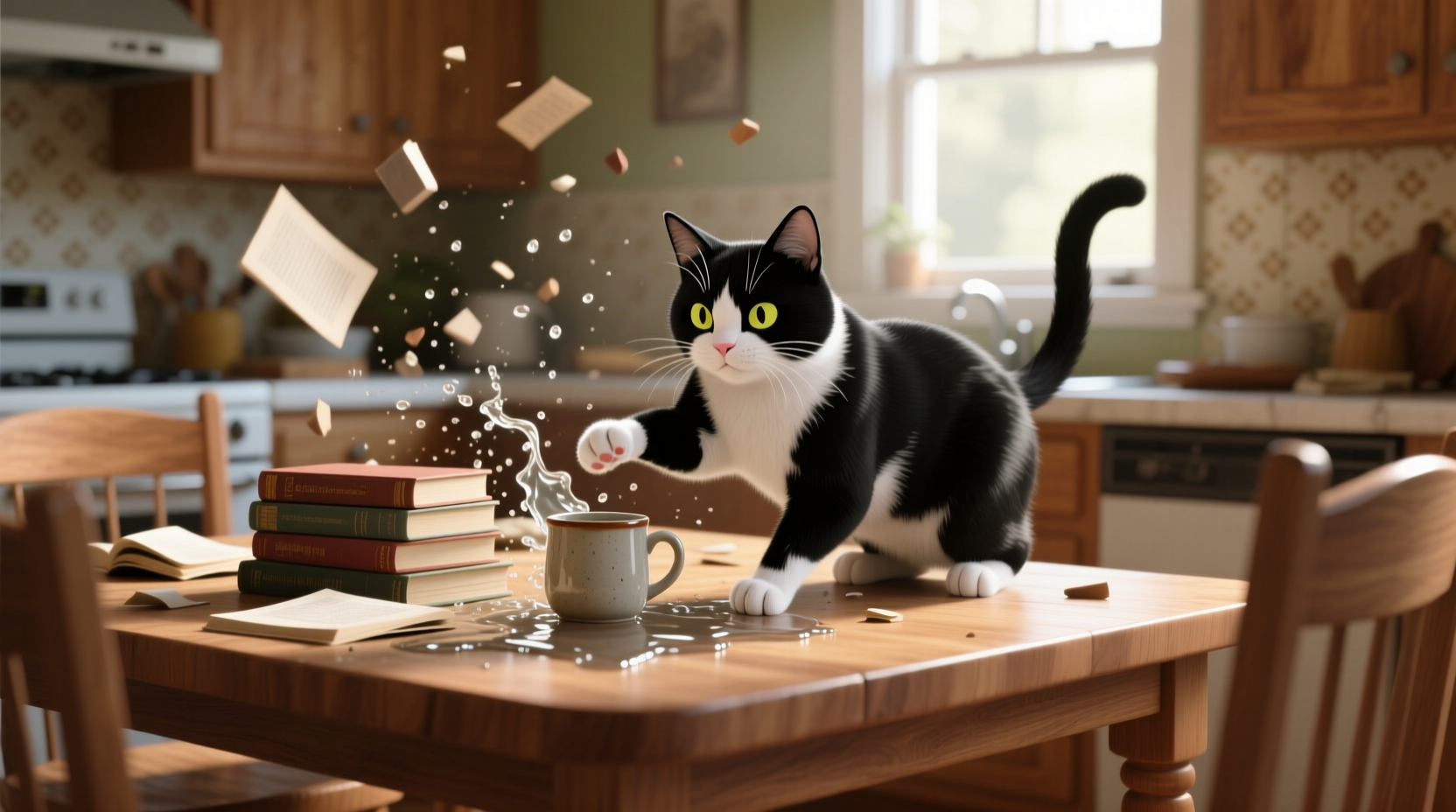
Cats are predators by nature. Even well-fed indoor cats retain the hunting behaviors passed down from their wild ancestors. One such behavior is testing movement—something small objects on a ledge naturally trigger. When a cat sees an item partially hanging over the edge of a surface, it resembles prey caught between environments: half-in, half-out. A gentle paw tap mimics the way a cat might test a bird perched on a branch or a mouse at the edge of a burrow.
This action also serves a sensory purpose. Cats have limited close-up vision but highly sensitive paws packed with nerve endings. By nudging an object, they gather tactile feedback. Does it move? Does it make noise? Is it dangerous? These micro-interactions help them map their environment using touch and sound rather than sight alone.
“Cats don’t knock things off surfaces out of spite—they’re gathering information. To them, every object is part of their sensory landscape.” — Dr. Lena Reyes, Feline Behavior Specialist
Attention-Seeking and Communication
In multi-pet or human-centered households, cats often learn that knocking something over leads to immediate attention—even if it’s negative. If you react strongly when a mug crashes to the floor, your cat quickly associates the action with interaction. Over time, this becomes a reliable strategy for engagement, especially if the cat feels under-stimulated or lonely.
Some cats develop routines around this behavior. They may wait until you're focused on your laptop or phone before launching a calculated swipe at a pen or plant pot. The resulting reaction—your startled jump, your voice raised in surprise—confirms the success of their tactic. In essence, the falling object becomes a tool for breaking through human distraction.
Environmental Enrichment Deficit
Boredom is a major contributor to destructive or repetitive behaviors in cats. Indoor cats, particularly those without access to outdoor views, toys, or climbing structures, may resort to manipulating household items simply because there’s nothing else to do. Knocking objects off tables provides novelty, auditory stimulation (the crash), and physical engagement—all valuable inputs in an otherwise predictable environment.
A study published in *Applied Animal Behaviour Science* found that cats in low-stimulation homes were significantly more likely to engage in object displacement behaviors compared to those with enriched surroundings. This suggests that the root issue isn’t defiance but unmet mental and physical needs.
Signs Your Cat May Be Under-Stimulated
- Frequent swatting at dangling cords or curtains
- Excessive grooming or licking
- Nighttime hyperactivity
- Repetitive actions like pawing at water bowls or shelves
- Waking owners abruptly during sleep cycles
Step-by-Step Guide to Reducing Unwanted Knocking
Changing your cat’s behavior requires consistency, patience, and environmental adjustment. Follow these steps to reduce the frequency of object-knocking episodes:
- Assess the Environment: Walk through each room from your cat’s eye level. Identify high-traffic surfaces where items are within paw range. Note any patterns—does it happen more in the evening? Near feeding times?
- Clear Hazard Zones: Remove breakable, valuable, or dangerous items from ledges, side tables, and countertops. Use shelf dividers or museum putty to secure decorative pieces.
- Introduce Interactive Toys: Rotate puzzle feeders, motorized mice, and treat-dispensing balls every few days to maintain interest.
- Schedule Play Sessions: Engage your cat in two 10–15 minute play periods daily using wand toys that mimic prey movements (zigzagging, sudden stops).
- Provide Vertical Space: Install cat shelves, window perches, or a tall scratching post to give your cat alternative vantage points.
- Use Positive Reinforcement: Reward calm behavior near tables with treats or affection. Never punish your cat after an incident—it won’t understand the connection and may become anxious.
- Monitor Progress: Keep a log for one week noting when and where knocking occurs. Look for improvements as enrichment increases.
Do’s and Don’ts: Managing Table-Knocking Behavior
| Do | Don't |
|---|---|
| Place soft barriers (like fabric runners) along edges to catch falling items | Yell at or physically punish your cat after knocking something over |
| Use double-sided tape on surfaces you want to keep clear | Leave tempting objects (bells, dangling strings, unstable cups) within reach |
| Encourage exploration with safe tunnels and cardboard boxes | Ignore signs of stress or overstimulation (dilated pupils, flattened ears) |
| Offer regular interactive play to burn excess energy | Assume the behavior will stop on its own without intervention |
| Consult a vet or behaviorist if the behavior escalates suddenly | Label your cat as “bad” or “destructive”—it’s a symptom, not a character flaw |
Mini Case Study: Bella and the Midnight Knocking Spree
Sarah, a remote worker living in a downtown apartment, adopted Bella, a 2-year-old tabby, six months ago. Initially, Bella was playful but well-mannered. However, Sarah began noticing a pattern: every night around 11 PM, she’d hear a crash from the living room. First, it was a candle. Then a photo frame. Then her wireless earbuds case.
Frustrated, Sarah considered restricting Bella’s access to certain rooms. Instead, she consulted a certified cat behavior consultant. After reviewing video footage and Sarah’s routine, the expert noted two key factors: Bella had no nighttime play session, and all daytime interactions occurred while Sarah was typing—making sudden movements (like knocking objects) the only way to get her attention.
The solution involved three changes: introducing a 15-minute laser pointer game before bedtime, installing a window-mounted bird feeder to provide visual stimulation during the day, and replacing fragile decor with lightweight, unbreakable alternatives. Within two weeks, the nighttime incidents dropped from nearly every night to once every ten days—and eventually stopped altogether.
Bella wasn’t being defiant—she was seeking engagement in the only way she knew how.
When Knocking Signals a Deeper Issue
While most object-knocking is benign and rooted in normal feline behavior, sudden or obsessive repetition can indicate underlying problems. Medical conditions such as hyperthyroidism, cognitive dysfunction in older cats, or vision loss can lead to increased disorientation and accidental or compulsive pawing.
Neurological disorders or pain may also alter a cat’s spatial awareness, causing them to misjudge distances or react unpredictably to stimuli. If your cat begins knocking things over aggressively, appears confused, or shows other behavioral shifts (excessive vocalization, litter box avoidance, aggression), consult your veterinarian promptly.
Frequently Asked Questions
Is my cat knocking things over because it’s angry with me?
No. Cats don’t act out of revenge or emotional retaliation. While they can feel stressed or neglected, knocking objects is typically exploratory, attention-seeking, or playful—not punitive. Attributing human emotions like anger to this behavior can delay effective solutions.
Can I train my cat to stop knocking things off tables?
You can’t eliminate natural curiosity, but you can redirect it. Training focuses on managing the environment and reinforcing desirable behaviors. For example, reward your cat for interacting with toys instead of household items. Consistency and positive reinforcement are far more effective than punishment.
Are certain breeds more prone to this behavior?
Yes. Breeds known for high intelligence and activity levels—such as Siamese, Bengals, and Abyssinians—are more likely to engage in object manipulation due to their need for mental stimulation. However, any cat can develop the habit if their environment lacks enrichment.
Conclusion: Understanding Over Control
Your cat isn’t trying to annoy you when it knocks things off tables. It’s responding to instincts shaped over millennia, navigating a world designed for humans, not felines. Rather than viewing this behavior as defiance, consider it a form of communication—a signal that your cat needs more engagement, stimulation, or clarity in its environment.
By making thoughtful adjustments—securing fragile items, increasing playtime, and enriching your home—you can reduce unwanted incidents while strengthening your bond. Remember, the goal isn’t to suppress your cat’s nature but to guide it in ways that work for both of you.




 浙公网安备
33010002000092号
浙公网安备
33010002000092号 浙B2-20120091-4
Comments
No comments yet. Why don't you start the discussion?