
Cats are enigmatic creatures whose behaviors often leave their human companions puzzled—sometimes amused, sometimes frustrated. One of the most common yet perplexing habits is knocking objects off tables, shelves, and countertops. A water glass topples at 3 a.m. A carefully placed photo frame crashes to the floor with no warning. While it may seem random or even mischievous, this behavior is deeply rooted in feline psychology. Understanding why your cat engages in this seemingly destructive act can transform frustration into empathy—and help you manage it constructively.
The Instinctual Roots of Object-Knocking
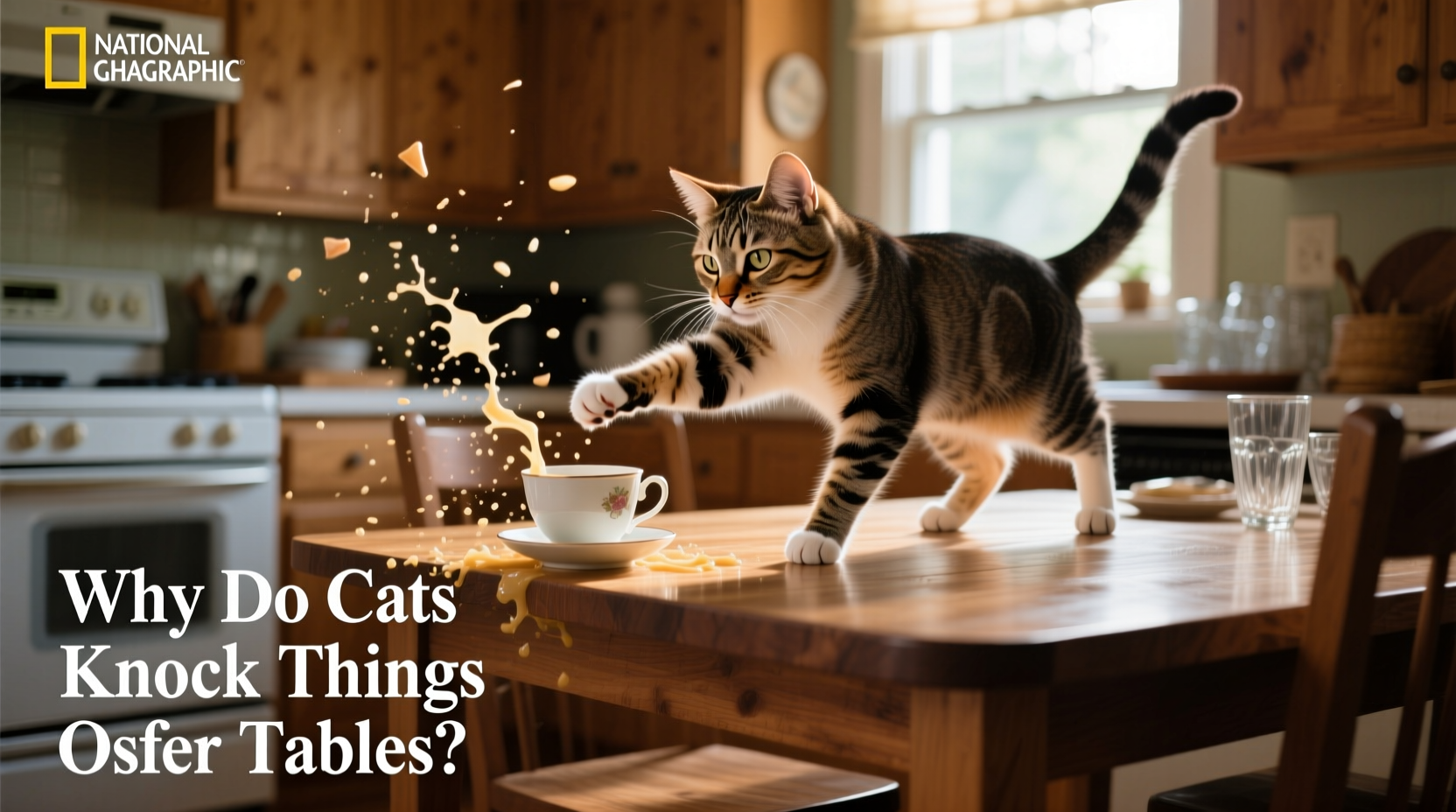
Cats are natural hunters, and even well-fed domestic felines retain strong predatory instincts. In the wild, cats use their paws to investigate, manipulate, and test potential prey. When your cat bats at a pen or nudges a mug off the edge, they’re not necessarily trying to break it—they’re exploring its movement, weight, and reaction. This tactile investigation mimics how kittens play with live prey, testing how it moves when pawed or prodded.
Movement triggers a cat’s hunting reflex. Objects that wobble, roll, or dangle activate their chase instinct. Once the item falls and makes noise or rolls across the floor, the sensory feedback reinforces the behavior. The crash becomes part of the “reward,” much like the squeak of a toy mouse. Over time, if the action results in attention—even negative attention—the behavior becomes more entrenched.
“Cats don’t knock things over out of malice. They’re conducting physics experiments with their paws.” — Dr. Sarah Ellis, Feline Behavior Researcher, University of Lincoln
Curiosity and Environmental Enrichment Needs
Cats are highly intelligent animals that require mental stimulation. A lack of enrichment can lead to boredom, which often manifests in repetitive or attention-seeking behaviors. Knocking things off surfaces provides novelty in an otherwise predictable environment. For indoor cats especially, household objects become makeshift toys in the absence of sufficient interactive play.
This behavior is particularly common in younger cats and kittens, who are in a critical phase of learning about their world. Their exploration is driven by curiosity, not defiance. What might look like chaos is actually cognitive development in motion.
Attention-Seeking and Communication
If your cat learns that knocking something over gets a reaction—whether you shout, rush into the room, or clean up dramatically—they’ve found an effective way to communicate. Even scolding provides interaction, which some cats prefer over being ignored. In multi-pet households or busy homes, object-knocking can be a bid for notice during quiet periods.
It’s important to recognize that cats don’t operate on human morality. They aren’t “being bad” when they cause a mess. Instead, they’re responding to environmental cues. If destruction leads to engagement, the behavior will persist. Conversely, if calm, ignored actions are met with indifference, and positive interactions occur during scheduled playtime, the cat will gradually shift its focus.
Recognizing the Pattern
Observe when the behavior occurs:
- Does it happen when you're working on the computer?
- Is it more frequent in the evening or early morning?
- Does your cat watch you closely after knocking something down?
If yes, attention-seeking is likely a factor. The solution isn’t punishment—it’s redirection.
Testing Boundaries and Sensory Exploration
Cats experience the world through touch, sound, and sight. Pawing at objects allows them to assess texture, stability, and auditory response. Some cats are drawn to smooth, cold surfaces like glass or metal, while others prefer lightweight items that move easily. This tactile curiosity is part of how cats map their environment.
In some cases, cats knock things over simply to see what happens. It’s akin to a child pressing every button on a remote control—not out of rebellion, but to understand cause and effect. Your cat may not grasp the value or fragility of your belongings, but they do learn patterns: “When I touch this, it falls. When it falls, it makes noise. Noise brings people.”
| Behavior | Possible Motivation | What It Might Mean |
|---|---|---|
| Knocks over full glass | Sensory interest (water movement) | Fascinated by liquid motion; may want to drink |
| Pushes lightweight object slowly | Testing mechanics | Exploring cause and effect |
| Targets same object repeatedly | Attention-seeking or habit | Learned behavior reinforced by response |
| Selects fragile or noisy items | Auditory feedback | Enjoys the sound of breaking or clattering |
| Only does it when alone | Boredom or anxiety | Needs more enrichment or companionship |
Underlying Stress or Anxiety
While many cases of object-knocking are benign, persistent or sudden increases in the behavior can signal stress. Cats are sensitive to changes in routine, new pets, visitors, or even rearranged furniture. Destructive habits may emerge as displacement behaviors—actions performed out of frustration when a cat cannot respond appropriately to stress.
Signs that anxiety may be involved include:
- Increased hiding
- Over-grooming
- Changes in appetite or litter box use
- Aggression or clinginess
If your cat has recently started knocking things over more frequently—and especially if other behaviors have changed—consider recent environmental shifts. A move, new family member, or even construction noise could be contributing factors.
Mini Case Study: Luna, the Window-Watcher
Luna, a 3-year-old tabby, lived in a high-rise apartment with floor-to-ceiling windows. Her owners noticed she began knocking pens, phones, and books off their desks every afternoon. At first, they assumed she wanted to play. But after installing a camera, they discovered a pattern: each incident occurred shortly after a large bird perched on the building’s ledge outside.
Luna would stare intently, tail twitching, then abruptly swat at nearby objects. A behaviorist concluded that Luna was experiencing redirected aggression—frustrated by her inability to reach the bird, she displaced her energy onto nearby items. The solution wasn’t discipline, but environmental adjustment: adding bird-safe window perches with interactive toys and increasing play sessions with feather wands to simulate hunting.
Within three weeks, the knocking decreased by 80%. Luna still watches birds, but now she chases a motorized mouse instead of your phone charger.
How to Respond: A Step-by-Step Guide
Reacting emotionally—yelling, startling, or punishing—only worsens the issue. Instead, follow this proactive approach:
- Assess the Environment: Identify high-risk zones (desks, nightstands, shelves). Remove valuable or dangerous items.
- Provide Alternatives: Place sturdy, interactive toys nearby—especially those that move or make soft sounds.
- Increase Playtime: Engage in two 10–15 minute play sessions daily using wand toys to simulate hunting.
- Ignore the Behavior: When your cat knocks something over, avoid eye contact or verbal response. Wait until they’re calm before cleaning.
- Reinforce Positive Actions: Reward calm behavior near surfaces with treats or affection.
- Modify the Space: Use double-sided tape or aluminum foil on edges to deter pawing (cats dislike sticky or crinkly textures).
- Consult a Professional: If the behavior persists or escalates, seek advice from a certified feline behaviorist.
“Never underestimate the power of structured play. A cat that hunts for its ‘prey’ during play is less likely to hunt your coffee mug.” — Jackson Galaxy, Cat Behavior Consultant
Checklist: Reducing Table-Knocking Behavior
Use this checklist to create a cat-friendly, low-frustration home:
- ✅ Remove fragile or hazardous items from ledges and tables
- ✅ Introduce puzzle feeders or treat-dispensing toys
- ✅ Schedule daily interactive play sessions
- ✅ Rotate toys weekly to maintain interest
- ✅ Provide vertical spaces (cat trees, shelves) for climbing
- ✅ Use deterrents (tapes, mats) on off-limits surfaces
- ✅ Avoid reinforcing the behavior with attention
- ✅ Monitor for signs of stress or anxiety
- ✅ Consider a companion pet if loneliness is suspected
- ✅ Consult a vet or behaviorist if needed
FAQ
Is my cat knocking things over because they’re mad at me?
No. Cats don’t hold grudges or express anger through targeted destruction. While they can feel stressed or frustrated, the behavior is more likely driven by instinct, boredom, or a desire for interaction—not retaliation.
Should I punish my cat for knocking things off tables?
No. Punishment damages trust and increases anxiety. Cats don’t connect delayed consequences with past actions. Instead, focus on prevention, redirection, and enriching their environment.
Can this behavior be trained out?
Yes—but not through scolding. Consistent reinforcement of alternative behaviors, combined with environmental management, can significantly reduce or eliminate the habit over time. Patience and routine are key.
Conclusion: From Frustration to Understanding
Your cat isn’t trying to ruin your day when they send your keys tumbling to the floor. They’re acting on deep-seated instincts, unmet needs, or simple curiosity. By reframing this behavior as communication rather than defiance, you open the door to a more harmonious relationship. The goal isn’t to suppress natural feline tendencies, but to guide them toward appropriate outlets.
Start today: clear one high-risk surface, add a new toy, and schedule a play session. Small changes yield lasting results. As you begin to understand your cat’s motivations, you’ll find fewer messes—and more moments of connection.




 浙公网安备
33010002000092号
浙公网安备
33010002000092号 浙B2-20120091-4
Comments
No comments yet. Why don't you start the discussion?