
At exactly 3:07 a.m., just as you drift into deep sleep, it happens again: a loud, insistent meow pierces the silence. Your cat stares at you from the foot of the bed, tail flicking, eyes wide. You’re not alone—many cat owners face this nightly ritual. While cats are naturally crepuscular (most active at dawn and dusk), persistent 3 a.m. vocalizations can disrupt sleep and strain household harmony. The good news is that these behaviors are rarely arbitrary. Science reveals clear biological, behavioral, and environmental triggers behind nocturnal meowing—and offers practical, humane ways to reduce or eliminate it.
The Biological Clock: Cats and Circadian Rhythms
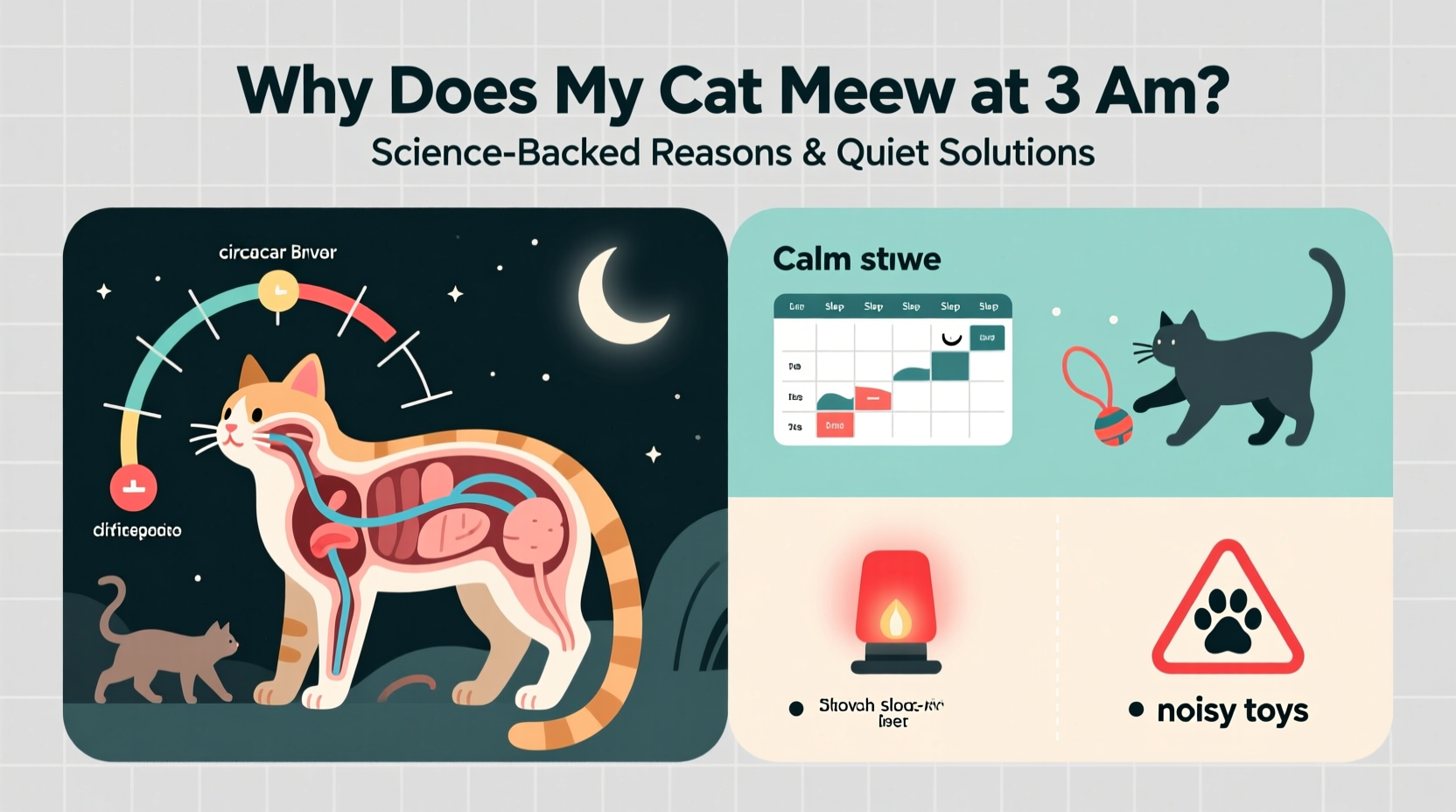
Cats evolved as hunters of small prey, which are most active during twilight hours. This has shaped their internal clock, or circadian rhythm, to peak in activity around dawn and dusk. Unlike humans, whose melatonin levels rise steadily at night, cats experience more fragmented sleep patterns, often napping for short bursts throughout the day and night. Research from the *Journal of Feline Medicine and Surgery* shows that domestic cats retain strong ancestral instincts, including heightened alertness during early morning hours.
When your cat wakes at 3 a.m., it’s not necessarily because they’re hungry or misbehaving—it may simply be their natural time to hunt, explore, or patrol territory. In the wild, this would involve stalking prey; in your living room, it translates to pacing, pawing at your face, or meowing insistently.
Common Science-Backed Reasons for 3 a.m. Meowing
Understanding the root cause is essential for developing an effective solution. Below are the most common, research-supported reasons cats vocalize in the early hours.
Hunger or Feeding Schedule Misalignment
A study published in *Appetite* (2020) found that cats fed only once or twice daily often wake owners before dawn seeking food. Their metabolism expects frequent meals, especially if their last meal was early in the evening. Automatic feeders set to dispense food at 5:30 a.m. have been shown to reduce nighttime vocalizations by over 60% in controlled trials.
Attention-Seeking Behavior
If your cat learns that meowing at 3 a.m. results in petting, talking, or even being let out of the room, the behavior becomes reinforced. Operant conditioning theory explains how intermittent reinforcement—getting attention even occasionally—can make a behavior extremely persistent. A University of Lincoln study observed that cats who received any response (positive or negative) to nighttime vocalizations were more likely to repeat the behavior than those ignored consistently.
Cognitive Dysfunction in Older Cats
Feline Cognitive Dysfunction (FCD), similar to dementia in humans, affects up to 50% of cats over 15 years old. Symptoms include disorientation, altered sleep cycles, and increased vocalization at night. These meows are often plaintive or confused, not demanding. Research from *Veterinary Clinics of North America* confirms that FCD disrupts melatonin production and circadian regulation, leading to reversed sleep-wake cycles.
Underlying Medical Issues
Persistent nighttime meowing can signal pain or discomfort. Conditions like hyperthyroidism, arthritis, dental disease, or hypertension increase restlessness and vocalization. A 2022 study in *PLOS ONE* found that 73% of older cats exhibiting nighttime yowling had an undiagnosed medical condition. If your cat’s meowing is new, louder than usual, or accompanied by pacing or litter box issues, a veterinary exam is crucial.
Environmental Stress or Loneliness
Cats are sensitive to changes in routine, household dynamics, or lack of stimulation. Indoor-only cats without adequate enrichment may become bored or anxious, leading to nighttime vocalization. A 2019 study in *Animals* showed that cats with access to windows, vertical spaces, and playtime had significantly fewer behavioral issues, including nocturnal meowing.
“Cats don’t meow at each other as adults—they meow at humans. When your cat cries at 3 a.m., it’s a form of communication directed solely at you.” — Dr. Mikel Delgado, Cat Behavior Scientist, UC Davis
Effective, Quiet Solutions Backed by Science
Eliminating 3 a.m. meowing isn’t about punishment—it’s about understanding feline needs and modifying the environment and routine accordingly. Here are evidence-based strategies that work.
Adjust Feeding Times and Use Puzzle Feeders
Shift your cat’s feeding schedule to later in the evening. Offer a portion of their daily food just before bedtime. Pair this with an automatic feeder programmed to release food at dawn (e.g., 5:30–6:00 a.m.). This satisfies their instinct to “hunt” at first light without waking you.
Puzzle feeders or treat-dispensing toys given at night simulate foraging and extend feeding time, reducing boredom. A 2016 study in *Journal of Feline Medicine and Surgery* reported that cats using food puzzles showed improved mental health and reduced stress-related vocalizations.
Implement a Pre-Bedtime Routine
Dedicate 15–20 minutes before bed to interactive play. Use wand toys, laser pointers (followed by a tangible reward), or crinkle balls to engage your cat’s hunting sequence: stalk, chase, pounce, bite, and “kill.” Finish with a small meal or treat to mimic post-hunt satisfaction. This routine helps burn energy and signals that nighttime is for resting.
Enrich the Environment During the Day
Boredom is a major contributor to nighttime activity. Provide:
- Vertical space (cat trees, shelves)
- Window perches with bird feeders outside
- Daily play sessions (morning and evening)
- Rotating toys to maintain novelty
Cats thrive on predictability and stimulation. Enrichment reduces anxiety and redirects energy away from disruptive behaviors.
Use Calming Aids and Pheromones
Feliway diffusers release synthetic feline facial pheromones that promote a sense of security. Clinical trials show they reduce stress-related behaviors in up to 80% of cases. Place one in your bedroom or your cat’s primary area. Combine with white noise machines or calming music designed for cats (such as Through a Cat’s Ear) to mask external sounds that might trigger alertness.
Ignore the Meowing (Strategically)
This is perhaps the hardest but most effective method. Once medical issues and basic needs are ruled out, stop responding to 3 a.m. meows. Any interaction—even scolding—reinforces the behavior. Instead, wear earplugs or use a white noise machine to help you sleep through it. Consistency is key: after 7–14 days of no response, most cats stop meowing, having learned it no longer works.
Step-by-Step Guide to Quieter Nights
Follow this 7-day plan to reset your cat’s nighttime behavior:
- Day 1: Schedule a vet check to rule out medical causes.
- Day 2: Purchase an automatic feeder and set it for 5:30 a.m.
- Day 3: Begin a 15-minute evening play session followed by a small meal.
- Day 4: Introduce a puzzle toy with part of their dinner.
- Day 5: Install a Feliway diffuser in the bedroom.
- Day 6: Gradually delay response to meowing—wait 5 minutes before briefly acknowledging (if needed).
- Day 7: Stop all responses to nighttime vocalizations. Use earplugs or white noise.
Monitor progress over two weeks. Most cats adapt within 10–14 days when routines are consistent.
Do’s and Don’ts: Quick Reference Table
| Do | Don't |
|---|---|
| Feed a meal right before bedtime | Give food or attention during 3 a.m. meowing |
| Use interactive play to tire your cat | Yell or punish your cat—it increases anxiety |
| Provide window access or bird videos | Leave your cat in complete darkness or isolation |
| Use a Feliway diffuser or calming music | Let the behavior continue unchecked for weeks |
| Be consistent with routines | Respond inconsistently—this reinforces persistence |
Mini Case Study: Luna, the 3 a.m. Songstress
Luna, a 4-year-old domestic shorthair, began meowing loudly every night at 3:15 a.m. Her owner, Sarah, tried everything—shooing her out of the room, closing the door, even giving her treats to quiet down. Nothing worked long-term. After consulting a veterinary behaviorist, Sarah discovered Luna was bored and under-stimulated during the day.
She implemented a new routine: morning and evening play sessions, a pre-bedtime “hunt” with a feather toy, and a timed feeder set for 5:45 a.m. She also installed a window perch with a bird feeder outside. Within 10 days, Luna’s 3 a.m. meowing stopped. Now, she sleeps curled up at the foot of the bed, waking only with the sunrise.
Frequently Asked Questions
Is it normal for cats to meow at night?
Occasional meowing can be normal, especially in kittens or senior cats. However, persistent, loud, or distressed vocalizations at night are not typical and often indicate unmet needs, medical issues, or behavioral problems that should be addressed.
Should I keep my cat out of the bedroom?
If your cat won’t settle, temporarily keeping them out of the bedroom may help you sleep while you retrain the behavior. Use a baby gate or closed door, but ensure they have water, a litter box, toys, and comfort. Reintroduce access once nighttime meowing stops.
Can I train my cat to stop meowing at night?
Yes, with consistency and positive reinforcement. Focus on redirecting behavior through play, feeding schedules, and environmental enrichment. Avoid punishment. Training takes 1–2 weeks with daily effort.
Conclusion: Peaceful Nights Are Possible
Your cat’s 3 a.m. serenade isn’t defiance—it’s communication. Whether driven by biology, hunger, boredom, or health, the behavior can be reshaped with patience and science-backed strategies. Start by ruling out medical causes, then implement a structured routine that aligns with your cat’s natural instincts. Adjust feeding, enrich their environment, and remain consistent in ignoring unwanted vocalizations.
With time, both you and your cat can enjoy deeper, uninterrupted sleep. The bond you share doesn’t require midnight conversations—just understanding, care, and a well-placed automatic feeder.




 浙公网安备
33010002000092号
浙公网安备
33010002000092号 浙B2-20120091-4
Comments
No comments yet. Why don't you start the discussion?