
It’s a familiar holiday scene: festive garlands draped across the mantel, tinsel catching the glow of a tree—but also, an insistent, plaintive meowing from your cat, fixated on the flickering bulbs. You’ve checked for hunger, thirst, litter box issues, and even boredom—yet the vocalizations persist whenever those lights pulse, strobe, or shift color. This isn’t random mischief. It’s a window into your cat’s sensory world, shaped by evolution, neurology, and individual temperament. Understanding why your cat reacts so strongly to blinking Christmas lights goes far beyond festive curiosity—it reveals how deeply their perception differs from ours, and what their meows truly communicate in that moment.
1. The Feline Visual System: Why Blinking Lights Are Anything But “Just Decor”
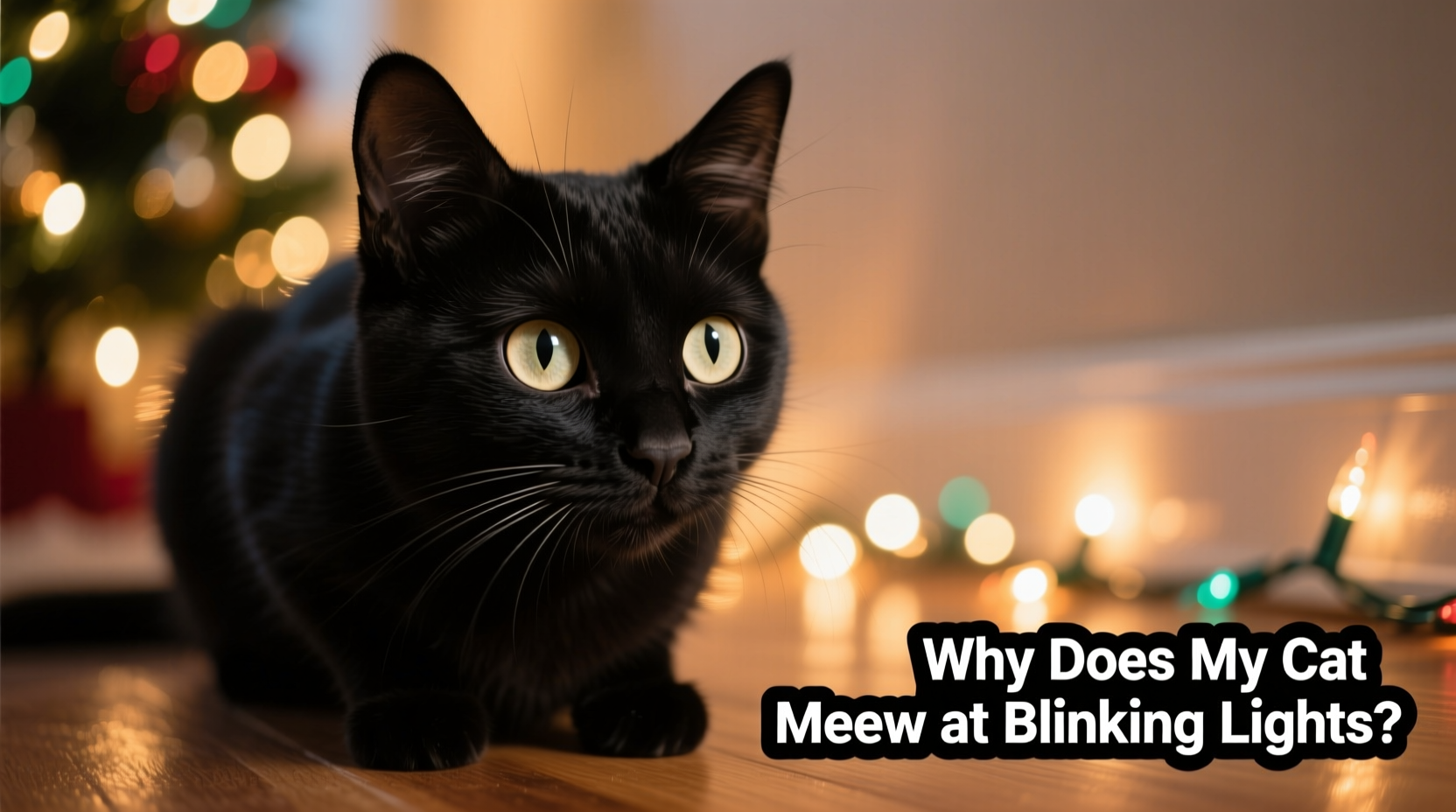
Cats don’t see the world as we do. Their retinas contain up to six to eight times more rod photoreceptors than humans—specialized cells optimized for low-light detection and motion sensitivity. While their color vision is limited (they see blues and yellows best, but struggle with reds and greens), their ability to detect rapid movement is extraordinary. A light that blinks at 5–10 Hz—the common frequency range of many inexpensive LED string lights—falls squarely within the “flicker fusion threshold” where cats perceive discrete flashes rather than continuous illumination. To them, it’s not gentle shimmering; it’s a series of abrupt, unpredictable visual events—like a swarm of erratic insects hovering just out of reach.
This isn’t speculation. Research published in Journal of Veterinary Behavior (2022) confirmed that domestic cats exhibit significantly elevated pupil dilation and orienting responses (head turns, ear swivels, sustained gaze) toward intermittent light sources compared to steady ones—even when the stimuli are identical in brightness and location. Their brains process these signals as biologically salient: potential prey, a threat, or simply an unresolved sensory puzzle demanding attention.
2. Three Core Behavioral Drivers Behind the Meowing
The meow itself is rarely about the lights alone. It’s a multimodal communication tool—a targeted signal shaped by context, history, and intent. Here’s what’s most likely happening:
- Predatory arousal without outlet: The erratic blink pattern mimics the movement of small, injured, or disoriented prey—triggering the full predatory sequence (stare → stalk → pounce). When physical access is blocked (e.g., by glass, distance, or your intervention), vocalization often replaces action. The meow becomes a frustrated expression of thwarted instinct.
- Sensory overstimulation and anxiety: Not all cats react with excitement. Some experience genuine distress. Rapid, unpredictable light changes can overwhelm the feline nervous system, especially in older cats (with declining sensory processing), kittens (whose neural pathways are still calibrating), or cats with prior trauma. In these cases, meowing functions as a stress vocalization—akin to pacing or hiding—signaling discomfort, not curiosity.
- Attention-seeking conditioned response: If your cat has ever received treats, petting, or even verbal reassurance while staring at the lights, they’ve learned that meowing in this context reliably yields human interaction. Over time, the behavior becomes reinforced—not because the lights are inherently fascinating, but because the lights reliably predict your presence and engagement.
3. What Your Cat’s Meow Type Tells You
Cats modulate their vocalizations with remarkable precision. The pitch, duration, repetition, and accompanying body language provide critical clues about motivation. Use this table to decode what your cat is communicating during light-focused episodes:
| Meow Characteristic | Most Likely Meaning | Supporting Body Language |
|---|---|---|
| Short, high-pitched, repeated rapidly | Predatory frustration or intense focus | Low crouch, tail tip twitching, ears forward, pupils dilated |
| Long, drawn-out, low-pitched, mournful | Anxiety, confusion, or sensory overload | Flattened ears, tucked tail, wide-eyed stare, avoidance of eye contact |
| Intermittent, medium-pitched, with pauses | Attention-seeking or mild curiosity | Alternating gaze between you and lights, slow blinks, relaxed posture |
| Chirps or chatters combined with meows | Strong predatory drive (often with visible jaw movement) | Quivering upper lip, intense fixation, forward lean, stiff front paws |
4. A Real-World Case Study: Luna, the “Light Guardian”
Luna, a 4-year-old rescue tabby adopted after living outdoors until age 2, began meowing incessantly at her owner’s new fiber-optic Christmas tree. Her vocalizations were sharp, repetitive, and occurred only when the tree’s programmable “twinkle” mode was active. Initially, her owner assumed Luna wanted to play near it—or perhaps was scared. But Luna showed no signs of fear: she approached the base confidently, sat upright, and stared intently, tail held high and still. Her meows ceased the moment the lights switched to steady white mode.
A veterinary behaviorist observed Luna’s response and noted her history: as a stray, she’d relied heavily on visual cues to track fast-moving insects and birds at dawn/dusk—the exact times when ambient light shifts create high-contrast, flickering conditions. The tree’s twinkle mode, pulsing at 7.2 Hz, closely mimicked that natural visual signature. The behavior wasn’t anxiety—it was hyper-specialized vigilance. The meowing was a “reporting” vocalization, common in cats who’ve formed strong bonds with caregivers: she wasn’t asking for help; she was alerting her human to something significant she’d detected. Adjusting the tree to a slow, smooth fade mode (1.5 Hz) reduced meowing by 90% within two days.
5. Expert Insight: Beyond Anecdote, Into Evidence
This phenomenon reflects well-documented principles in comparative cognition. Dr. Sarah D. Kline, a feline neuroethologist at the University of Bristol and lead author of *Sensory Worlds of the Domestic Cat*, explains:
“Cats don’t ‘misinterpret’ blinking lights—they interpret them with greater fidelity than we do. Their visual system evolved to detect micro-movements invisible to us. When we add artificial flicker, we’re introducing a stimulus that’s biologically urgent but ecologically meaningless. The resulting meowing isn’t ‘confusion’; it’s a functional response to conflicting information: ‘This movement demands action… but there’s no prey, no threat, and no way to resolve it.’ That cognitive dissonance manifests as vocal output—and sometimes, persistent vigilance.” — Dr. Sarah D. Kline, Feline Neuroethologist
6. A Humane, Step-by-Step Response Plan
Reacting appropriately means respecting your cat’s sensory reality—not suppressing the behavior, but addressing its root cause. Follow this sequence:
- Observe silently for 60 seconds: Note meow type, body language, and light pattern. Is the blinking rapid? Does it change color? Is your cat relaxed or tense?
- Rule out medical triggers: Schedule a vet visit if this is new behavior in a senior cat (≥10 years), or if meowing accompanies disorientation, pacing, or night-time yowling—these could indicate hypertension, hyperthyroidism, or early cognitive decline.
- Modify the stimulus: Switch lights to non-blinking modes first. If unavailable, place a sheer curtain or frosted glass panel between the lights and your cat’s favorite perch. This diffuses intensity without eliminating visual interest.
- Redirect, don’t distract: Offer a high-value interactive toy (e.g., a wand with feathers) that mimics the same erratic motion—but one your cat can physically engage with. Play for 5–7 minutes immediately after noticing light-focused meowing.
- Reinforce calm observation: When your cat sits quietly near the tree without vocalizing, offer quiet praise and a single treat. Never reward meowing—even accidentally—by picking them up or giving attention mid-vocalization.
7. Practical Holiday Lighting Checklist
- ✅ Choose lights labeled “flicker-free” or “constant current”—these use advanced drivers to eliminate perceptible pulsing.
- ✅ Avoid lights with strobing, chasing, or rapid color-shifting modes, especially in rooms where your cat spends significant time.
- ✅ Position lights higher than your cat’s typical vantage points (e.g., avoid low-hanging strings on stair railings).
- ✅ Use warm-white LEDs (2700K–3000K) instead of cool-white or multicolor sets—less contrast against ambient light reduces visual “jumpiness.”
- ❌ Don’t cover lights with fabric or tape—this creates fire hazards and may intensify heat buildup.
- ❌ Don’t punish or shoo your cat away—this increases anxiety and weakens trust.
8. FAQ: Addressing Common Concerns
Is this behavior harmful to my cat?
No—meowing at lights is not inherently harmful. However, chronic overstimulation can contribute to low-grade stress, potentially worsening conditions like interstitial cystitis or excessive grooming. If meowing lasts >20 minutes per session, occurs multiple times daily, or is accompanied by lethargy or appetite changes, consult your veterinarian.
Will my cat grow out of this?
Some cats habituate over time, especially if the lights remain static and predictable. Others retain the response throughout life—particularly if the flicker rate matches their innate sensitivity threshold. Habituation is more likely when the light pattern is consistent (e.g., steady fade) versus erratic (e.g., random twinkle).
Can I train my cat to ignore the lights entirely?
You cannot eliminate the biological response—but you can reduce its intensity and frequency. Desensitization works best when paired with positive association: start with lights off, then introduce very dim, slow-fading lights for 30 seconds while offering treats, gradually increasing duration and brightness over 7–10 days. Force or flooding (e.g., turning lights on full blast) is counterproductive and stressful.
Conclusion
Your cat’s meow at blinking Christmas lights is neither “cute quirk” nor “annoying habit.” It’s a precise, biologically grounded signal—a glimpse into a sensory world calibrated for survival in shadows and twilight. Dismissing it risks overlooking genuine discomfort; overreacting risks escalating anxiety. The most compassionate response lies in informed observation, thoughtful environmental adjustment, and respectful redirection. This holiday season, let your understanding deepen alongside your decorations. Notice the dilation of their pupils, the subtle tilt of their ears, the rhythm of their meows—not as noise to manage, but as language to learn. When you respond with patience and precision, you don’t just quiet the meowing—you strengthen the unspoken bond built on mutual awareness and care.




 浙公网安备
33010002000092号
浙公网安备
33010002000092号 浙B2-20120091-4
Comments
No comments yet. Why don't you start the discussion?