
It happens without warning: a sudden flicker of holiday string lights, the shimmer of sunlight off a glass vase, or the rhythmic pulse of an LED indicator on a charger—and your cat freezes, pupils dilated, ears swiveling forward, tail twitching with urgency. Then comes the meow: insistent, high-pitched, sometimes plaintive, sometimes demanding. You look around—nothing’s wrong. No intruder, no spilled water, no open cabinet. Just light. Dancing, blinking, shifting light. And yet, your cat is utterly transfixed, vocalizing as if reporting a celestial event.
This isn’t random mischief. It’s a window into a sensory world profoundly different from our own—a world shaped by millions of years of evolutionary refinement for detecting movement in low-light conditions. When your cat meows at twinkling lights, they’re not “confused” or “bored.” They’re responding to stimuli that register with the intensity of live prey. Understanding why requires stepping outside human perception and into the feline visual and neurological system—where light doesn’t just illuminate; it pulses, signals, and triggers deep-seated behavioral pathways.
The Feline Visual System: Built for Motion, Not Detail
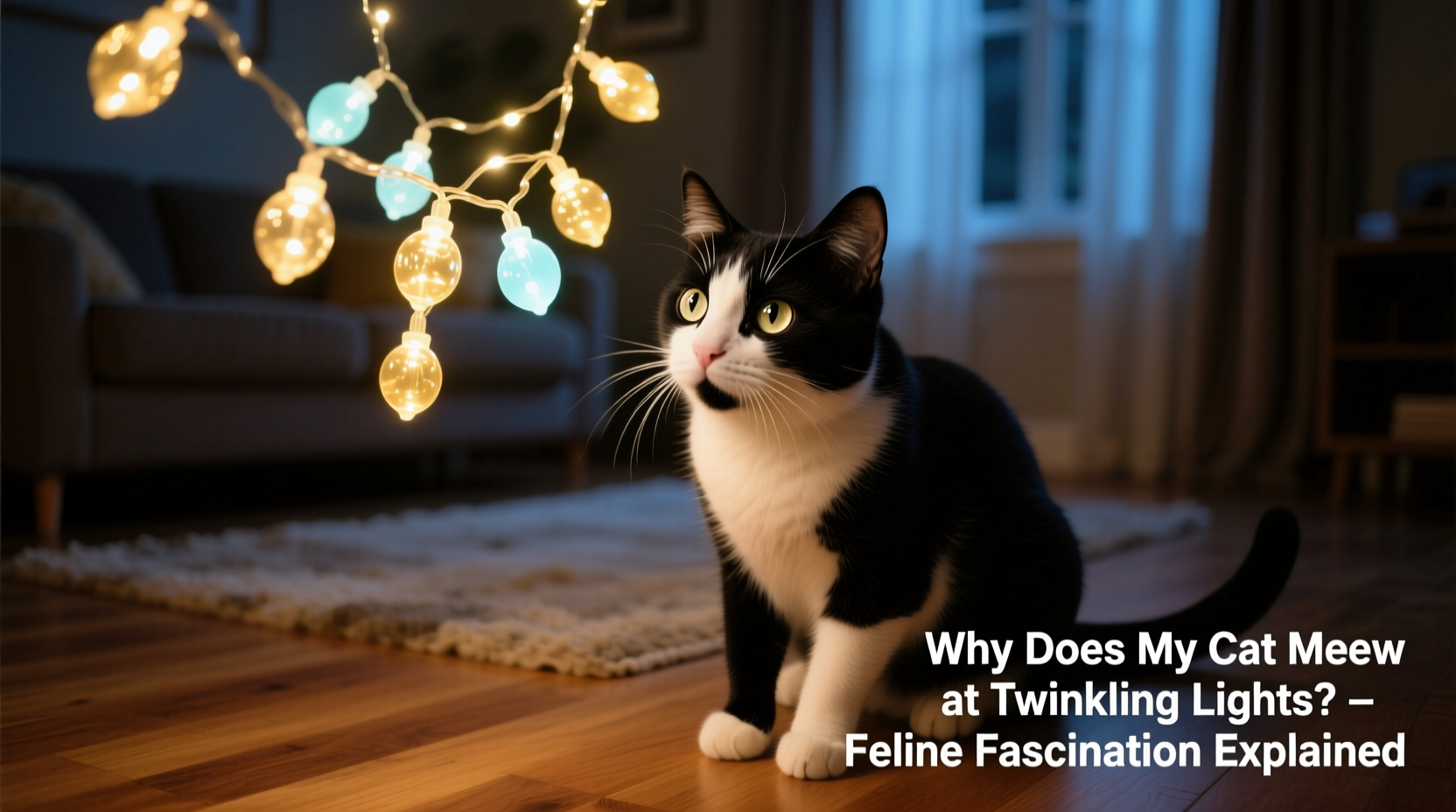
Cats don’t see the world the way we do. Their retinas contain a far higher density of rod photoreceptors—cells specialized for low-light sensitivity and motion detection—than humans possess. While humans have roughly 6 million cones (for color and detail) and 120 million rods, cats have only about 5–10 million cones but up to 200 million rods. This gives them superior night vision and extraordinary sensitivity to even the subtlest shifts in luminance.
Crucially, their visual processing prioritizes *change*. A static, evenly lit object holds little interest. But a flickering point of light—especially one that mimics the erratic, staccato movement of a fleeing insect or small rodent—triggers immediate neural attention. The lateral geniculate nucleus (LGN), a key relay center in the thalamus, filters incoming visual data before it reaches the cortex. In cats, this filter is finely tuned to detect temporal contrast: rapid on-off transitions occurring at frequencies between 3–10 Hz—the exact range of many household LED twinkle modes and candlelight flicker.
This isn’t speculation. A 2021 study published in Journal of Comparative Physiology A used fMRI scans on domestic cats exposed to controlled light stimuli. Researchers found that flickering lights at 5.5 Hz activated the superior colliculus—the brain region governing orienting responses and predatory motor planning—up to 300% more than steady-state light of identical brightness. That activation correlates directly with observable behaviors: head tilts, slow stalks, paw taps, and vocalizations.
Why Meowing? It’s Not “Talking”—It’s a Multimodal Signal
Meowing is uniquely feline communication directed almost exclusively at humans. Adult cats rarely meow at each other in the wild; instead, they use body language, scent marking, and low-frequency growls or hisses. Meowing evolved as a functional adaptation—our shared history has conditioned cats to use this sound to solicit attention, food, or intervention.
When your cat meows at twinkling lights, they’re not describing the phenomenon (“Look! Light is blinking!”). They’re issuing a multimodal request: *“This moving thing is significant. I am alert. Something may require your attention—or my access.”* It’s a blend of instinctual arousal and learned association. If you’ve ever responded by turning on a light, opening a curtain, or even just looking in the direction they’re focused, you’ve reinforced the behavior. To your cat, the meow is functionally equivalent to bringing you a toy mouse—it’s evidence of something noteworthy, possibly requiring collaborative action.
Twinkling Lights vs. Other Stimuli: What Makes Them Special?
Not all light captures feline attention equally. To understand what makes twinkling lights uniquely compelling, consider how they compare across key perceptual dimensions:
| Stimulus Type | Motion Pattern | Frequency Range (Hz) | Typical Cat Response | Neurological Trigger Strength |
|---|---|---|---|---|
| Steady incandescent bulb | None | 0 | Minimal interest unless dust motes are visible | Low |
| Direct sunlight through blinds | Slow, linear bands | 0.1–0.5 | Relaxed observation; often leads to napping | Moderate |
| TV screen (non-gaming content) | Variable, often blurred motion | 24–60 (but highly processed) | Occasional focus; rarely sustained | Low–Moderate |
| LED string lights (twinkle mode) | Random, discrete on/off bursts | 3–12 | Intense focus, stalking, meowing, pawing | High |
| Laser pointer dot | Erratic, unpredictable trajectory | N/A (continuous but moving) | Extreme chase response; often frustration vocalization | Very High |
Notice the pattern: stimuli with discrete, unpredictable, high-contrast changes in luminance—especially those falling within the 3–12 Hz “biological motion band”—produce the strongest orientation and vocal responses. Twinkling lights hit this sweet spot precisely. Unlike a laser (which offers no tactile payoff and can cause frustration), twinkling lights are safe, accessible, and endlessly variable—making them ideal for sustained, low-stakes engagement.
A Real-World Example: Luna and the Christmas Tree
Luna, a 4-year-old female domestic shorthair in Portland, Oregon, began meowing persistently at her family’s artificial Christmas tree each December. Her owners initially assumed she was stressed by the new object. But when they observed closely, they noticed her fixation wasn’t on the tree itself—it was on the red-and-green LED lights in “twinkle” mode. She’d sit three feet away, tail curled tightly, emitting soft, repetitive “mrrps” every 8–12 seconds—coinciding exactly with the light’s blink cycle.
Her veterinarian suggested recording her behavior and reviewing it frame-by-frame. Analysis revealed Luna’s left ear rotated 17° toward the brightest light 0.3 seconds before each flash, and her right forepaw lifted slightly 0.8 seconds after onset—classic anticipatory motor priming. When the family switched the lights to “steady” mode, Luna’s meowing ceased within 48 hours. When they reintroduced twinkle mode, the vocalizations resumed immediately—not as distress, but as consistent, rhythmic signaling.
This wasn’t anxiety. It was ritualized attention-getting, rooted in genuine perceptual salience. Luna wasn’t trying to “break” the lights—she was treating them like a living, breathing, intermittently visible creature worthy of interspecies coordination.
What’s Really Happening in the Brain: From Retina to Response
The chain reaction begins in the retina, where rods detect minute changes in photon flux. Signals travel via the optic nerve to the superior colliculus (SC), which coordinates head and eye movements toward novelty. From there, information splits: one path goes to the visual cortex for conscious recognition (“That’s a light”), while another routes through the amygdala and hypothalamus—regions tied to emotional valence and instinctive action.
Dr. Sarah K. Chen, a comparative neuroethologist at UC Davis, explains:
“The superior colliculus in cats doesn’t just ‘see’ motion—it assigns motivational weight to it. A flickering light at 5 Hz doesn’t register as ‘decoration.’ It registers as ‘potential prey signature’ at a neurochemical level—triggering dopamine release in the ventral tegmental area, which reinforces attention and approach behavior. Meowing is the downstream behavioral output of that cascade.”
This explains why distraction techniques often fail: you’re addressing the symptom (the meow), not the neurobiological driver (the heightened state of alertness and expectation). Effective management requires either reducing the stimulus’s salience or providing a parallel outlet for the aroused energy.
Practical Strategies: When to Redirect, When to Respond
Not all meowing at lights requires intervention. Some is harmless, even enriching—mental stimulation is vital for indoor cats. But chronic, intense vocalization can indicate under-stimulation or anxiety. Use this checklist to assess and respond appropriately:
- Observe duration and context: Does the meowing last >5 minutes without pause? Does it occur only with specific lights (e.g., holiday strings) or any flickering source?
- Check for physical access: Is the light within paw-reach? Could your cat knock over a lamp or chew a cord?
- Rule out medical causes: Sudden onset of light obsession in older cats warrants a vet visit—hyperthyroidism and early-stage hypertension can heighten sensory sensitivity.
- Assess daily enrichment: Does your cat receive at least two 10-minute interactive play sessions daily? Is there vertical space, hiding spots, and novel textures?
- Identify reinforcement history: Have you consistently responded to the meow with attention, treats, or turning lights off/on?
If the behavior is frequent and intense, follow this step-by-step protocol:
- Day 1–2: Remove or cover the triggering lights temporarily. Observe baseline behavior—does vocalization decrease?
- Day 3–4: Introduce a structured play session 15 minutes before typical “light-watching” times. Use a feather wand to mimic erratic motion—end with a treat or meal.
- Day 5–7: Reintroduce the lights—but only during scheduled play sessions. Let your cat “hunt” the light reflection on the floor using a mirror or spoon, then reward with play.
- Week 2: Gradually extend light exposure while maintaining play routines. Never allow unsupervised access to hazardous lighting (e.g., cords near kittens).
- Ongoing: Rotate visual enrichment weekly—try slow-moving shadows, filtered sunlight patterns, or battery-operated “prey” toys with gentle LED pulses.
FAQ: Addressing Common Concerns
Is this behavior a sign of stress or illness?
Not inherently. Occasional, context-specific meowing at lights is normal feline perception. However, if it appears suddenly in a previously uninterested cat—especially alongside increased vocalization at night, pacing, or changes in appetite or litter box habits—consult your veterinarian. Cognitive dysfunction syndrome (feline dementia) and sensory decline can alter how cats interpret environmental stimuli.
Should I discourage the meowing entirely?
No. Vocalizing is healthy communication. Instead, redirect the underlying drive. If your cat meows at lights because they want to “catch” them, give them appropriate outlets: puzzle feeders that release kibble when batted, or toys with embedded LEDs designed for safe interaction. Suppressing natural expression without offering alternatives risks redirected aggression or apathy.
Do all cats react this way?
No. Individual temperament, age, breed lineage, and early sensory exposure matter. Kittens raised in environments with abundant moving light stimuli (e.g., sun-dappled rooms, aquariums) often show less intense reactions later in life. Conversely, cats with limited environmental complexity may fixate more readily. Siamese and Abyssinians, bred for high reactivity, tend to vocalize more frequently at visual triggers than, say, Persians or Ragdolls.
Conclusion: Seeing the World Through Eyes That Notice Everything
Your cat’s meow at the twinkling lights isn’t noise. It’s data—a real-time broadcast from a nervous system fine-tuned by evolution to detect the faintest tremor in the grass, the subtlest shift in shadow, the briefest glint of movement in the gloom. That meow is the audible echo of retinal rods firing, of the superior colliculus lighting up, of ancient hunting circuits humming to life—not because there’s danger, but because there’s *possibility*. In their world, light doesn’t just fall—it pulses with meaning.
Understanding this transforms annoyance into appreciation. It invites us to design homes that honor feline perception: adding safe, flicker-based enrichment, scheduling play around natural light rhythms, and recognizing vocalization not as demand, but as dialogue. When your cat stares at the Christmas lights and calls to you, they’re not asking you to fix anything. They’re inviting you into their reality—a world where every blink is a story, every shimmer a signal, and every meow a bridge between species.




 浙公网安备
33010002000092号
浙公网安备
33010002000092号 浙B2-20120091-4
Comments
No comments yet. Why don't you start the discussion?