
Cats have long fascinated humans with their mysterious behaviors—pouncing on invisible prey, batting objects off tables, and, perhaps most famously, squeezing into cardboard boxes that seem far too small for their bodies. But what about when they choose a box that’s actually larger than themselves? It might seem counterintuitive. After all, if the appeal of boxes is their snug fit, why would a cat opt for extra space?
The truth is, feline behavior rarely follows human logic. What appears random or whimsical often has deep evolutionary, psychological, and physiological roots. The tendency to sit in oversized boxes isn’t an anomaly—it’s part of a broader pattern of instinctual habits shaped by survival, comfort, and sensory needs. Understanding why cats do this reveals not just quirky preferences, but insight into how they perceive safety, temperature, and territory.
The Evolutionary Need for Enclosed Spaces
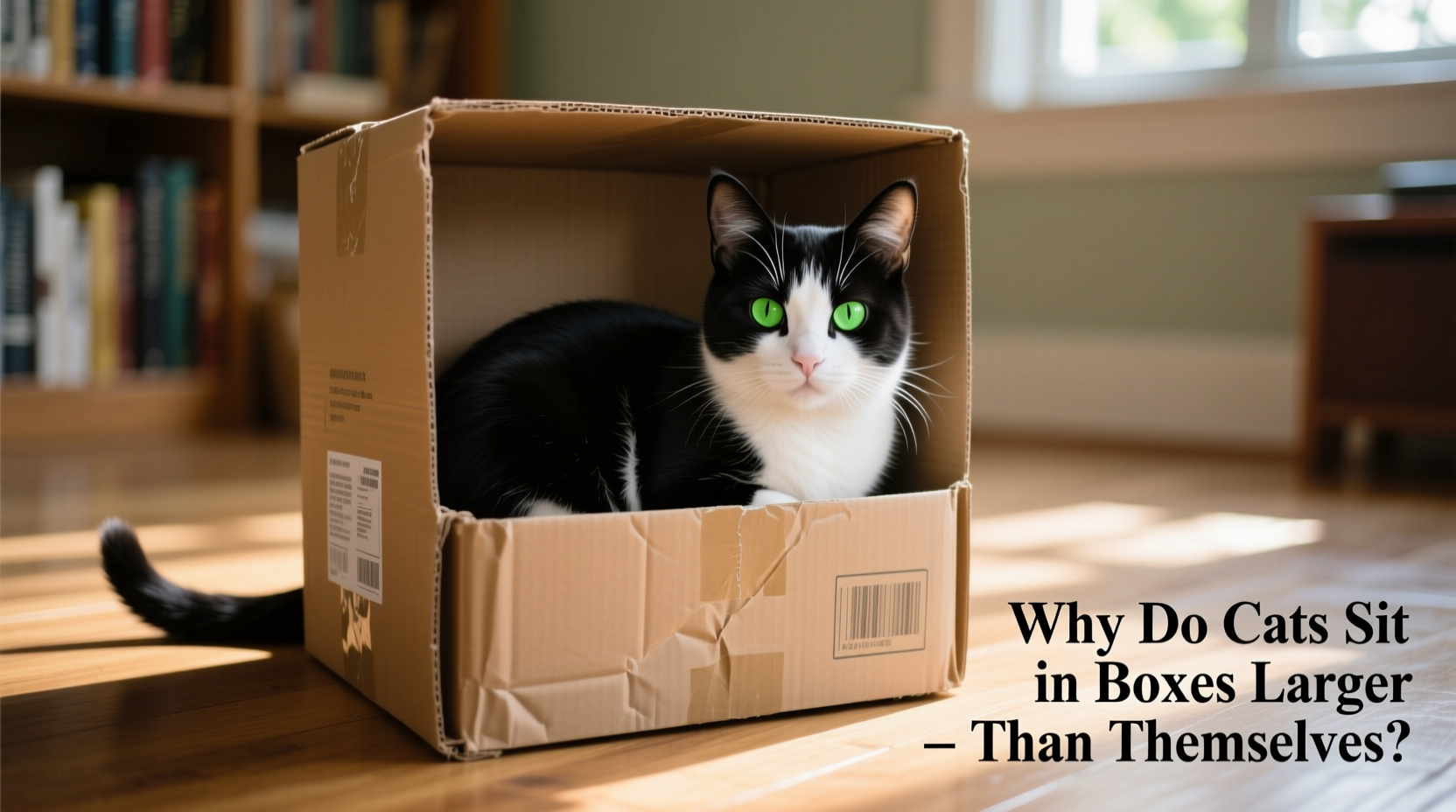
In the wild, cats are both predators and prey. Even though domesticated cats don’t face the same threats as their ancestors, their instincts remain finely tuned to avoid exposure. An enclosed space—whether it’s a hollow log, a cave, or a cardboard box—offers protection from potential dangers. This sense of enclosure triggers a neurological response that reduces stress and increases feelings of security.
Dr. Sarah Ellis, a feline behavior specialist at the University of Lincoln, explains: “Cats seek out spaces where they can observe without being seen. A box—even one larger than their body—provides visual cover and a defined boundary, which helps them feel in control of their environment.”
This need for concealment doesn’t disappear simply because a box has extra room. In fact, a slightly oversized box may be more appealing than a tight one because it allows for movement while still offering walls on all sides. Unlike a small box that forces a cramped posture, a larger one gives the cat the freedom to stretch, turn, or reposition without sacrificing the feeling of shelter.
“Even in safe homes, cats experience low-level stress from environmental changes. Enclosed spaces act as emotional reset zones.” — Dr. Karen Overall, Veterinary Behaviorist
Thermoregulation and the Warmth Factor
Cats maintain a higher body temperature than humans—typically between 100.5°F and 102.5°F (38°C–39.2°C). To conserve energy and stay comfortable, they prefer warm environments. Cardboard is a natural insulator, trapping body heat and creating a microclimate within the box. This makes even large boxes appealing thermal sanctuaries.
A study published in *Applied Animal Behaviour Science* found that shelter cats given access to cardboard boxes showed significantly lower stress levels during their first week in a new environment. The researchers noted that the boxes helped stabilize body temperature, reducing the physiological strain of adapting to unfamiliar surroundings.
When a cat enters a large box, it often curls up in one corner, minimizing surface area exposed to cooler air. Over time, the spot warms up through contact with the cat’s body, turning the box into a personalized heated retreat. The size becomes irrelevant once the cat establishes its preferred resting zone within the container.
Psychological Security vs. Physical Fit
While tight spaces offer pressure-based comfort (similar to swaddling in infants), larger boxes fulfill different psychological needs. A spacious box allows a cat to engage in surveillance behavior—sitting upright, peering over the edge, and monitoring household activity without fully exposing itself.
This vantage point satisfies two core feline drives: curiosity and caution. Cats are naturally observant animals. They gather information about their environment before deciding whether to approach or retreat. A large box acts like a command center—a place where they can assess movement, sounds, and scents while remaining protected.
Additionally, some cats use oversized boxes as transitional zones. For example, a shy cat may initially sit near the entrance of a large box, gradually moving deeper inside as confidence grows. This incremental adjustment wouldn’t be possible in a smaller, restrictive container.
Behavioral Stages in Box Use
- Approach: Cat sniffs the box, circles it, and touches the edge with a paw.
- Partial Entry: Sits just inside the opening, maintaining quick exit access.
- Full Occupation: Settles completely inside, often choosing a corner.
- Claiming Territory: Begins grooming or sleeping in the box regularly.
Scent Marking and Territorial Ownership
Cats have scent glands located on their cheeks, paws, and flanks. When they rub against objects—including the interior walls of a box—they deposit pheromones that mark the item as “safe” and “theirs.” This process, known as bunting, reinforces territorial familiarity.
An oversized box provides more surface area for scent marking, making it a prime candidate for ownership. Once a cat has thoroughly marked a large box, it becomes a recognized part of their personal domain. Other pets or humans may see it as just another piece of packaging, but to the cat, it’s a certified sanctuary infused with their identity.
In multi-cat households, this behavior can also serve a social function. A dominant cat may occupy the largest box as a subtle display of status, while subordinate cats wait for access or claim smaller enclosures. However, in peaceful homes, multiple cats may share a single large box, indicating strong social bonds and mutual trust.
| Box Size | Primary Benefit | Common Feline Response |
|---|---|---|
| Smaller than cat | Pressure comfort, warmth | Tight curling, prolonged sleep |
| Same size as cat | Balanced security and mobility | Frequent entry/exit, alert posture |
| Larger than cat | Surveillance, scent marking, stretching | Vigilant sitting, corner claiming, grooming |
Environmental Enrichment and Mental Stimulation
Boredom is a real issue for indoor cats. Without adequate mental stimulation, they may develop compulsive behaviors or become withdrawn. Boxes—regardless of size—offer tactile variety, hiding opportunities, and play potential.
A large box can be transformed by a cat’s imagination into a fortress, a hunting blind, or a launchpad for ambush games. Even stationary use provides novelty if the box is placed in a new location or rotated periodically. Changing the orientation or adding cutouts can renew interest and encourage exploration.
Mini Case Study: Luna and the Moving Box
Luna, a 3-year-old rescue tabby, was adopted into a busy household with two children and a dog. Initially, she stayed under furniture and avoided interaction. Her new owner placed several boxes around the living room, including a large shipping container (approximately 24” x 18” x 16”).
At first, Luna only approached the largest box, sniffing the edges. By day three, she sat just inside the opening. Within a week, she slept inside it nightly. Over time, she began using it as a lookout post, watching family activities from a seated position. After a month, she allowed petting while inside the box—an unthinkable behavior earlier.
The oversized box didn’t confine her; it empowered her. It became a psychological anchor that gave her control over proximity and exposure. Eventually, Luna expanded her range, but the large box remained her preferred resting spot—a testament to how spatial choice supports emotional recovery in cats.
Do’s and Don’ts of Cat Box Provision
| Do | Don’t |
|---|---|
| Provide multiple box sizes for choice | Force your cat into a box |
| Place boxes in quiet, accessible areas | Use boxes with staples, tape, or toxic ink |
| Replace damp or soiled boxes promptly | Assume all cats will use boxes equally |
| Add soft bedding for comfort | Block escape routes—always leave at least one open side |
| Rotate boxes weekly to maintain novelty | Use plastic bins without ventilation |
FAQ
Is it normal for my cat to prefer large boxes over small ones?
Yes. While some cats favor tight spaces, others value visibility and room to move. Preference varies by personality, age, and past experiences. A large box can offer both security and situational awareness, making it ideal for curious or cautious cats.
Should I be concerned if my cat suddenly starts hiding in boxes more often?
A sudden change in behavior—especially increased hiding—can signal illness, anxiety, or environmental stress. Monitor for other symptoms like appetite loss, vocalization changes, or litter box avoidance. If concerns persist, consult your veterinarian.
Can I use plastic containers instead of cardboard boxes?
Only if they are well-ventilated and free of sharp edges. Cardboard remains superior due to its insulating properties and ease of scratching. Avoid sealed plastic bins, which can trap heat and reduce airflow.
Step-by-Step Guide: Creating the Ideal Cat Box Environment
- Choose sturdy, clean cardboard boxes – Remove tape, labels, and staples.
- Select varied sizes – Include at least one box noticeably larger than your cat.
- Position strategically – Place boxes in low-traffic areas with good sightlines (e.g., near a window or doorway).
- Add soft lining – Use an old towel or fleece blanket for comfort.
- Encourage exploration – Sprinkle catnip or place treats inside to promote initial interest.
- Rotate locations weekly – Move boxes to new spots to maintain novelty.
- Monitor usage patterns – Note which boxes are favored and adjust accordingly.
Conclusion: Respecting Feline Instincts
The question “why does my cat sit in boxes larger than themselves?” ultimately underscores a deeper truth: cats don’t conform to human expectations of comfort. Their choices are guided by ancient instincts, sensory needs, and individual personalities. A large box isn’t wasted space—it’s a dynamic environment that offers warmth, security, observation points, and olfactory ownership.
By providing access to boxes of various sizes—and respecting their right to use them—you support your cat’s mental well-being and strengthen the bond between you. These simple containers aren’t just junk to be recycled; they’re essential tools for feline emotional regulation.




 浙公网安备
33010002000092号
浙公网安备
33010002000092号 浙B2-20120091-4
Comments
No comments yet. Why don't you start the discussion?