
If you work from home, write creatively, or simply enjoy browsing the web, there’s a good chance your cat has claimed your laptop as their personal throne. You settle in to focus, only to find a warm feline body parked directly over your keys. While it may seem like deliberate sabotage, your cat isn’t trying to ruin your productivity—there are deep-rooted psychological and emotional reasons behind this behavior. Understanding why your cat sits on your keyboard reveals insights into feline communication, social bonding, and instinctual drives that have evolved over thousands of years.
The Attention Factor: You’re the Prize
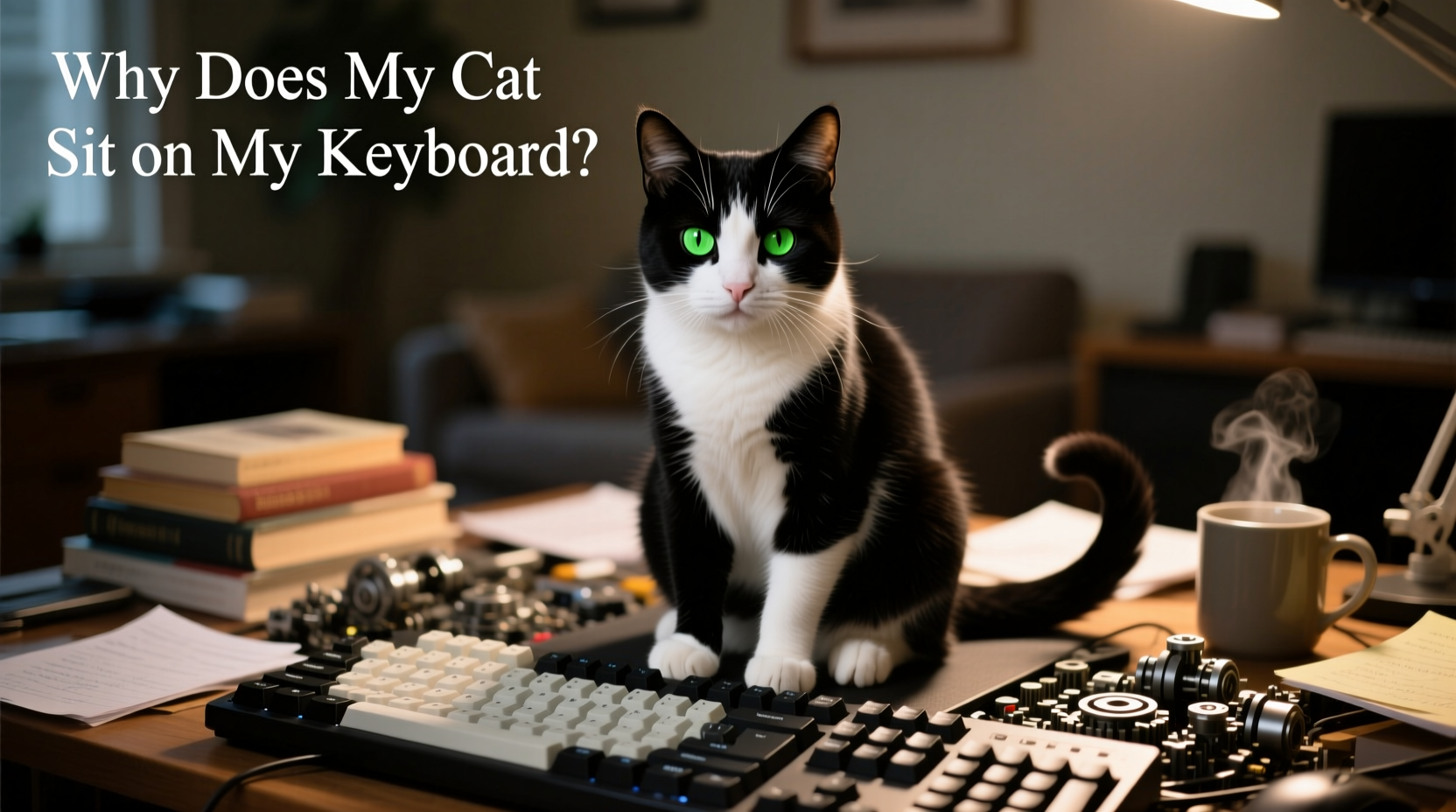
Cats are masters of behavioral reinforcement. When they want something—food, play, affection—they’ve learned which actions get results. Sitting on your keyboard places them directly in your line of sight and physical space, making it nearly impossible to ignore them. This isn’t random; it’s strategic.
In multi-pet households or homes where owners spend long hours on devices, cats quickly learn that proximity equals attention. The keyboard becomes a hotspot not because of its function, but because it's where you are most engaged. By inserting themselves into that space, cats reclaim connection.
“Cats don’t see screens—they see us. When a cat steps onto a keyboard, they’re stepping into the center of your world.” — Dr. Sarah Ellis, Feline Behavior Researcher, University of Lincoln
This behavior is especially common in cats with strong attachment styles. Studies show that some cats form secure bonds with their humans similar to those seen in human infants and caregivers. For these cats, interrupting your work isn’t defiance—it’s an attempt to maintain closeness.
Territorial Instincts and Scent Marking
Beneath the surface of every domesticated cat lies the legacy of a solitary hunter. Even indoor-only cats retain strong territorial instincts. One way they assert ownership is through scent marking—and your keyboard happens to be prime real estate.
Cats have scent glands concentrated on their cheeks, chin, forehead, and paws. When they rub against objects—or sit firmly atop them—they deposit pheromones that signal, “This belongs to me.” Your laptop, frequently touched by you, already carries your scent. When your cat sits on it, they’re layering their own identity over yours, creating a shared olfactory signature.
This blending of scents serves two purposes: it reinforces social bonds within what the cat considers their family unit, and it deters potential rivals (real or imagined). In households with multiple pets, you may notice increased keyboard occupation during times of stress or environmental change—like after introducing a new pet or rearranging furniture.
| Behavior | Biological Purpose | Emotional Implication |
|---|---|---|
| Sitting on keyboard | Scent marking via paw and facial glands | Claiming shared space with human |
| Kneading while seated | Activates milk-release reflex from kittenhood | Sign of comfort and trust |
| Purring during lap use | Self-soothing and bonding mechanism | Contentment and desire for continued contact |
Warmth and Comfort: The Physical Appeal
Let’s not overlook the obvious: laptops emit heat. To a cat whose ideal ambient temperature ranges between 86°F and 97°F (30°C–36°C), a gently warming device is irresistible. Unlike humans, cats conserve energy by seeking external heat sources rather than generating it internally. A powered-on computer offers a cozy microclimate perfect for napping.
But warmth alone doesn’t explain why your cat chooses the keyboard over other warm spots. Location matters. Devices are often placed on desks near windows, in quiet corners, or at human eye level—all desirable vantage points. Combine thermal comfort with elevated positioning and access to you, and the keyboard becomes a triple-threat perch.
Interestingly, kittens raised in colder environments show higher tendencies toward heat-seeking behaviors well into adulthood. If your cat was adopted during winter months or spent early life without consistent heating, this preference may be even more pronounced.
Communication Through Disruption
Cats don’t communicate in words, but they are highly effective at sending messages through action. Sitting on your keyboard is one such message—one that says, “I’m here,” “I need something,” or “You’re not paying attention to me.”
Disruptive behaviors often stem from unmet needs. These might include:
- Lack of mental stimulation
- Insufficient interactive playtime
- Hunger or thirst (especially if feeding time is approaching)
- Anxiety related to solitude or household changes
A 2020 study published in *Applied Animal Behaviour Science* found that cats who received daily structured play sessions were significantly less likely to engage in attention-seeking disruptions during owner work hours. The key wasn’t just duration, but predictability. Cats thrive on routine, and knowing when interaction will occur reduces their need to solicit it unpredictably.
Mini Case Study: Maya and Her Remote Worker Owner
Maya, a three-year-old tortoiseshell cat, began consistently blocking her owner’s screen each morning around 10 a.m. Initially dismissed as cute, the behavior escalated to vocal protests and gentle paw swipes at the monitor. Concerned, the owner consulted a veterinary behaviorist.
Upon review, it was discovered that Maya’s primary playtime occurred late in the evening. During the day, she was left alone for six hours while her owner worked. Though provided with toys and perches, Maya lacked midday engagement. The 10 a.m. keyboard invasion coincided with peak feline activity—cats are naturally crepuscular, most active at dawn and dusk.
The solution? A scheduled 15-minute interactive play session using a wand toy at 9:45 a.m., followed by a food puzzle. Within a week, Maya’s keyboard occupation dropped by 80%. She still occasionally lounged nearby—but no longer blocked the screen.
Step-by-Step Guide to Reducing Keyboard Occupation
Instead of discouraging the behavior through frustration, redirect it with empathy and structure. Follow this timeline to create lasting change:
- Observe patterns (Days 1–3): Note when your cat approaches the keyboard. Is it tied to specific times, sounds (like closing a fridge), or your actions (e.g., minimizing a window)?
- Create alternative zones (Day 4): Set up a comfortable cat bed or heated pad near your workspace. Place it slightly above floor level if possible—cats prefer elevated resting spots.
- Introduce positive association (Days 5–7): Toss treats or place catnip on the new spot whenever your cat passes by. Do not force interaction.
- Preempt with play (Ongoing): Engage in 10 minutes of active play before sitting down to work. Use wand toys to simulate hunting sequences: stalk, chase, catch, and “kill.”
- Respond calmly to recurrence (As needed): If your cat returns to the keyboard, gently lift them and place them on their designated spot. Offer praise or a small treat only if they stay.
- Maintain consistency (Weeks 2+): Continue the routine even when progress seems made. Habits take time to shift.
Checklist: Cat-Friendly Workspace Setup
Make coexistence easier by designing your environment with both productivity and feline needs in mind:
- ✅ Provide a warm, soft perch adjacent to your desk
- ✅ Install a window-mounted bird feeder to stimulate visual interest
- ✅ Keep a rotation of puzzle feeders or treat-dispensing toys nearby
- ✅ Schedule two 10–15 minute play sessions daily (morning and evening)
- ✅ Use a laptop cooling pad to prevent overheating when cats lie on it
- ✅ Avoid yelling or pushing—this increases anxiety and reinforces attention-seeking
FAQ
Is it harmful for my cat to sit on my laptop?
Occasional sitting is generally safe, especially if the device isn’t overheating. However, prolonged exposure to high temperatures can lead to discomfort or mild heat stress. Ensure proper ventilation and consider using an external keyboard to keep your cat off the main unit.
Why does my cat only sit on my keyboard and not my partner’s?
This often reflects differences in scent, routine, or perceived availability. Your cat may view you as more attentive, emotionally accessible, or simply smell different due to skincare products, diet, or hygiene habits. It could also indicate a stronger bond with you.
Can I train my cat to stop sitting on my keyboard?
You can’t eliminate natural behaviors, but you can redirect them. Training focuses on offering better alternatives rather than punishment. With patience and consistency, most cats learn to prefer their own designated spaces.
Conclusion: A Sign of Trust, Not Sabotage
Your cat sitting on your keyboard isn’t an act of defiance—it’s a complex expression of love, instinct, and communication. They’re drawn to your warmth, your scent, and your presence. In choosing that exact spot, they’re declaring their place in your life. Rather than seeing it as an interruption, consider it a compliment: among all the surfaces in your home, they’ve chosen the one closest to you.
By understanding the psychology behind this behavior, you can respond with compassion instead of irritation. Create environments that meet your cat’s emotional and physical needs, and you’ll find harmony between work and whiskers.




 浙公网安备
33010002000092号
浙公网安备
33010002000092号 浙B2-20120091-4
Comments
No comments yet. Why don't you start the discussion?