
Many cat owners have woken up to find their feline companion perched nearby, eyes wide open and fixed intently on them. This quiet, unwavering gaze can feel both endearing and slightly unnerving—especially in the dim light of early morning or late at night. While it might seem like a random quirk, cats don’t act without reason. Their behavior is deeply rooted in instinct, emotion, and communication. Understanding why your cat stares at you while you sleep requires insight into feline psychology, social bonds, and sensory perception. Below, we explore the most likely explanations for this behavior, supported by animal behavior research and expert observations.
Feline Bonding and Social Monitoring
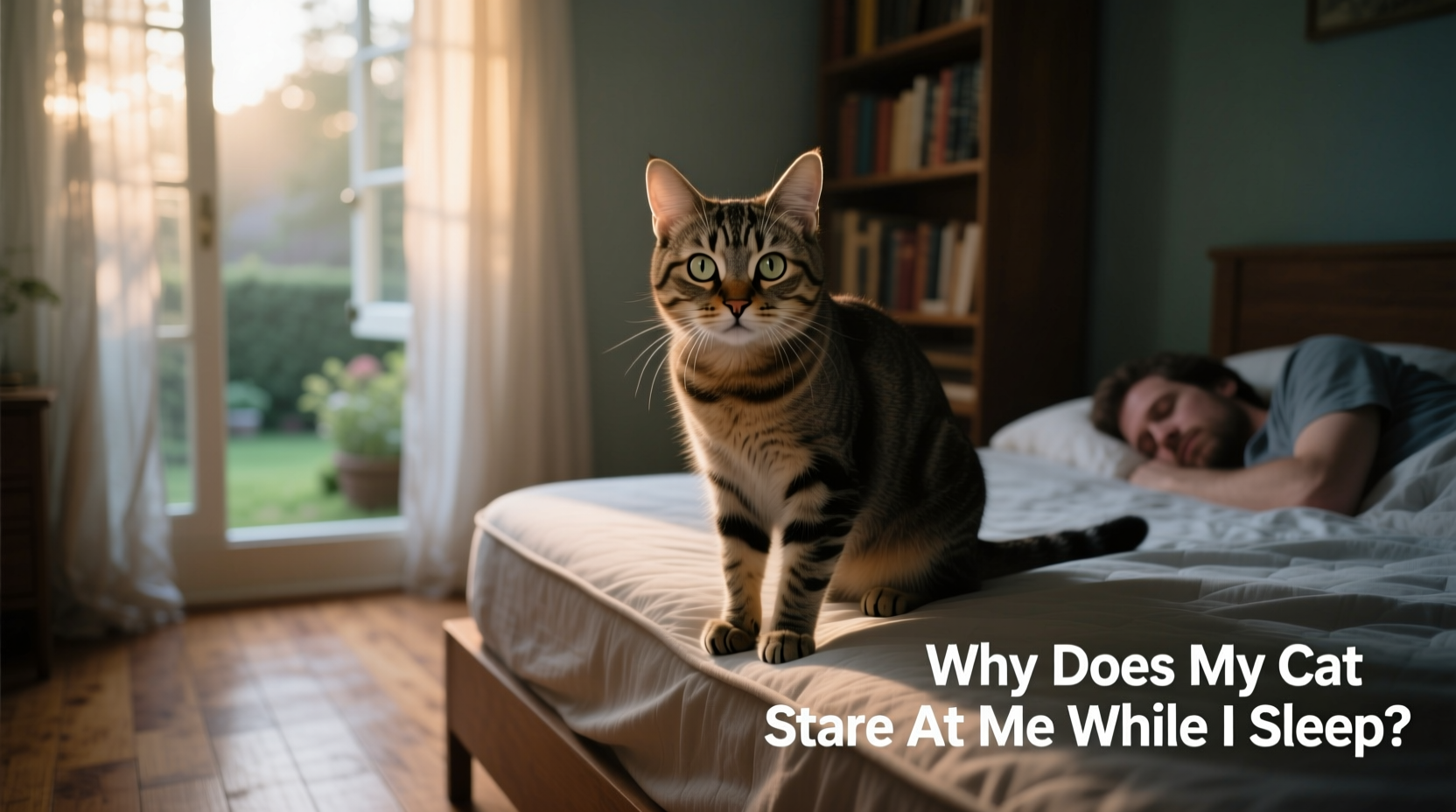
Cats are often misunderstood as solitary or indifferent animals, but modern research shows they form strong emotional attachments to their human caregivers. A 2019 study published in *Current Biology* found that over two-thirds of cats exhibit secure attachment behaviors toward their owners—similar to those seen in dogs and even human infants. When your cat watches you while you sleep, it may simply be checking in on someone it considers part of its social group.
In the wild, cats live in loose colonies where individuals monitor each other’s movements for safety and social cohesion. Your sleeping body represents a period of stillness and vulnerability. By observing you, your cat may be ensuring everything is normal within its territory. This kind of passive surveillance isn’t just about curiosity—it reflects trust and a sense of shared responsibility.
Hunting Instincts and Movement Sensitivity
Cats are crepuscular predators, meaning they’re most active during dawn and dusk—times when light levels are low and prey movement is more detectable. Their eyes are specially adapted to pick up the slightest motion, even in near darkness. While you’re asleep, small twitches, breathing patterns, or shifts under the blanket may trigger your cat’s natural alertness.
This doesn’t mean your cat thinks you’re prey. Rather, their evolutionary wiring makes them highly responsive to movement. Even subtle cues—like the rise and fall of your chest or a finger adjusting the pillow—can capture their attention. Over time, some cats learn that certain movements precede feeding, petting, or playtime, reinforcing the habit of watching closely.
Additionally, cats use visual scanning as a way to gather information. Staring allows them to assess whether anything has changed in their environment. Since humans are central figures in a cat’s world, monitoring us becomes a priority.
Attention-Seeking Behavior
If your cat consistently stares at you right before meowing, pawing, or nudging you awake, it’s likely using eye contact as a tool to initiate interaction. Cats are intelligent and quickly learn cause-and-effect relationships. They observe that staring often leads to engagement—whether it’s receiving food, pets, or access to a closed room.
Some cats develop routines around their owner’s sleep schedule. For example, if you tend to feed them shortly after waking, your cat may begin fixating on you as a signal that breakfast time is approaching. In these cases, the stare isn’t passive observation—it’s an anticipatory strategy.
It’s also worth noting that cats rarely make direct eye contact with other cats unless asserting dominance or preparing for conflict. With humans, however, prolonged eye contact often serves a different purpose: bonding. Slow blinks from a cat are considered signs of affection. But a hard, unblinking stare usually indicates focus or expectation.
“Cats use gaze not just to observe, but to communicate. A steady look can be a silent request for food, warmth, or companionship.” — Dr. Sarah Ellis, Feline Behavior Specialist, University of Lincoln
Environmental Security and Territory Awareness
Your bedroom is more than just a place to rest—it’s a core zone in your cat’s perceived territory. Cats are territorial animals, and they rely heavily on routine and environmental predictability. Watching you while you sleep helps them maintain a sense of control over their surroundings.
When you’re awake and moving, your presence provides constant feedback to your cat. But during sleep, you become still and unresponsive. This shift can prompt vigilance. Your cat may be confirming that no threats have entered the space and that all remains as expected. This is especially true for outdoor-access cats or those living in multi-pet households, where unpredictability is higher.
Moreover, cats often choose elevated vantage points—like a dresser or windowsill—to observe their domain. If your bed is centrally located or offers visibility to doors and windows, it becomes a strategic post. From there, your cat can simultaneously watch you and scan for changes in the environment.
Health and Age-Related Factors
Sometimes, staring behavior can indicate underlying health issues, particularly in older cats. Cognitive dysfunction syndrome (CDS), similar to dementia in humans, affects approximately 55% of cats aged 11–15 and over 80% of those 16 and older, according to the ASPCA. One symptom of CDS is disorientation, including staring blankly at walls or people for extended periods.
Other medical concerns that may contribute to unusual staring include:
- Vision problems: Cataracts or retinal degeneration can alter how a cat perceives movement, leading to fixation on light sources or stationary faces.
- Pain or discomfort: A cat in pain may become hyper-vigilant, watching its owner for reassurance or assistance.
- Hearing loss: As cats lose auditory input, they rely more on visual cues, increasing the frequency and duration of staring.
If your cat’s staring is accompanied by vocalization, pacing, confusion, or litter box accidents, consult a veterinarian. Sudden behavioral changes should never be dismissed as mere quirks.
Signs That Staring May Be Cause for Concern
| Normal Behavior | Potentially Problematic |
|---|---|
| Occasional, calm observation | Constant, unfocused staring |
| Responds to voice or movement | Ignores calls or stimuli |
| Relaxes after brief observation | Paces or circles after staring |
| Engages in normal daily activities | Loses interest in food, grooming, or play |
Real-Life Example: Luna the Night Watcher
Maria, a graphic designer from Portland, noticed her 7-year-old tabby, Luna, began spending nights sitting at the foot of her bed, silently watching her sleep. At first, she found it sweet. But when Luna started meowing loudly at 4 a.m., Maria grew concerned. She adjusted Luna’s evening routine—feeding her later, adding a second play session before bedtime, and providing a heated cat bed nearby. Within a week, Luna still watched Maria sleep, but the disruptive meowing stopped. The change suggested that Luna’s staring was initially tied to anticipation of food and play, not anxiety or illness.
This case illustrates how seemingly odd behaviors often stem from simple, addressable causes. Observation combined with minor environmental adjustments resolved the issue without medication or stress.
Actionable Tips for Cat Owners
Checklist: How to Respond to Sleep-Time Staring
- Observe the context: Is your cat relaxed or tense?
- Note the timing: Does staring happen before meals or play?
- Check for health changes: Any new vocalizations, accidents, or lethargy?
- Adjust feeding and play schedules to reduce nighttime anticipation.
- Provide alternative resting spots near the bed to maintain proximity without disruption.
- Use slow blinking to return affection if your cat makes eye contact.
- Consult a vet if the behavior is sudden, intense, or paired with other symptoms.
Understanding the Silent Language of Gaze
Cat communication is largely nonverbal. Unlike dogs, who use exaggerated facial expressions and tail wags, cats rely on subtlety—ear position, pupil dilation, body orientation, and yes, eye contact. When your cat stares at you while you sleep, it’s processing information, expressing attachment, or preparing for action. It’s not judgment or suspicion, as some might assume. More often, it’s care, curiosity, or conditioned expectation.
Interestingly, cats rarely sustain direct eye contact with peers. In feline society, prolonged staring between cats can signal aggression. But with trusted humans, cats relax these rules. They may hold your gaze precisely because they feel safe enough to do so. In this light, being stared at isn’t intrusive—it’s a sign of inclusion in your cat’s inner circle.
Frequently Asked Questions
Is it normal for my cat to stare at me all night?
Occasional staring is completely normal, especially if your cat is bonded to you. However, constant, unblinking fixation—particularly if accompanied by vocalization or agitation—may warrant a veterinary checkup, especially in senior cats.
Should I make eye contact back when my cat stares at me?
Avoid intense, unbroken eye contact, which can be interpreted as confrontational. Instead, try the “slow blink”—a gradual closing of the eyes, often called a “cat kiss.” This signals trust and relaxation, and many cats will reciprocate.
Can I stop my cat from staring at me while I sleep?
You can’t—and shouldn’t—eliminate the behavior entirely, as it’s a natural part of feline monitoring. However, you can reduce disruptive aspects by adjusting routines, enriching nighttime environments with toys or puzzles, and ensuring your cat’s needs are met before bedtime.
Final Thoughts: Embracing the Quiet Watchfulness
The image of a cat silently observing its sleeping human is one of the most intimate moments in the human-feline relationship. It reflects trust, attentiveness, and a deep-seated need to understand and connect. While the reasons vary—from instinctual vigilance to learned expectations—the underlying message is consistent: you matter to your cat.
Rather than viewing the stare as strange or unsettling, consider it a quiet testament to your role in your cat’s world. With awareness and small adjustments, you can honor this behavior while maintaining peaceful sleep for both of you.




 浙公网安备
33010002000092号
浙公网安备
33010002000092号 浙B2-20120091-4
Comments
No comments yet. Why don't you start the discussion?