
If you’ve ever caught your cat fixated on an empty corner of the room, tail twitching and pupils dilated, you’re not alone. Many cat owners have puzzled over this seemingly bizarre behavior: a feline locked in intense concentration on something invisible to the human eye. While it might appear odd—or even slightly eerie—this behavior is often rooted in natural instincts, sensory perception, and sometimes subtle health signals. Understanding why your cat stares at nothing requires insight into how cats perceive the world, what drives their behaviors, and when such actions might indicate something more serious.
The Science Behind Feline Vision and Perception
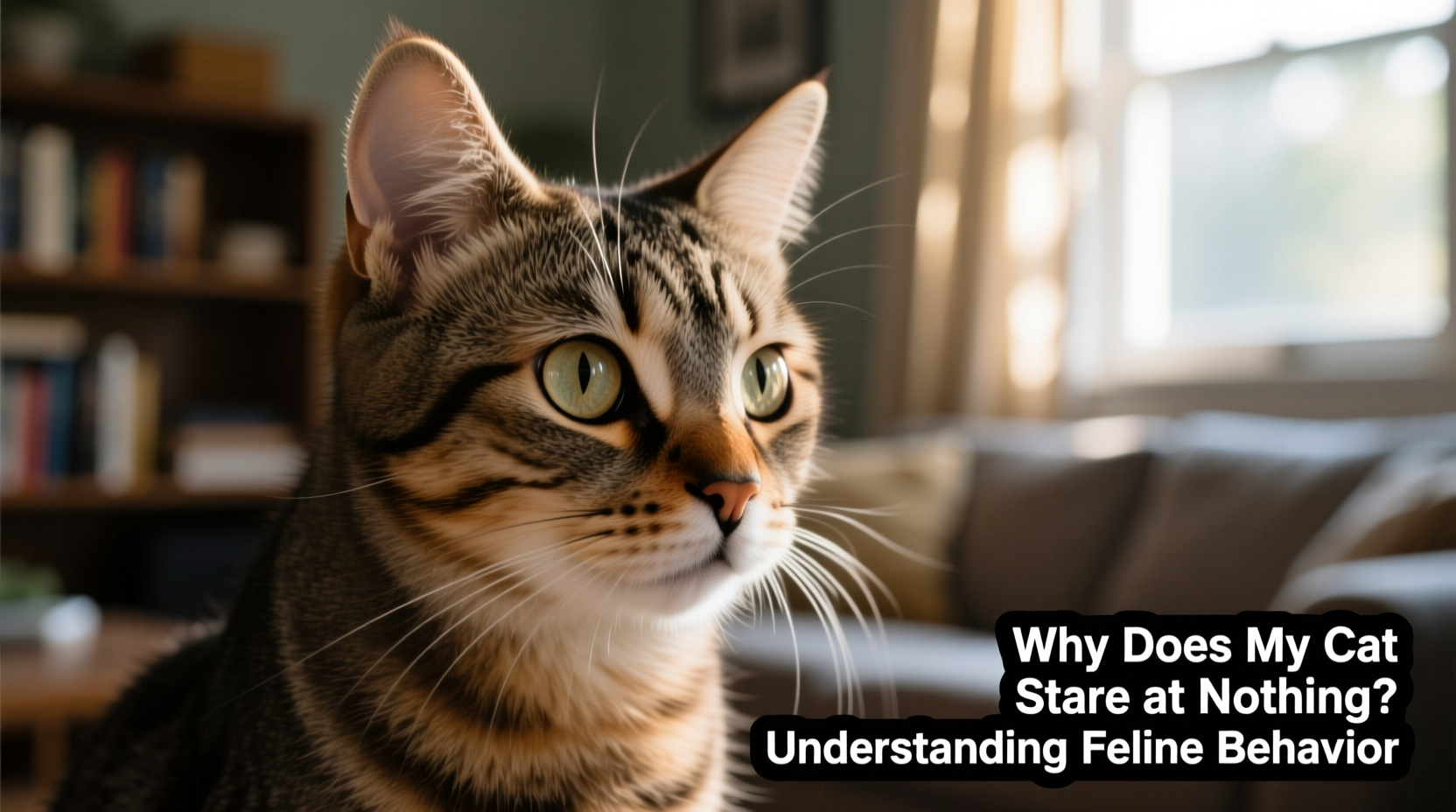
Cats don’t see the world the same way humans do. Their eyes are adapted for low-light hunting, giving them superior night vision but less clarity in bright daylight. More importantly, their visual processing prioritizes movement over detail. A speck of dust drifting in a sunbeam or a shadow shifting on the wall can trigger a full alert response—even if there’s no tangible object present.
Research shows that cats have a higher density of rod cells in their retinas, which enhances motion detection. This means they’re far more sensitive to slight movements than we are. What looks like “nothing” to us could be a flicker of light, a draft moving a curtain, or even the reflection of a passing car outside. These stimuli, though imperceptible to humans, are enough to capture a cat’s attention.
In addition, cats possess a reflective layer behind the retina called the *tapetum lucidum*, which amplifies available light. This gives them their signature eye-shine in the dark but also causes visual artifacts—ghostly glimmers or afterimages—that may contribute to staring episodes.
Hunting Instincts and Imaginary Prey
Even well-fed domestic cats retain strong predatory instincts. Staring at nothing may actually be your cat tracking an imagined or perceived threat or prey. This behavior mimics the first phase of the hunting sequence: orientation. In the wild, a cat will freeze and lock its gaze on potential prey before stalking and pouncing.
Indoor cats often lack sufficient outlets for these natural behaviors. Without real mice or birds to chase, their brains may simulate hunts based on minor environmental cues. A fluttering cobweb, a dust mote in sunlight, or even the hum of an appliance can become a target for their predatory focus.
This kind of staring isn't necessarily a sign of boredom—it's a sign of a healthy, active mind. However, if your cat seems overly fixated or agitated, it may benefit from increased mental stimulation through interactive toys or scheduled play sessions.
How Play Mimics Natural Hunting Patterns
Engaging your cat in structured play using wand toys or laser pointers replicates the hunt-and-capture cycle. This not only satisfies their instinctual needs but may also reduce obsessive staring by providing a physical outlet for pent-up energy.
“Cats are hardwired to respond to movement. When they stare at ‘nothing,’ they’re often responding to stimuli we can’t detect—but regular play helps channel that instinct constructively.” — Dr. Lena Patel, Veterinary Ethologist
When Staring Signals Health Concerns
While occasional staring is normal, persistent or unusual fixation can point to underlying medical issues. Two primary concerns include vision problems and neurological conditions.
Eye disorders such as cataracts, glaucoma, or retinal detachment can cause visual disturbances. A cat with impaired vision may stare into space because they’re experiencing hallucinations or disorientation due to blurred or distorted sight.
Neurological issues, including seizures or cognitive dysfunction (especially in senior cats), can also manifest as vacant staring. Feline Cognitive Dysfunction Syndrome (CDS), similar to dementia in humans, affects up to 50% of cats over 15 years old. Symptoms include confusion, altered sleep patterns, and prolonged periods of immobility or staring.
| Behavior | Normal? | Potential Red Flag |
|---|---|---|
| Stares for a few seconds, then resumes activity | Yes | No |
| Stares for minutes without blinking or reacting | No | Possible seizure or disorientation |
| Eyes appear cloudy or unevenly dilated | No | Vision problem |
| Accompanied by vocalization or twitching | No | Neurological issue |
Mini Case Study: Bella the Overstimulated Tabby
Bella, a 3-year-old tabby, began staring at the ceiling fan for extended periods, sometimes freezing mid-step. Her owner initially dismissed it as quirky behavior. However, after noticing drooling and brief muscle tremors, she consulted a veterinarian. Tests revealed mild epilepsy triggered by repetitive motion—a condition exacerbated by the rotating blades. With medication and environmental adjustments (turning off the fan when unattended), Bella’s episodes decreased significantly. This case highlights how seemingly harmless staring can mask medical concerns when paired with other symptoms.
Environmental Triggers and Sensory Overload
Cats are highly sensitive to changes in their surroundings. Subtle shifts—like a new scent, unfamiliar sound frequency, or electromagnetic field from appliances—can provoke alert behaviors. Some experts suggest cats may hear ultrasonic noises (above 20 kHz) emitted by devices like timers, chargers, or fluorescent lights. These sounds are inaudible to humans but can be startling or intriguing to felines.
Additionally, stress or anxiety can lead to hyper-vigilance. A cat in a chaotic household or one adjusting to a new pet may scan the environment constantly, appearing to stare at nothing while actually monitoring for threats.
Checklist: Assessing Your Cat’s Staring Behavior
- ✅ How long does the staring last? (Under 30 seconds is usually normal)
- ✅ Does your cat respond when called during the episode?
- ✅ Are there any accompanying symptoms (twitching, drooling, falling)?
- ✅ Has there been a recent change in environment or routine?
- ✅ Is your cat up to date on veterinary checkups?
- ✅ Are windows or mirrors creating unusual reflections?
- ✅ Have you noticed flies, spiders, or drafts in the area?
Understanding Cat Body Language During Staring Episodes
Context matters. The meaning of a stare depends heavily on accompanying body language:
- Ears forward, tail still: Curious observation—likely tracking something faint.
- Ears flattened, tail lashing: Agitation or frustration—possibly over inaccessible prey.
- Pupils dilated, body tense: High arousal state—could escalate to pouncing or fleeing.
- Blinking slowly, relaxed posture: Calm awareness—not distressed.
A cat that suddenly stops mid-stride and stares with wide eyes may be reacting to a noise or movement just beyond our perception. Conversely, a cat that stares blankly with half-closed eyes and slack muscles may be zoning out—similar to daydreaming in humans.
FAQ: Common Questions About Cat Staring
Is it normal for cats to stare at walls?
Yes, especially if there are shadows, textures, or air currents affecting the surface. Cats are drawn to irregular patterns and movement. However, repeated staring at the same spot without external triggers may warrant a vet visit to rule out seizures or vision loss.
Can cats see spirits or ghosts?
There’s no scientific evidence that cats perceive supernatural entities. However, their acute senses allow them to detect subtle changes—like drafts, infrasound, or minute movements—that humans miss. These experiences may fuel myths about cats seeing “ghosts,” but they’re better explained by biology than the paranormal.
Should I interrupt my cat when they’re staring?
Generally, no. Interrupting can frustrate them, especially if they’re focused on a real stimulus. Wait until they break focus naturally. If the episode lasts longer than a minute or ends with confusion, gently call their name to reorient them.
Step-by-Step Guide: Responding to Excessive Staring
- Observe silently for 30 seconds: Note duration, body language, and surroundings.
- Check for environmental triggers: Look for insects, reflections, or appliance hums.
- Engage gently: Call your cat’s name or shake a treat bag to see if they respond.
- Document frequency and context: Keep a log for a week if episodes recur.
- Schedule a vet consultation: If staring is prolonged, repetitive, or accompanied by odd behaviors.
Conclusion: Respecting the Mystery of the Feline Mind
Cats live in a sensory world far richer and more complex than our own. When your cat stares at nothing, they may very well be seeing, hearing, or sensing something we cannot. In most cases, this behavior is a testament to their evolutionary brilliance—an apex predator finely tuned to detect the slightest anomaly.
However, as responsible caregivers, we must balance appreciation for their instincts with vigilance for their well-being. By learning to read the nuances of their behavior, providing enriching environments, and seeking professional advice when needed, we honor both their wild nature and their role as beloved companions.




 浙公网安备
33010002000092号
浙公网安备
33010002000092号 浙B2-20120091-4
Comments
No comments yet. Why don't you start the discussion?