
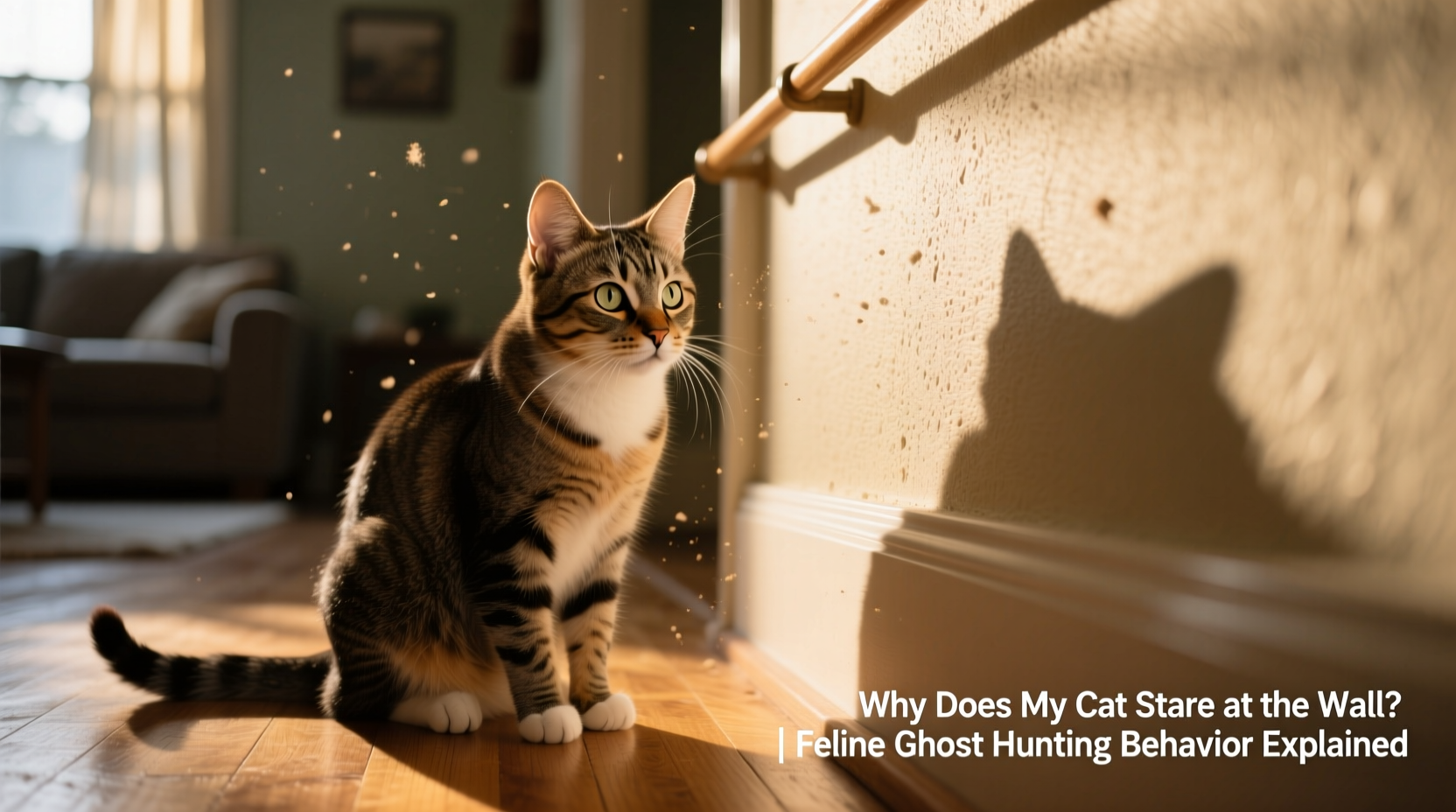
It’s a scene familiar to many cat owners: your feline companion suddenly freezes, eyes locked on a blank stretch of wall, tail twitching, ears forward, completely absorbed in something invisible to you. Minutes pass. You follow their gaze—nothing. No movement, no sound, just drywall and paint. Is your cat seeing spirits? Or is there a more grounded explanation for this eerie yet common behavior?
While the idea of cats as supernatural sentinels has persisted for centuries—from ancient Egyptian beliefs to modern internet lore—the truth is both more complex and more fascinating. Cats don’t need ghosts to explain their wall-staring episodes. Instead, their behavior stems from a combination of evolutionary instincts, heightened senses, neurological quirks, and sometimes, underlying health issues.
This article explores the full spectrum of reasons why your cat might be fixated on an empty wall, separating myth from science while offering practical advice for concerned pet owners.
The Science Behind Feline Perception
Cats experience the world differently than humans. Their sensory systems are fine-tuned for hunting and survival, which means they detect stimuli that often go unnoticed by us.
For instance, cats have a visual field of about 200 degrees (compared to our 180), allowing them to see peripherally with greater ease. They also possess a high density of rod cells in their retinas, making them exceptionally sensitive to low light and motion. While their color vision is limited, their ability to detect the slightest flicker or shadow is unmatched.
Moreover, cats hear frequencies up to 64 kHz—far beyond human range (20 kHz). This means they can pick up ultrasonic sounds from rodents, insects, or even electrical devices like aging fluorescent lights or faulty wiring. What appears to be “nothing” to you may be a symphony of unseen activity to your cat.
Is Your Cat Really ‘Ghost Hunting’?
The notion that cats can see spirits is deeply rooted in cultural mythology. In Japan, the maneki-neko (beckoning cat) is believed to ward off evil. In Celtic folklore, cats were thought to guard the threshold between worlds. Even today, anecdotal reports describe cats reacting to “invisible presences,” especially in old homes or during emotional events like grief or illness.
While these stories are compelling, there is no scientific evidence that cats perceive ghosts. However, their acute senses may interpret environmental cues that humans miss—such as electromagnetic fluctuations, infrasound vibrations, or changes in air pressure—which some paranormal researchers speculate could be linked to so-called \"haunted\" locations.
“Cats are not psychic, but they are exquisitely attuned to their environment. What looks like ghost hunting is usually just superior sensory processing.” — Dr. Sarah Thompson, Veterinary Ethologist, Cornell Feline Health Center
In reality, when a cat stares at a wall, it’s far more likely responding to a real, physical stimulus—just one that escapes human detection.
Common Explanations for Wall Staring
Before concluding that your cat has entered the spirit realm, consider these scientifically supported causes:
- Visual stimuli: Dust particles, cobwebs, or light reflections can catch a cat’s attention, especially in sunlit rooms.
- Auditory triggers: Mice in walls, plumbing noises, or buzzing electronics emit sounds cats can hear but we cannot.
- Olfactory input: Cats have 200 million scent receptors (humans have 5 million). A faint odor from mold, pests, or cleaning products may draw their focus.
- Play anticipation: Some cats stare at spots where toys or prey-like objects have appeared before, exhibiting learned behavior.
- Neurological factors: In rare cases, staring spells can be signs of seizures or cognitive dysfunction.
When Wall Staring Becomes a Concern
Occasional wall gazing is normal. But if your cat exhibits any of the following behaviors, it may indicate an underlying issue:
- Staring for extended periods (over 10 minutes) without reorientation
- Twitching, drooling, or falling over after staring episodes
- Loss of appetite, disorientation, or vocalization during fixation
- Increased frequency or occurrence in older cats (possible sign of feline cognitive dysfunction)
Feline Seizures and Cognitive Decline: Medical Causes
Not all wall-staring episodes are benign. One serious possibility is partial (focal) seizures, which originate in a specific area of the brain. During such seizures, a cat may appear alert but be unresponsive, often fixating on a single point. These episodes typically last seconds to minutes and may be followed by confusion or aimless wandering.
Feline cognitive dysfunction (FCD), similar to Alzheimer’s in humans, affects up to 50% of cats over 15 years old. Symptoms include disorientation, altered sleep cycles, and repetitive behaviors—like staring into space or at walls.
If you suspect a medical cause, consult your veterinarian. Diagnostic steps may include blood work, neurological exams, or advanced imaging like MRI.
| Behavior | Normal? | Potential Red Flag |
|---|---|---|
| Short stares (under 1 min), occasional | ✅ Yes | No action needed |
| Repetitive head tilting or twitching | No | Neurological issue |
| Unresponsiveness during staring | No | Possible seizure |
| Increased frequency in senior cats | Sometimes | Consider FCD screening |
| Vocalization or aggression after episode | No | Seek veterinary evaluation |
Step-by-Step Guide: What to Do When Your Cat Stares at the Wall
Instead of dismissing the behavior or assuming the worst, take a structured approach to understand what’s happening.
- Observe quietly: Note the duration, time of day, and your cat’s body language. Are ears forward? Is the tail flicking?
- Scan the environment: Look for light patterns, sounds, or smells. Turn off appliances to test if buzzing stops the behavior.
- Record the episode: Use your phone to capture video. This helps veterinarians assess whether the behavior is typical or concerning.
- Check for patterns: Does it happen at night? Near certain rooms? After feeding? Patterns can reveal triggers.
- Consult your vet: If episodes increase in frequency or are accompanied by other symptoms, schedule a professional evaluation.
Mini Case Study: Bella and the Basement Wall
Maria, a cat owner from Portland, noticed her 4-year-old tabby, Bella, began spending hours staring at a corner of the basement wall. At first, she joked about “cat ghosts,” but when Bella started growling and pouncing at nothing, Maria grew concerned.
She recorded several episodes and brought the footage to her vet. After reviewing the video and conducting a neurological exam, the vet ruled out seizures. Maria then called a pest control specialist, who discovered a mouse nest behind the drywall. The faint scratching and squeaking—inaudible to Maria—were clear signals to Bella.
Once the infestation was resolved, Bella’s wall-staring stopped entirely. This case illustrates how instinctual hunting behavior, combined with superior hearing, can manifest in ways that seem mysterious but have logical explanations.
Environmental Enrichment: Reducing Fixation Through Stimulation
Boredom and lack of stimulation can lead to obsessive or repetitive behaviors in cats. A cat that stares at walls may be seeking engagement, especially if its environment lacks novelty.
Providing mental and physical enrichment can redirect focus and reduce fixation:
- Rotate toys weekly to maintain interest
- Install window perches for bird-watching
- Use puzzle feeders to simulate hunting
- Introduce interactive play sessions with wand toys
- Add vertical spaces like cat shelves or towers
Enriched environments not only prevent behavioral oddities but also support overall well-being and reduce stress-related issues.
FAQ: Common Questions About Cat Wall Staring
Can cats really see things we can’t?
Yes—but not in a supernatural way. Cats detect motion, light variations, and sounds outside human perception. Their eyes and ears are biologically optimized for detecting prey, not ghosts.
Should I stop my cat from staring at walls?
Not if it’s brief and occasional. Interrupting natural behaviors can cause frustration. However, if the behavior is prolonged or paired with other symptoms, investigate further or consult a vet.
Do indoor cats stare at walls more than outdoor cats?
Indoor cats may appear to do so more frequently because they’re in a controlled environment where unusual stimuli stand out. Outdoor cats face constant sensory input, so isolated fixations are less noticeable.
Conclusion: Understanding, Not Mythologizing, Your Cat’s Behavior
Your cat isn’t haunted. It’s highly perceptive. The next time you catch your feline transfixed by a blank wall, resist the urge to reach for a Ouija board. Instead, consider the rich sensory world they inhabit—one filled with whispers of wind, flickers of light, and echoes of life that escape our limited senses.
By observing with curiosity rather than fear, you deepen your understanding of your cat’s instincts and needs. Whether it’s a moth fluttering behind a frame, a mouse in the walls, or simply a patch of sunlight shifting across the floor, your cat’s behavior is a window into a finely tuned predator’s mind.
And if concerns persist? Trust your instincts as a caregiver. When in doubt, seek professional guidance. After all, the best way to honor your cat’s mysterious nature is through attentive, informed care.




 浙公网安备
33010002000092号
浙公网安备
33010002000092号 浙B2-20120091-4
Comments
No comments yet. Why don't you start the discussion?