
Cats are enigmatic creatures. Their silent watches, sudden sprints, and intense focus on seemingly nothing can leave even the most observant owner puzzled. One of the most frequently reported oddities? A cat sitting perfectly still, eyes locked on a blank wall for minutes—or even hours—without blinking. It’s not just eerie; it’s concerning. Is your cat hallucinating? Bored? Ill? Or is there a logical explanation?
Feline behaviorists have spent decades studying cat cognition, sensory perception, and instinctual patterns. What they’ve found is that while prolonged wall-staring isn’t always normal, it’s rarely supernatural. Instead, it’s usually rooted in biology, environment, or subtle health cues. Understanding why your cat stares at the wall requires looking beyond the surface—into their senses, instincts, and emotional state.
The Science Behind Cats’ Perception of Space
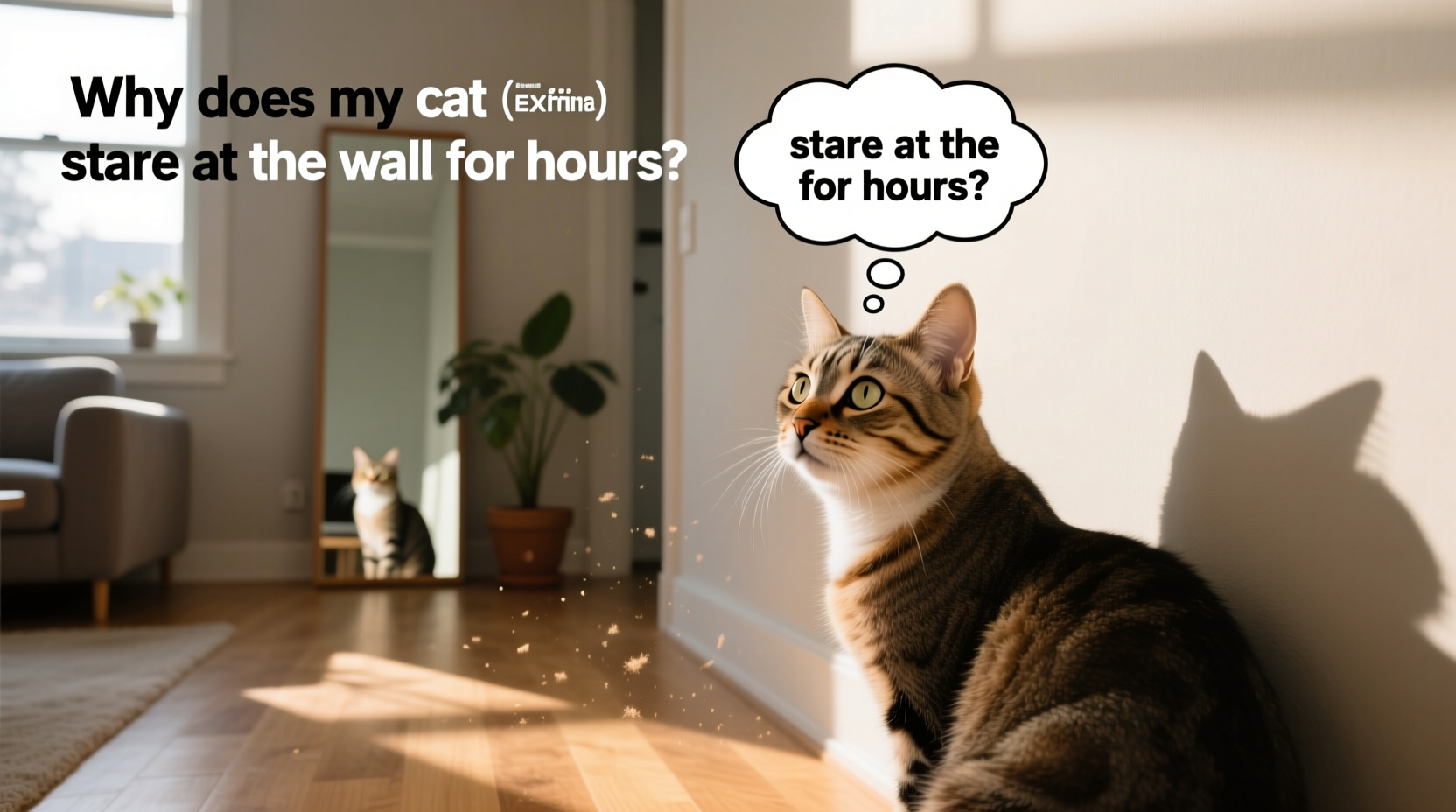
Cats don’t experience the world the way humans do. Their vision, hearing, and sense of movement detection are finely tuned for hunting and survival. What appears as a blank wall to you might be teeming with stimuli to your cat.
Feline eyes are adapted for low-light conditions and motion detection. While cats have limited color vision compared to humans, they excel at spotting the tiniest movements—even microscopic shifts in dust particles dancing in a sunbeam. A shadow flickering from a tree outside, a fly crawling along baseboards, or even air currents moving wallpaper can capture a cat’s full attention.
Dr. Sarah Hartwell, a renowned feline ethologist, explains:
“Cats see in a different visual spectrum and frame rate than humans. They perceive up to 70 frames per second—compared to our 24—meaning they detect motion we simply can’t see. A ‘blank’ wall may appear animated to them.” — Dr. Sarah Hartwell, Feline Behavior Researcher
This heightened sensitivity means that what looks like vacant space to us could be visually rich territory for a cat. In fact, many indoor cats fixate on walls because they’re tracking imperceptible environmental changes: light reflections, vibrations, or drafts.
Common Behavioral Reasons for Wall Staring
Not every episode of wall-gazing signals a problem. Often, it’s a natural expression of curiosity or instinct. Here are the most common non-medical explanations:
- Hunting simulation: Even well-fed domestic cats retain strong predatory drives. If your cat sees a tiny insect, spider, or moving shadow, they may lock onto it for extended periods, waiting for the perfect pounce moment.
- Environmental fascination: Sunbeams shifting across the wall, ceiling fans casting rotating shadows, or dangling cords can captivate a cat’s attention.
- Sensory enrichment deficit: Cats in under-stimulating environments often develop repetitive behaviors. Wall-staring may become a self-soothing habit when mental engagement is lacking.
- Anticipation behavior: Some cats learn that staring at a specific spot precedes an event—like food being placed down or their owner entering the room—and they watch intently in expectation.
When Wall Staring Signals Health Concerns
Prolonged, unfocused staring—especially if accompanied by other symptoms—can indicate underlying medical issues. Veterinarians and feline neurologists caution that certain neurological or sensory disorders manifest through obsessive visual fixation.
One major red flag is feline cognitive dysfunction (FCD), commonly seen in senior cats. Similar to dementia in humans, FCD can cause disorientation, aimless wandering, and prolonged staring into space. Other possible causes include:
- Seizure activity: Cats can experience partial (focal) seizures that don’t involve convulsions. During these episodes, they may freeze, twitch slightly, drool, or stare vacantly for several minutes.
- Vision problems: Cataracts, retinal detachment, or glaucoma can distort perception. A cat may appear to stare at walls due to visual hallucinations or confusion.
- Hypertension: High blood pressure in cats—often secondary to kidney disease or hyperthyroidism—can lead to retinal bleeding or brain changes that affect behavior.
- Pain or discomfort: Chronic pain, especially neurological or dental, can cause zoning out or fixed gazes as a coping mechanism.
If your cat’s staring is new, increasing in frequency, or paired with any of the following, consult a veterinarian promptly:
- Lack of response to name or sounds
- Loss of litter box training
- Changes in appetite or grooming habits
- Unusual vocalizations during staring episodes
- Head tilting or circling behavior
Mini Case Study: Bella, the Senior Tabby
Bella, a 14-year-old domestic shorthair, began spending hours each day staring at the corner of her living room wall. Her owner, Maria, initially dismissed it as “old cat quirks.” But when Bella started missing her litter box and meowing at night, she scheduled a vet visit.
After bloodwork and a neurological exam, Bella was diagnosed with hypertension and early-stage kidney disease. The staring episodes were linked to mild seizure activity triggered by elevated blood pressure affecting her visual cortex. With medication and dietary changes, Bella’s episodes decreased significantly within three weeks.
This case illustrates how behavioral changes—even subtle ones like wall-staring—can be early warnings of systemic illness.
Environmental & Psychological Factors
Even in healthy cats, psychological stressors can trigger obsessive behaviors. Indoor cats are particularly vulnerable to environmental monotony, which can lead to stereotypic actions like tail-chasing, fabric-sucking, or persistent wall-watching.
Common triggers include:
- Lack of vertical space or hiding spots
- Inadequate playtime or predatory outlet
- Household changes (new pet, move, visitor)
- Exposure to outdoor animals through windows
Cats are highly territorial and sensitive to routine disruptions. A cat staring at a wall might actually be monitoring a perceived threat—such as a stray cat visible through a window or unfamiliar scents lingering in the air.
| Behavior | Likely Cause | Action Step |
|---|---|---|
| Stares at wall after loud noise | Startle response, hyper-vigilance | Provide safe retreat space |
| Follows moving light/shadow | Natural prey drive stimulation | Encourage interactive play |
| Stares without blinking, unresponsive | Potential seizure or disorientation | Record video, consult vet |
| Fixates before meals | Learned anticipation behavior | Maintain consistent feeding schedule |
| Stares while vocalizing | Anxiety or cognitive decline | Evaluate age and health history |
Step-by-Step Guide: Assessing and Responding to Wall Staring
If your cat exhibits prolonged wall-staring, follow this practical timeline to determine whether intervention is needed:
- Day 1–2: Observe and document
Note the duration, frequency, and context of the behavior. Use your phone to record a short video. Check for patterns: Does it happen at certain times? After noises? Near windows? - Day 3: Enhance environmental enrichment
Introduce puzzle feeders, feather wands, or a bird feeder outside a window. Increase daily play sessions to at least 15 minutes twice a day to redirect focus. - Day 5: Eliminate distractions
Turn off ceiling fans, close blinds, or cover reflective surfaces temporarily to rule out visual triggers. - Day 7: Evaluate changes
If the behavior decreases with enrichment, it was likely boredom-related. If unchanged or worsening, proceed to step five. - By Day 10: Consult your veterinarian
Share your observations and video. Request a full physical, blood panel, and blood pressure check—especially if your cat is over 10 years old.
Checklist: When to Worry About Your Cat’s Staring
Use this checklist to assess whether your cat’s behavior warrants professional evaluation:
- ✅ Staring lasts longer than 5 minutes with no reaction to stimuli
- ✅ Episodes occur multiple times per day
- ✅ Accompanied by twitching, drooling, or falling
- ✅ Cat seems “zoned out” or confused afterward
- ✅ New behavior in a senior cat (age 10+)
- ✅ Loss of coordination or bumping into walls
- ✅ Changes in sleep, eating, or social interaction
If two or more apply, schedule a veterinary appointment without delay.
FAQ: Common Questions About Cat Wall Staring
Can cats see ghosts or spirits when they stare at walls?
There’s no scientific evidence that cats perceive supernatural entities. However, their superior night vision, acute hearing, and sensitivity to electromagnetic fields may allow them to detect stimuli invisible to humans—such as high-frequency sounds, infrared heat patterns, or static electricity. These can create the illusion of reacting to “nothing.”
Is it normal for kittens to stare at walls?
Occasional staring in kittens is usually harmless and part of sensory development. Young cats are learning to process visual input and may fixate on moving objects or light reflections. However, frequent unresponsiveness or trembling should be evaluated by a vet to rule out congenital or neurological issues.
How can I stop my cat from staring at the wall?
You can’t—and shouldn’t—stop the behavior outright unless it’s pathological. Instead, address potential causes: increase playtime, provide window perches, rotate toys, and reduce household stress. If the staring is health-related, treatment will resolve it. For behavioral cases, mental stimulation is key.
Conclusion: Understanding Your Cat’s Silent Language
A cat’s gaze holds meaning. Whether they’re tracking a gnat only they can see or experiencing neurological distress, wall-staring is a form of communication. As owners, our role isn’t to dismiss these moments as quirks, but to interpret them with empathy and awareness.
By combining observation, environmental adjustment, and timely veterinary care, you can ensure your cat’s behavior remains within the realm of normal feline idiosyncrasy—not a cry for help. The next time your cat locks eyes with an empty wall, resist the urge to laugh or worry immediately. Instead, pause, observe, and ask: What is my cat trying to tell me?




 浙公网安备
33010002000092号
浙公网安备
33010002000092号 浙B2-20120091-4
Comments
No comments yet. Why don't you start the discussion?