
If you've ever caught your cat motionless, eyes locked on an empty patch of wall, you're not alone. Millions of cat owners have witnessed this eerie behavior and wondered: Is my cat seeing a ghost? A spirit only they can perceive? Or is there a more grounded explanation rooted in biology and instinct? The truth lies closer to science than the supernatural. While cats do possess senses far beyond our own, their wall-staring habits are rarely paranormal—they’re usually signs of heightened awareness, neurological quirks, or even early indicators of health concerns.
This behavior, while unsettling at first glance, is often completely normal. But understanding when it crosses from quirky feline charm into potential cause for concern requires a deeper look at feline perception, brain function, and environmental triggers.
The Feline Gaze: How Cats See the World
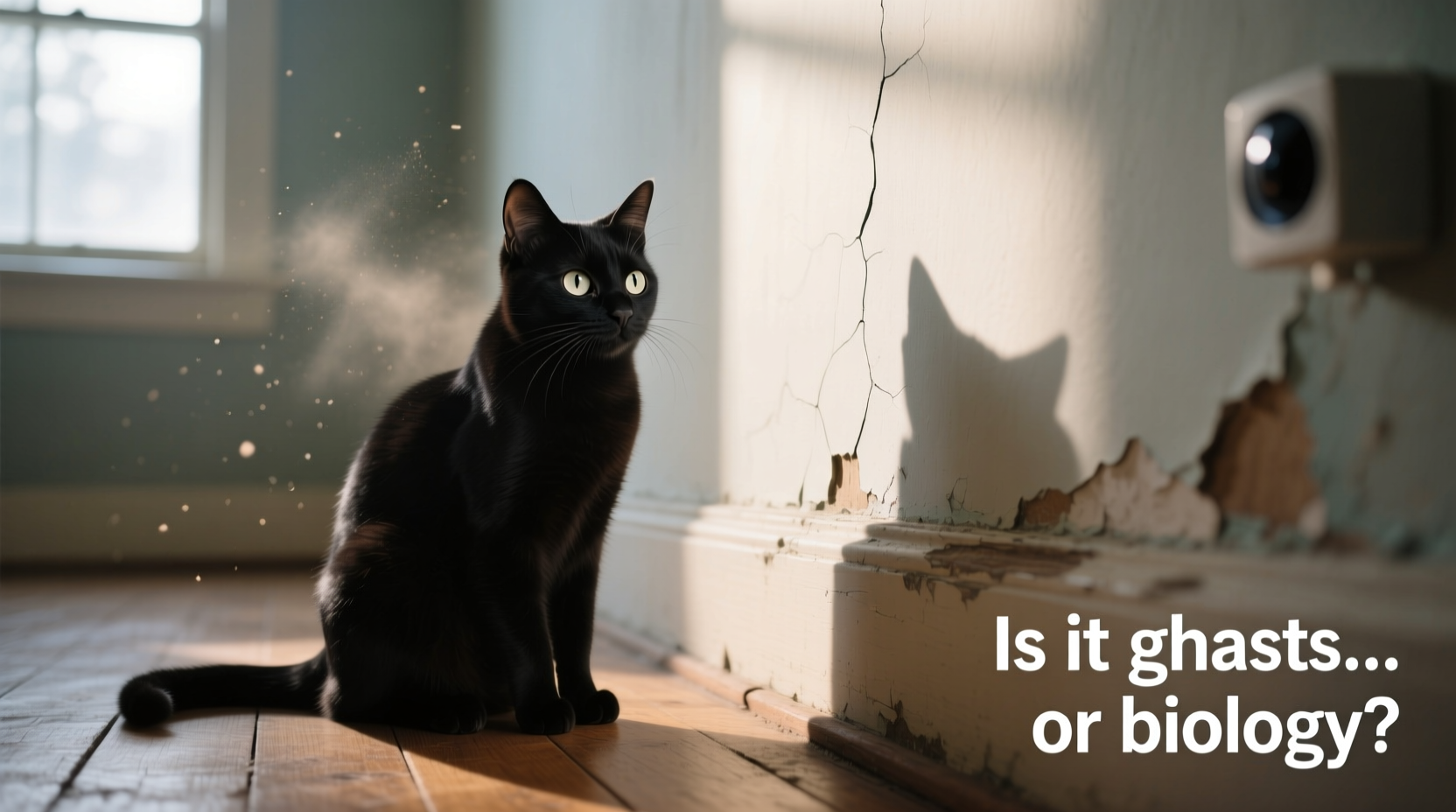
Cats don’t experience reality the same way humans do. Their sensory systems evolved for hunting in low light and detecting subtle movements—skills essential for survival in the wild. This shapes how they interact with their environment, including why they might fixate on what appears to be nothing at all.
A cat’s vision is optimized for detecting motion rather than fine detail. They have a higher density of rod cells in their retinas, which enhances night vision but reduces color perception and visual acuity compared to humans. What looks like a blank wall to you may appear differently to a cat. Tiny cracks, shadows shifting due to ambient light, or dust particles catching the breeze can trigger their predatory instincts.
“Cats live in a sensory world we can't fully access. Their eyes, ears, and whiskers pick up stimuli long before we notice them.” — Dr. Lydia Chen, Veterinary Neurologist, Cornell Feline Health Center
In addition to superior motion detection, cats also hear frequencies up to 64 kHz—well above the human limit of 20 kHz. This means they may be responding to sounds we cannot hear: mice scratching inside walls, electrical buzzing from outlets, or even ultrasonic emissions from appliances. So when your cat stares at the wall, they might actually be listening intently to something behind it.
Biology Over the Paranormal: Common Scientific Explanations
Despite popular myths about cats sensing spirits, no scientific evidence supports the idea that felines detect ghosts. Instead, several biological and behavioral factors explain wall-staring:
- Motion detection: Even slight air currents can make curtains, dust, or cobwebs move—enough to capture a cat’s attention.
- Light reflections: Sunlight bouncing off mirrors, glass, or metallic surfaces can create fleeting patterns on walls.
- Prey anticipation: If pests like spiders or insects have been seen nearby, your cat may be waiting for another appearance.
- Sensory memory: Cats remember locations where they’ve previously caught prey or heard noises and may return to monitor those spots.
- Neurological activity: In some cases, staring episodes can be linked to seizures or cognitive dysfunction, especially in older cats.
One study published in the Journal of Feline Medicine and Surgery found that over 70% of cats exhibiting “blank staring” were simply responding to micro-movements or auditory cues imperceptible to their owners. Only a small subset showed signs consistent with partial seizures or compulsive behaviors.
When Staring Crosses Into Medical Territory
While occasional wall-gazing is normal, persistent or repetitive staring without external triggers may signal underlying health issues. Conditions such as feline hyperesthesia syndrome, epilepsy, or cognitive decline in senior cats can manifest through vacant stares, twitching, or unresponsiveness.
Focal seizures (also called partial seizures) are particularly subtle. Unlike full-body convulsions, these may involve just a few seconds of fixed gaze, lip-smacking, or sudden freezing—often mistaken for daydreaming. These episodes typically last less than a minute and may occur multiple times a day.
Real Example: Bella the Wall-Watcher
Bella, a 7-year-old tabby from Portland, began staring at the same corner of her living room every evening. Her owner, Sarah, initially thought Bella was reacting to drafts or shadows. But when the behavior escalated—Bella would freeze mid-step, pupils dilated, tail twitching—Sarah consulted a veterinarian.
After a neurological exam and video review of the episodes, the vet diagnosed Bella with mild focal seizures. An MRI ruled out tumors, and Bella was placed on a low-dose anticonvulsant. Within weeks, the staring decreased significantly. The wall hadn’t held ghosts—it had revealed a treatable medical condition.
This case highlights a crucial point: observation matters. Not all odd behaviors require intervention, but changes in frequency, duration, or accompanying symptoms should prompt professional evaluation.
Do’s and Don’ts: Responding to Your Cat’s Staring Habits
| Action | Recommended? | Reason |
|---|---|---|
| Record the episode on video | ✅ Yes | Helps vets assess behavior accurately |
| Interrupt gently with a soft noise | ✅ Yes | Can break seizure-like episodes safely |
| Yell or startle the cat | ❌ No | Causes stress and worsens anxiety |
| Assume it's always normal | ❌ No | Ignores possible medical red flags |
| Check for environmental triggers | ✅ Yes | Dust, bugs, or flickering lights may be culprits |
Step-by-Step Guide: Assessing Unusual Cat Behavior
Follow this timeline to determine whether your cat’s wall-staring is harmless or warrants veterinary attention:
- Observe and document: Note the time, duration, frequency, and any associated actions (twitching, drooling, vocalizing).
- Eliminate obvious triggers: Check for insects, drafts, reflections, or high-pitched appliance noises.
- Video record: Use your phone to capture a typical episode. Include audio if possible.
- Monitor for patterns: Does it happen after meals, during rest, or at specific times of day?
- Consult your vet: Share your notes and video. Request a neurological screening if episodes recur.
Early detection of conditions like epilepsy or cognitive dysfunction can significantly improve quality of life. Never dismiss repeated odd behaviors as “just being a cat”—especially in cats over eight years old.
Tips for Enriching Your Cat’s Environment
Some wall-staring stems from boredom or under-stimulation. Indoor cats, in particular, may develop fixation behaviors when their natural hunting drives go unmet. Providing mental engagement can reduce obsessive focus on static objects.
Consider adding:
- Interactive puzzle feeders that mimic prey movement
- Window perches with views of bird feeders or passing wildlife
- Laser pointers used in short, controlled sessions (always end with a physical toy so the hunt feels complete)
- Automated moving toys that activate randomly throughout the day
Environmental enrichment doesn’t eliminate all staring—but it redirects focus toward healthier outlets.
FAQ: Common Questions About Cat Wall-Staring
Is my cat having a seizure when it stares at the wall?
Not necessarily. Seizures involving staring (focal seizures) are possible, but so are normal reactions to unseen stimuli. Signs that suggest a seizure include unresponsiveness, facial twitching, drooling, sudden collapse, or disorientation afterward. If you suspect seizures, consult a vet immediately.
Can cats really see ghosts or spirits?
There is no scientific evidence that cats—or any animals—can perceive supernatural entities. While folklore often links cats to the spirit world, their advanced senses explain most “mysterious” behaviors. Attributing staring to ghosts may delay diagnosis of real medical issues.
Should I be worried if my older cat stares at walls?
Yes, increased staring in senior cats can indicate cognitive dysfunction syndrome (CDS), similar to dementia in humans. Other signs include confusion, nighttime vocalization, litter box accidents, and altered sleep cycles. Early intervention with diet, medication, and routine adjustments can slow progression.
Checklist: When to Seek Veterinary Help
Use this checklist to evaluate whether your cat’s behavior needs professional assessment:
- ✅ Staring lasts longer than 30 seconds
- ✅ Episodes occur multiple times per day
- ✅ Cat doesn’t respond when called during the episode
- ✅ Accompanied by muscle tremors, blinking spasms, or drooling
- ✅ Begins suddenly in a cat with no prior history
- ✅ Followed by confusion or disorientation
- ✅ Occurs alongside other behavior changes (aggression, hiding, appetite loss)
If three or more apply, schedule a vet visit. Bring your video recordings and detailed notes.
Understanding the Line Between Instinct and Illness
Cats walk the edge between wild predator and domestic companion. Their brains remain wired for vigilance—a trait that served them well in nature but sometimes manifests oddly in modern homes. Staring at walls isn’t inherently alarming; it becomes concerning only when it deviates from the cat’s baseline behavior.
Every cat has unique quirks. One may watch ceiling fans like prey, another may follow sunbeams across the floor. These are expressions of natural curiosity. But when the behavior becomes compulsive, prolonged, or detached from stimuli, it may reflect neurological imbalance.
The key is knowing your cat. You are the best judge of what’s normal for them. Trust your instincts—if something feels off, it probably is.
Conclusion: Look Beyond the Myth, Focus on the Facts
Your cat isn’t haunted. It’s far more likely responding to a flicker of light, a hidden sound, or an ingrained hunting reflex. While the idea of cats seeing ghosts makes for compelling stories, the biological explanations are both more plausible and more actionable.
By paying close attention to context, frequency, and accompanying symptoms, you can distinguish between harmless feline idiosyncrasy and a sign of something serious. And when in doubt, documentation and veterinary consultation are your strongest tools.




 浙公网安备
33010002000092号
浙公网安备
33010002000092号 浙B2-20120091-4
Comments
No comments yet. Why don't you start the discussion?