
Cats are enigmatic creatures. One moment they’re curled up in your lap, purring softly; the next, they’re frozen in place, eyes locked on a blank stretch of wall with an intensity that can unsettle even the most seasoned pet owner. You might wonder: Is my cat seeing ghosts? Is something wrong? Or is this just another quirk of feline behavior?
The truth is, cats staring at walls is more common than you think—and while it can sometimes signal a health issue, in most cases, it’s a completely normal expression of their natural instincts and sensory perception. This article breaks down the real reasons behind this behavior, separates myth from fact, and helps you determine when it's harmless curiosity versus a sign that warrants a vet visit.
Understanding Feline Senses and Natural Instincts
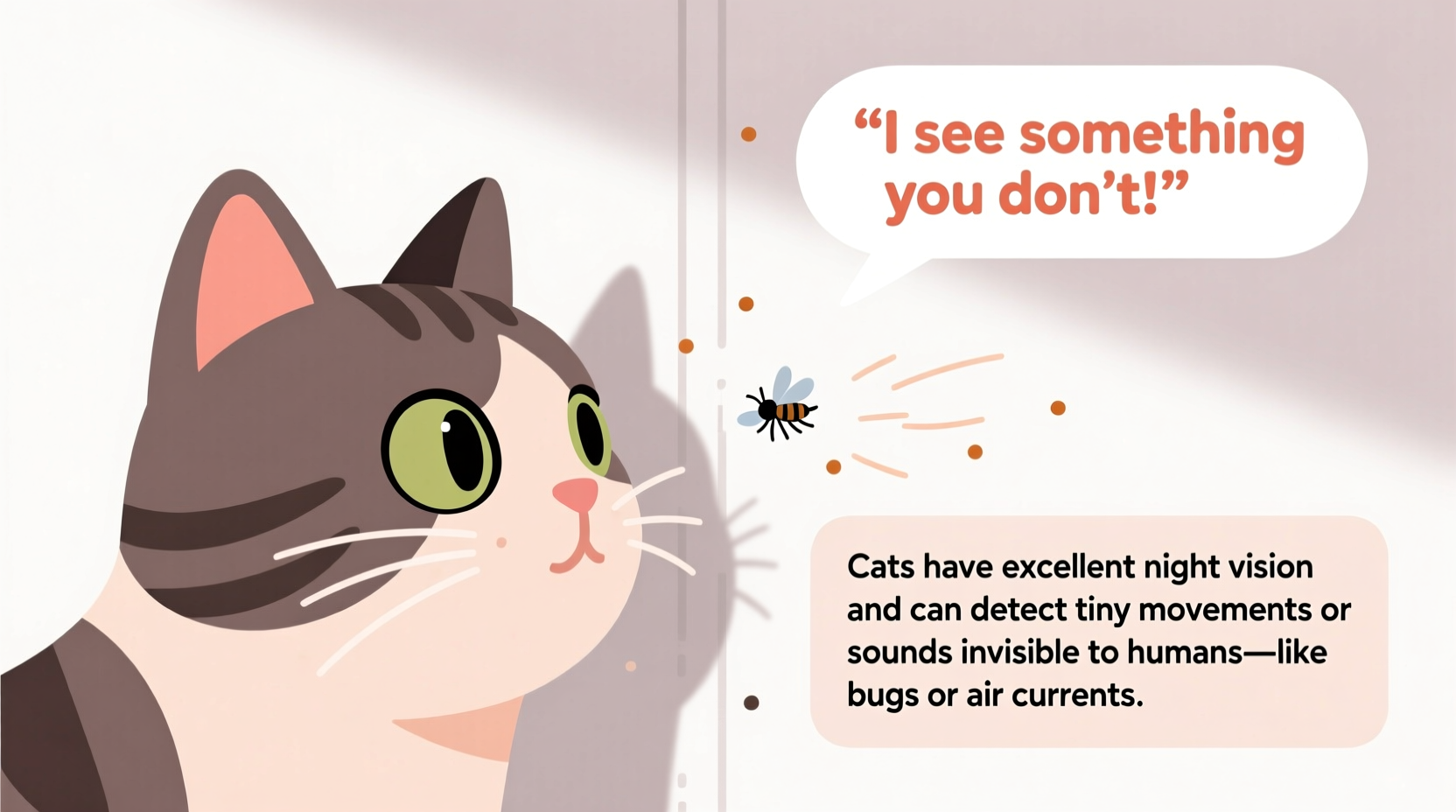
Cats perceive the world differently than humans do. Their senses—especially sight, hearing, and movement detection—are finely tuned for hunting and survival. What looks like a blank wall to you might be teeming with visual or auditory stimuli to your cat.
For instance, subtle changes in light, tiny movements from insects, or even dust particles floating in a sunbeam can capture a cat’s attention. Their peripheral vision is wider than ours, and they’re highly sensitive to motion, even at the edge of their visual field. This means they might detect something you can’t see—like a spider crawling behind baseboards or a flicker caused by a loose wire vibrating in the wall.
Additionally, cats have a reflective layer behind their retinas called the *tapetum lucidum*, which enhances night vision. While this adaptation helps them see in low light, it can also make them more sensitive to shadows and reflections, leading them to fixate on areas where light shifts subtly.
Common Reasons Cats Stare at Walls
While the behavior may seem odd, there are several logical explanations for why your cat might be transfixed by a wall:
- Movement detection: Even the tiniest motion—a fly, a shadow, or a ripple in wallpaper—can trigger a cat’s predatory focus.
- Hearing hidden sounds: Mice, insects, or electrical buzzing inside walls may be audible to cats but not to humans.
- Light and shadow play: Sunlight moving across a textured wall can create patterns that mimic prey-like movement.
- Reflections: Glass, mirrors, or glossy paint can reflect motion from another room, drawing your cat’s gaze.
- Scent tracking: Cats rely heavily on smell. If there’s a scent trail along a baseboard (e.g., from pests), your cat may stare as they process olfactory information.
In many households, owners report their cats staring at specific spots only at certain times of day—often dawn or dusk, when light angles change and nocturnal pests are active. This timing supports the idea that environmental cues, not psychological issues, are usually responsible.
When It’s Just Normal Cat Behavior
Short episodes of wall-staring—lasting seconds or a minute or two—are typically nothing to worry about. If your cat resumes normal activity afterward (grooming, playing, eating), the behavior is likely instinct-driven. Think of it as your cat “scanning the perimeter” for potential threats or prey.
“Cats are hardwired to monitor their environment constantly. A few seconds of intense focus on a wall is no different than a birdwatcher spotting movement in the trees.” — Dr. Lena Reyes, Feline Behavior Specialist
Potential Health Concerns Behind Prolonged Staring
While occasional wall-gazing is normal, persistent or repetitive staring—especially when accompanied by other symptoms—can indicate an underlying medical issue. The key is observing frequency, duration, and associated behaviors.
One of the most serious conditions linked to wall-staring is feline cognitive dysfunction (FCD), often referred to as \"cat dementia.\" It’s more common in senior cats (10 years and older) and may present with:
- Staring into space for extended periods (5+ minutes)
- Disorientation in familiar spaces
- Vocalizing at night
- Accidents outside the litter box
- Reduced interaction with family members
Another possible cause is seizures. Feline epileptic episodes can be subtle and may involve:
- Rigid posture with fixed gaze
- Twitching whiskers or facial muscles
- Loss of awareness
- Followed by confusion or sleepiness
These episodes, known as partial or focal seizures, don’t always involve convulsions. A cat might simply appear “zoned out” while staring at a wall, then snap out of it minutes later with no memory of the event.
Other Medical Causes to Consider
| Condition | Symptoms | Action Step |
|---|---|---|
| High Blood Pressure | Staring, blindness, disorientation | Veterinary exam with blood pressure check |
| Hyperthyroidism | Restlessness, weight loss, vocalization | Blood test for thyroid levels |
| Brain Tumor | Behavioral changes, circling, head tilt | Neurological evaluation and imaging |
| Vision Problems | Bumping into walls, squinting | Ophthalmic examination |
If your cat’s staring is new, frequent, or worsening over time, consult your veterinarian. Early diagnosis can significantly improve quality of life, especially for age-related or neurological conditions.
How to Monitor and Respond to Wall-Staring
You don’t need to intervene every time your cat stares at a wall. But creating a monitoring system helps distinguish between normal quirks and potential red flags.
Step-by-Step Guide: Assessing Your Cat’s Behavior
- Observe the duration: Use a timer. Episodes under 1–2 minutes are usually benign.
- Note the context: Is it near feeding time? During a storm? After a home renovation?
- Check for triggers: Look for drafts, insects, reflections, or noises in the area.
- Record associated behaviors: Does your cat drool, twitch, fall over, or seem confused afterward?
- Keep a log: Track date, time, length, and any patterns over 2–3 weeks.
- Consult your vet: Bring your notes if the behavior persists or escalates.
Real-Life Example: Bella the Curious Calico
Sarah, a cat owner from Portland, noticed her 7-year-old calico, Bella, began staring at the same corner of the living room every evening. At first, she assumed Bella was watching a bug. But when the behavior continued nightly for over two weeks, Sarah grew concerned.
She started recording the episodes and observed that Bella would sit perfectly still, pupils dilated, tail twitching slightly. After about 90 seconds, Bella would shake her head and walk away, seemingly unaware of what had just happened.
Sarah brought the videos to her vet, who suspected a mild seizure disorder. A blood panel revealed elevated kidney values, a common cause of neurological symptoms in cats. With medication and a kidney-friendly diet, Bella’s staring episodes stopped entirely within a month.
This case highlights how seemingly odd behavior can be an early warning sign—and how attentive observation leads to timely intervention.
Prevention and Environmental Enrichment
Even if your cat’s wall-staring is harmless, enriching their environment can reduce fixation behaviors and promote mental well-being.
Cats are natural hunters. Without adequate stimulation, they may redirect their focus onto minor environmental stimuli—like a flickering shadow—as a form of mental engagement.
Enrichment Checklist
- ✅ Provide daily interactive play sessions (10–15 minutes, twice a day)
- ✅ Rotate toys weekly to maintain novelty
- ✅ Install window perches for bird-watching
- ✅ Use puzzle feeders to encourage foraging behavior
- ✅ Introduce safe outdoor views via catio or screened porch
- ✅ Play calming nature sounds or species-specific music
Environmental enrichment doesn’t eliminate all staring—nor should it—but it gives your cat healthier outlets for their instincts.
Frequently Asked Questions
Is it normal for cats to stare at walls?
Yes, brief episodes of wall-staring are normal, especially if triggered by movement, light, or sound. However, prolonged or repetitive staring should be evaluated by a vet.
Can cats see spirits or ghosts?
There’s no scientific evidence that cats see supernatural entities. What may seem like “seeing ghosts” is more likely heightened sensory perception—detecting things beyond human range, such as high-pitched sounds or infrared movement.
When should I worry about my cat staring at the wall?
Seek veterinary advice if the staring lasts more than a few minutes, occurs frequently, or is paired with disorientation, tremors, vocalization, or changes in appetite or litter box habits.
Conclusion: Understanding, Not Fear
Your cat staring at the wall isn’t necessarily a sign of illness or the paranormal. More often, it’s a glimpse into the rich sensory world cats inhabit—one filled with sights, sounds, and smells we can barely perceive. By understanding their instincts and paying attention to behavioral patterns, you can better support your cat’s physical and mental health.
If the behavior is occasional and your cat seems otherwise happy and healthy, there’s likely no cause for concern. But if you notice changes in frequency, duration, or demeanor, don’t hesitate to seek professional guidance. Early detection of medical issues can make all the difference.




 浙公网安备
33010002000092号
浙公网安备
33010002000092号 浙B2-20120091-4
Comments
No comments yet. Why don't you start the discussion?