
It’s December. Twinkling lights glow along rooftops, synchronized music pulses from front lawns, and neighbors gather with hot cocoa to admire the spectacle. But for your child, that same display triggers a racing heart, clenched fists, or a sudden refusal to step outside after dusk. You’re puzzled—how can something so festive provoke such intense distress? This isn’t “just being shy” or “overreacting.” It’s a real, biologically rooted response shaped by sensory processing, developmental stage, cognitive understanding of reality versus illusion, and even family emotional climate. Understanding the *why* is the first, essential step—not to fix your child, but to meet them where they are with empathy, science-backed support, and quiet confidence.
What’s Really Happening: The Neuroscience Behind the Fear
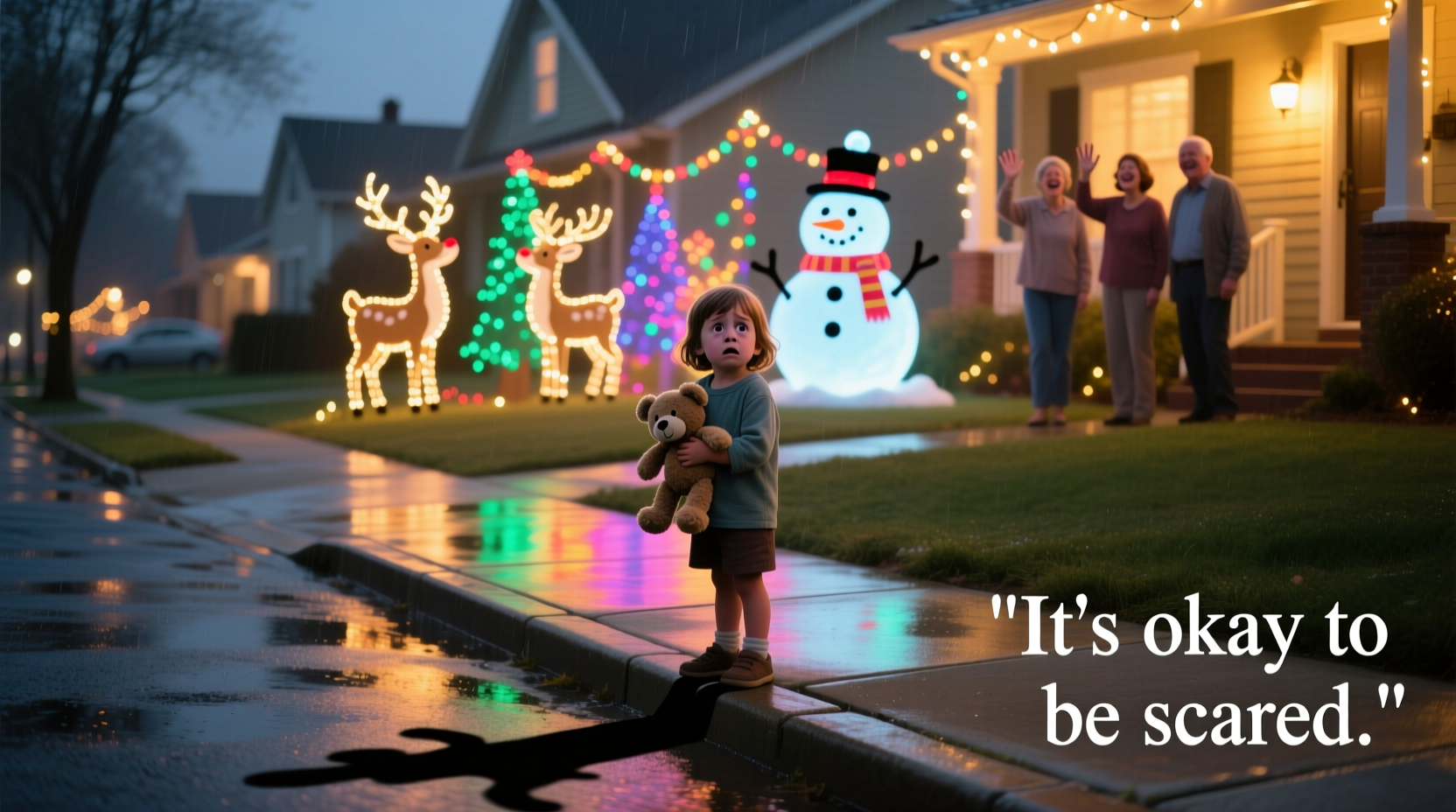
Light displays activate multiple sensory systems simultaneously: rapid visual motion (strobing LEDs), unpredictable soundscapes (sudden bass drops, looping melodies), shifting shadows, and often crowded, unfamiliar environments. For many children—especially those under age 7—this overload exceeds their nervous system’s capacity to regulate. The amygdala, the brain’s threat-detection center, interprets flickering lights and booming speakers not as holiday cheer, but as potential danger. This isn’t irrational; it’s evolutionary wiring optimized for survival, not seasonal decor.
Developmental psychologist Dr. Elena Torres explains:
“A 4-year-old doesn’t yet possess the neural maturity to inhibit fear responses when stimuli violate expectations—like a giant inflatable snowman ‘blinking’ its eyes or a singing reindeer emitting a startling ‘Ho ho ho!’ at 6:03 p.m. Their prefrontal cortex, which manages logic and reassurance, is still under construction. What looks like resistance is often a child’s nervous system screaming, ‘I need safety *now*.’”
This response is especially common in children with sensory processing differences, anxiety predispositions, autism spectrum traits, or those recovering from recent stressors (a move, new sibling, illness). It’s also more likely if the display includes animatronics, fog machines, or interactive elements that blur boundaries between object and agent—making it harder for young minds to categorize and predict.
Common Triggers—and What They Reveal About Your Child’s Needs
Fear rarely stems from “the lights” as a monolith. Pinpointing the specific trigger helps tailor support. Below is a breakdown of frequent culprits and their underlying roots:
| Trigger | Neurological/Developmental Root | What It Suggests Your Child Needs |
|---|---|---|
| Rapid flashing or strobing lights | Overstimulation of the visual cortex; may trigger mild photosensitive responses even without epilepsy | Visual predictability, reduced contrast, and opportunities to control exposure (e.g., sunglasses, looking away on cue) |
| Loud, sudden, or repetitive music/sounds | Hyper-reactivity in the auditory brainstem; difficulty filtering background noise | Auditory buffers (noise-reducing headphones), advance warning before sound cues, and quiet exit options |
| Animatronic figures or moving props | Uncanny valley effect; difficulty distinguishing animate vs. inanimate objects | Clear, concrete language about mechanics (“That bear moves because wires inside pull its arms”), slow exposure, and co-viewing with trusted adults |
| Crowds or unfamiliar people nearby | Heightened social vigilance; underdeveloped theory of mind (difficulty reading others’ intentions) | Personal space buffers, clear exit plans, and naming emotions (“I see you’re watching that group closely—would you like to stand behind me?”) |
| Darkness surrounding bright lights | Increased uncertainty; limited peripheral vision development makes shadows feel threatening | Shared flashlight use, walking paths with consistent lighting, and validating that darkness + brightness *can* feel confusing |
Practical, Step-by-Step Support Strategies
Helping your child navigate light-display anxiety isn’t about pushing through fear—it’s about building tolerance, agency, and felt safety. Follow this evidence-informed sequence over days or weeks, not hours:
- Observe & Name Without Judgment: For two evenings, sit together near a window or porch—no pressure to go out. Quietly note what draws your child’s attention: “I notice you looked away when the red lights flashed,” or “You held my hand tighter when the music started.” Avoid interpreting (“You’re scared”)—just describe.
- Introduce Predictability: Watch a short video of the display online *together*. Pause, rewind, and narrate: “Now the tree lights up. Then the music starts. Then the snowman waves—see his arm move?” Predictability reduces amygdala activation.
- Co-Create a “Safety Toolkit”: Let your child choose 2–3 tools: noise-reducing headphones, a favorite small flashlight, a smooth stone to hold, or a laminated “break card” they can hand you to signal overwhelm. Practice using them indoors first.
- Micro-Exposure Walks: Start with 30 seconds outside at dusk—just standing on your own porch. Praise effort, not outcome: “You stayed for five breaths—that took calm thinking.” Gradually extend time and distance only when your child initiates or agrees.
- Reframe the Narrative: Shift from “seeing the lights” to “noticing how lights work.” Bring a simple prism, draw light patterns with chalk, or build a mini display with battery-operated tea lights. Curiosity displaces fear when children feel competent.
Real Example: Maya, Age 5, and the Singing Reindeer
Maya began covering her ears and crying every time her family passed the Hendersons’ yard—home to a 12-foot inflatable reindeer that sang “Jingle Bells” on a 90-second loop, complete with head-bobbing and blinking eyes. Her parents initially thought she’d “grow out of it,” but her distress escalated: sleep disruptions, refusal to walk past certain streets, and meltdowns before holiday gatherings.
Working with a pediatric occupational therapist, they mapped Maya’s triggers. Video analysis revealed her reaction spiked precisely 1.2 seconds *before* the song began—not during it. She’d learned to anticipate the jarring start and braced for it. They implemented three changes: First, they played the song at low volume at home, starting 10 seconds before the chorus, so she could predict the pattern. Second, they gave her a pair of soft silicone earplugs labeled “quiet helpers.” Third, they walked past the display only during daylight, letting her examine the reindeer’s mechanics up close—the motor, wires, and speaker grille.
By week four, Maya initiated walking past the display at dusk—holding her earplugs loosely, not inserted. By week six, she stood beside it for 20 seconds while humming her own version of the song. Her fear didn’t vanish—but it transformed into manageable curiosity. As her mom shared: “We stopped trying to make her *not be afraid*, and started helping her *feel capable* around the fear. That changed everything.”
What NOT to Do: A Critical Checklist
Well-intentioned actions can unintentionally reinforce fear or erode trust. Use this checklist to safeguard your child’s sense of safety:
- ❌ Don’t laugh it off or label it “silly.” Dismissing minimizes their neurological experience.
- ❌ Don’t compare to siblings or peers. “Your brother loves it!” signals their feelings are unacceptable.
- ❌ Don’t use light displays as rewards or punishments. “If you’re brave, we’ll go see the lights” ties safety to performance.
- ❌ Don’t insist on “one more try” after visible distress. Pushing past physiological signs (shaking, pallor, shutdown) teaches distrust of their own body cues.
- ❌ Don’t avoid all displays indefinitely. Gentle, child-led exposure builds resilience; total avoidance reinforces threat perception.
FAQ: Addressing Real Parent Concerns
Is this just a phase—or could it signal something more serious?
Fear of light displays alone is rarely a clinical concern. However, consider consulting a pediatrician or child mental health specialist if the fear generalizes to other non-threatening stimuli (e.g., vacuum cleaners, balloons, ceiling fans), persists intensely beyond age 7–8, interferes with daily routines (school drop-offs, playdates), or is accompanied by chronic sleep issues, stomachaches, or avoidance of new experiences. Early support is highly effective—and far less about “fixing” than about equipping your child with regulation tools.
My child is fine with our own Christmas lights—why only the neighborhood ones?
Your home environment is saturated with safety cues: familiar scents, predictable sounds, known people, and full control over turning lights on/off. Neighborhood displays remove all these anchors. The scale, unpredictability, and lack of personal agency create a fundamentally different neurological context—even if the lights themselves look similar.
Should I let my child skip holiday events altogether?
Yes—if skipping preserves their sense of security and autonomy. But frame it proactively: “We’ll go to Aunt Lisa’s party, and you can bring your quiet helpers. If it feels too much, we’ll step outside for fresh air—and that’s perfect.” Children need to know their boundaries are respected *before* they’re tested. Often, that assurance alone reduces anticipatory anxiety enough to allow participation.
When to Seek Additional Support
Most children benefit significantly from the strategies above. Yet some require additional scaffolding—especially if anxiety manifests across multiple settings or intensifies over time. Consider reaching out to a professional if your child:
- Shows physical symptoms (vomiting, hyperventilation, freezing) consistently in response to displays or similar stimuli;
- Develops new fears rapidly (e.g., suddenly afraid of the dark, mirrors, or reflections after a light-display experience);
- Uses rigid rituals to “neutralize” fear (e.g., counting steps, repeating phrases, needing identical routes);
- Withdraws socially or expresses hopelessness (“Nothing ever feels safe”).
Board-certified child psychologists, occupational therapists specializing in sensory integration, and developmental-behavioral pediatricians offer tailored, non-pathologizing support. These professionals don’t aim to eliminate fear—they help children understand their nervous system, expand their window of tolerance, and reclaim joyful participation on their own terms.
Conclusion: Turning Fear Into Felt Safety
Your child’s fear of the neighborhood light display isn’t a flaw in their character or a failure in your parenting. It’s data—a precise, unfiltered signal about how their unique nervous system interfaces with a complex world. Every time you pause to observe instead of rush to fix, every time you honor their “no” while holding space for curiosity, every time you co-create a toolkit instead of imposing a solution—you reinforce a foundational truth: *You are safe with me, exactly as you are.*
This approach transforms holiday stress into a quiet opportunity: to model emotional intelligence, deepen attunement, and nurture resilience not by erasing discomfort—but by walking alongside it with steady presence. The lights will blink. The music will play. And your child, supported with patience and precision, will discover their own rhythm within the glow.




 浙公网安备
33010002000092号
浙公网安备
33010002000092号 浙B2-20120091-4
Comments
No comments yet. Why don't you start the discussion?