
Every holiday season begins the same way: you pull out last year’s Christmas lights, full of festive anticipation, only to be met with a knotted mess that defies logic. No matter how carefully you thought you packed them away, the strands are twisted, looped, and fused together like a puzzle no one asked for. This annual frustration isn’t just bad luck—it’s physics, human behavior, and storage habits colliding. The good news? With a deeper understanding of why tangles happen and proven techniques to prevent them, you can reclaim your holiday prep time and enjoy stress-free decorating.
The Science Behind the Snarl
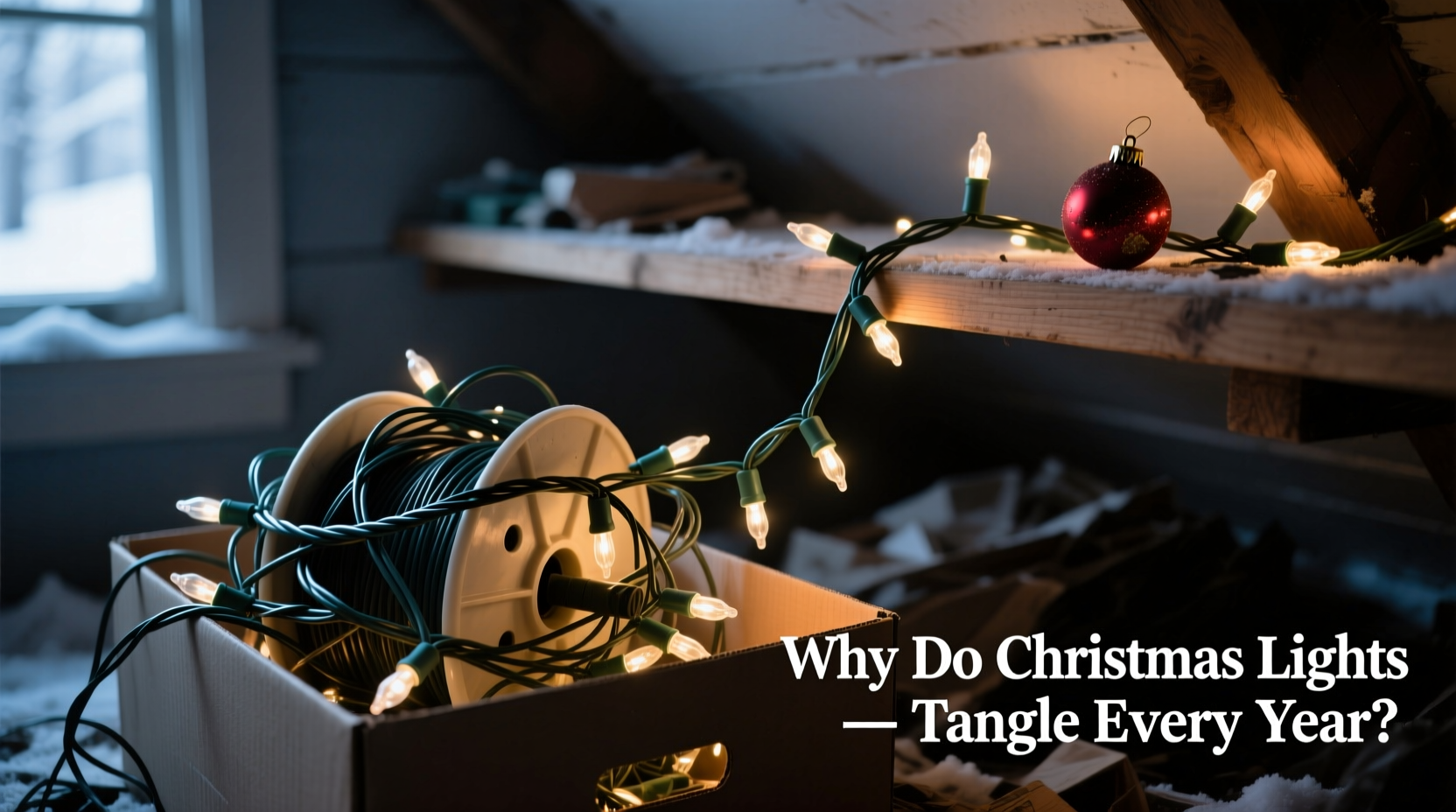
Tangled Christmas lights aren’t random—they follow predictable patterns rooted in physics. In 2007, two physicists from the University of California, San Diego—Dorian Raymer and Douglas Smith—conducted a study on string tangling. They placed strings of varying lengths into a box and rotated it randomly. Their findings? Any string longer than about 1.5 feet has a high probability of forming knots when agitated. Most Christmas light strands exceed this length by many times over, making them especially prone to chaos.
The key culprit is movement. When lights are loosely coiled and stored in boxes that shift during handling or stacking, the strands move independently. This motion allows loops to form, cross over each other, and tighten into knots. The more flexible the wire and the looser the coil, the worse the tangle becomes. Even gravity plays a role—over months of storage, heavier sections sink and press against others, increasing friction and entanglement.
“Knots form rapidly and spontaneously under random motion. Once started, they’re difficult to reverse without careful manipulation.” — Dorian Raymer, PhD, Physical Review Letters (2007)
This explains why even “careful” wrapping often fails. If the method doesn’t eliminate slack or secure the ends, microscopic shifts during storage compound into major snarls by December.
Common Mistakes That Guarantee Tangles
Many people believe they’re storing lights correctly—until they open the box and face the inevitable. These everyday errors are often overlooked but directly contribute to recurring tangles:
- Overhand coiling like a garden hose: This common method creates loops that easily slip and twist. Without securing the ends, coils unravel slightly during storage, setting off a chain reaction of knots.
- Using mismatched reels or spools: Storing different strand lengths on the same reel leads to uneven tension. Shorter strands loosen while longer ones compress, increasing internal movement.
- Poor box organization: Throwing multiple reels into a single container without dividers causes them to bump and rub, transferring motion and encouraging new tangles.
- Ignoring plug and end security: Failing to fasten the male plug or bulb end allows free movement, which initiates knotting at the weakest points.
- Storing in temperature-variable areas: Attics and garages expand and contract materials with seasonal temperature swings, subtly shifting coils over time.
Step-by-Step: How to Wrap Lights Without Tangles
Preventing tangles isn’t about perfection—it’s about consistency and technique. Follow this reliable method used by professional decorators and lighting technicians:
- Gather supplies: Have your lights, a sturdy cardboard reel or plastic spool, masking tape, and zip ties ready.
- Start at the plug end: Hold the male plug firmly and let the strand hang straight down. This ensures orientation remains consistent.
- Use the hand-to-hand wrap: Pass the cord from your dominant hand to your non-dominant hand in smooth, controlled loops. Keep tension even—neither too tight (which damages wires) nor too loose (which invites slippage).
- Maintain loop size: Aim for 6–8 inch diameter coils. Larger loops increase instability; smaller ones risk wire fatigue.
- Secure every 3–5 wraps: After every few loops, use a small piece of masking tape to pin the cord to itself. This prevents unraveling if one section shifts.
- Finish with the end: Once fully coiled, tuck the female end (or last bulb) into the center. Use a zip tie through the reel’s center hole to lock both ends in place.
- Label clearly: Note color, length, and location (e.g., “Warm White – 50 ft – Front Porch”) with permanent marker.
This process takes only 3–5 minutes per strand but pays dividends in saved time and frustration. The taped anchor points act as checkpoints—if one section slips, it won’t compromise the entire coil.
Storage Solutions Compared: What Works and What Doesn’t
How you store your reels matters as much as how you wrap them. Below is a comparison of common storage methods based on effectiveness, cost, and space efficiency.
| Method | Pros | Cons | Tangle Risk |
|---|---|---|---|
| Cardboard Reel + Bin | Low cost, easy to label, limits motion | Cardboard warps in humidity | Low (if secured) |
| Plastic Storage Reel | Durable, built-in handles, weather-resistant | Higher upfront cost | Very Low |
| Original Packaging | Compact, labeled, stackable | No support for coils; wires shift freely | High |
| Zip-Tied Loose Coils | Fast, uses minimal tools | Single failure point; high internal stress | Very High |
| Decorative Box with Dividers | Aesthetic, organized, protects bulbs | Bulky, expensive | Low |
For most households, a hybrid approach works best: use rigid reels for long-term stability and store them vertically in a labeled plastic tote with lid. This minimizes horizontal pressure and keeps moisture out.
A Real Example: From Chaos to Control
Consider Mark from Portland, Oregon, who decorates his home with over 1,200 feet of Christmas lights each year. For nearly a decade, he spent up to four hours untangling strands before installation. In 2021, after reading about the UCSD knot study, he redesigned his system. He built custom wooden reels with notched edges to hold tape anchors, wrapped each strand using the hand-to-hand method, and stored them upright in a climate-controlled closet.
The result? His setup time dropped from six hours to 45 minutes. More importantly, zero tangles occurred over the next three seasons. “It felt like magic,” he said. “But really, it was just applying basic physics instead of wishful thinking.”
Checklist: Year-Round Light Maintenance Routine
To keep your lights tangle-free and functional, integrate these steps into your annual cycle:
- ✅ Test all strands immediately after unwrapping.
- ✅ Replace burnt bulbs or faulty fuses before storage.
- ✅ Clean dust and debris with a dry microfiber cloth.
- ✅ Wrap using consistent tension and anchor points.
- ✅ Secure both ends with zip ties or Velcro straps.
- ✅ Store in a cool, dry place away from rodents and sharp objects.
- ✅ Label each reel with type, color, and intended use.
- ✅ Inspect packaging annually for wear or moisture damage.
Following this checklist transforms light management from a chore into a streamlined ritual. Over time, it reduces replacement costs and extends the lifespan of each strand.
Frequently Asked Questions
Can I use twist ties instead of zip ties?
Twist ties are acceptable for lightweight strands, but metal can corrode or cut into insulation over time. Plastic zip ties are safer and more durable. If using twist ties, wrap the end to prevent sharp edges.
Is there a difference between LED and incandescent light storage?
Yes. LED strands are typically thinner and more flexible, making them more prone to tangles. However, they generate less heat, so they can be stored closer together without risk of melting. Incandescent wires are stiffer but more vulnerable to insulation cracks when bent too tightly.
What should I do if my lights are already tangled?
Work slowly from one end. Lay the strand flat on a clean surface, identify the main knot, and gently pull slack around it. Avoid yanking—this tightens knots further. Use a safety pin or crochet hook to tease apart stubborn loops. Patience saves time in the long run.
Expert Insight: Learning from the Pros
Professional event decorators handle thousands of feet of lighting each season. Their systems prioritize repeatability and speed. One such expert, Lena Torres, who manages holiday installations for commercial clients across New England, emphasizes discipline over tools.
“It’s not about having the fanciest reel. It’s about treating each strand the same way, every time. Muscle memory beats motivation.” — Lena Torres, Lead Lighting Technician, BrightPath Events
She trains her team to wrap all cables clockwise, always start at the power end, and never carry more than two coils at once. These small standards eliminate variability—the real enemy of tangle-free storage.
Conclusion: Break the Cycle of Holiday Frustration
The annual battle with tangled Christmas lights isn’t inevitable—it’s a solvable problem rooted in physics and habit. By understanding how and why knots form, avoiding common mistakes, and adopting a consistent wrapping and storage routine, you can transform a frustrating tradition into a seamless part of your holiday rhythm. The investment of a few extra minutes each year saves hours of untangling and preserves your lights longer. This season, don’t just decorate—organize with intention. Your future self will thank you when the lights come out next December, bright, smooth, and ready to shine.




 浙公网安备
33010002000092号
浙公网安备
33010002000092号 浙B2-20120091-4
Comments
No comments yet. Why don't you start the discussion?