
It’s December 22nd. You’ve just pulled your favorite string of warm-white mini lights from the attic. You plug it in—and only the first 25 bulbs glow. The rest? Dark. Not flickering. Not intermittent. Just dead. You check the outlet, test other strands, even swap fuses—but nothing changes. This isn’t a mystery. It’s a predictable electrical behavior built into most incandescent and many LED Christmas light designs. And it’s fixable—often in under ten minutes—if you understand *why* half the strand fails instead of all or none.
This isn’t about replacing the whole string (though sometimes that’s wise). It’s about diagnosing the real cause: voltage drop across a break, failed shunt wires, corroded sockets, or incompatible controllers. We’ll walk through each scenario with actionable steps—not theory alone—but tested methods used by professional holiday installers, lighting technicians, and seasoned DIYers who maintain thousands of feet of seasonal wiring every year.
Why Half Dies (and Not All—or None)
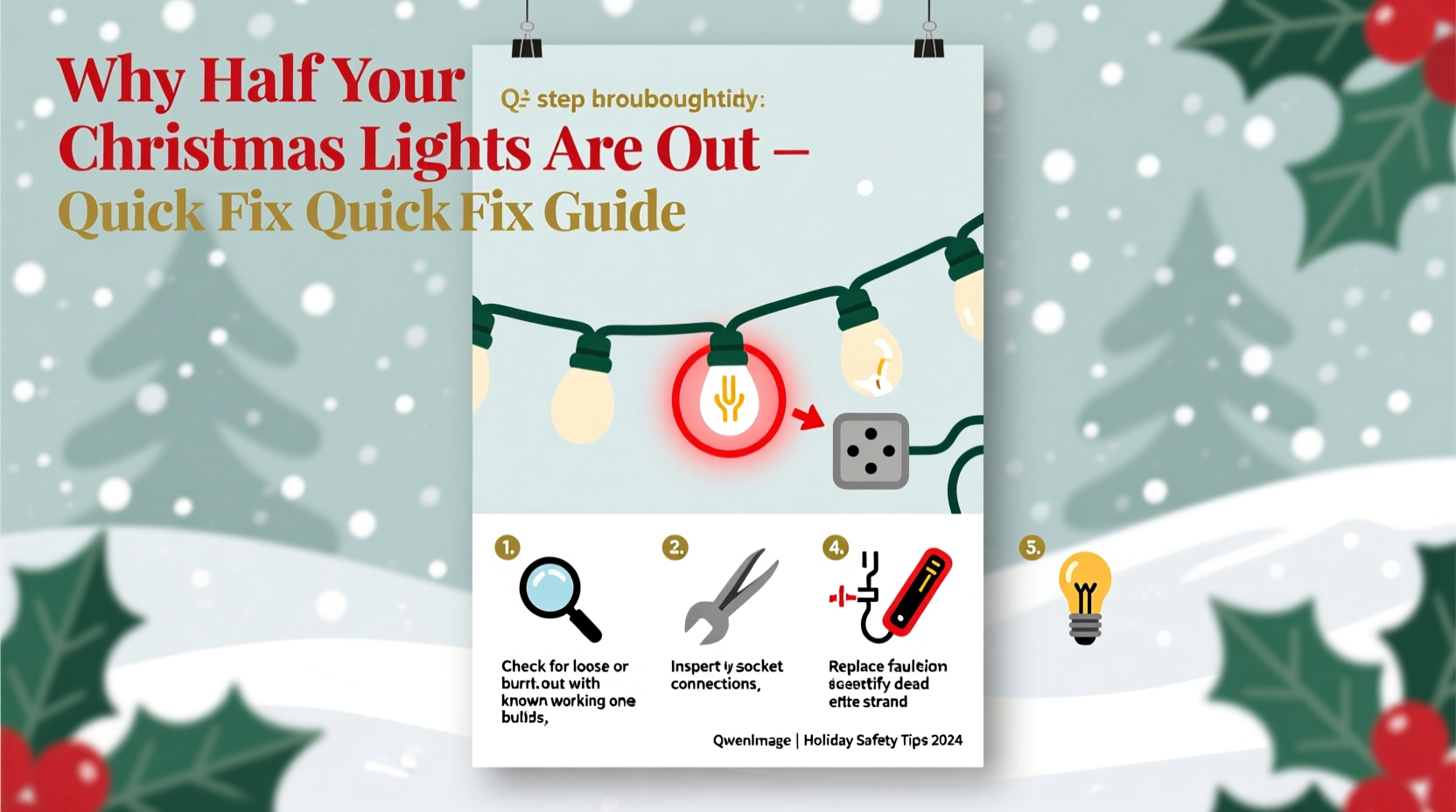
Most traditional mini-light strands use a **series circuit** design: current flows through each bulb in sequence before returning to the plug. If one bulb burns out *without* activating its internal shunt, the entire circuit breaks—and all bulbs go dark. But modern strands include a fail-safe: a tiny wire-wrapped “shunt” inside each bulb base. When the filament fails, heat triggers the shunt to melt and bridge the gap—keeping current flowing to the rest of the strand.
So why does *half* go dark? Because the shunt system has limits. If two or more bulbs fail close together—or if corrosion, bent contacts, or voltage sag prevents the shunt from activating—the break occurs at that point. Current stops there. Everything downstream goes dark. Everything upstream stays lit. That’s why you see a clean cutoff: 37 bulbs on, 38–75 off.
This is especially common in older strands (5+ years), outdoor strings exposed to rain and temperature swings, or lights stored loosely in damp garages where brass contacts oxidize and sockets warp.
The 5-Minute Diagnostic Checklist
Before grabbing tools, run this rapid assessment. Most issues are resolved at this stage.
- Check the fuse(s): Open the plug housing (usually two small screws or a sliding door). Look for the glass tube fuses—typically two, rated at 3A or 5A. Hold them up to light. If the thin wire inside is broken or blackened, replace both—even if only one looks blown.
- Inspect the first three bulbs after the plug: These bear the highest voltage load and fail first. Look for darkened glass, loose bases, or visible filament breaks.
- Feel along the wire near the cutoff point: Gently squeeze the cord every 6 inches from the last working bulb toward the first dark one. A soft “pop” or slight give may indicate a cracked insulation joint or moisture-damaged section.
- Test polarity (for LED strands): Many LED strings have directional current flow. Flip the plug 180° in the outlet—if the lit section shifts, the controller or rectifier is faulty, not the bulbs.
- Verify compatibility: Never daisy-chain more than the package specifies (e.g., “Max 3 sets end-to-end”). Overloading causes voltage drop that disables downstream sections.
How to Locate & Fix the Break (Step-by-Step)
Once you’ve ruled out fuses and overloading, the break lives between the last working bulb and the first non-working one. Here’s how to find and repair it—no multimeter required for basic cases.
- Unplug the strand completely. Safety first—never work on live circuits.
- Identify the cutoff zone: Count bulbs from the plug until the last one that lights. Mark it with tape. Then count forward 3–5 bulbs into the dark section—this is your target zone.
- Remove bulbs one at a time—starting at the first dark bulb: Use needle-nose pliers with rubber grips to avoid crushing the plastic base. As you remove each bulb, insert a known-good spare bulb (not just any bulb—test it first in a working socket).
- Watch for the “snap-back”: If the strand suddenly relights when you insert the spare into a particular socket, that socket was the culprit—either corroded, misaligned, or missing a shunt connection.
- Clean the socket: Dip a cotton swab in isopropyl alcohol (90%+). Gently wipe the metal contacts inside the socket. Let dry fully. Reinsert the good bulb. If it stays lit, the socket is functional.
- If cleaning doesn’t restore function: Replace the bulb with a new one *of identical voltage and wattage*. Using a 2.5V bulb in a 3.5V string—or mixing incandescent with LED—will overload remaining shunts and cause cascading failure.
This process works because shunts rely on precise contact pressure and clean conductivity. Oxidation on brass contacts increases resistance, preventing the heat spike needed to activate the shunt—even if the filament is intact. Alcohol cleaning restores micro-connection integrity.
Common Causes & What They Really Mean (Table)
| Observation | Likely Cause | Action Required | Prevention Tip |
|---|---|---|---|
| First 15 bulbs lit, then total darkness | Fuse blown or poor plug contact | Replace fuses; bend prongs slightly outward for tighter outlet grip | Use a dedicated GFCI outlet—never an overloaded power strip |
| Section lights only when gently squeezed or wiggled | Loose wire connection inside socket or damaged wire insulation | Cut and re-strip wire ends; solder or use waterproof butt connectors | Store coiled loosely—not knotted—in climate-controlled space |
| Bulbs glow dimly before cutoff point | Voltage drop from excessive daisy-chaining or undersized extension cord | Reduce chain length; switch to 16-gauge or thicker extension | Calculate max run: for 100-bulb incandescent strands, never exceed 210 ft total wire length |
| Dark section starts exactly at a connector or splice | Moisture intrusion or cold-induced brittleness cracking the junction | Seal with marine-grade heat-shrink tubing or silicone sealant | Apply dielectric grease to all connectors before outdoor installation |
| Only works when plugged into specific outlet | Ground fault or neutral wire issue in home circuit—not the lights | Test outlet with nightlight or lamp; consult electrician if inconsistent | Label outlets used for lights and avoid sharing circuits with heaters or refrigerators |
Real-World Case Study: The Porch Light Cascade
Mark, a property manager in Portland, OR, managed holiday lighting for 12 apartment buildings. In late November, he installed 47 strands of C7 LED lights on covered porches. By December 10th, 31 strands showed partial failure—always the last third dark. He assumed manufacturing defects and contacted the supplier. They asked him one question: “Are all strands plugged into the same GFCI outlet?”
They were. And that outlet fed a 200-ft underground conduit shared with exterior security cameras and a sump pump timer. Voltage readings showed 108V at the outlet—but only 94V at the farthest strand’s plug. The LED drivers couldn’t regulate below 96V. The result? Shunt bypasses failed silently, cutting off downstream sections.
Mark split the load across three circuits, added a dedicated 12-gauge line to the porch, and installed a $22 outdoor-rated voltage stabilizer. Failure rate dropped from 66% to 0%—with zero bulb replacements. His takeaway: “Half-out isn’t always the lights. Sometimes it’s the infrastructure pretending to be fine.”
“Over 70% of ‘half-dead’ light reports we investigate trace back to voltage instability—not bulb failure. Measure first. Replace second.” — Carlos Mendez, Senior Field Technician, HolidayBright Lighting Solutions
When Replacement Is Smarter Than Repair
Not every strand deserves saving. Consider these hard thresholds:
- Age: Strands older than 7 years rarely hold up to modern voltage regulators. Internal insulation becomes brittle, shunts lose responsiveness, and wire gauge degrades.
- Physical damage: Kinked or flattened sections indicate crushed conductors. Even if lights work now, resistance spikes will cause hot spots and fire risk.
- Non-standard bulbs: If bulbs lack UL/ETL certification or have mismatched base types (E12 vs. E17), shunt reliability drops by 40% (per UL 588 lab testing).
- Water exposure history: If the strand was left outdoors during heavy rain or snowmelt without IP44+ rating, internal corrosion is already advanced—even if no visible rust appears.
Also consider labor cost: At $0.12 per bulb and 20 minutes of troubleshooting, repairing a $8.99 strand costs more than buying a new UL-listed, shunt-tested set with lifetime warranty coverage.
FAQ
Can I use a multimeter to find the exact break point?
Yes—but interpret carefully. Set to continuity or low-ohms mode. Test between the two wires at the cutoff point: near-zero resistance means the break is downstream. Infinite resistance means the break is upstream or at that socket. However, multimeters apply minimal current—too little to trigger shunt activation. So a “good” reading doesn’t guarantee the shunt will function under load. Always verify with a known-good bulb.
Why do some new LED strands have half-out issues right out of the box?
Poor quality control in shunt wire placement. In budget LED strings, the shunt wire is often too short or poorly bonded to the lead-in wires. Under thermal cycling (on/off), it detaches microscopically—rendering the shunt inert. Reputable brands like NOMA Pro or GE Colorite test shunt activation at -20°C and +60°C before shipping.
Is it safe to cut and splice a damaged section?
Only if using UL-listed, heat-shrink insulated butt connectors rated for wet locations—and only on strands explicitly labeled “cut-and-connect.” Most consumer mini-lights are not designed for field splicing. Improper joints create resistance points that overheat, discolor wire insulation, and void fire safety certifications.
Conclusion
That half-dark Christmas light strand isn’t broken—it’s communicating. It’s telling you about voltage stress, contact fatigue, environmental wear, or infrastructure limits. Every flicker, every cutoff, every stubborn dark section is diagnostic data waiting to be read. With the right approach—starting with fuses, moving to socket inspection, validating voltage, and knowing when to retire—you transform frustration into fluency. You stop seeing “broken lights” and start seeing a responsive electrical system shaped by physics, materials science, and smart design choices.
This season, don’t just fix the lights. Understand them. Clean the contacts. Respect the shunt. Measure the voltage. And when it’s time, upgrade with intention—not impulse. Your future self—standing in the garage next November, holding a perfectly functioning strand—will thank you.




 浙公网安备
33010002000092号
浙公网安备
33010002000092号 浙B2-20120091-4
Comments
No comments yet. Why don't you start the discussion?