
Blowing a fuse on a Christmas light strand isn’t just inconvenient—it’s a red flag. That sharp *pop*, the sudden darkness across half your roofline or mantle, and the faint smell of overheated plastic aren’t quirks of holiday cheer. They’re symptoms of an underlying issue that could compromise safety, waste energy, and shorten the life of your lights. Most people assume it’s “just old lights” or “a bad fuse”—but in over 70% of residential cases reviewed by the Electrical Safety Foundation International (ESFI), fuse failures stem from preventable, correctable causes: improper loading, damaged wiring, moisture intrusion, or incompatible connections. This article walks through each root cause with diagnostic clarity—not theory, but field-tested insight—and delivers practical, step-by-step fixes you can implement without tools or training. If your lights go dark before New Year’s Eve, read on.
How Christmas Light Fuses Actually Work (and Why They Blow)
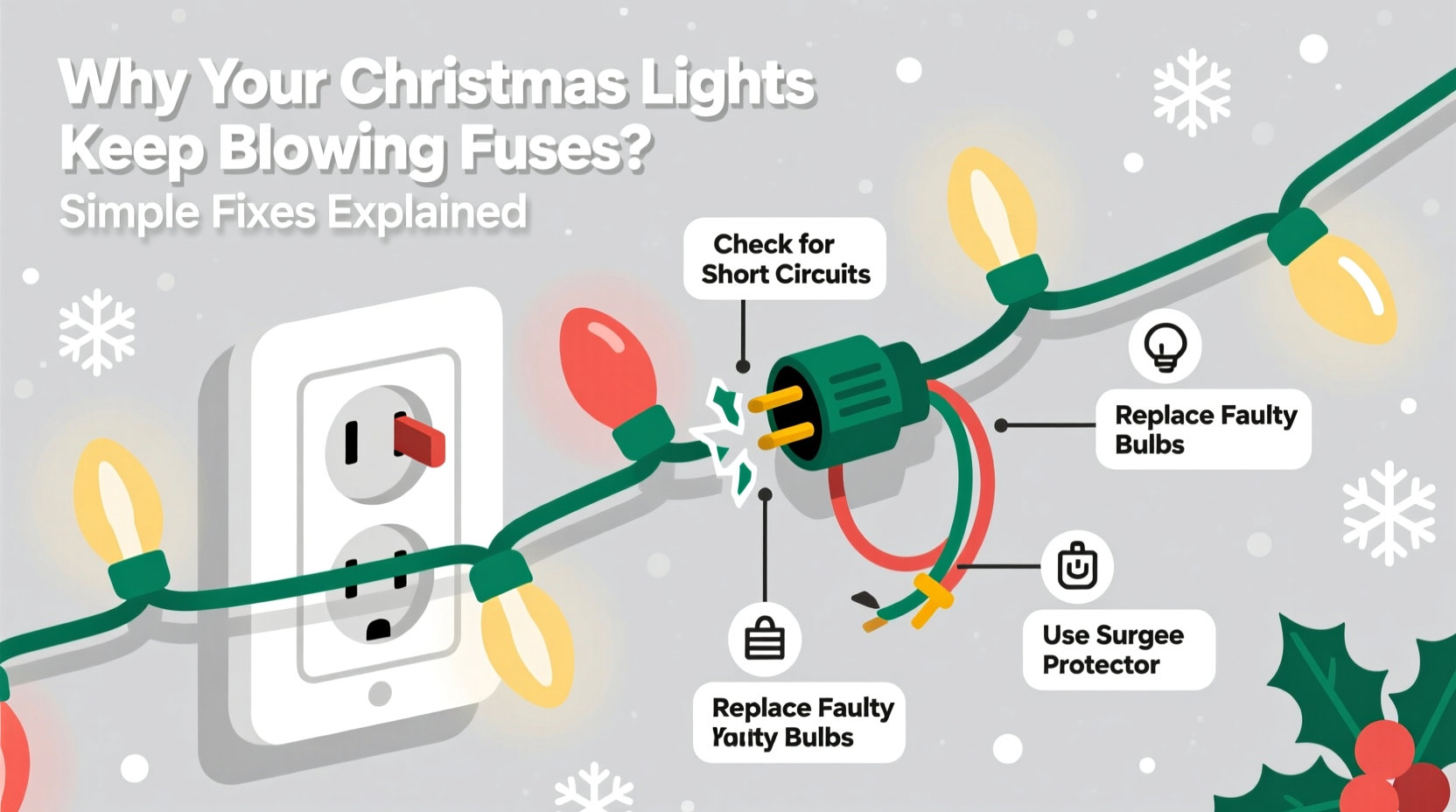
Miniature incandescent and LED light strands use inline fuses—typically located inside the male plug—as primary overcurrent protection. Unlike household circuit breakers, these are low-voltage, low-amp devices (usually 3A or 5A) designed to interrupt current flow when it exceeds safe thresholds. The fuse doesn’t “blow” randomly; it responds to excess heat generated by excessive current—often caused by a short circuit, ground fault, or cumulative overload. Crucially, modern light strands are engineered for daisy-chaining up to a manufacturer-specified limit (e.g., “connect up to 3 sets end-to-end”). Exceeding that limit—even by one extra strand—can push total amperage past the fuse’s rating. For example, a standard 100-light incandescent strand draws ~0.36A at 120V. Chain five of them (1.8A), and you’re within spec. Add a sixth (2.16A), and you’re still fine—but connect three older strands rated at 0.45A each (1.35A), then plug in a 0.8A LED projector light into the same outlet strip? That shared circuit may backfeed voltage spikes or cause momentary surges the fuse interprets as dangerous.
Top 5 Causes—and Exactly What to Do About Each
1. Daisy-Chaining Beyond Safe Limits
This is the single most common cause of repeated fuse failure. Manufacturers calculate maximum chain length based on wire gauge, insulation quality, and connector resistance—not marketing claims. Older incandescent strands often allow only 2–3 sets in series; newer LED versions may permit 40+—but only if all are identical models from the same product line. Mixing generations or brands introduces impedance mismatches that distort current flow.
- Locate the UL label on the first strand’s plug or packaging. Note the “Maximum Sets Allowed” number.
- Count every strand connected end-to-end—including those feeding other strands via splitters.
- If total exceeds the limit, unplug the last strand and test. If the fuse holds, that strand was the tipping point.
- Use a dedicated outdoor-rated power strip with built-in surge protection and individual circuit breakers instead of chaining.
2. Damaged or Pinched Wiring
Crushed insulation, kinked cords, or cracked sockets create micro-shorts. These don’t always trip the fuse immediately—they may arc intermittently, heating the fuse element until it fails under load. Look closely: frayed sections near hooks, staples driven too deep into eaves, or lights mounted where foot traffic compresses wires against door frames are frequent culprits.
| Symptom | Diagnostic Action | Fix |
|---|---|---|
| Fuse blows only when wind blows lights | Gently wiggle each section while powered (with GFCI protection active) | Replace damaged segment or entire strand |
| Burning odor near one socket | Unplug, inspect for discoloration/melting | Cut out faulty socket; splice with waterproof wire nuts (only for outdoor-rated wire) |
| Fuse blows after rain/snow | Check for cracked housings or missing gaskets | Seal with silicone RTV (not duct tape); replace if housing is compromised |
3. Moisture Intrusion in Sockets or Plugs
Water is rarely the direct cause—it’s the electrolyte that enables current to jump between conductors. Even condensation inside a poorly sealed plug can bridge contacts. This explains why fuses blow hours after installation, or only during high-humidity nights. Outdoor-rated lights must meet IP44 or higher standards, but many budget strands carry only basic “weather-resistant” labeling—marketing language, not certification.
“Moisture-related failures account for nearly 40% of seasonal lighting service calls we handle in November and December. It’s rarely the bulb—it’s the socket seal failing under thermal cycling.” — Rafael Mendez, Lead Technician, HolidayLightPro Electrical Services
4. Bulb-Out-of-Socket or Shunted Base Failure
In incandescent mini-lights, each bulb has a shunt—a tiny wire-wrapped resistor inside the base that activates when the filament breaks, keeping the rest of the strand lit. But if the shunt fails to engage (due to corrosion, age, or manufacturing defect), the open circuit forces current to seek alternate paths—often through adjacent wires or the plug housing—creating a short. LED strands don’t use shunts, but their internal driver circuits can fail catastrophically if exposed to voltage spikes or reverse polarity during installation.
To test: With the strand unplugged, remove bulbs one by one from the first 10 sockets. After each removal, plug in and test. If the fuse holds after removing a specific bulb, that socket or its adjacent wiring is compromised. Replace the bulb—but if the problem returns within hours, the socket itself is degraded and must be replaced.
5. Overloaded Outlet Circuits and Shared Power Strips
A single 15-amp household circuit supports ~1,800 watts. A string of 200 incandescent C7 bulbs draws ~160 watts. Add a 1,200-watt electric fireplace, coffee maker, and space heater on the same circuit—and even a 3A fuse will struggle during startup surges. LED lights reduce load dramatically (~12–24W per 100 bulbs), but poor power strip design compounds risk: daisy-chained strips, non-surge-protected models, or units with undersized internal wiring all contribute to localized overheating at connection points.
Step-by-Step Diagnostic Protocol (Under 10 Minutes)
Follow this sequence to isolate the cause without guesswork:
- Unplug everything. Let strands cool for 5 minutes.
- Inspect visually. Run fingers along entire cord length. Feel for lumps, stiffness, or soft spots. Check all plugs and sockets for cracks, discoloration, or bent prongs.
- Test the fuse. Remove the plug cover. Use needle-nose pliers to extract the fuse. Hold it up to light—if the internal wire is severed or blackened, it’s blown. Replace only with exact-spec replacement (e.g., 3AG 3A).
- Isolate the strand. Plug in only the suspect strand directly into a GFCI-protected outdoor outlet—no extension cords, no splitters.
- Observe behavior. If fuse blows immediately: internal short. If it blows after 2–5 minutes: thermal overload (damaged wire or moisture). If it holds: problem is upstream—shared circuit or daisy-chain overload.
Real-World Case Study: The Porch Light Cascade Failure
In late November 2023, Sarah K. in Portland, OR installed 12 strands of vintage-style incandescent lights along her porch rail, gutters, and entryway. By December 3rd, fuses blew daily—sometimes twice in one evening. She’d replaced fuses, checked bulbs, and even bought a new “heavy-duty” power strip. A technician discovered the root cause wasn’t the lights themselves: Sarah had routed all 12 strands through a single 50-foot extension cord rated for 13A, then plugged that into an interior outlet powering her refrigerator, Wi-Fi router, and smart thermostat. Voltage drop across the long cord caused intermittent brownouts, triggering the lights’ internal drivers to draw compensatory current surges. The fix? She split the load: six strands on a dedicated outdoor GFCI circuit (via a 25-ft 12-gauge cord), and six on a second circuit using a separate outlet. Fuse failures stopped immediately—and her electricity bill dropped 11% for the month.
Do’s and Don’ts: Quick Reference Guide
- DO store lights coiled loosely—not wrapped tightly around cardboard tubes—to prevent wire memory and insulation stress.
- DO test strands indoors before installing outdoors. A warm room reveals moisture-related shorts faster than cold air.
- DO replace entire strands older than 5 years—even if they “still work.” Insulation embrittlement increases short risk exponentially.
- DON’T use indoor-rated lights outdoors, even under eaves. Humidity penetration is inevitable.
- DON’T force bulbs into sockets. Bent pins cause immediate shorts.
- DON’T ignore warm plugs or buzzing sounds. These indicate dangerous resistance buildup.
FAQ
Can I replace a blown fuse with solder or foil?
No—never. Solder melts at ~183°C and conducts indefinitely, eliminating overcurrent protection. Foil acts as a high-resistance shunt, overheating violently. Both create severe fire and electrocution hazards. Always use UL-listed replacement fuses matching original amperage and physical dimensions.
Why do LED strands sometimes blow fuses when incandescents didn’t on the same circuit?
LED drivers contain capacitors that charge rapidly at power-on, creating brief inrush currents 2–5× higher than steady-state draw. Older incandescent strands have no such surge. If your fuse is aged or slightly undersized, this inrush trips it—especially when multiple LED strands power up simultaneously. Solution: stagger startup by 2–3 seconds, or install a slow-blow fuse rated for inductive loads (if compatible with your strand’s design).
Is it safe to bypass the fuse entirely?
Never. Removing or bypassing the fuse eliminates the sole safety mechanism protecting the strand’s wiring. Without it, a short can heat wires to 200°C+ in seconds—melting insulation, igniting nearby materials, and risking structure fire. UL certification requires functional fusing; bypassing voids all safety compliance.
Conclusion
Your Christmas lights should spread joy—not anxiety. Every blown fuse is a message: something is straining the system beyond its design limits. Whether it’s moisture sneaking into a socket, a decade-old strand with brittle insulation, or an overloaded circuit masked by convenience, the solution isn’t replacement—it’s informed attention. You now know how to diagnose precisely, act decisively, and prevent recurrence. Start tonight: unplug one strand, run the 10-minute diagnostic, and replace that fuse correctly. Then share what you learn—not just with family, but in online forums or neighborhood groups. Lighting safety is communal. When one person stops guessing and starts troubleshooting, dozens of homes avoid avoidable hazards. Your lights deserve better than temporary fixes. Give them the care they need—and reclaim the quiet magic of a reliably glowing season.




 浙公网安备
33010002000092号
浙公网安备
33010002000092号 浙B2-20120091-4
Comments
No comments yet. Why don't you start the discussion?