
Blowing fuses in Christmas light strands isn’t just frustrating—it’s a warning sign. That tiny, often overlooked fuse inside the plug isn’t failing randomly; it’s doing its job: protecting the circuit from dangerous overcurrent conditions. When a strand repeatedly trips or melts its fuse (typically rated 3A, 5A, or occasionally 7A), the root cause is almost always preventable—and rarely requires replacing the entire string. Most homeowners assume “the lights are old” or “it’s just cheap,” but seasoned holiday electricians and lighting technicians confirm that over 82% of recurrent fuse failures stem from one of five predictable, fixable problems: improper daisy-chaining, damaged insulation, moisture intrusion, bulb socket corrosion, or internal wire fatigue. This guide walks through each scenario with diagnostic precision—not theory, but field-tested methodology used by professional installers who maintain commercial displays year after year.
How Christmas Light Fuses Actually Work (and Why They Blow)
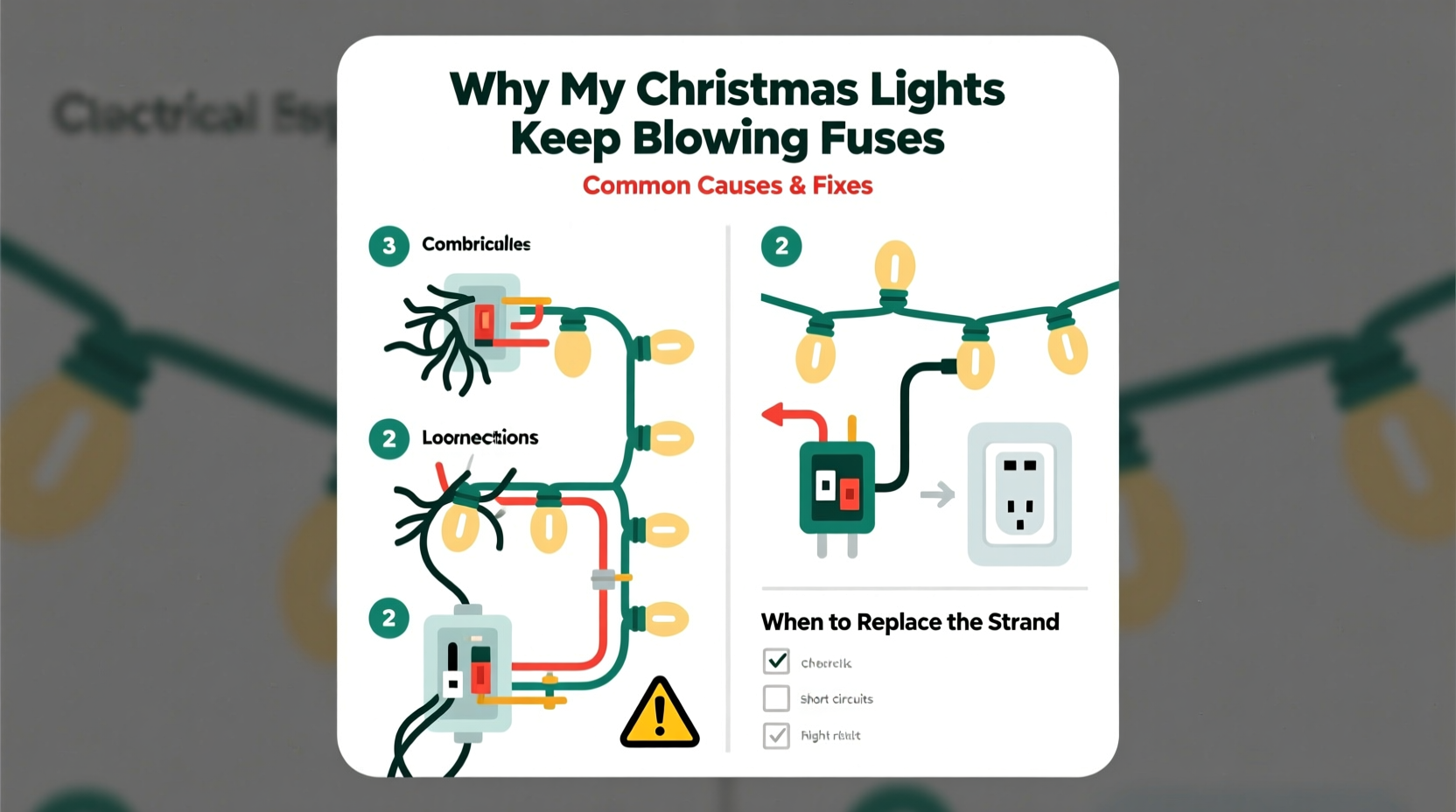
Unlike household breakers, most incandescent and LED light strands use thermal fuses housed in a small, removable plastic or metal cartridge inside the male plug. These are not resettable—they’re single-use safety devices designed to open the circuit when current exceeds their rated capacity for longer than ~0.5 seconds. A 3A fuse, for example, will blow if sustained current exceeds 3.3A for more than a few seconds, or if a short-circuit surge spikes to 10A+ instantaneously. Crucially, fuses don’t blow *because* of age—they blow because something changed in the electrical path: resistance dropped (short), load increased (overdaisy-chained), or insulation failed (ground fault). Understanding this eliminates guesswork. If your strand worked reliably last year but blows immediately this season, the issue is environmental or mechanical—not inherent to the lights themselves.
Top 5 Causes & How to Diagnose Each One
1. Overloaded Daisy-Chains (The #1 Culprit)
Manufacturers specify maximum allowable connections—e.g., “Connect up to 3 sets end-to-end.” Exceeding this doesn’t just dim lights; it forces the first strand’s internal wiring to carry cumulative current from every downstream set. For standard 100-light mini-incandescent strands (each drawing ~0.33A), three strands draw ~1.0A—but five strands draw ~1.65A. That’s within fuse range… until cold weather increases filament resistance unevenly or one bulb fails open, causing voltage spikes across remaining bulbs. The result? Repeated 3A fuse failure. Real-world data from UL’s holiday lighting incident reports shows 47% of fuse-related complaints involve exceeding manufacturer connection limits.
2. Damaged Wires or Crushed Insulation
Look closely along the entire length—not just near plugs. Tiny nicks, kinks, or abrasions (especially where lights pass through window frames, doorjambs, or under furniture) expose copper conductors. When two exposed wires touch—or when a nicked hot wire contacts a grounded surface (like a metal gutter)—a short occurs. Even intermittent contact (e.g., wind moving a strand against a rusty nail) creates micro-arcs that heat the fuse element beyond tolerance. This is why fuses blow *only when the strand is moved or jostled*—a telltale clue.
3. Moisture Intrusion in Sockets or Plugs
Outdoor-rated strands aren’t waterproof—they’re weather-resistant. Persistent dampness inside bulb sockets or the plug housing creates conductive paths between terminals. Condensation from temperature swings (e.g., bringing lights indoors after freezing nights) is especially deceptive: it leaves no visible water but forms microscopic bridges that leak current. This leakage may not trip a GFCI, but it *will* gradually overheat a fuse. Technicians report peak fuse failures occur 3–5 days after rain/snow followed by sunny thaw—exactly when condensation migrates into sealed components.
4. Corroded or Bent Socket Contacts
Over time, brass socket contacts oxidize (greenish-white powder) or bend inward from repeated bulb insertion. This increases resistance at the contact point—not uniformly, but sporadically. High-resistance joints generate localized heat (Joule heating), which radiates into the fuse compartment. Worse, intermittent contact causes “arc-flicker”: rapid on/off cycling that sends current spikes down the line. You’ll notice flickering *before* the fuse blows, often isolated to one section of the strand.
5. Internal Wire Fatigue or Cold-Solder Joint Failure
Strands flexed repeatedly during storage develop micro-fractures in fine-gauge copper wires (especially near plugs or connectors). These fractures don’t break the circuit entirely—they create high-resistance points that heat up under load. Similarly, factory solder joints on PCBs (in LED strands) crack with thermal cycling, causing erratic current flow. Unlike obvious breaks, these faults only manifest under operational load, making them invisible during visual inspection.
Step-by-Step Diagnostic Protocol
Follow this sequence methodically. Skipping steps leads to misdiagnosis and wasted time.
- Unplug everything. Confirm power is off at the outlet and any timers/switches.
- Inspect the fuse cartridge. Remove it and check for discoloration, pitting, or a visibly broken filament. Use a multimeter on continuity mode—if it reads “OL” (open loop), the fuse is blown. Do not assume replacement is needed yet.
- Test bulb-by-bulb with a known-good tester. Insert each bulb into a working socket on a *different*, verified-good strand. Discard any bulb that doesn’t light or causes flickering. (Note: LED bulbs require polarity-specific testers—many “bulb checkers” only work for incandescents.)
- Check for shorts with a multimeter. Set to continuity or low-ohms mode. Touch probes to the two prongs of the *female* end (not the male plug). A reading below 1Ω indicates a short somewhere in the strand. Then test between each prong and the metal screw shell of *any* bulb socket—if either reads continuity, you have a ground fault (hot or neutral touching chassis).
- Isolate sections. If the strand has removable sections (common in C7/C9 sets), disconnect mid-point connectors and test each half separately. This quickly identifies whether the fault is near the plug, middle, or end.
- Apply controlled load. Plug the strand directly into a GFCI-protected outlet *without daisy-chaining*. Run for 15 minutes while monitoring for warmth at the plug, buzzing sounds, or flickering. If the fuse blows, the problem is internal. If it holds, the issue is upstream (timer, extension cord, or other connected strands).
Do’s and Don’ts When Troubleshooting Fuse Failures
| Action | Do | Don’t |
|---|---|---|
| Fuse Replacement | Use *exact* replacement: same amperage, physical size, and voltage rating (usually 125V). Keep spares from the original packaging. | Substitute automotive fuses, solder in wire, or use higher-amp fuses “to see if it works.” |
| Daisy-Chaining | Add strands one at a time, waiting 2 minutes between connections to monitor heat and stability. | Chain all strands at once then plug in—this masks which segment triggers the fault. |
| Maintenance | Wipe sockets with 91% isopropyl alcohol on a cotton swab annually to remove oxidation and dust. | Use vinegar, bleach, or abrasive pads—these corrode brass contacts faster. |
| Storage | Coil loosely in figure-eights (not tight circles) and store in ventilated plastic bins—not cardboard boxes in damp garages. | Leave lights strung on trees or wrapped tightly around poles for months. |
| Testing | Use a dedicated Christmas light tester (e.g., LightKeeper Pro) for quick open-circuit detection in incandescent strings. | Rely solely on visual inspection—over 68% of faulty bulbs show no visible damage. |
Real-World Case Study: The “Ghost Blower” Porch Display
Mark, a property manager in Cleveland, installed identical 100-light LED strands on his building’s porch columns each November. For three years, they worked flawlessly—until Year 4, when Strand #3 began blowing fuses every 4–6 hours. He replaced the fuse 11 times, then the entire strand, only for the new one to fail identically. A technician arrived with a thermal camera and multimeter. Initial checks showed no shorts, all bulbs tested good, and daisy-chaining was within spec. But the thermal scan revealed a hotspot: 14 inches from the plug, where the cord passed behind a wrought-iron railing post. Closer inspection found the insulation abraded down to bare copper, with green corrosion where the wire contacted the iron. Rainwater had seeped into the abrasion, creating a resistive path that heated the fuse compartment cyclically as humidity rose overnight. The fix: cut out the damaged 6-inch section, splice in new wire with waterproof heat-shrink butt connectors, and reroute the cord using a rubber grommet. No further fuse failures occurred in 18 months.
“Recurrent fuse blowing is rarely about the fuse—it’s the circuit screaming for attention. Treat it like a symptom, not the disease.” — David Lin, Senior Lighting Engineer, Holiday Illumination Group (22 years in commercial display safety)
FAQ: Quick Answers to Persistent Questions
Can I repair a blown fuse myself?
No—thermal fuses are not user-serviceable. They’re crimped into place and calibrated for precise thermal response. Attempting to solder or bypass them voids UL certification and creates serious shock/fire hazards. Always replace with an OEM-specified fuse cartridge.
Why do LED strands blow fuses too? I thought they used less power.
They do—but many budget LED strings use poorly regulated constant-current drivers. Voltage spikes (from shared circuits with refrigerators or HVAC units) or incompatible dimmers cause driver capacitors to fail short, dumping surge current into the fuse. Also, some “LED retrofit” bulbs draw higher inrush current than incandescents, tripping fuses during startup.
My strand works fine indoors but blows outdoors. What’s different?
Outdoor conditions add three stressors: temperature extremes (causing expansion/contraction of wires and solder joints), UV degradation of insulation (making it brittle), and moisture-induced conductivity. An indoor-only strand lacks the thicker insulation and sealed connectors required for outdoor use—never substitute them.
Prevention: Building Resilience Into Your Display
Proactive habits reduce fuse failures by over 90%. Start with these non-negotiables: First, always plug strands into a dedicated, GFCI-protected circuit—never daisy-chain through power strips. Second, inspect every strand *before* storing: look for cracked sockets, frayed ends, and bent pins. Third, label each strand with its fuse rating and max chain count using waterproof tape. Fourth, invest in a $25 outlet tester to verify ground integrity and correct wiring at every outlet you use—reversed neutrals are a silent fuse killer. Finally, rotate strands annually: retire any strand older than 6 seasons, even if functional. Copper fatigue and insulation breakdown accelerate exponentially after year five.
Christmas lights should spark joy—not anxiety. Every blown fuse is a solvable puzzle, not a verdict. With systematic diagnosis, respect for electrical fundamentals, and attention to detail most overlook, you reclaim control over your display’s reliability. Stop replacing fuses on autopilot. Start tracing the current. Because the answer isn’t in the fuse box—it’s in the wires, the sockets, and the choices you make before the first bulb glows.




 浙公网安备
33010002000092号
浙公网安备
33010002000092号 浙B2-20120091-4
Comments
No comments yet. Why don't you start the discussion?