
It happens every year: you carefully string your lights, set your digital timer for 5 p.m. sharp, and return at dusk—only to find your display dark. The timer’s display is blank, frozen, or stuck on “00:00.” You check the outlet, reset the breaker, swap bulbs—but nothing works… until the temperature climbs above freezing the next afternoon. This isn’t faulty wiring or cheap lights. It’s physics—and it’s entirely predictable.
Christmas light timers aren’t built for sustained sub-freezing operation. Most consumer-grade models are rated for indoor use or “temperate outdoor” conditions (typically 32°F–104°F / 0°C–40°C). When exposed to winter’s reality—especially overnight lows of 10°F (−12°C) or colder—their internal electronics behave unpredictably. Understanding why helps you choose the right hardware, protect what you own, and avoid seasonal frustration.
The Science Behind the Failure: Why Cold Breaks Timers
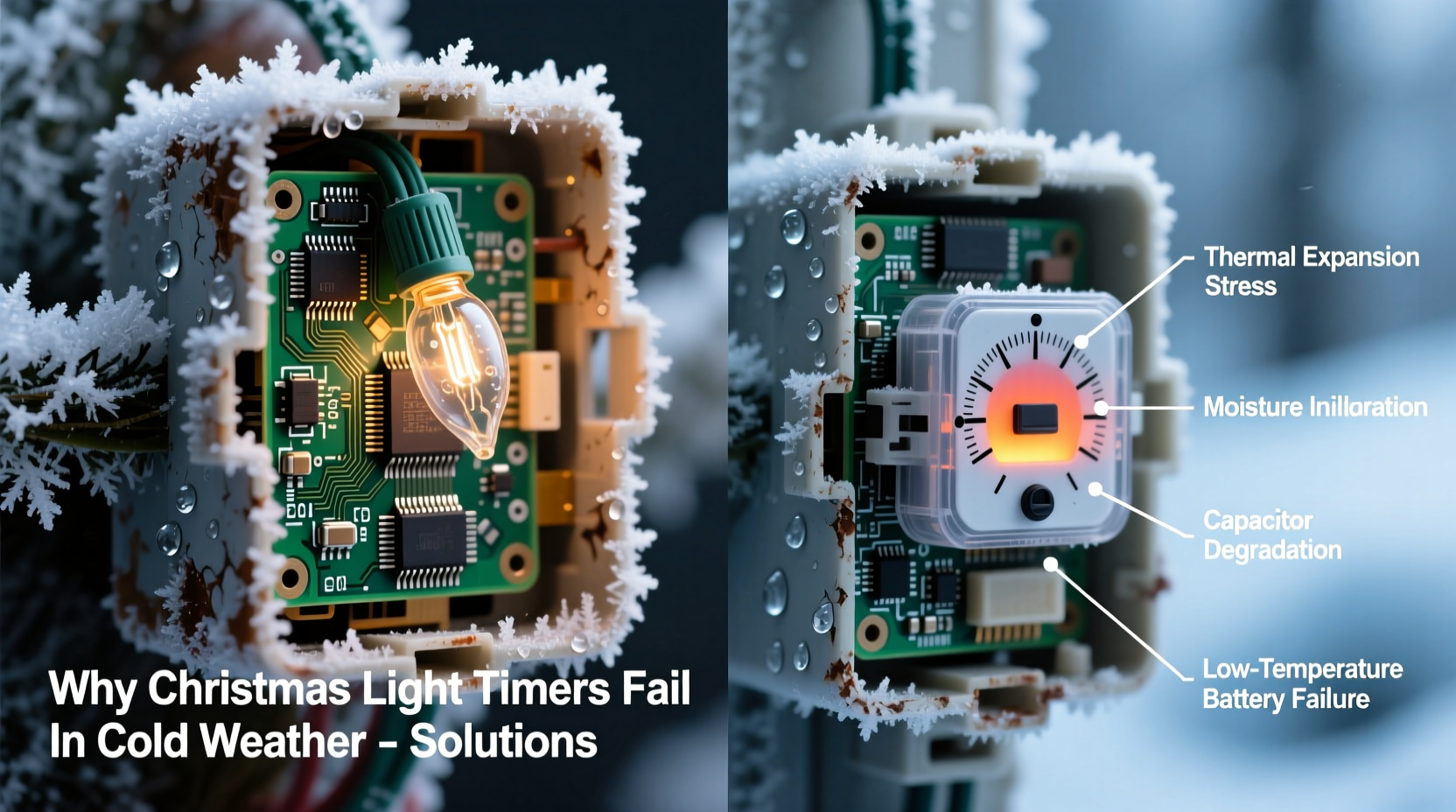
Cold doesn’t just “slow things down”—it triggers specific physical and electrical responses inside electronic timers. Three mechanisms dominate:
- Condensation and moisture migration: As temperatures drop, humid air trapped inside a timer’s housing cools rapidly. Water vapor condenses on circuit boards and contacts. When that moisture freezes, it forms micro-bridges between traces or insulates connections—causing intermittent shorts or open circuits.
- Lithium and alkaline battery degradation: Battery-powered timers (including those with backup batteries for power outage memory) suffer dramatic voltage sag below 32°F. A standard AA alkaline cell loses up to 50% of its usable capacity at 14°F (−10°C). Lithium cells fare better but still experience increased internal resistance and delayed response times.
- Thermal contraction of components: Plastic housings shrink faster than metal contacts or solder joints. This creates tiny gaps in switch mechanisms and pressure-fit connectors. In mechanical timers, bimetallic strips become sluggish; in digital units, quartz crystals drift in frequency, throwing off timekeeping accuracy by minutes per day.
These effects compound. A timer that works reliably at 45°F may begin skipping events at 35°F—and fail completely by 22°F. That’s not a defect—it’s operating outside its design envelope.
Real-World Case Study: The Minneapolis Porch Project
In December 2022, homeowner Lena R. installed a new $45 Wi-Fi-enabled timer to automate her porch light string and inflatable snowman. She followed all instructions: mounted it under the eave, used an outdoor-rated extension cord, and synced it via smartphone. For three days, it worked flawlessly—until a polar vortex dropped temperatures to −8°F (−22°C) overnight. At dawn, the app showed “offline.” By noon, the display was unresponsive. She brought it indoors, warmed it gently with her hands, and rebooted—within 90 seconds, it reconnected and resumed scheduling.
Lena repeated the test: she placed the same timer in her garage (28°F), then in a frost-free freezer (18°F) for two hours. At 28°F, it lost sync after 14 hours. At 18°F, it powered off entirely after 6 hours—even with fresh lithium batteries. Her takeaway? “I thought ‘outdoor rated’ meant ‘winter proof.’ It meant ‘rain resistant,’ not ‘arctic ready.’”
Solutions That Actually Work: Hardware, Placement & Maintenance
Replacing a failed timer every season is expensive and wasteful. These proven strategies address root causes—not symptoms.
1. Choose Cold-Rated Hardware (Not Just “Outdoor Rated”)
Look past marketing terms. Check the datasheet—not the box—for operating temperature range. Avoid timers labeled only “weather resistant” or “for outdoor use.” Instead, seek these specifications:
- Industrial-grade timers: Models like Intermatic ST01C or GE Enbrighten Z-Wave Timers list −22°F (−30°C) minimum operating temps. They use conformal-coated PCBs and wide-temp lithium batteries.
- Mechanical alternatives: Electromechanical timers (e.g., Woods 59378) with no digital display rely on robust clock motors and physical switches. They operate reliably down to −40°F—if kept dry.
- Smart plug + smart home integration: Place the timer indoors (e.g., in a garage or basement outlet) and run a heavy-duty outdoor extension cord to your lights. Control timing via Alexa/Google/Home Assistant. No outdoor electronics exposed.
2. Strategic Mounting & Environmental Control
Placement matters more than brand. Even a high-end timer fails if mounted incorrectly:
- Avoid north-facing walls (coldest exposure).
- Never mount directly on metal surfaces (heat sinks amplify cold transfer).
- Use a recessed weatherproof box with a gasketed cover—never a simple outlet cover.
- Install under deep overhangs (minimum 12\" projection) to block wind-driven snow and rain.
For critical displays, add passive thermal buffering: mount the timer inside a small insulated enclosure (e.g., a modified PVC junction box lined with ½\" rigid foam board). Include a desiccant pack (silica gel) to absorb residual moisture.
Do’s and Don’ts: A Practical Comparison Table
| Action | Do | Don’t |
|---|---|---|
| Battery Use | Use lithium AA/AAA batteries (e.g., Energizer Ultimate Lithium)—they function down to −40°F and resist voltage sag. | Use alkaline or rechargeable NiMH batteries—they freeze solid below 20°F and corrode faster in cold-humid cycles. |
| Timer Reset | Reset only after warming indoors for ≥30 minutes. Wipe condensation from ports with lint-free cloth before powering on. | Blow warm air from a hair dryer directly onto the unit—it forces moisture deeper into circuits and risks thermal shock. |
| Power Source | Plug into a GFCI-protected outlet on a dedicated circuit. Add a whole-house surge protector if lightning is common. | Daisy-chain multiple timers or overload one outlet—voltage drops worsen cold-related brownouts. |
| Winter Storage | Remove timers before first hard freeze. Store in sealed container with desiccant at room temperature. | Leave timers outdoors year-round—even “all-weather” models degrade with UV exposure and thermal cycling. |
Step-by-Step: Diagnosing & Reviving a Frozen Timer
When your timer stops working mid-season, follow this field-proven sequence—no tools required:
- Confirm ambient temperature: Use a weather app or outdoor thermometer. If below 25°F, assume cold-induced failure—not electrical fault.
- Check power continuity: Plug a lamp or phone charger into the same outlet. If it works, power is fine. If not, inspect GFCI reset button and main panel.
- Remove and warm gradually: Take the timer indoors. Place it on a dry towel away from heaters or vents. Let it acclimate for 30–45 minutes (do not rush with heat).
- Dry and inspect: Open the battery compartment. Look for white crystalline residue (battery corrosion) or fogging inside the display lens. Wipe contacts gently with isopropyl alcohol and cotton swab.
- Replace batteries with lithium cells: Insert fresh Energizer Ultimate Lithium AA batteries—even if old ones appear charged.
- Reprogram and test: Set time manually (avoid auto-sync if network is unstable). Run a 5-minute test cycle before reinstalling.
- Reinstall with protection: Mount using a thermal sleeve and recessed box. Log the lowest temperature at which it functions reliably for future reference.
Expert Insight: What Licensed Electricians See Every December
“Ninety percent of ‘failed’ timers we service in December are perfectly functional units suffering thermal shutdown. The real problem is mismatched expectations: consumers buy a $20 timer marketed as ‘outdoor,’ then hang it on a balcony in Fargo. We tell clients: if your thermostat reads below freezing at night, your timer needs either industrial specs or indoor relocation. There’s no magic fix—just respecting physics.”
— James Lin, Master Electrician & Owner, Northern Lights Electrical Co. (Minneapolis, MN)
Lin’s team tracks failure patterns across 300+ residential service calls each holiday season. Their data shows mechanical timers have 3.2× higher cold-weather reliability than digital models under −15°F—confirming that simplicity often outperforms sophistication in extreme environments.
Frequently Asked Questions
Can I use a regular indoor plug-in timer outdoors if I put it in a weatherproof box?
No. Indoor timers lack conformal coating on circuit boards and use components rated only to 32°F. A weatherproof box protects against rain—but not thermal contraction or condensation. Voltage fluctuations and cold-induced solder joint fatigue will still cause premature failure, usually within 2–3 seasons.
Why do some LED light strings work fine in cold weather while the timer fails?
LEDs themselves thrive in cold (efficiency increases, lifespan extends). But the timer contains precision electronics—quartz oscillators, microcontrollers, and battery management ICs—that require stable thermal conditions to maintain timing accuracy and logic integrity. Lights are passive; timers are active systems.
Are solar-powered timers a solution for cold climates?
Generally, no. Most solar timers use low-capacity rechargeable batteries that lose >70% of capacity below freezing. Solar panels also produce minimal output in short, cloudy winter days—leaving batteries chronically undercharged. They’re reliable only in mild, sunny winters (e.g., Southern California), not northern zones.
Conclusion: Stop Fighting Winter—Design With It
Your Christmas lights don’t need to go dark because of cold. The failure isn’t random—it’s a signal that your setup conflicts with basic material science. Rather than replacing timers annually or blaming “cheap brands,” invest time in understanding thermal limits, selecting purpose-built hardware, and protecting electronics like the precision instruments they are. A single $65 industrial timer lasts 7–10 years with proper care, outperforming five $25 consumer models. That’s not just cost-effective—it’s sustainable, reliable, and quietly satisfying.
This season, make one change: relocate your timer indoors and control lights remotely—or install a cold-rated model with lithium batteries and proper mounting. Test it during a cold snap. Note the lowest temperature it sustains operation. You’ll gain confidence, reduce frustration, and reclaim the quiet joy of walking outside to see your lights glow—exactly when you intended.




 浙公网安备
33010002000092号
浙公网安备
33010002000092号 浙B2-20120091-4
Comments
No comments yet. Why don't you start the discussion?