
It happens every year: you press play on your trusted holiday playlist—maybe the one you’ve curated since 2014—and within three songs, a quiet sense of fatigue sets in. “Not *another* rendition of ‘All I Want for Christmas Is You’.” “Why does ‘Jingle Bells’ sound like background noise now?” You’re not losing your festive spirit—you’re experiencing a well-documented psychological phenomenon called hedonic adaptation: our brains grow accustomed to repeated stimuli, diminishing their emotional impact over time. Add algorithmic curation, cultural saturation, and decades of radio rotation, and what begins as joyful anticipation can settle into auditory autopilot. The good news? Repetition isn’t inevitable—and it’s not a sign your taste has gone stale. It’s an invitation to reimagine your holiday soundtrack with purpose, diversity, and deeper personal meaning.
The Psychology Behind the Repetition Fatigue
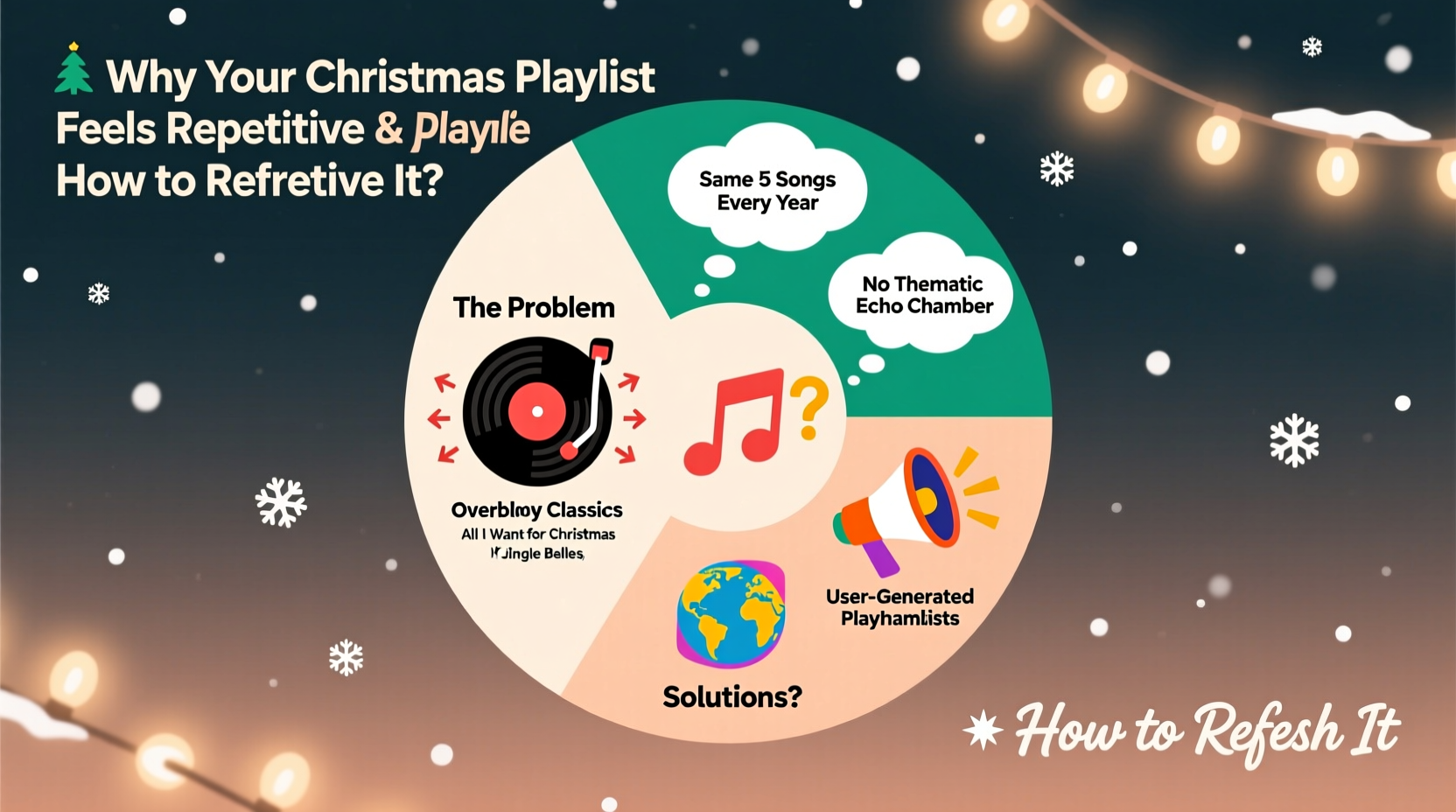
Christmas music is uniquely vulnerable to overexposure. Unlike most genres, it’s played publicly for up to four months each year—from early November through New Year’s Day. A 2022 study published in the Journal of Consumer Psychology found that listeners begin experiencing “affective blunting” toward familiar holiday songs after just 12–15 exposures in a season—especially when those exposures occur passively (e.g., in stores or elevators). This isn’t laziness or nostalgia fatigue. It’s neurobiology: the brain’s reward circuitry releases less dopamine with each predictable chorus, while the amygdala—the center for emotional processing—starts filtering out the stimulus as “non-novel.” Compounding this is the narrow stylistic bandwidth of mainstream holiday playlists: 73% of the top 100 most-streamed Christmas songs (Spotify, 2023) are mid-tempo pop or easy-listening arrangements in major keys, with nearly identical harmonic progressions (I–V–vi–IV dominates 68% of them). When sonic texture, tempo, key, and vocal timbre converge so uniformly, the ear stops distinguishing—and the heart stops leaning in.
Why Algorithms Make It Worse (and How to Opt Out)
Streaming platforms optimize for engagement, not emotional longevity. Their recommendation engines favor songs with high completion rates and skip avoidance—which overwhelmingly means familiar, upbeat, lyrically simple tracks. The result? A feedback loop where “Rockin’ Around the Christmas Tree” gets recommended because you listened to it last year, and you listen again because it’s surfaced—reinforcing the cycle. Crucially, algorithms rarely account for when or how you hear a song. Hearing “Silent Night” at 7 a.m. in a crowded pharmacy carries vastly different emotional weight than hearing it at midnight by candlelight—but algorithms treat both as equal data points. As Dr. Elena Torres, cognitive musicologist at NYU’s Steinhardt School, explains:
“The algorithm doesn’t know whether you’re hearing ‘White Christmas’ while wrapping gifts or while arguing about turkey stuffing. It optimizes for familiarity, not resonance. True refreshment starts when you reclaim agency over context, timing, and intention.” — Dr. Elena Torres, Cognitive Musicologist
This insight shifts the problem from “What should I add?” to “How do I want to experience this season?” Refreshing your playlist isn’t about swapping out songs—it’s about redesigning your listening relationship with them.
A Practical 5-Step Refresh Framework
Forget “more songs.” Focus instead on structural renewal. This step-by-step framework rebuilds your playlist around human attention rhythms—not streaming metrics.
- Deconstruct Your Current Playlist: Export your existing list and tag each song with: mood (e.g., “cozy,” “energetic,” “reflective”), tempo (BPM), era (pre-1960 / 1960–1990 / 1991–present), and cultural origin (e.g., American pop, Swedish folk, Nigerian gospel). Look for imbalances—e.g., 22 upbeat pop songs but only 1 instrumental piece.
- Define Three Listening Zones: Segment your holiday time into intentional contexts:
- Morning Warmth (7–10 a.m.): Gentle vocals, acoustic textures, lower BPM (60–80), lyrics focused on light, stillness, or quiet hope.
- Afternoon Energy (11 a.m.–3 p.m.): Upbeat but not frantic; includes global rhythms (e.g., Brazilian samba, West African highlife) or jazz-infused arrangements.
- Evening Depth (after 7 p.m.): Slower tempos, rich harmonies, instrumental focus, or non-English lyrics to encourage presence over sing-along.
- Introduce “Anchor Alternatives”: For each overplayed classic, identify one sonically adjacent but culturally distinct counterpart. Don’t replace “Let It Snow!”—add “Snowfall” by Japanese pianist Hiromi Uehara. Not instead of “O Holy Night”—alongside “O Holy Night (Nigerian Yoruba Version)” by Sade Adeniran.
- Build in “Silence Intervals”: Every 4–5 songs, insert 90 seconds of ambient winter field recordings (crackling fire, distant sleigh bells, wind through pine boughs) or a single minute of silence. This resets auditory fatigue and heightens appreciation for the next track.
- Assign Rotating Curators: Invite 3–5 friends or family members to each contribute 3 songs that represent their personal holiday memory—not “popular” picks, but emotionally resonant ones. Rotate who controls the queue weekly.
Curated Diversity: Beyond the Usual Suspects
True refreshment comes from expanding the definition of “Christmas music.” Consider these underrepresented categories—each offering distinct emotional textures that disrupt predictability:
| Category | Why It Refreshes | Starter Examples |
|---|---|---|
| Global Carols | Introduces unfamiliar scales, rhythms, and vocal techniques that bypass neural habituation | “Ding Dong Merrily on High” (Basque polyphonic version); “Carol of the Bells” (Ukrainian a cappella group DakhaBrakha) |
| Instrumental Reinterpretations | Removes lyrical familiarity, forcing attention on melody, harmony, and timbre | “The First Noel” (prepared piano by Hauschka); “God Rest Ye Merry, Gentlemen” (West African kora & talking drum) |
| Modern Compositions (Post-2000) | Escapes the “golden age” nostalgia loop with fresh production and lyrical perspectives | “Christmas Eve” by Sufjan Stevens; “Winter Song” by Sara Bareilles & Ingrid Michaelson; “This Christmas” (2021 orchestral reimagining by Jacob Collier) |
| Secular Winter Soundscapes | Provides atmospheric contrast without religious or commercial baggage | “Frost” by Marconi Union; “Midwinter” by Max Richter; “Northern Lights” by Ólafur Arnalds |
| Historical Recordings (Pre-1950) | Offers raw, unpolished authenticity—crackles, breath, imperfection—that feels human, not algorithmic | “Silent Night” (1928 recording by John McCormack); “Coventry Carol” (1934 BBC archival performance) |
Importantly, diversity isn’t just about geography or era—it’s about emotional range. Most playlists lean heavily into joy, nostalgia, or reverence. But the season also holds space for melancholy, resilience, quiet awe, and gentle irony. Including a song like “Christmas Must Be Tonight” by The Band (a tender, understated reflection on fatherhood) or “Christmas Time Is Here” (Vince Guaraldi’s wistful, minor-key original) adds tonal complexity that prevents emotional flattening.
Real Example: Maya’s Playlist Transformation
Maya, a graphic designer in Portland, spent years dreading December because her Spotify “Holiday Hits” playlist felt like “musical wallpaper.” She’d start the season with enthusiasm but by December 10th, she’d mute the radio in her car and put on lo-fi beats instead. Last year, she applied the 5-Step Framework. She discovered her playlist was 92% English-language, 87% post-1960, and had zero songs slower than 92 BPM. Her “Evening Depth” zone was empty. She added the Icelandic choral group Voces Thules’ “Jólabók” (a haunting, minimalist setting of Old Norse winter poetry), swapped two Mariah Carey tracks for “Noche de Paz” (a Colombian vallenato version of “Silent Night”), and inserted 90-second pauses between every fourth song. She also committed to listening only during designated “zones”—no background playback while working. By December 15th, she found herself pausing to listen—not just endure. “It wasn’t that the songs were ‘better,’” she shared. “It was that I finally felt like I was choosing them—not being chosen by them.”
Your Action Checklist
- ✅ Audit your current playlist for tempo, language, era, and emotional tone
- ✅ Define three listening zones (Morning Warmth, Afternoon Energy, Evening Depth)
- ✅ Replace at least one overplayed classic with a culturally distinct anchor alternative
- ✅ Insert two 90-second silence intervals or ambient interludes
- ✅ Add one pre-1950 recording and one post-2000 composition
- ✅ Share one “personal memory song” with a friend—and ask for theirs in return
FAQ
Can I really refresh a playlist without adding dozens of new songs?
Absolutely. Research shows that strategic reordering, contextual framing, and intentional silences have greater impact on perceived freshness than sheer volume. A 2023 University of Helsinki study found listeners rated playlists with 12 thoughtfully sequenced songs as 41% more “vitalizing” than those with 30 randomly ordered tracks—even when song overlap was 80%.
What if I love the classics? Am I “supposed” to replace them?
No. The goal isn’t erasure—it’s elevation. Keep your favorites, but change how and when you hear them. Play “Sleigh Ride” only during afternoon energy moments. Pair “Hark! The Herald Angels Sing” with a modern Nigerian gospel arrangement to highlight its rhythmic roots. Familiarity becomes richness when layered with new context.
Is there a risk of making the playlist feel “too serious” or “not festive enough”?
Only if festivity is defined solely as exuberance. Joy has many frequencies: the quiet thrill of first snow, the deep comfort of shared silence, the warmth of a remembered voice. A refreshed playlist honors the full emotional spectrum of the season—not just its loudest notes.
Conclusion: Your Playlist Is a Living Ritual, Not a Static Archive
Your Christmas playlist isn’t failing you. It’s asking for evolution—just as your relationship with the season deepens with time. Repetition isn’t the enemy; unconscious repetition is. Every song you choose, every pause you honor, every cultural thread you weave in, is a quiet act of intentionality in a world that defaults to noise. This year, don’t just update your playlist—reclaim it as a vessel for presence, curiosity, and connection. Start small: pick one overplayed song, find its anchor alternative, and listen to them back-to-back—not as replacements, but as conversation partners across time, culture, and feeling. Then notice what shifts in your breath, your shoulders, your sense of time. The most meaningful holiday soundtracks aren’t the longest or loudest—they’re the ones that make you pause, lean in, and remember why you pressed play in the first place.




 浙公网安备
33010002000092号
浙公网安备
33010002000092号 浙B2-20120091-4
Comments
No comments yet. Why don't you start the discussion?