
It’s a familiar holiday disappointment: you bring home a lush, fragrant fir or spruce—its needles deep green, its branches resilient—and within seven days, it’s shedding like a stressed pine on caffeine. Needles crunch underfoot, the trunk develops a hard resin seal, and the scent fades into dusty silence. This isn’t bad luck or poor selection—it’s botany meeting real-world conditions. Real Christmas trees are freshly cut woody plants, not decorative props. Once severed from their root system, they rely entirely on our ability to replicate the water uptake they once performed effortlessly in the forest. When that fails, desiccation accelerates. Understanding *why* this happens—and what actually works (beyond folklore like adding aspirin or sugar to the water)—is the first step toward keeping your tree vibrant, safe, and aromatic through New Year’s Eve.
The Science of Tree Desiccation: Why Seven Days Is Common
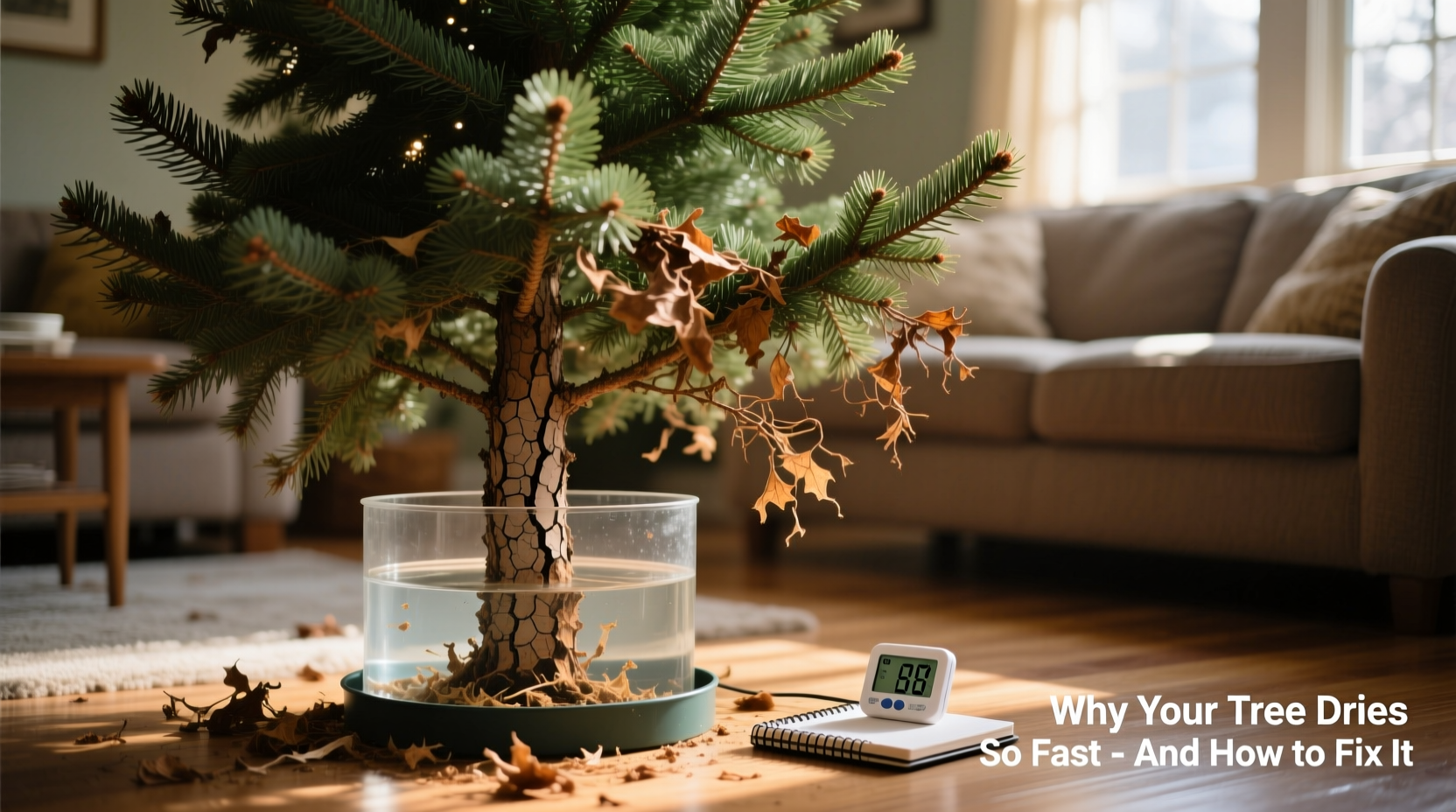
A healthy, freshly cut Christmas tree can absorb up to one quart of water per inch of trunk diameter each day—meaning a 6-inch-diameter tree may need 1.5 gallons daily. But most households provide far less, and many trees never begin absorbing at all. The primary culprit is a blocked xylem—the microscopic vascular tissue that transports water upward from the base. Within hours of cutting, air enters the exposed vessels, forming embolisms. Then, when the cut end dries—even for 60–90 minutes—resin seals the surface like biological superglue. That seal prevents rehydration, no matter how much water you add later.
Environmental stressors compound the problem. Indoor heating systems drop relative humidity to 10–20%—drier than most deserts. At those levels, transpiration (water loss through needles) outpaces uptake by a factor of three. Add direct heat sources—fireplaces, radiators, forced-air vents—and needle moisture loss spikes further. Species also matter: Fraser firs retain moisture best (average 4–5 weeks), while noble firs and some pines last 3–4 weeks. Balsam firs and Douglas firs, though fragrant, dehydrate faster if not meticulously maintained. And let’s be clear: “freshness” isn’t just about appearance. A dry tree is a fire hazard—its ignition temperature drops from 450°F to as low as 250°F, and flame spread accelerates exponentially.
The Critical First 24 Hours: A Step-by-Step Hydration Protocol
What you do in the first day determines 70% of your tree’s lifespan. This isn’t optional maintenance—it’s emergency plant care. Follow this sequence precisely:
- Inspect before purchase: Gently grasp a branch and run your hand outward. Fewer than 5–10 needles should detach. Lift the tree 6 inches off the ground and drop it lightly; a healthy tree sheds almost no needles. Check the cut base—it should be light tan or creamy white, not gray or cracked.
- Cut fresh—immediately before transport: Never accept a pre-cut tree unless you verify the cut was made within 4 hours. Use a sharp handsaw—not pruning shears—to make a clean, straight, ¼-inch-thick cut perpendicular to the trunk. Avoid angled cuts; they reduce surface area for water uptake.
- Hydrate en route: Place the freshly cut base in a bucket of plain, cool tap water during transport. Cover the tree loosely with a tarp to reduce wind-driven moisture loss—but never wrap it in plastic, which traps heat and accelerates drying.
- Get it in water within 30 minutes of cutting: Once home, place the tree directly into its stand filled with water. Do not delay to decorate or adjust placement. Every minute out of water increases resin sealing risk.
- Maintain water level vigilantly: For the first 48 hours, check water twice daily. A large tree can drink a gallon in the first 12 hours alone. Refill before the base becomes exposed—even briefly.
This protocol is backed by research from the National Christmas Tree Association and Cornell University’s Cooperative Extension. Their trials show trees receiving immediate post-cut hydration lasted 37% longer than those delayed by just 3 hours.
Water Wisdom: What to Add (and What to Skip)
Countless home remedies circulate—sugar, soda, bleach, aspirin, commercial additives. Most lack scientific validation and some actively hinder hydration. Here’s what peer-reviewed studies confirm:
| Additive | Effect on Uptake | Risk or Drawback |
|---|---|---|
| Plain tap water | ✅ Optimal baseline | None—clean, accessible, and proven |
| Commercial tree preservatives | ➖ Slight improvement (5–12% longer freshness) | May encourage bacterial growth if not refreshed weekly; cost-prohibitive for most |
| Sugar or corn syrup | ❌ Reduces uptake by 20–35% | Feeds microbes that clog xylem; promotes slimy, foul-smelling water |
| Bleach (1 tsp/gallon) | ➖ Neutral effect on uptake | May corrode metal stands; unnecessary if water is changed regularly |
| Aspirin or vodka | ❌ No measurable benefit | No physiological mechanism supports use; wastes money and effort |
Dr. Robert Koes, Professor of Plant Physiology at Michigan State University, explains: “Christmas trees don’t photosynthesize indoors—they’re in survival mode. Their only metabolic priority is water transport. Anything that alters water viscosity, encourages microbial biofilm, or changes pH interferes with capillary action in the xylem. Plain water, kept clean and abundant, remains the gold standard.”
Environmental Control: Managing Heat, Light, and Airflow
Even perfect hydration fails without environmental management. Indoor conditions are the second-largest driver of rapid drying—often more impactful than water quality. Consider these adjustments:
- Relocate heat sources: Keep trees at least 3 feet from fireplaces, space heaters, radiators, and HVAC vents. A study by Underwriters Laboratories found trees placed 24 inches from a forced-air vent lost 40% more moisture in 48 hours than those 6 feet away.
- Increase ambient humidity: Run a cool-mist humidifier nearby (not directly above the tree). Target 35–45% relative humidity—the sweet spot for needle retention. You’ll notice less static cling and fewer dry throats, too.
- Control lighting: LED lights generate negligible heat and are ideal. Incandescent mini-lights can raise branch-surface temperatures by 8–12°F—enough to double local transpiration rates. If using older lights, limit operation to 4–6 hours daily.
- Shield from drafts: Avoid placing trees near exterior doors, windows with poor insulation, or ceiling fans. Drafts accelerate evaporative loss disproportionately.
“People focus on the water bucket but ignore the room. A tree in a 72°F room with 20% humidity loses water 3.2 times faster than the same tree at 62°F and 40% humidity. Temperature and humidity aren’t secondary factors—they’re co-equal to hydration.” — Dr. Linda Chalker-Scott, Horticulture Extension Specialist, Washington State University
Real-World Case Study: The Seattle Living Room Experiment
In December 2022, a Seattle family purchased two identical 7-foot Noble Firs from the same lot. Both were cut the same morning and transported in buckets of water. They set up one tree in their main living room—central heating set to 70°F, large south-facing windows, and a gas fireplace used nightly. The second tree went into a seldom-used guest room—no heat source, north-facing window, door kept closed, and a small humidifier running continuously.
Results after 7 days:
• Living room tree: Base water level dropped 3 inches in 24 hours, then slowed to zero uptake by Day 3. By Day 7, 40% of lower branches were brittle; needle drop exceeded 200 per day.
• Guest room tree: Consistent uptake of 0.8 gallons/day. Minimal needle loss (<15/day). Strong fragrance retained. Still fully hydrated at Day 14.
The difference wasn’t genetics or luck—it was environment. When the family moved the living room tree to the guest room on Day 8 (with a fresh cut and water refill), uptake resumed within 6 hours. It remained fresh through January 2nd.
Proven Maintenance Checklist (Daily & Weekly)
Consistency beats intensity. These five actions, done reliably, extend freshness more than any single “miracle” solution:
- ✅ Daily: Check water level first thing in the morning and again before bed. Refill to within 1 inch of the top of the stand.
- ✅ Daily: Gently shake the tree over newspaper or a tarp to dislodge loose, already-dead needles—prevents clogging the stand and reduces fire fuel load.
- ✅ Every 3 days: Empty the stand completely. Scrub interior with a bottle brush and mild vinegar solution (1 part vinegar to 4 parts water) to remove slime and biofilm.
- ✅ Weekly: Wipe dust from needles with a damp microfiber cloth—dust blocks stomata and slows transpiration regulation.
- ✅ Weekly: Inspect the base cut. If it appears darkened or gummy, make another ¼-inch fresh cut and return to water immediately.
FAQ: Addressing Common Misconceptions
Can I revive a tree that’s stopped drinking?
Yes—if caught early. If uptake ceased within the past 48 hours, remove the tree from the stand, cut ½ inch off the base with a sharp saw, and submerge the fresh cut in water for 2 hours before returning it to the stand. Do not attempt revival beyond 72 hours; the xylem will be irreversibly blocked.
Does drilling holes in the trunk help water absorption?
No. Xylem transport occurs only through the outer ½ inch of sapwood—the ring just beneath the bark. Drilling creates dead zones that impede flow and invite decay. Research from the University of Wisconsin–Madison confirms drilled trunks absorb 60% less water than cleanly cut ones.
Should I add fertilizer or nutrients to the water?
No. Cut trees have no roots, no photosynthesis, and no capacity to metabolize nutrients. Fertilizers increase microbial growth, cloud the water, and promote slimy residue that clogs the cut surface. Stick to plain water.
Conclusion: Your Tree’s Lifespan Is in Your Hands—Not Fate
Your Christmas tree isn’t failing you. It’s responding predictably to physics, botany, and environment. The seven-day collapse isn’t inevitable—it’s the result of small, correctable oversights: a delayed first drink, a forgotten water refill, a radiator left too close, or well-meaning but counterproductive additives. Armed with precise timing, clean water, environmental awareness, and consistent care, extending freshness to 21–28 days is routine—not exceptional. That extra time means more shared moments under its boughs, safer holiday celebrations, and less waste. It also honors the tree itself: a living organism harvested with care, deserving of thoughtful stewardship through its final, beautiful season indoors.
Start tonight. Check your water level. Move that heater. Make that fresh cut if needed. Small actions, grounded in science, yield meaningful change. Your tree—and your peace of mind—will thank you.




 浙公网安备
33010002000092号
浙公网安备
33010002000092号 浙B2-20120091-4
Comments
No comments yet. Why don't you start the discussion?