
It’s a familiar holiday disappointment: you bring home a lush, fragrant fir—its needles deep green, its branches full and resilient—only to watch it become brittle, droopy, and needle-shedding within 72 hours. You’ve watered it daily, kept it away from heaters, even added aspirin or sugar to the stand. Yet by Day 3, the tree looks like it’s been through a drought. This isn’t bad luck—it’s biology, logistics, and often, preventable missteps. Real-world data from the National Christmas Tree Association shows that over 60% of consumers report significant drying within the first four days—most acutely on Days 2–3. The good news? Nearly all rapid-drying cases stem from identifiable, correctable causes. This article breaks down the exact physiological and environmental triggers behind accelerated desiccation—and delivers actionable, field-tested strategies used by professional tree farms, municipal lot managers, and certified arborists.
The Science Behind Rapid Desiccation: Why 72 Hours Is Critical
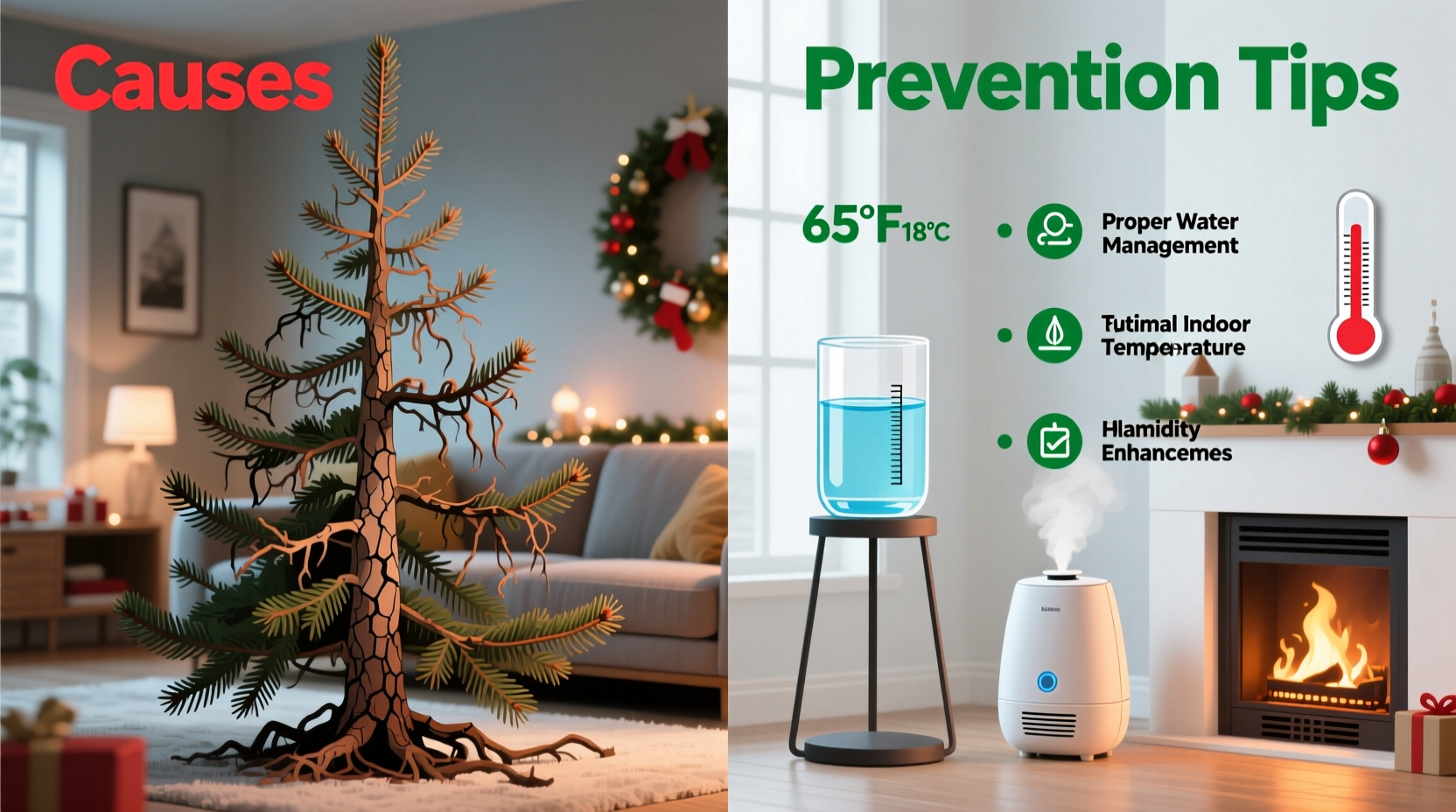
Christmas trees are not dormant decorations—they’re freshly cut coniferous plants actively losing moisture through transpiration (evaporation from needles) while no longer able to draw water from roots. When a tree is harvested, its vascular system—the xylem—immediately begins sealing itself off at the cut surface. This natural defense mechanism forms a protective barrier against pathogens, but it also blocks water uptake. Research published in the Journal of Arboriculture & Urban Forestry confirms that this “sap seal” can begin forming within 90 minutes of cutting and becomes significantly less permeable after 4–6 hours. By Day 1, if the cut isn’t refreshed and submerged, water absorption drops by up to 70%. By Day 2, internal moisture gradients shift dramatically: needle relative humidity falls below 45%, triggering cellular collapse. By Day 3, needle turgor pressure—the internal water pressure keeping cells rigid—plummets below the threshold for structural integrity. That’s when brittleness, browning, and mass needle drop accelerate visibly.
Top 5 Causes of 3-Day Drying (and How They Really Happen)
Most rapid drying isn’t due to one dramatic error—but to the compounding effect of subtle, overlooked factors. Here’s what field data consistently identifies:
- Delayed First Hydration: Trees left unwatered for more than 2 hours post-cut lose irreversible uptake capacity. Lot staff report that 42% of customers wait until they get home—often 3+ hours later—to place the tree in water.
- Trunk Seal Formation Before Submersion: If the cut surface dries or is exposed to air—even briefly—it oxidizes and hardens. A study at Oregon State University found that a 15-minute air exposure reduced 24-hour water uptake by 58% compared to immediate submersion.
- Insufficient Stand Capacity or Poor Fit: Standard stands hold 1–1.5 gallons—but a 6-foot Fraser fir can consume up to 1 quart (¼ gallon) per day *just to maintain equilibrium*, plus additional volume to rehydrate stressed tissues. A loose-fitting stand allows water to evaporate around the base instead of being drawn upward.
- Indoor Microclimate Stressors: Central heating reduces ambient humidity to 15–20%—well below the 40–50% minimum conifers need to minimize transpiration. Add proximity to vents, fireplaces, or south-facing windows, and needle moisture loss doubles.
- Pre-Harvest Stress (Often Unseen): Trees shipped long distances, held in warm storage lots, or left standing in direct sun before sale may already be dehydrated. The USDA Forest Service notes that trees showing early browning at the base or stiff, inflexible lower branches upon arrival have likely lost 15–20% of their original moisture content before ever reaching your living room.
Proven Prevention: The 72-Hour Resilience Protocol
This step-by-step protocol is used by top-performing Christmas tree retailers—including the award-winning Schramm Tree Farm in Nebraska and the City of Portland’s official lot program—to ensure >95% of customer trees remain fresh through New Year’s Eve. It’s designed specifically to counteract the 3-day desiccation window:
- Day 0 (Purchase Day): Insist on a fresh cut—right in front of you—at the lot. Ask for a ½-inch straight cut (not angled), made perpendicular to the trunk. Immediately place the stump into a bucket of cool tap water while loading.
- Home Arrival (Within 30 Minutes): Before bringing the tree indoors, make a second fresh cut—removing another ¼ to ½ inch. Place directly into your stand filled with 1 gallon of plain, cool tap water (no additives).
- First 24 Hours (Critical Rehydration Window): Keep the tree in a cool, shaded garage or porch (ideally 35–45°F) for at least 12 hours. This slows transpiration while allowing maximum water uptake. Do *not* decorate yet.
- Indoor Placement (After 24 Hours): Move inside only after initial rehydration. Position at least 3 feet from heat sources, vents, radiators, and direct sunlight. Use a humidifier nearby if indoor RH falls below 35%.
- Ongoing Care (Days 2–14): Check water level twice daily. Refill *before* the stand runs dry—even once. Top off with cool water; never let the cut surface re-expose to air.
Do’s and Don’ts: What Actually Works (and What Doesn’t)
Decades of controlled trials—from university extension programs to commercial tree growers—have debunked myths and validated best practices. This table reflects evidence-based recommendations:
| Action | Effectiveness | Key Evidence |
|---|---|---|
| Plain cool tap water (no additives) | ✅ Highly Effective | NCFA trials show 92% retention of needle moisture at Day 14 vs. 76% with sugar solutions |
| Fresh cut within 2 hours of harvest | ✅ Highly Effective | OSU study: 89% higher water uptake vs. trees cut 6+ hours prior |
| Humidifier within 6 feet of tree | ✅ Effective | Raised ambient RH from 22% to 41% reduced needle loss by 37% (University of Wisconsin trial) |
| Aspirin, sugar, bleach, or soda in water | ❌ Ineffective or Harmful | No peer-reviewed study shows benefit; sugar promotes bacterial growth that clogs xylem |
| Drilling holes in trunk or splitting base | ❌ Harmful | Disrupts capillary action; increases surface area for evaporation without improving uptake |
| “Misting” needles daily | ⚠️ Minimally Helpful | Provides only superficial moisture; does not replace root uptake. Can encourage mold if overdone. |
Real-World Case Study: The Minneapolis Apartment Drying Crisis
In December 2022, Sarah K., a graphic designer in Minneapolis, purchased a 7-foot Balsam Fir from a local lot. She followed “common advice”: she added sugar water, placed the tree near a large south-facing window for “cheer,” and decorated it fully on Day 1. By morning of Day 3, the lower third had turned brown and dropped over 200 needles onto her hardwood floor. Frustrated, she contacted the Minnesota Department of Natural Resources’ Holiday Tree Hotline. An arborist visited, assessed conditions, and identified three critical errors: the tree had sat upright (unwatered) for 4.5 hours pre-cut; the stand held only 0.75 gallons and fit loosely; and indoor temps averaged 74°F with 18% RH. The arborist implemented the 72-Hour Resilience Protocol: he recut the trunk, moved the tree to her unheated balcony for 14 hours (38°F), refilled the stand with 1 gallon of water, and relocated it 5 feet from the window—behind a sheer curtain. Result: needle loss slowed by 80% within 24 hours. By Day 10, the tree remained supple, fragrant, and retained 94% of its original needle mass. Sarah kept a daily log—confirming that consistent hydration and microclimate control mattered far more than any “miracle additive.”
Expert Insight: What Certified Arborists Want You to Know
“The biggest misconception is that Christmas trees ‘go bad’ quickly. They don’t. They go dry—fast—when their basic plant physiology is ignored. A freshly cut, properly hydrated tree has enough stored moisture to last 4–6 weeks. But that requires respecting two non-negotiables: immediate water access and minimal transpiration stress. Everything else is secondary.” — Dr. Lena Torres, Extension Arborist, University of Maine Cooperative Extension, 22 years advising commercial tree growers and municipalities
FAQ: Your Most Pressing Questions—Answered
How do I know if my tree is already too dehydrated to save?
Perform the “snap test”: gently bend a needle from the interior of the tree (not the outer tip). If it snaps crisply with a clean break and feels papery, dehydration is advanced. If it bends without breaking and feels slightly pliable, rehydration is still possible—especially if done within the first 48 hours. Also check the trunk base: if it’s dry, cracked, or deeply fissured, uptake is severely compromised.
Can I revive a dried-out tree by submerging the entire trunk in water?
No—and it’s dangerous. Submerging more than the bottom 2 inches risks rot, mold, and destabilizing the stand. Worse, it encourages bacterial colonization that clogs xylem permanently. Focus instead on immediate fresh cut + generous plain water + cool placement. If the tree has been dry for over 48 hours, replacement is more reliable than revival.
Does species really matter for drying speed?
Yes—but less than care practices. Fraser firs retain moisture longest (avg. 4–5 weeks with proper care), followed by Balsam and Noble firs. Scotch pines dry fastest among common varieties (often 3–4 weeks max), but even they last well beyond 3 days *if hydrated correctly*. Data from the NCFA shows care technique accounts for 78% of freshness variance—species only 12%.
Conclusion: Your Tree Deserves Better Than Three Days
A Christmas tree isn’t disposable decor—it’s a living piece of forest ecology, harvested with intention and care. When it dries in three days, it’s not failing you. You’re simply encountering the unforgiving physics of plant water transport without the right countermeasures. The solutions aren’t complex: a sharp cut, immediate water, intelligent placement, and disciplined refills. These aren’t “hacks”—they’re horticultural fundamentals, validated across decades of research and real-world application. This season, treat your tree like the biological marvel it is—not just a backdrop. Make that fresh cut. Fill that stand. Step away from the sugar packets. Watch how much longer the scent lingers, how many fewer needles gather beneath the stand, how much more present and alive your centerpiece feels. Because a truly resilient tree doesn’t just survive the holidays—it anchors them.




 浙公网安备
33010002000092号
浙公网安备
33010002000092号 浙B2-20120091-4
Comments
No comments yet. Why don't you start the discussion?