
Nothing signals the holiday season quite like the scent of fresh pine—but nothing dampens the spirit faster than watching your Christmas tree shed needles by mid-December. A healthy cut evergreen should retain moisture and stay vibrant for four to six weeks indoors. Yet many households report significant drying within 7–10 days: brittle branches, rapid needle drop, and a dangerously flammable condition. This isn’t just an aesthetic disappointment—it’s a sign that critical moisture dynamics have been disrupted. The reasons go far beyond “just forgetting to water.” From harvest timing and transport conditions to indoor climate and stand design, multiple interlocking factors determine how long your tree stays hydrated. Understanding these variables—and applying precise, evidence-based interventions—can extend freshness by 50% or more.
The Science Behind Tree Hydration (and Why It Fails Indoors)
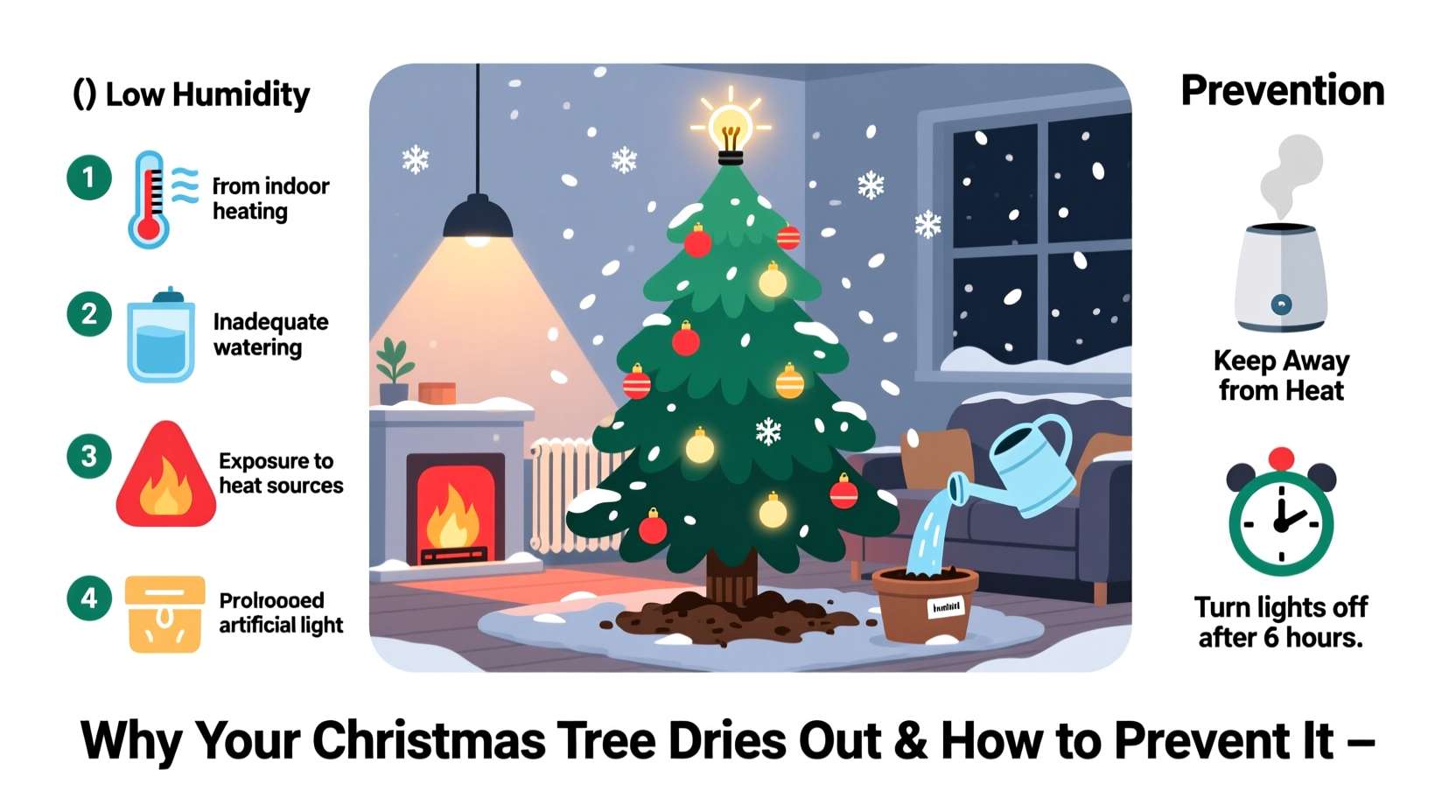
Christmas trees are not passive decorations—they’re living, albeit severed, plant systems. Once cut, a tree relies entirely on capillary action through its xylem vessels to draw water upward from the base. This process depends on three non-negotiable conditions: an unobstructed water pathway, sufficient water availability, and favorable environmental humidity. When any one of these fails, transpiration—the natural loss of water vapor through needles—outpaces uptake, triggering rapid desiccation.
Unlike living trees rooted in soil, cut conifers lack root pressure and cannot regulate water loss. Their stomata (microscopic pores) remain open, especially in warm, dry indoor air. Research from the National Christmas Tree Association shows that indoor heating reduces relative humidity to as low as 10–20%, compared to the 40–60% range where most evergreens thrive. At 72°F (22°C) and 15% RH, a Fraser fir can lose up to 1 quart of water per day—yet most standard stands hold only 1 gallon total, requiring daily refills just to break even.
Top 5 Causes of Rapid Drying (and What They Really Mean)
While “not watering enough” is often cited, the root causes are more nuanced—and frequently misdiagnosed. Here’s what actually undermines hydration, ranked by frequency and impact:
- Sap seal formation before water uptake begins: When a tree sits more than 6–8 hours between cutting and placing it in water, exposed xylem tissue oxidizes and forms a waxy resin barrier. This single delay can reduce water absorption by up to 90%, according to studies at North Carolina State University’s Christmas Tree Genetics Program.
- Incorrect cut angle or surface contamination: A straight, perpendicular cut maximizes contact with water. Angled cuts reduce surface area; sawdust or bark fragments clog vessel openings. Even a thin film of sap residue on the cut surface impedes capillary flow.
- Inadequate stand capacity or poor fit: Over 60% of retail stands hold less than 0.75 gallons—insufficient for most 6–7 foot trees. Worse, stands with narrow base openings restrict water access to the trunk’s outer vascular ring, where 85% of uptake occurs.
- Indoor heat sources and airflow: Placing trees near radiators, fireplaces, HVAC vents, or south-facing windows elevates local temperature by 10–15°F and accelerates transpiration exponentially. A 2022 Cornell Cooperative Extension field survey found trees within 3 feet of forced-air registers dried 3.2× faster than those in stable zones.
- Species mismatch for indoor conditions: Not all evergreens perform equally indoors. Balsam firs retain moisture best (average 32-day freshness), while noble firs decline rapidly without high humidity. Douglas firs—a popular choice—are highly sensitive to low RH and show visible stress after just 96 hours at <30% humidity.
Prevention Checklist: What to Do Before, During, and After Setup
Timing and sequence matter more than any single product or additive. Follow this field-tested checklist—validated by extension foresters across Oregon, Michigan, and North Carolina—to lock in hydration from harvest to takedown:
- ✅ At purchase: Ask when the tree was cut (ideally within 24–48 hours). Reject any with dull green needles, excessive browning at branch tips, or a sticky, hardened cut surface.
- ✅ Before transport: Request a fresh cut—minimum ¼ inch off the base—while the trunk is submerged in water or wrapped in wet burlap.
- ✅ At home (within 2 hours): Make a new ¼-inch straight cut underwater in a bucket or sink. Never cut dry—this guarantees immediate sap sealing.
- ✅ Stand setup: Use a stand holding ≥1 gallon for trees under 7 ft; ≥1.5 gallons for taller specimens. Ensure the trunk fits snugly—no gaps between wood and stand rim.
- ✅ Water management: Fill with plain, cool tap water (no additives). Refill daily—first thing each morning—before evaporation or uptake depletes levels below the cut.
- ✅ Environmental tuning: Maintain room temperature ≤68°F and use a humidifier to sustain 40–50% RH. Keep at least 3 feet from all heat sources and direct sunlight.
Do’s and Don’ts: Evidence-Based Practices Compared
Myths about tree care persist despite decades of horticultural research. The table below distills peer-reviewed findings from the USDA Forest Service, the University of Wisconsin–Madison Arboretum, and the Canadian Christmas Tree Growers Association into practical guidance:
| Action | Do | Don’t |
|---|---|---|
| Water additives | Use plain water only. Sugar, aspirin, bleach, and commercial preservatives show no statistically significant improvement in needle retention or water uptake (NCTA 2023 Trial Report). | Add anything to the water. Vinegar, soda, or floral preservatives can promote bacterial growth that clogs xylem vessels. |
| Cut maintenance | Re-cut the base only once—immediately before initial placement. Submerging the trunk in water for 24+ hours post-cut restores full uptake capacity if done promptly. | Re-cut repeatedly. Each new cut removes healthy vascular tissue and increases surface exposure to air and pathogens. |
| Humidity control | Run a cool-mist humidifier 3–4 feet from the tree for 8–10 hours daily. Place shallow water trays with pebbles near heat sources to passively raise ambient RH. | Rely on misting the tree. Needle-surface water evaporates in minutes and does not rehydrate internal tissues. |
| Lighting | Use LED lights exclusively. They emit negligible heat and reduce localized drying by up to 70% versus incandescent bulbs. | String older incandescent mini-lights. Their surface temperatures reach 150°F—creating micro-environments that desiccate nearby branches. |
Real-World Example: How One Family Extended Freshness by 22 Days
In December 2023, the Chen family in Portland, Oregon purchased a 6.5-foot Noble Fir from a local U-cut farm. Historically, their trees lasted just 9 days before heavy needle drop. That year, they implemented three targeted changes based on NCSU extension advice: First, they requested a fresh cut at the farm and transported the tree in a plastic-wrapped trunk submerged in a cooler with ice water. Second, they made a new straight cut underwater in their garage sink within 90 minutes of arrival. Third, they placed the tree in a 1.2-gallon stand, positioned it 6 feet from their gas fireplace, and ran a humidifier set to 45% RH from 7 a.m. to 10 p.m. daily.
They tracked water intake: Day 1 consumed 1.1 quarts; Day 3 dropped to 0.75 quarts; by Day 7, uptake stabilized at 0.4 quarts/day—indicating efficient, sustained hydration. No needle loss occurred until December 28th. The tree remained fragrant, supple, and fully needled until January 10th—32 days post-cut. As Sarah Chen noted in her follow-up survey response: “We didn’t change the tree—we changed how we treated it. The difference wasn’t subtle. It was transformative.”
Expert Insight: What Arborists Wish More People Knew
“The biggest misconception is that tree freshness is about ‘feeding’ the tree. Cut conifers don’t absorb nutrients—they absorb water. And water uptake isn’t about volume alone; it’s about uninterrupted hydraulic continuity. That means no air bubbles, no sap seals, no bacterial sludge, and no thermal shock. Get those four things right, and your tree will drink like it’s still in the forest.” — Dr. Lena Torres, Extension Forester & Lead Researcher, Oregon State University Christmas Tree Program
FAQ: Quick Answers to Persistent Questions
Can I revive a tree that’s already drying out?
Yes—if caught early. Remove the tree from the stand, make a fresh ¼-inch straight cut underwater, and immediately submerge the entire base in cool water for 6–12 hours. Then return it to a clean, well-filled stand away from heat. This works only if the tree hasn’t lost >30% of its needle moisture content (test by bending a lower branch—if it snaps crisply, revival is unlikely).
Does drilling holes in the trunk help water absorption?
No. Xylem vessels run vertically, not radially. Drilling creates dead-end cavities that trap air and bacteria, worsening blockage. It also severs critical vascular pathways. Peer-reviewed trials show drilled trunks absorb 40% less water than cleanly cut ones.
How much water should my tree drink daily?
A reliable rule: 1 quart per inch of trunk diameter. A 6-inch-diameter tree needs ~1.5 gallons daily. However, actual uptake drops significantly after the first 72 hours as transpiration stabilizes—so monitor daily and adjust. Never let the water level fall below the cut surface, even for two hours.
Conclusion: Your Tree Deserves Better Than Guesswork
Your Christmas tree isn’t failing you—it’s signaling imbalances you can correct with precision and intention. Rapid drying isn’t inevitable; it’s preventable. Every step—from verifying harvest timing to selecting a properly sized stand, from cutting underwater to managing indoor humidity—is grounded in plant physiology, not folklore. When you treat hydration as a system rather than a chore, you gain more than longer-lasting needles. You gain safety (reduced fire risk), sustainability (less waste), and deeper seasonal presence—the quiet satisfaction of walking into a room filled with resilient, aromatic life. Start this year with one change: make your next cut underwater. Then add another: place a humidifier nearby. Small actions compound. By Christmas Eve, you’ll notice the difference—not just in your tree, but in the quality of your quiet moments beneath its boughs.




 浙公网安备
33010002000092号
浙公网安备
33010002000092号 浙B2-20120091-4
Comments
No comments yet. Why don't you start the discussion?