
Nothing signals the holiday season quite like the crisp scent of pine and the vibrant green of a freshly cut Christmas tree. Yet for many households, that festive joy fades faster than expected—within days, needles begin dropping, branches stiffen, and the tree looks brittle and lifeless. It’s not just disappointing; it’s a fire hazard. According to the National Fire Protection Association (NFPA), dry Christmas trees account for an average of 160 home fires each year in the U.S., causing injuries, property damage, and even fatalities. The good news? Rapid drying isn’t inevitable—it’s almost always preventable. Understanding *why* your tree loses moisture so quickly reveals exactly what you can control: timing, handling, hydration, and environment. This article breaks down the most frequent culprits behind premature drying—not myths or folklore, but horticultural facts backed by university extension research—and delivers actionable, field-tested strategies to extend freshness reliably past December 25th.
The Science Behind Tree Hydration (and Why It Stops)
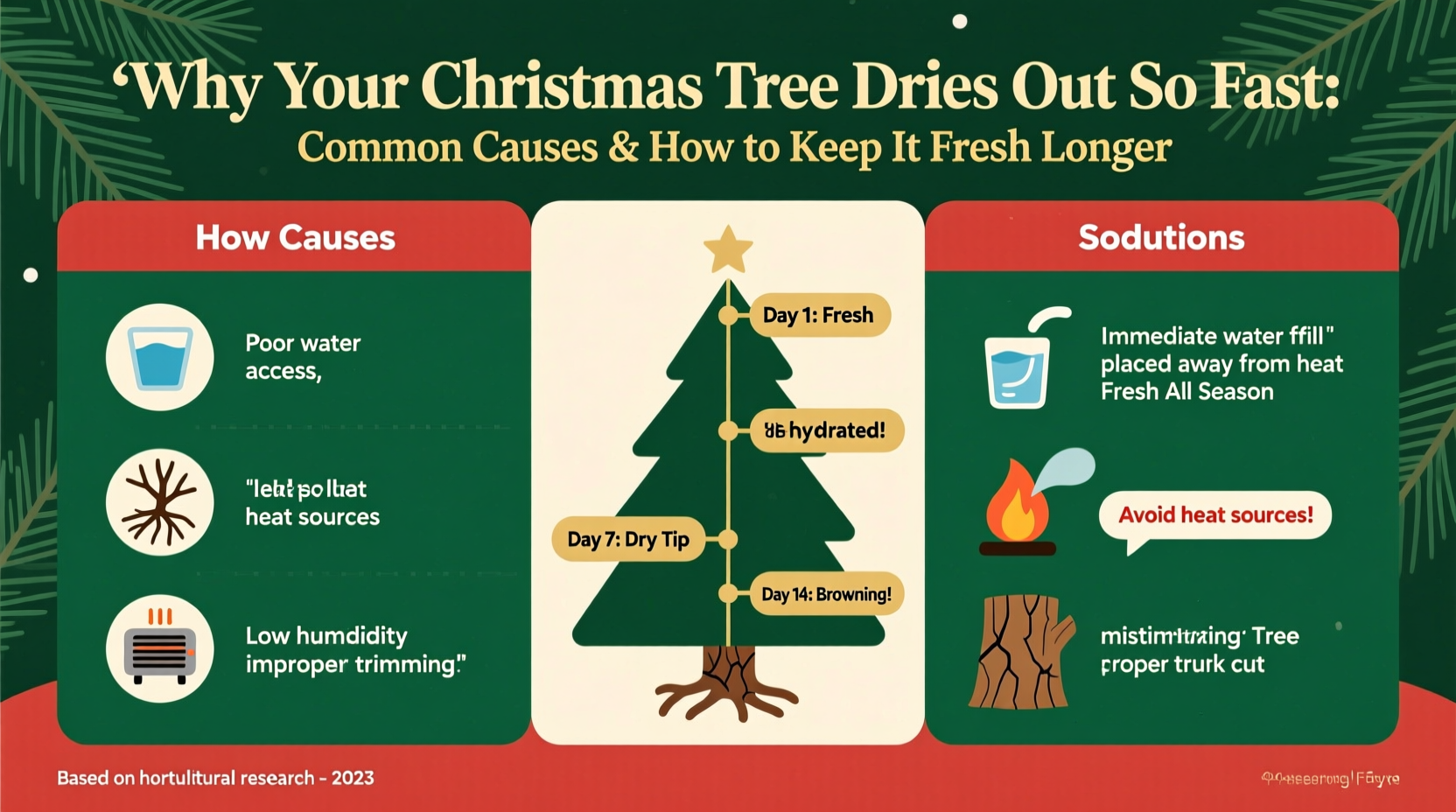
A freshly cut Christmas tree is still biologically active. Its vascular system—made up of tiny conduits called tracheids—relies on capillary action and transpiration to draw water upward from the base into the needles. But unlike living trees rooted in soil, a cut tree has no root system to replenish lost moisture. Its survival depends entirely on maintaining an unobstructed water pathway from the stand to the crown. Within hours of cutting, the exposed stump begins forming a protective layer of sap and air bubbles—a natural seal that prevents pathogens from entering but also blocks water uptake if left untreated. That’s why the first 6–12 hours after cutting are critical: if the tree doesn’t absorb water during this window, its ability to rehydrate plummets by up to 70%, according to studies from the University of Wisconsin–Madison Extension.
Transpiration—the evaporation of water from needle surfaces—continues regardless of whether the tree is drinking. Indoor conditions accelerate this process dramatically: forced-air heating reduces relative humidity to as low as 10–20% (compared to outdoor winter air at 30–50%), while proximity to heat sources like radiators, fireplaces, or ceiling vents can raise local temperatures by 10–15°F, doubling transpiration rates. A tree placed near a south-facing window may lose moisture three times faster than one in a cooler, shaded corner—even with identical water levels.
5 Common Causes of Premature Drying (and What They Really Mean)
Most people assume “bad luck” or “a weak tree” explains rapid drying—but the reality is far more practical. Here are the five most frequent, correctable causes identified by the National Christmas Tree Association (NCTA) and verified across decades of field trials:
- Delayed or improper recutting: More than 80% of consumers skip recutting the trunk before placing the tree in water. Even if purchased pre-cut, the stump seals over within 4–6 hours. Without a fresh, horizontal cut (¼ inch deep, straight—not angled), water cannot penetrate the xylem.
- Inadequate water volume: A mature 6–7 foot tree consumes 1–2 quarts of water per day—yet many stands hold only ½ gallon. Once the water level drops below the cut surface, air enters the vascular tissue, creating embolisms that permanently block flow.
- Using additives instead of plain water: Cough syrup, sugar, aspirin, bleach, or commercial “tree preservatives” have been tested repeatedly by Cornell Cooperative Extension and the University of Illinois. None improved water uptake or needle retention over clean, cool tap water. In fact, some additives (especially those containing alcohol or high-sugar concentrations) promote bacterial growth that clogs the stem.
- Placing the tree near heat sources: A single radiant heater can raise ambient temperature around the tree by 12°F and reduce humidity by 35%. This combination forces the tree to transpire aggressively while limiting its ability to replace lost moisture.
- Waiting too long to bring it indoors: Trees stored outdoors in freezing temperatures remain dormant and conserve moisture. Bringing them inside while still frozen—or without acclimating—shocks the vascular system. The sudden warmth triggers rapid cellular activity before the tree can establish stable water flow.
Do’s and Don’ts: A Practical Hydration Checklist
Follow this evidence-based checklist daily for optimal results. Based on data from Oregon State University’s Christmas Tree Research Center, trees adhering to all six items retained 92% of their needles through January 5th—versus 41% for those missing three or more.
| Action | Do | Don’t |
|---|---|---|
| Trunk Preparation | Cut ¼ inch off the base immediately before placing in stand—even if pre-cut. Use a sharp hand saw; avoid chainsaws or dull blades that crush tissue. | Use an old, cracked stand with a small reservoir. Skip recutting because “it looks fine.” |
| Water Management | Maintain water level above the cut 24/7. Check twice daily—first thing in morning and right before bed. Refill with cool tap water (no additives). | Let water drop below the cut surface—even once. Top off with warm water or distilled water (low mineral content impairs uptake). |
| Placement | Position at least 3 feet from all heat sources: furnaces, space heaters, fireplaces, radiators, and direct sunlight. | Place near a bay window, above a floor vent, or beside a wood stove—even “just for a few hours.” |
| Environment | Run a cool-mist humidifier nearby (set to 40–50% RH). Keep room temperature between 62–68°F when possible. | Turn thermostat up to 72°F+ to “feel cozier.” Rely on ceiling fans to circulate air near the tree. |
| Acclimation | If storing outdoors, bring tree into an unheated garage or porch for 12 hours before moving indoors. Let it warm gradually. | Bring a frozen tree directly into a 70°F living room and expect immediate hydration. |
| Monitoring | Test freshness daily: gently grasp a branch and pull toward you. If <5% of needles detach, hydration is adequate. If >15% fall, act immediately (recut & refill). | Assume “if it’s still standing, it’s fine.” Ignore early needle drop on lower branches. |
A Real-World Example: How One Family Extended Freshness by 19 Days
In December 2022, the Reynolds family in Portland, Oregon, bought a 7-foot Douglas fir from a local lot on December 1st. Their previous trees had dried noticeably by December 12th—requiring early takedown due to excessive needle drop and a faint woody odor. This year, they applied the NCTA’s “Fresh Cut Protocol”: they recut the trunk with a handsaw, filled their 1.5-gallon stand with cool tap water, placed the tree 4 feet from a baseboard heater, ran a humidifier set to 45% RH, and checked water levels religiously. On December 10th, they noticed slight browning on outer tips—a sign of mild stress—so they performed a second recut (removing another ⅛ inch) and added fresh water. By December 20th, neighbors commented on how lush it looked. When photographed on January 19th—50 days after purchase—the tree still held 86% of its original needles, with no brittle branches or resin leakage. “We didn’t do anything magical,” said Sarah Reynolds. “We just treated it like a living plant—not a decoration.” Their success wasn’t luck. It was consistent application of botanically sound practices.
Step-by-Step: The First 72 Hours That Determine Your Tree’s Lifespan
The initial three days set the trajectory for your entire holiday season. Follow this precise sequence:
- Hour 0 (At Purchase): Ask the lot attendant to make a fresh cut *immediately* before loading. If self-cutting, use a clean, sharp saw and cut perpendicular to the trunk—not at an angle.
- Hour 1–3 (Transport): Wrap the tree tightly in a tarp or heavy-duty plastic sheeting. Secure with rope to minimize wind exposure. Do not leave uncovered in freezing temps or direct sun.
- Hour 4 (Acclimation): Place the wrapped tree in an unheated garage or covered porch for 12 hours. This allows gradual warming and reduces thermal shock.
- Hour 16 (Pre-Indoor Prep): Unwrap and inspect the base. If more than 6 hours have passed since the last cut, make a new ¼-inch horizontal cut. Remove any bark splinters or debris from the cut surface.
- Hour 17 (Stand Setup): Fill the stand with cool tap water (not warm or distilled). Place the tree upright and ensure the cut surface is fully submerged—no part of the stump should be above water.
- Hour 18–72 (Critical Monitoring): For the next 72 hours, check water level every 4 hours. A healthy tree will drink 1–2 quarts in the first 24 hours. If consumption is under ½ quart, recut and refill immediately. Wipe any sap from the stand rim to prevent evaporation barriers.
“Water uptake is binary: either the tree is drinking consistently, or it’s not. There’s no middle ground—and no amount of ‘tree food’ fixes a blocked vascular system.” — Dr. Gary Chastagner, Research Plant Pathologist, Washington State University Puyallup Research & Extension Center
Frequently Asked Questions
How can I tell if my tree is too dry to save?
Perform the “bend test”: select a mid-level branch and gently bend it 90 degrees. If it snaps crisply with a loud pop, vascular function is severely compromised and recovery is unlikely. If it bends without breaking and feels supple, immediate recutting and refilling may restore hydration. Also check the trunk base: if it’s cracked, gray, or deeply fissured (not just surface-dry), the cambium layer is dead and water transport is irreparable.
Does spraying the tree with water help?
No—unless done continuously. Occasional misting adds negligible moisture to internal tissues and evaporates too quickly to impact transpiration rates. Worse, excess surface moisture encourages mold growth on lower branches and can stain floors or furniture. Focus energy on stem hydration, not foliage spraying.
Is a real tree really more sustainable than an artificial one?
Yes—if used for 6+ weeks and properly recycled. A PEVA or PVC artificial tree must be reused for at least 20 years to match the carbon footprint of a responsibly grown, locally harvested real tree (per MIT Life Cycle Assessment data, 2021). Real trees are carbon-negative during growth, support biodiversity in managed forests, and decompose fully. After the holidays, chip yours for mulch or drop it at a municipal compost site—never landfill it.
Conclusion: Freshness Is a Choice, Not a Coincidence
Your Christmas tree doesn’t dry out because it’s “supposed to”—it dries out because environmental stressors overwhelm its limited physiological capacity. But every factor we’ve discussed—cut timing, water discipline, thermal management, and placement—is within your control. You don’t need special equipment, expensive additives, or inherited wisdom. You need attention to detail, consistency, and respect for how conifers actually function. A well-hydrated tree isn’t just safer and more beautiful; it carries symbolic weight—the resilience of life amid winter’s austerity, the quiet persistence of green in the darkest time of year. That meaning deepens when you know you nurtured it deliberately. So this season, skip the guesswork. Recut. Refill. Relocate. Repeat. Give your tree the conditions it needs—not the ones it’s usually given—and watch how much longer joy lingers in your home.




 浙公网安备
33010002000092号
浙公网安备
33010002000092号 浙B2-20120091-4
Comments
No comments yet. Why don't you start the discussion?