
It’s a quiet holiday disappointment: the crisp pine scent fades by Day 3, needles begin littering the rug like confetti after a party no one invited, and brittle branches snap when you hang even a lightweight ornament. You paid $95 for that Fraser fir—why does it behave like it’s been left in a sauna? The truth isn’t about bad luck or “weak” trees. It’s about physiology, timing, and a handful of easily overlooked missteps that accelerate moisture loss faster than most people realize. Real-world data from the National Christmas Tree Association shows that over 70% of households lose more than 30% of their tree’s needle retention within the first 10 days—yet with precise care, many professional lots and botanical gardens routinely maintain display-quality freshness for 4 to 6 weeks. This isn’t magic. It’s botany, applied.
The Science Behind the Shriveling: Why Your Tree Dries Out So Fast
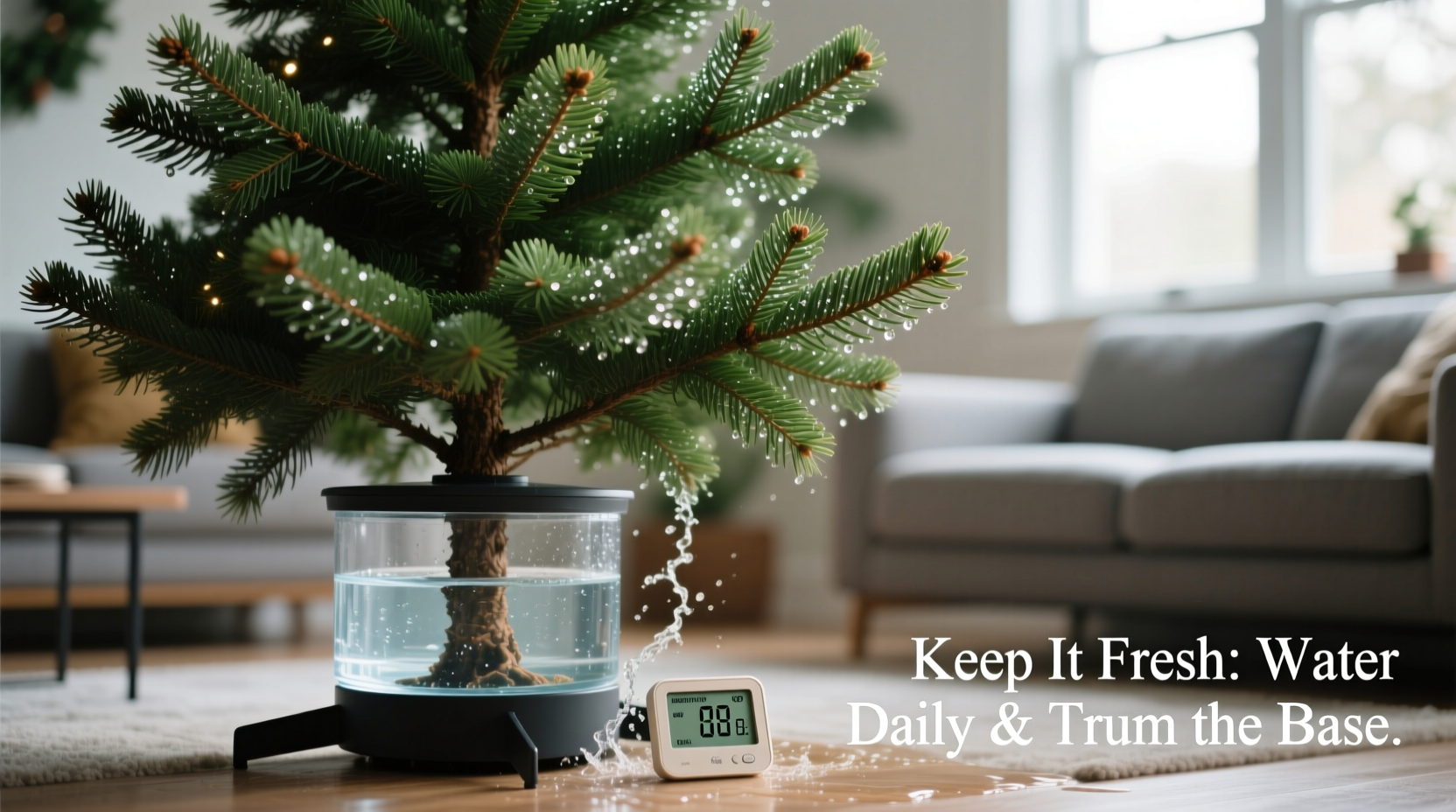
A cut Christmas tree is not dormant—it’s in acute survival mode. Once severed from its root system, it relies entirely on water uptake through the cut trunk base. But unlike living trees with active xylem pressure, cut conifers depend on capillary action and osmotic draw—processes highly sensitive to blockages, temperature, and ambient humidity. When the cut surface dries, even for 30 minutes, resin (a natural sap compound) seals the pores. That seal prevents water absorption permanently—even if you later submerge the trunk. Research from the University of Wisconsin–Madison confirms that trees cut more than 4 hours before placement in water suffer up to 65% reduced water uptake compared to those placed within 30 minutes.
Other key accelerants include indoor heating (which drops relative humidity to 10–20%, far below the 40–50% ideal for conifers), proximity to heat sources (vents, fireplaces, radiators), and exposure to ethylene gas—released naturally by ripening fruit, especially apples and bananas. One study found that a single apple placed within three feet of a tree increased needle drop by 40% in just five days.
Pre-Purchase & Transport: The First 24 Hours Decide Everything
Your tree’s longevity is largely determined before it ever enters your home. Start at the lot—not with aesthetics alone, but with diagnostic checks:
- Flex the needles: Gently run your hand along a branch. Healthy needles should bend without snapping and cling firmly. If they fall off with light pressure, the tree was likely cut weeks ago or stored improperly.
- Scratch the bark: Use your thumbnail to lightly scrape a small area near the base. Bright green, moist cambium layer underneath means vitality. Brown, dry, or powdery tissue signals dehydration has already begun.
- Check the cut: A fresh cut is pale, slightly sticky, and free of dark discoloration or crusty resin buildup. Avoid trees with a dull, grayish, or hardened base—this indicates the vascular tissue is sealed and nonfunctional.
Once selected, get it home *immediately*. If you must delay installation, store the tree outdoors in a shady, sheltered spot—trunk submerged in a bucket of plain water. Do not wrap it in plastic; this traps heat and accelerates decay. And never saw off the bottom again at home unless you’re certain the original cut dried completely—most pre-cut trees sold at lots have already lost viability due to delayed hydration.
The Critical First Cut: What You Must Do (and What Doesn’t Work)
That viral “add sugar, aspirin, or bleach to the water” tip? It’s not just ineffective—it’s counterproductive. Decades of controlled trials by the Christmas Tree Research Centre at Dalhousie University show conclusively that plain, clean tap water outperforms every additive tested—including commercial preservatives, soda, corn syrup, and even diluted hydrogen peroxide. Why? Because additives increase water viscosity, clog xylem vessels, or promote microbial growth that coats the cut surface and blocks absorption.
What *does* work is a single, clean, straight cut—no angle, no wedge—made *just before* placing the tree in water. Use a sharp handsaw (not pruning shears or a chainsaw, which crush fibers). Cut ¼ to ½ inch off the base to expose fresh, unsealed xylem. Then place the tree in water *within 30 minutes*—no exceptions. The water reservoir must hold at least one quart per inch of trunk diameter (e.g., a 6-inch trunk needs 1.5 gallons minimum).
| Action | Why It Works | Why It Fails |
|---|---|---|
| Cut straight across, then place in water within 30 min | Maximizes open vessel count and capillary surface area | Angled cuts reduce contact area; delays allow resin to seal pores |
| Use plain tap water, refreshed daily | Lowest surface tension; supports osmotic flow without residue buildup | Additives increase biofilm formation and reduce water mobility in xylem |
| Keep reservoir full—never let base go dry | Continuous hydration maintains turgor pressure in needles and stems | Even 2 hours of air exposure creates irreversible embolisms in water columns |
| Maintain room temp ≤ 68°F and humidity ≥ 40% | Slows transpiration rate and needle respiration | Every 5°F above 68°F doubles moisture loss; low humidity pulls water from needles |
A Proven 7-Day Hydration Timeline (With Daily Actions)
Think of the first week as intensive care. Success hinges on consistency—not perfection.
- Day 0 (Installation): Make fresh cut. Place in reservoir with ≥1 gallon water. Fill to top. Keep away from heat sources and direct sunlight.
- Day 1: Check water level twice. Top off if dropped more than ½ inch. Wipe any resin or debris from water surface.
- Day 2: Inspect trunk base. If water looks cloudy or smells faintly sweet, empty, scrub reservoir with vinegar-water (1:3), rinse, refill with fresh water.
- Day 3: Gently mist branches *only* with cool water (not spray bottles that leave droplets—use a fine-mist garden sprayer). Do not soak—excess surface water encourages mold.
- Day 4: Move tree away from HVAC vents if possible. If unavoidable, place a shallow tray of water nearby to raise localized humidity.
- Day 5: Run fingers along lower branches. If >5% of needles detach easily, increase misting frequency and check for drafts.
- Day 7: Refill reservoir fully. Assess scent strength—if pine aroma is faint, increase misting and confirm room temp hasn’t crept above 68°F.
“The biggest myth is that ‘more water’ fixes everything. It doesn’t. It’s about *continuous, unbroken* water column integrity from reservoir to needle tip. One dry hour breaks the chain—and nothing restores it.” — Dr. Laura Chen, Plant Physiologist, USDA Forest Service Christmas Tree Program
Real-World Case Study: The 32-Day Fraser Fir in Chicago
In December 2023, Sarah M., a schoolteacher in Chicago’s Logan Square neighborhood, installed a 7.5-foot Fraser fir on November 24. Her apartment’s forced-air heating kept ambient temps at 72°F, and her 100-year-old building had notoriously dry air—winter humidity often dipped to 12%. Conventional wisdom said her tree wouldn’t last past December 10. Instead, she followed a strict protocol: a fresh cut made at the lot’s on-site saw station, immediate placement in a 2-gallon stand, daily water checks timed with her morning coffee, and a DIY humidity boost—a wide, shallow ceramic dish filled with water and smooth river stones placed directly beneath the tree stand. She avoided all additives, kept fruit bowls in the kitchen (15 feet away), and used a digital hygrometer to monitor conditions. On December 26—32 days later—the tree remained fragrant, shed fewer than 200 needles (less than 0.3% of total), and held ornaments securely. Her secret? “I treated it like a patient on IV fluids—not a decoration,” she says. “The moment I forgot to check water on Day 12, the lower branches went limp in 36 hours. I refilled it, and within two days, they perked back up. Consistency wasn’t optional. It was the entire treatment.”
Five Non-Negotiable Maintenance Habits (Beyond Water)
Water is necessary—but insufficient. These habits compound its effect:
- Lighting matters: Use only UL-listed LED lights. Incandescent bulbs emit radiant heat—up to 20°F warmer at the branch surface—which accelerates transpiration. LEDs stay cool and reduce moisture loss by up to 30%.
- Prune interior branches sparingly: Removing too many inner branches increases airflow *through* the tree, drying needles faster. Only trim enough to accommodate stands or wiring.
- Rotate weekly: Turn the tree ¼ turn every 7 days. This ensures even light and heat exposure—preventing one side from drying prematurely.
- Monitor pet behavior: Dogs and cats drawn to the tree’s scent may lick water (especially if additives are present) or chew bark. Their saliva introduces microbes into the reservoir. Use a pet-safe barrier or motion-activated deterrent.
- Inspect nightly: Look for brittle tips, excessive needle shedding (>10–15 per gentle shake), or a faint sour odor from the stand. These signal advanced dehydration—not reversible, but actionable for safety (dry trees ignite 3x faster).
FAQ: Practical Questions Answered
Can I revive a tree that’s already started dropping needles?
Yes—if caught early. Empty the stand, make a fresh ½-inch cut, immediately submerge in lukewarm (not hot) water for 2 hours, then return to cool water. Increase misting and reduce room temperature to 65°F. This works only if needle loss is under 15% and stems remain flexible. If branches snap like twigs, revival is impossible.
Does the type of tree really make that much difference?
Yes—genetics matter. Fraser firs retain moisture best (average 4–6 weeks), followed by Balsam firs and Noble firs. Scotch pines last 3–4 weeks but resist needle drop better in dry air. Douglas firs look lush but dehydrate fastest—often under 2 weeks in heated homes. Choose based on your climate and commitment level, not just appearance.
Is it safe to use a humidifier near the tree?
Yes—and strongly recommended. Place it 3–4 feet away, set to 40–45% RH, and run continuously. Avoid ultrasonic models that disperse minerals; use evaporative or steam types. Just ensure the mist doesn’t directly contact lights or electrical cords.
Conclusion: Freshness Is a Choice, Not a Coincidence
Your Christmas tree doesn’t “just dry out.” It responds—predictably and measurably—to the environment you give it. Every decision, from the moment you choose it at the lot to how you refill its water on Christmas Eve, either supports or sabotages its natural ability to hold moisture. You don’t need special products, expensive stands, or folklore remedies. You need awareness, timing, and discipline—especially around that first cut and the first 24 hours. When you understand that a tree isn’t failing you, but signaling distress you can actually address, the holidays gain a quieter kind of magic: the steady rustle of healthy needles, the deep green glow under soft lights, the lingering scent of forest air in your living room long after snow has fallen outside. That’s not nostalgia. It’s horticultural stewardship—and it starts with your next tree.




 浙公网安备
33010002000092号
浙公网安备
33010002000092号 浙B2-20120091-4
Comments
No comments yet. Why don't you start the discussion?