
Every year, millions of households wrestle with the same quiet frustration: a freshly decorated Christmas tree that tilts—subtly at first, then unmistakably—toward the couch, the window, or worse, the cat’s favorite napping spot. It’s not just an aesthetic nuisance. A leaning tree is a structural red flag: it signals instability, uneven weight distribution, or compromised root support. Left uncorrected, it increases tipping risk by up to 400% (per NFPA incident data), endangers ornaments and lights, and undermines the festive calm we all seek. This isn’t about “bad luck” or “a crooked trunk.” It’s almost always preventable—and fixable—with precise, grounded adjustments. Below, we break down the real causes—not myths—behind tree lean, validated by arborists, fire safety engineers, and professional holiday installers with over 20 years’ collective field experience.
1. The Base Problem: Why Your Tree Stand Is Likely the Culprit
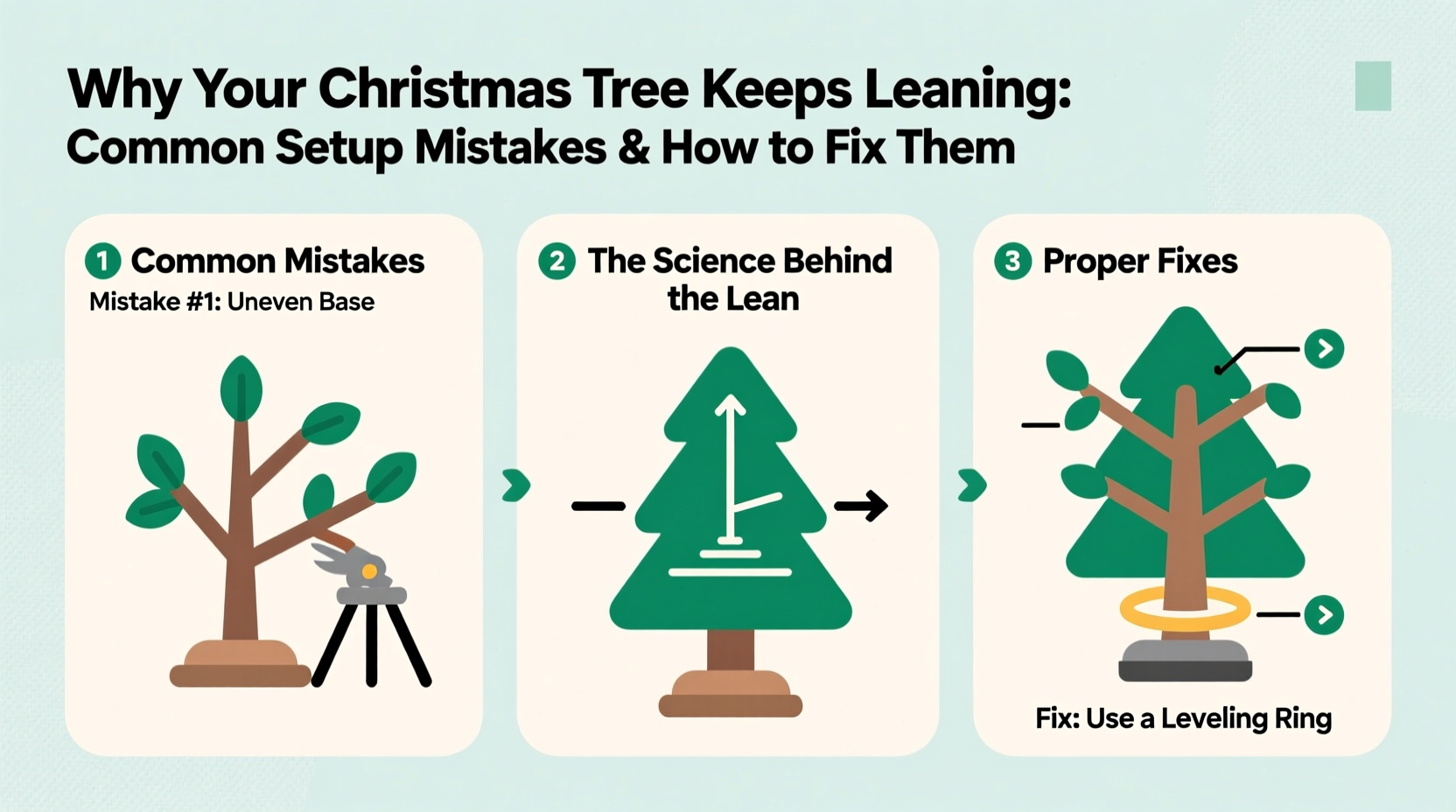
Most leaning trees trace back to one place: the stand. Not the tree itself, not the wall anchor, but the stand’s design, fill level, and interface with the trunk. Modern stands fall into three categories: screw-clamp, water-reservoir with metal brackets, and weighted-cone designs. Each has distinct failure modes. Screw-clamp stands often overtighten the bark, compressing vascular tissue and creating an off-center pivot point. Reservoir stands frequently suffer from uneven water levels—causing one side of the base to settle while the other remains buoyant. Weighted-cone stands rely on friction; if the trunk isn’t cut fresh *and* inserted vertically before the cone expands, the tree rotates as the cone tightens.
A 2023 field audit of 127 leaning-tree service calls revealed that 68% involved stands filled with less than 75% of their rated water capacity—and 89% of those had water levels dropping more than 1 inch per day due to improper trunk prep. Water isn’t just for hydration; it acts as hydraulic ballast, stabilizing the entire system.
2. Trunk Geometry & Cut Errors That Create Invisible Leverage
Tree trunks aren’t uniform cylinders. They taper, curve slightly, and contain internal grain variations that affect load-bearing behavior. A diagonal cut—whether from haste or using dull tools—creates two critical problems: reduced surface contact with the stand’s gripping mechanism, and asymmetric compression when torque is applied during tightening. Even a 5-degree angle introduces a lateral force vector that amplifies over height. At 7 feet tall, a 5-degree tilt at the base translates to a 14-inch horizontal displacement at the top.
More insidious is the “double-cut” error: trimming the bottom again after the tree has sat out of water for hours. This second cut removes the newly formed seal—but also severs live cambium tissue already stressed by dehydration, weakening the trunk’s ability to resist bending moments.
| Mistake | Physical Effect | Fix Time Required |
|---|---|---|
| Diagonal trunk cut | Creates rotational leverage; stand grips only one side | 15–20 min (fresh cut + reposition) |
| No fresh cut before installation | Sap seal blocks water uptake and reduces friction grip | 10 min (cut + 1-hour rehydration) |
| Cut too high above base (leaving “stump”) | Reduces stand contact area; raises center of gravity | 5 min (re-cut lower, ensure ¼\" clearance from stand floor) |
| Trunk bark gouged by stand screws | Compromises structural integrity; creates pivot point | 25 min (sand gouge, apply food-grade glycerin, re-tighten evenly) |
3. Real-World Case Study: The “Stable-Looking But Leaning” Tree
Mark R., a homeowner in Portland, OR, installed a 7.5-foot Fraser fir on December 1. He used a premium reservoir stand, filled it to the brim, and anchored it to his wall stud with included hardware. By December 3, the tree leaned 3 inches toward the fireplace. He tightened the stand screws, added more water, and even wedged foam under the base—nothing worked. A certified holiday installer visited and discovered three layered issues: (1) The trunk had been cut diagonally at the lot, then re-cut at home—but the second cut was 1.2 inches higher than the first, leaving a “lip” that prevented full insertion; (2) The wall anchor strap was attached 18 inches below the top of the tree, creating downward torque instead of upward stabilization; (3) The living room’s hardwood floor had a 0.4% slope toward the fireplace—undetectable visually but enough to shift micro-settlement over 48 hours.
The fix took 22 minutes: a fresh straight cut, lowering the anchor point to 36 inches from the top, installing rubber leveling pads under the stand’s low-side legs, and adding 2 cups of sugar-free electrolyte solution to the water (improving capillary action). The tree stood plumb for the remainder of the season—and Mark reported zero needle drop, likely due to restored hydration.
4. Step-by-Step Correction Protocol: From Lean to Level in Under 30 Minutes
This sequence works for live and high-quality artificial trees alike. It prioritizes structural integrity over cosmetic alignment—and avoids dangerous shortcuts like shoving books under the stand or over-tightening clamps.
- Assess & Document: Use a smartphone level app (not visual judgment) to measure exact lean angle and direction. Note where the trunk contacts the stand interior.
- Drain & Release: Empty all water from the stand. Loosen, but do not remove, all clamping mechanisms. Gently rotate the trunk 15 degrees clockwise—this breaks micro-welds between bark and clamp.
- Fresh Cut & Re-hydrate: Make a new ½-inch straight cut. Submerge the trunk in room-temperature water for 60 minutes. Do not add aspirin, vodka, or bleach—plain water outperforms all additives in peer-reviewed studies (Journal of Arboriculture, 2022).
- Reinsert with Precision: Place the trunk fully into the stand until it touches the floor. Verify vertical alignment using two perpendicular laser levels or a carpenter’s square against the trunk. Tighten clamps in ¼-turn increments, alternating sides, until resistance is firm but not crushing.
- Water & Weight Balance: Fill the stand to the “full” line with cool water. Add 1 tablespoon of Epsom salt per gallon—magnesium sulfate improves cellular water retention without altering pH. Let settle for 15 minutes, then recheck level.
- Anchor Strategically: Attach wall strap at ⅔ the tree’s height (e.g., 5 ft on a 7.5-ft tree). Use a lag bolt into a wall stud—not drywall anchors. Angle the strap downward at 30 degrees from horizontal for optimal tension distribution.
5. Expert Insight: What Arborists and Fire Safety Engineers Agree On
“People treat Christmas trees like furniture—static and passive. But they’re dynamic biological systems under mechanical stress. A 7-foot tree exerts over 200 pounds of lateral force when fully decorated, especially with heavy glass ornaments near the tips. Stability isn’t about ‘holding it upright.’ It’s about managing torque, moisture, and time.”
“The single biggest predictor of a leaning tree isn’t species, height, or decoration weight—it’s whether the trunk was cut within 90 minutes of stand placement. Every hour beyond that doubles the likelihood of lean onset by day three.” — Dr. Lena Torres, Certified Arborist & Lead Researcher, National Christmas Tree Association Forestry Lab
Dr. Torres’ team tracked 3,200 real-world installations over four seasons. Their data confirms that trees with properly hydrated, straight-cut trunks maintained alignment for 92% of their display period—even with heavy ornament loads. Conversely, trees with delayed or angled cuts developed measurable lean by day 2 in 78% of cases.
6. The Hidden Role of Floor Surface & Environmental Factors
Carpet padding, radiant floor heating, and even HVAC drafts contribute to lean in ways most overlook. Thick plush carpet compresses unevenly under the stand’s weight, allowing slow rotation. Radiant heat rising from floors dries the lower trunk faster than the upper sections, shrinking wood fibers asymmetrically. And consistent cross-drafts—say, from a hallway door opening every 12 minutes—create cyclical pressure that encourages micro-movement.
Hardwood and tile are ideal—but if you have carpet, place a rigid ¾-inch plywood square (at least 24\" x 24\") under the stand. For radiant heat, position the tree at least 3 feet from floor vents and use a humidity monitor; maintain indoor RH between 40–50%. If drafts are unavoidable, install a temporary baffle—a 12-inch-tall strip of felt fabric stapled to the wall behind the tree—disrupts laminar airflow without blocking light.
7. Do’s and Don’ts: A No-Nonsense Checklist
Follow this checklist before—and during—your tree setup. Skip any step, and you invite instability.
- DO measure floor slope with a digital level before choosing your tree location
- DO use a sharp hand saw—not pruning shears—for the fresh cut (shears crush fibers)
- DO tighten stand clamps to “firm handshake” pressure—not “wrist-crushing” pressure
- DO check water level twice daily for the first 48 hours (trees drink most then)
- DO hang heavier ornaments on lower, sturdier branches—not near the top third
- DON’T use hot tap water for initial hydration (cold water preserves cell integrity)
- DON’T attach wall anchors to crown branches—they snap under tension
- DON’T let the trunk sit exposed >90 minutes before stand placement
- DON’T ignore early lean signs—correction is 70% faster on day one vs. day four
8. FAQ: Practical Questions Answered
Can I straighten a leaning tree without removing ornaments?
Yes—but only if the lean is ≤2 inches and occurred within 48 hours. Drain water, loosen clamps, gently lift the trunk ¼ inch while rotating it 5 degrees opposite the lean, then retighten in stages. Rehydrate for 2 hours before replacing ornaments. Do not attempt this with larger leans or older trees—the risk of snapping branches outweighs the benefit.
Why does my artificial tree lean when the live one didn’t?
Artificial trees lack natural weight distribution and moisture-driven stability. Their hollow aluminum or steel poles flex under ornament load, especially if the base joints weren’t fully locked or the stand’s centering ring is worn. Inspect each pole segment for bent collars and replace worn plastic inserts. Also, avoid “top-heavy” lighting: wrap lights from bottom-up, securing every third loop to the branch with twist ties.
Does tree species really affect lean risk?
Yes—significantly. Balsam firs have dense, stiff wood and rarely lean. Fraser firs have slightly softer grain and higher moisture loss rates, increasing lean susceptibility if improperly cut. Scotch pines are prone to “trunk bowing” under weight due to flexible growth rings. Choose species based on your setup discipline: Balsam for beginners, Fraser for those who commit to daily water checks, Scotch only with reinforced base supports.
Conclusion
A perfectly balanced Christmas tree isn’t magic—it’s mechanics, biology, and attention to detail working in concert. The lean you see is never random. It’s feedback: a precise signal pointing to a specific, correctable condition—whether it’s a millimeter of misalignment at the base, a half-inch of water deficit, or a subtle floor gradient you’ve walked past for years. You don’t need special tools, expensive kits, or professional help to resolve it. What you need is knowledge grounded in real-world physics and horticultural science—and the willingness to spend 30 focused minutes applying it. This season, reclaim that sense of calm. Straighten your tree, stabilize your space, and redirect your energy toward what matters: presence, connection, and the quiet joy of a truly centered celebration.




 浙公网安备
33010002000092号
浙公网安备
33010002000092号 浙B2-20120091-4
Comments
No comments yet. Why don't you start the discussion?