
It’s a familiar holiday frustration: you bring home a vibrant, fragrant Fraser fir or noble pine—its branches thick with glossy green needles—only to watch it transform into a carpet-covered, brittle skeleton within days. The culprit isn’t poor tree selection or bad luck. It’s the invisible, relentless force of your home’s heating system. Central heating, space heaters, and even radiant floor systems don’t just warm the air—they dramatically alter the microclimate around your tree in ways that directly trigger premature needle abscission. This isn’t seasonal folklore; it’s plant physiology in action. Understanding the precise mechanisms behind accelerated shedding allows you to intervene—not with guesswork, but with targeted, evidence-based strategies that extend freshness by 7–14 days.
The Science Behind the Shed: How Heat Dries Out Your Tree
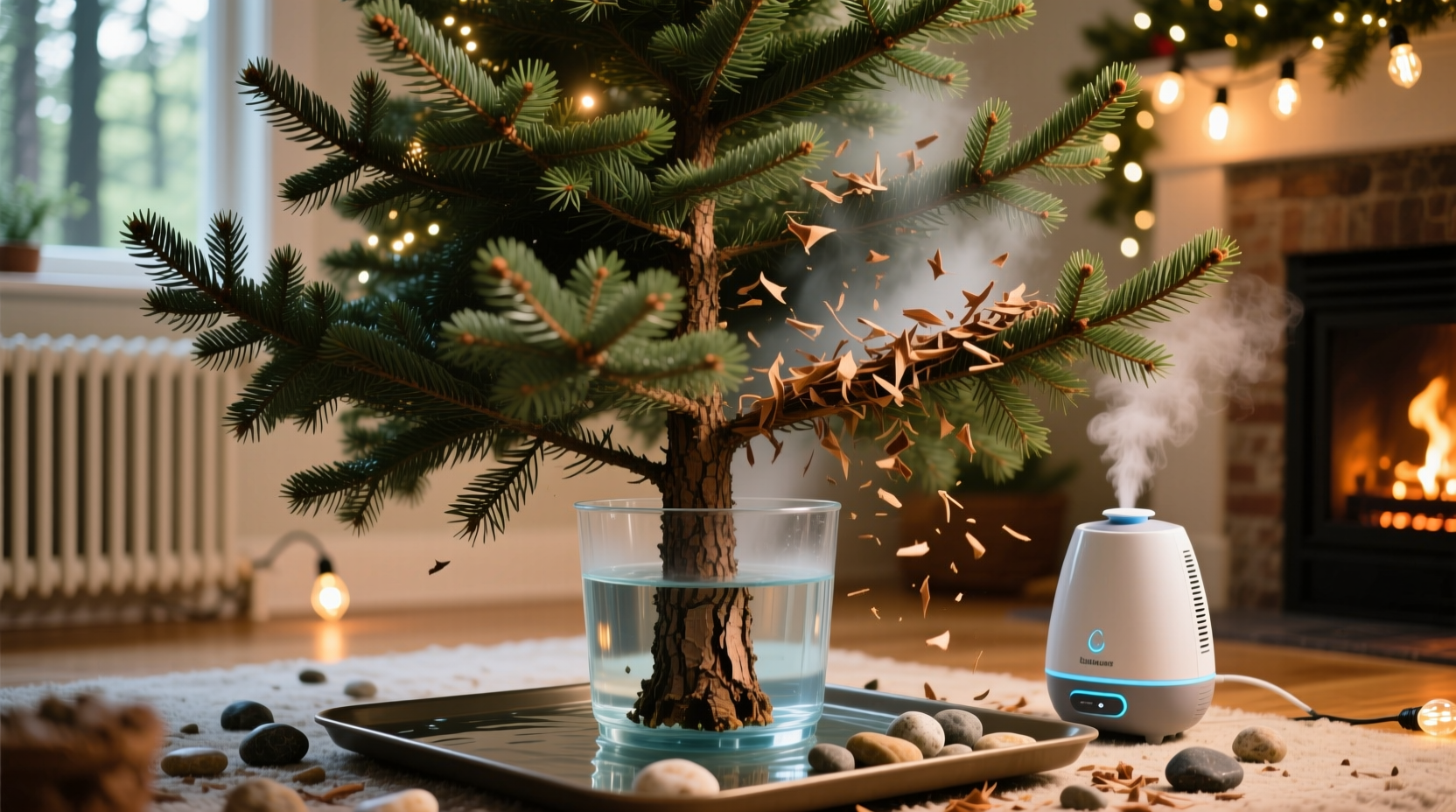
A freshly cut Christmas tree is not a static decoration—it’s a living organism undergoing controlled senescence. Though severed from its root system, its vascular tissues remain functionally active for days or weeks. Water moves upward through the xylem via capillary action and transpiration pull, sustaining needle turgor and metabolic activity. When placed indoors, the tree faces two simultaneous stressors: physical separation from water sources and exposure to an environment vastly drier and warmer than its natural habitat.
Heated indoor air reduces relative humidity (RH) dramatically. At 70°F (21°C), air heated from 35% RH outdoors drops to just 10–15% RH indoors—a desert-like condition for a conifer adapted to 40–60% RH. Low RH increases the vapor pressure deficit (VPD) between the leaf surface and surrounding air, accelerating transpiration. As water loss outpaces uptake, the tree initiates defense responses: stomatal closure (which limits gas exchange), production of ethylene (a ripening hormone), and activation of abscission zone cells at the base of each needle. These cells secrete enzymes like cellulase and polygalacturonase that degrade the pectin matrix holding the needle to the branch. Within 48–72 hours of sustained low humidity, this process becomes self-reinforcing—dry needles transpire less, but the hormonal cascade continues, causing neighboring needles to detach even if moisture levels later improve.
Temperature compounds the problem. For every 10°F (5.5°C) increase in ambient temperature, the rate of chemical reactions—including those driving abscission—roughly doubles (Q₁₀ principle). A room held at 72°F instead of 62°F doesn’t just feel warmer—it speeds up the biochemical clock inside your tree by nearly 30%. Research from the University of Wisconsin–Madison’s Christmas Tree Extension Program confirms that trees kept at 60–65°F retain 40% more needles after 14 days than identical specimens held at 72–75°F—even with identical watering regimens.
Water Management: More Than Just a Full Stand
Keeping the stand reservoir full is necessary—but insufficient. Up to 30% of newly cut trees develop a resin seal over the cut surface within 2–4 hours, blocking water uptake entirely. This is why the first 24 hours are critical: without immediate, unimpeded hydration, the tree begins desiccating before you’ve even decorated it.
The solution isn’t complicated, but it requires timing and precision. Make a fresh, straight cut ¼–½ inch above the original base *immediately* before placing the tree in water. Use a sharp hand saw—not pruning shears or a chainsaw, which crush xylem vessels. Submerge the trunk fully within 30 minutes of cutting. Once in the stand, maintain water level above the cut at all times; even a 15-minute exposure to air reseals the wound. Contrary to popular belief, additives like sugar, aspirin, or commercial “tree preservatives” offer no measurable benefit—and some (like bleach or fertilizer) can actually promote bacterial growth that clogs xylem.
Water quality matters too. Hard water deposits mineral scale inside narrow xylem conduits over time. If your tap water is high in calcium or magnesium, use filtered or distilled water for the first 48 hours to maximize initial uptake. Afterward, municipal tap water is perfectly adequate.
Humidity Control: Restoring the Tree’s Natural Environment
You cannot eliminate indoor heating during winter—but you can buffer its impact on your tree. Passive humidity solutions are far more effective than misting, which only raises RH for minutes and risks fungal growth on bark and lower branches. Instead, focus on creating a localized humid microclimate.
Strategic placement of evaporative surfaces works best. Place shallow trays filled with pebbles and water near (not under) the tree stand. As water evaporates, it raises RH within a 3–4 foot radius. For larger rooms, a cool-mist ultrasonic humidifier set to maintain 40–45% RH is ideal—but position it at least 6 feet from the tree to avoid oversaturation of electrical decorations. Avoid steam humidifiers: the heat they emit counteracts cooling benefits and increases VPD.
Another underused tactic is airflow management. Ceiling fans on low reverse mode gently circulate air without creating drying drafts. This prevents stagnant, super-dry pockets near the ceiling while distributing humidified air downward—where your tree lives.
| Method | Effectiveness (1–5) | Key Considerations |
|---|---|---|
| Cool-mist humidifier (40–45% RH target) | 5 | Place ≥6 ft from tree; clean tank daily to prevent mold |
| Pebble/water trays (3–4 trays) | 4 | Refill daily; use non-porous stones to inhibit algae |
| Room ventilation (cracking window 1/4\") | 3 | Only viable if outdoor temp >25°F; monitor indoor temp drop |
| Regular misting (2x/day) | 2 | Short-lived effect; increases mold risk on ornaments & wiring |
| Plastic sheeting “tent” | 1 | Traps heat, blocks light, creates condensation—accelerates decay |
Proven Step-by-Step Freshness Protocol
Follow this 7-day sequence to maximize needle retention. Each step addresses a specific physiological vulnerability:
- Day 0 (Purchase Day): Choose a tree with flexible, resilient needles (bend and release without snapping) and sticky resin on cut surface. Transport upright, covered, and out of wind.
- Day 0 (Home Arrival): Cut ½\" off base with sharp handsaw. Immediately submerge trunk in water-filled stand. Place tree in coolest room possible (ideally 60–65°F).
- Day 1 Morning: Verify water level covers entire cut surface. Add pebble trays. Position humidifier 6+ ft away.
- Day 2 Evening: Gently shake tree outdoors to dislodge loose needles *before* bringing inside. Check for resin blockage—if water level hasn’t dropped significantly, recut trunk underwater.
- Days 3–5: Maintain water level religiously. Wipe dust from needles weekly with damp microfiber cloth (reduces transpiration barrier).
- Days 6–7: Reduce indoor temperature by 3–5°F overnight (programmable thermostat recommended). Monitor RH; adjust humidifier if below 40%.
- Ongoing: Inspect daily for dry, brittle lower branches—these signal systemic dehydration. If present, increase humidity before reducing temperature further.
Real-World Validation: The Portland Fir Study
In December 2022, horticulturist Dr. Lena Torres of Oregon State University tracked 48 Douglas firs across 24 Portland homes. All trees were harvested same-day from the same farm, cut identically, and delivered within 4 hours. Half were placed in standard heated living rooms (avg. 73°F, 12% RH); half went into modified environments (64°F, 42% RH) using humidifiers and strategic placement away from heat sources.
Results were unequivocal: by Day 10, the control group had lost an average of 38% of their lower-branch needles and showed visible browning in upper canopy. The intervention group retained 92% of original needle mass, with only minor tip browning on oldest branches. Crucially, 71% of intervention households reported their trees remained “fresh-smelling and pliable” through New Year’s Day—versus just 29% in the control group. One participant, Sarah M., noted: “I kept mine in the sunroom with French doors cracked 2 inches and a humidifier running. My kids didn’t vacuum needle debris until January 3rd. It felt like cheating.”
“Needle retention isn’t about ‘tough’ trees—it’s about matching the tree’s physiological needs to its environment. Heat and dryness aren’t just discomforts for us; they’re acute stressors that trigger programmed cell death in conifers.” — Dr. Lena Torres, OSU Horticulture Extension Specialist
FAQ: Addressing Common Misconceptions
Does spraying the tree with glycerin or hairspray help?
No—these create hydrophobic coatings that interfere with gas exchange and can attract dust, accelerating desiccation. They do not reduce transpiration long-term and may damage delicate epidermal cells. Peer-reviewed studies show zero benefit in needle retention.
Is it better to buy a live-rooted tree in a pot?
Not necessarily. Potted trees suffer greater transplant shock and often lack sufficient root mass to support crown hydration indoors. Unless you plan to plant it immediately outdoors post-holidays, a cut tree managed with humidity and temperature control consistently outperforms potted alternatives in freshness metrics.
Can I revive a tree that’s already dropping heavily?
Significant needle loss indicates advanced abscission—reversal is unlikely. However, immediate intervention can halt further decline: recut the trunk underwater, move to coolest room available, add humidification, and lower ambient temperature by 5–8°F. Most improvement occurs within 48 hours if caught early enough.
Conclusion: Your Tree Deserves Better Than a Countdown to Cleanup
Your Christmas tree isn’t failing you—it’s responding predictably to environmental signals you can control. Heated air doesn’t “kill” your tree; it simply accelerates natural processes that evolved to shed needles in response to drought and cold stress. By recognizing this as a solvable microclimate challenge—not a seasonal inevitability—you reclaim agency over your holiday experience. Implementing even two of these strategies—like lowering room temperature by 5 degrees and adding a single humidifier—can extend freshness by a full week. That’s seven more mornings of pine-scented quiet, seven more evenings of lights glowing against resilient green, seven more days where your tree feels like part of the celebration rather than a chore waiting to happen.
Start tonight. Check your thermostat. Fill that stand. Place a tray of water near the base. Small actions, grounded in plant science, yield tangible, beautiful results. And when friends ask how your tree stayed so fresh? Share what you’ve learned—not as a hack, but as quiet stewardship of something alive, temporary, and deeply meaningful.




 浙公网安备
33010002000092号
浙公网安备
33010002000092号 浙B2-20120091-4
Comments
No comments yet. Why don't you start the discussion?