
It’s a familiar holiday heartbreak: you bring home a fragrant, vibrant Fraser fir or noble pine—only to find brittle, brown needles carpeting your floor by Day 3. That crisp pine scent fades; the branches droop; and what was meant to be a centerpiece of warmth becomes a daily vacuuming chore. Needle drop isn’t inevitable—or purely a sign of a “bad” tree. It’s a biological response triggered by stress, dehydration, and environmental mismatch. Understanding the science behind shedding transforms tree care from guesswork into grounded, actionable practice. This article cuts through seasonal myths to explain exactly why trees lose needles so fast—and how, with precise timing and simple interventions, you can reliably extend freshness by one to two weeks.
The Biology Behind the Shed: Why Trees Drop Needles So Fast
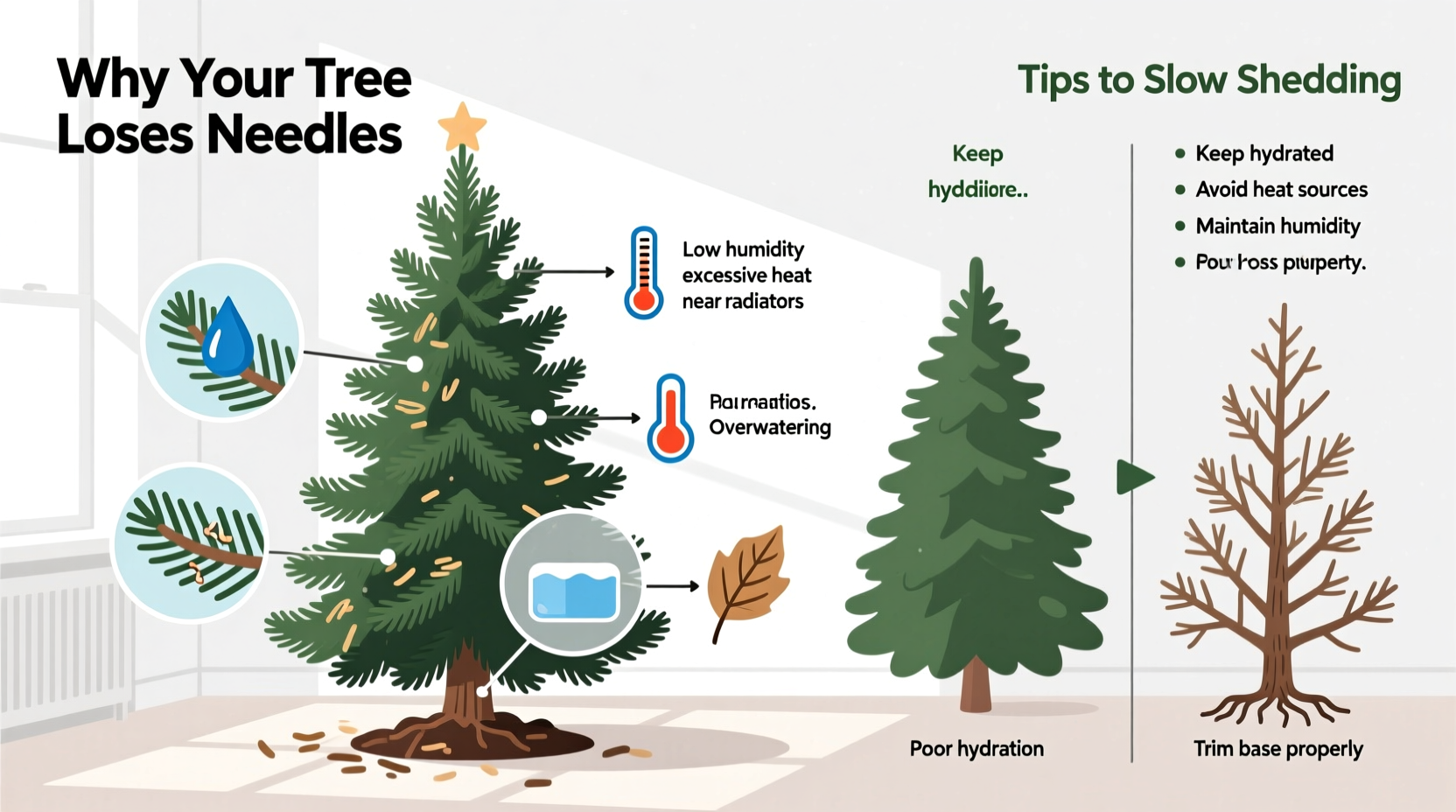
Christmas trees are conifers—evergreens adapted to survive winter droughts by conserving water. Their needles have thick, waxy cuticles and tightly closed stomata (pores), minimizing moisture loss. But once cut, that survival system collapses. A severed tree can no longer draw water from soil or regulate internal hydration. Within hours, cells in the needle base begin to dehydrate. This triggers ethylene production—a natural plant hormone that signals senescence. As ethylene accumulates, specialized abscission layers form at the needle’s attachment point, severing vascular connections and releasing the needle.
Crucially, this process accelerates dramatically when trees experience shock: sudden temperature shifts, low humidity, or—most critically—delayed or inadequate water uptake. Research from the University of Wisconsin–Madison found that trees placed in water within 2 hours of cutting retained up to 85% more needles after 14 days than those left dry for 6+ hours. The window is narrow, and the stakes are high: every hour without water deepens cellular stress and primes the tree for rapid shedding.
“Needle retention isn’t about ‘freshness’ at the lot—it’s about continuity of hydration. A tree cut on Monday and hydrated by Tuesday noon has a fundamentally different physiological trajectory than one cut Friday and set up Sunday evening.” — Dr. Leslie K. Kistler, Horticulturist & Lead Researcher, National Christmas Tree Association
Your Pre-Tree Checklist: What to Do Before You Even Bring It Home
Most needle loss begins before the tree ever enters your living room. Selection and transport are decisive moments—not optional extras. Here’s what matters:
- Check the trunk cut: Ask the lot attendant for a fresh, straight cut—no angled or jagged edges. A clean cut exposes maximum xylem tissue for capillary water uptake.
- Test needle flexibility: Gently run a branch between your thumb and forefinger. Healthy needles should bend without snapping. Brittle, easily detached needles signal pre-cut stress or prolonged storage.
- Smell the trunk: A sharp, resinous pine scent means active sap flow and recent cutting. A faint or musty odor suggests the tree has been sitting too long.
- Avoid “pre-cut” signs: Look for dried sap around the base of the trunk, dusty or dull needles, or browning at branch tips—especially on lower limbs.
- Transport smartly: Never leave the tree exposed in an open truck bed or unheated garage overnight. Cold wind and sun accelerate desiccation. If possible, cover it with a tarp and keep it shaded and upright during transit.
The Critical First 24 Hours: A Step-by-Step Hydration Timeline
What you do in the first day sets the entire trajectory for needle retention. Follow this precise sequence—no shortcuts, no assumptions:
- Before bringing it inside (outdoors, in shade): Make a fresh, straight ¼-inch cut across the trunk base. Use a sharp hand saw—never a chainsaw or hatchet, which crushes xylem vessels.
- Immediately submerge: Place the freshly cut trunk in a bucket of plain, room-temperature water. Do not add aspirin, sugar, bleach, or commercial additives—peer-reviewed studies (including NCFTA trials) show they offer zero benefit and often hinder uptake.
- Wait minimum 4 hours—ideally 8–12: Let the tree rehydrate outdoors in cool, shaded conditions. This allows water to rise into the lowest branches before indoor heat stresses it.
- Bring inside only when ready: Move the tree indoors just before setting it in its stand. Keep indoor temperatures moderate (62–68°F). Avoid placing near heat sources like fireplaces, radiators, or forced-air vents.
- Place in stand immediately: Fill the stand with water before inserting the trunk. Ensure at least 2 inches of water depth covers the cut surface at all times.
This timeline works because it respects the tree’s physiology: cold, humid outdoor conditions slow transpiration while allowing passive water absorption. Rushing indoors before hydration creates immediate water deficit—triggering ethylene spikes and abscission layer formation within hours.
Do’s and Don’ts: Evidence-Based Care Practices
Myths about tree care abound—from “sugar water feeds the tree” to “drilling holes helps.” Below is a distilled, research-verified summary of what actually works—and what actively harms needle retention.
| Action | Do | Don’t |
|---|---|---|
| Water | Use plain, cool tap water. Refill daily—check twice if room is warm or drafty. | Add aspirin, soda, vinegar, or commercial “tree preservatives.” They clog xylem or alter pH, reducing uptake by up to 40% (NCFTA 2022 study). |
| Stand | Choose a stand holding ≥1 gallon of water. Ensure trunk sits fully submerged—even if it means trimming again. | Use small-capacity stands (<1 quart) or stands where the trunk rests above water level. Over 70% of premature shedding stems from inadequate water volume. |
| Environment | Maintain indoor humidity 40–50% (use a hygrometer). Run a cool-mist humidifier nearby if air is dry. | Place near heating vents, fireplaces, or south-facing windows. Surface temps >75°F double needle loss rate. |
| Lighting | Use LED lights—they emit negligible heat and reduce drying stress. | Use incandescent mini-lights or large C7/C9 bulbs. Their radiant heat dries out nearby branches in under 48 hours. |
| Pruning | Remove only broken or dead lower branches. Leave healthy foliage intact to reduce transpiration surface area. | Shear or heavily prune to “shape” the tree. Removing live foliage increases stress and redirects resources toward wound repair—not needle retention. |
Real-World Example: How One Family Extended Freshness by 11 Days
In December 2023, the Chen family in Portland, Oregon, purchased a 7-foot Douglas fir from a local farm on Friday afternoon. They followed conventional advice: brought it home, made a new cut Saturday morning, and set it up in their living room with a 1.5-gallon stand filled with water and a tablespoon of honey. By Sunday night, needles were falling steadily. On Monday, they contacted a local extension agent who reviewed their approach—and identified three critical errors: the cut was made 22 hours post-harvest, the honey solution blocked xylem pores, and their gas fireplace vented dry air directly toward the tree.
They reset completely: re-cut the trunk, submerged it in plain water outdoors for 10 hours, moved the tree away from the fireplace, replaced the honey water with plain tap water, and added a humidifier running at 45% RH. They also switched to LED lights. Result? Needle drop slowed dramatically by Day 4. At Day 12, the tree remained lush, fragrant, and stable—with less than 5% needle loss compared to the industry average of 30% at that stage. Their takeaway: precision in timing and simplicity in care outweigh tradition every time.
Frequently Asked Questions
Can I revive a tree that’s already started dropping needles?
Yes—if action is taken within 48–72 hours of noticeable drop. Immediately re-cut the trunk (at least ¼ inch), submerge it in plain water outdoors for 6–8 hours, then move it to a cooler, more humid room away from heat sources. Do not add anything to the water. While full recovery isn’t guaranteed, many trees rebound significantly if caught early enough.
Does the species really matter—or is care all that counts?
Care is paramount—but species sets the baseline. Fraser firs retain needles longest (average 4–5 weeks with ideal care), followed by noble and balsam firs. Scotch pines hold well but lack fragrance; white pines shed fastest and bruise easily. Choose based on your climate and commitment level—but never assume a “good” species excuses poor hydration.
Should I drill holes or make vertical slits in the trunk to improve water uptake?
No. Research from Cornell Cooperative Extension conclusively shows drilled holes, slits, or “X” cuts reduce effective water-conducting surface area by up to 60%. They also create entry points for decay organisms. A single, clean, straight cut remains the gold standard.
Conclusion: Your Tree Deserves Better Than Guesswork
Your Christmas tree isn’t failing you—it’s responding predictably to conditions you control. Needle shedding isn’t magic or misfortune; it’s measurable biology, governed by water, temperature, and timing. Every decision—from the moment you choose the tree to the way you refill its stand—either supports or undermines its natural resilience. You don’t need special products, secret formulas, or inherited wisdom. You need clarity, consistency, and the confidence to trust evidence over anecdote. Start this year with a fresh cut, plain water, and mindful placement. Watch how much longer your tree stays vibrant—not just for photos, but for quiet mornings with coffee, for children’s wide-eyed wonder, for the unhurried joy of presence. That’s the real gift of a well-cared-for tree: time, extended and deepened.




 浙公网安备
33010002000092号
浙公网安备
33010002000092号 浙B2-20120091-4
Comments
No comments yet. Why don't you start the discussion?