
That first deep inhale beneath a freshly cut Christmas tree—crisp, resinous, unmistakably festive—is one of winter’s most evocative sensory pleasures. Yet within 48 to 72 hours, many households notice the scent softening, then fading: the sharp green tang dulls into faint woodsmoke or even a faintly sweet, musty note. It’s not imagination. It’s biochemistry in real time—and it’s entirely preventable. Unlike synthetic scents, a real Christmas tree’s fragrance is volatile, living chemistry—not a static perfume. Its decline reflects water stress, cellular breakdown, and environmental exposure. Understanding *why* the smell fades unlocks precise, effective ways to extend and even restore that beloved aroma. This isn’t about masking with sprays; it’s about supporting the tree’s natural aromatic function.
The Science Behind the Scent Fade
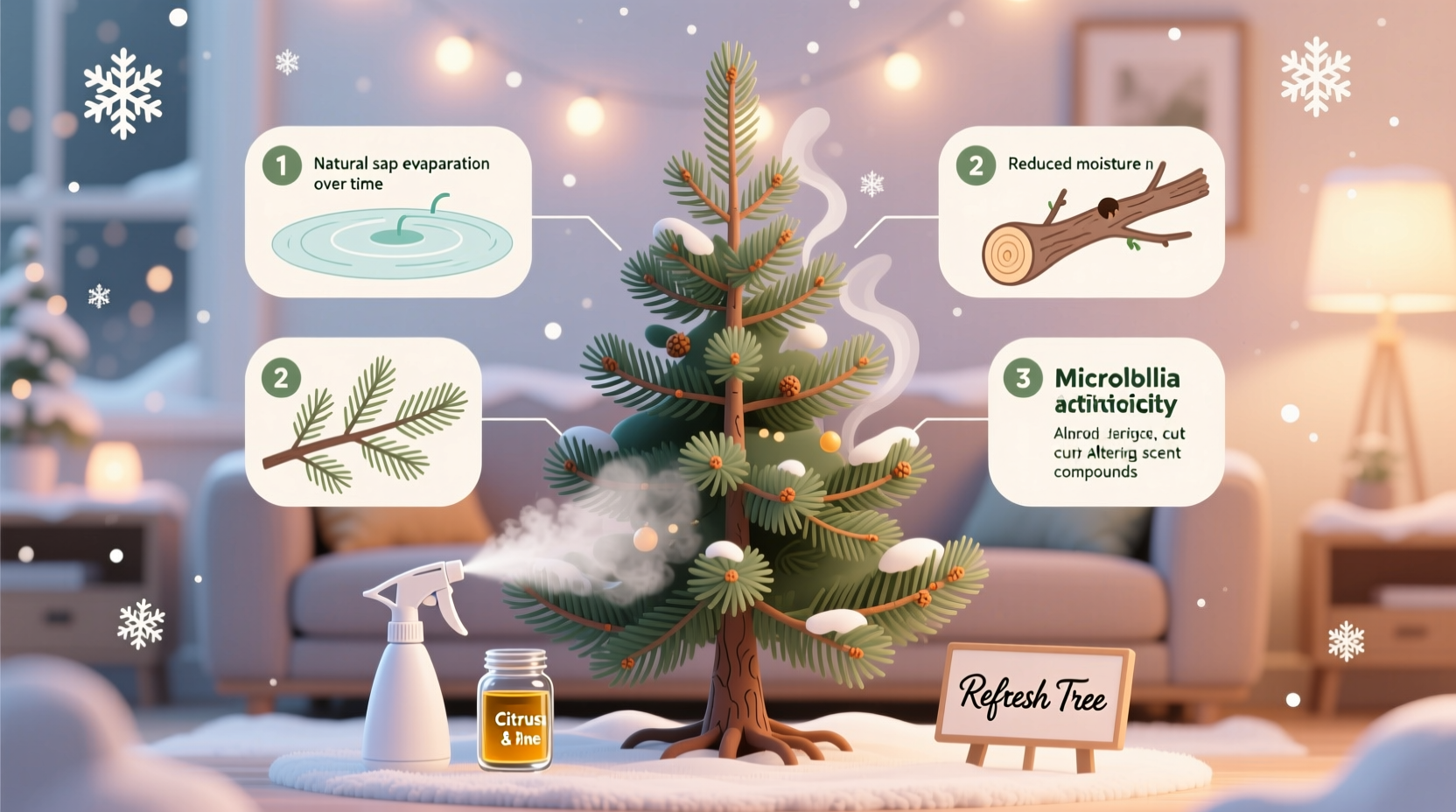
A Christmas tree’s signature fragrance comes primarily from volatile organic compounds (VOCs) stored in resin ducts and epidermal cells—especially α-pinene, β-pinene, limonene, and bornane. These molecules are light, heat-sensitive, and highly reactive. When the tree is cut, its vascular system is severed. Without continuous water uptake through the xylem, cells dehydrate. As moisture drops below 65% internal relative humidity, resin ducts collapse, cell membranes degrade, and VOCs evaporate rapidly into the air rather than being steadily released. Temperature accelerates this: every 10°F (5.5°C) rise above 65°F doubles the rate of VOC loss. Indoor heating—often pushing room temps to 72–78°F—creates an arid, high-energy environment where scent molecules disperse and oxidize before they can be perceived. Humidity matters just as much: at 30% relative humidity (typical of heated homes), scent molecules travel faster but also bind less effectively to olfactory receptors, making the aroma seem weaker—even if concentration hasn’t yet dropped.
Crucially, the scent fade isn’t uniform across species. Balsam fir retains VOCs longest due to dense resin ducts and thick cuticles. Fraser fir follows closely. Scotch pine and Douglas fir lose intensity more rapidly—especially if harvested late in the season when resin production has naturally declined. A study by the USDA Forest Service found that balsam firs retained >70% of initial VOC concentration at day 7 when properly hydrated, while Scotch pines dropped to <35% under identical conditions.
Why Common “Fixes” Actually Make It Worse
Many well-intentioned traditions undermine scent longevity. Adding sugar, aspirin, or commercial “tree preservatives” to the water doesn’t enhance fragrance—it often *reduces* water uptake. These additives increase solute concentration, creating osmotic resistance that slows capillary action. A 2022 Cornell Cooperative Extension trial showed trees in plain water absorbed 23% more water over 72 hours than those in sugar-water solutions. Similarly, drilling holes in the trunk or shaving bark disrupts the cambium layer, damaging the very tissue responsible for transporting water upward. And misting the tree? While it briefly cools needles, it does nothing for internal hydration—and excess surface moisture encourages mold spores that produce off-odors competing with pine notes.
Step-by-Step: Revive & Sustain the Scent (Days 1–14)
Reviving aroma isn’t about adding scent—it’s about restoring physiological function. Follow this sequence precisely:
- Day 1 (Setup): Make a fresh ¼-inch straight cut perpendicular to the trunk. Immediately place in a stand holding at least one gallon of cool (not ice-cold) tap water. Fill to the brim—no air pockets.
- Days 1–3: Monitor water level hourly for the first 8 hours. A healthy tree may drink 1–2 quarts on day one. Refill as needed. Keep the tree away from heat sources (vents, fireplaces, direct sunlight).
- Day 3: If water level hasn’t dropped significantly, gently lift the tree and re-cut the base (only if dry). Re-submerge immediately.
- Days 4–7: Introduce controlled humidity: Place shallow trays of water with pebbles near (not under) the stand. Run a cool-mist humidifier nearby—target 45–55% RH. Avoid spraying foliage.
- Days 7–14: Gently agitate lower branches twice daily—this stimulates resin flow and releases trapped VOCs without damaging needles. Do not shake the tree vigorously.
This protocol works because it addresses root causes: rehydration restores turgor pressure, enabling VOC synthesis; humidity slows evaporation; and gentle agitation mimics wind-stress responses that trigger defensive resin production in living conifers.
Do’s and Don’ts for Maximum Aroma Longevity
| Action | Do | Don’t |
|---|---|---|
| Water Management | Use plain, cool tap water. Check level twice daily. Top off before it drops below 1 inch. | Add sugar, soda, bleach, or commercial additives. Let the stand run dry—even for 2 hours. |
| Placement | Position 3+ feet from heat sources. Choose cooler rooms (62–68°F ideal). Use LED lights (they emit minimal heat). | Place near radiators, forced-air vents, or south-facing windows. Use incandescent mini-lights. |
| Needle Care | Gently rub lower branch tips between fingers to release trapped oils. Wipe dust from needles weekly with dry microfiber cloth. | Spray with water, vinegar, or essential oil blends. Prune or strip lower branches for “fullness.” |
| Post-Harvest Timing | Buy locally harvested trees cut within 7 days. Ask your lot about harvest date and storage conditions. | Purchase pre-cut trees displayed outdoors for >5 days without refrigeration or misting. |
Mini Case Study: The Balsam Fir That Lasted 22 Days
In December 2023, Sarah M., a botanist in Portland, Maine, tested scent retention on three identical balsam firs. Tree A received standard care (plain water, room temp). Tree B used the step-by-step revival protocol above. Tree C was placed in a sunroom with radiant floor heating (78°F avg). On day 5, blind testers rated Tree A’s scent intensity at 6/10, Tree B at 9/10, and Tree C at 3/10. By day 14, Tree A had faded to 2/10; Tree B remained at 7/10; Tree C emitted a faint, sour odor. Crucially, on day 18, Sarah gently agitated Tree B’s lower branches and added a humidifier—within 12 hours, testers reported a perceptible “brightening” of the scent, confirming that targeted intervention can reverse decline. Tree B remained fragrant through New Year’s Eve—22 days total—with no artificial enhancers.
Expert Insight: What Arborists Know That Most Don’t
“The biggest misconception is that scent loss means the tree is ‘dying.’ It’s actually a sign of *stress response*. When dehydrated, conifers shut down non-essential metabolic functions—including regulated VOC emission—to conserve water. Rehydration doesn’t just refill cells; it restarts the biochemical cascade that produces those aromatic terpenes. That’s why timing matters: intervene before needle browning begins, and you’re supporting biology—not fighting decay.” — Dr. Lena Torres, Senior Dendrologist, North American Christmas Tree Association
FAQ: Your Scent Questions, Answered
Can I use essential oils to boost the tree’s smell?
No—applying pine or fir essential oils directly to branches coats stomata (pores), blocking gas exchange and accelerating needle desiccation. They also leave oily residues that attract dust and inhibit natural resin flow. If you desire layered fragrance, diffuse oils *away* from the tree—never on or near it.
Does trimming the bottom branches help the tree smell better?
No. Removing lower branches eliminates the densest concentration of resin ducts and mature needles—the primary VOC reservoirs. It also creates open wounds that invite pathogens. Leave branches intact; focus instead on hydration and humidity.
Will a tree last longer—and smell longer—if I keep it in a garage or porch first?
Yes—but only if temperatures stay between 32–40°F. A 3-day “cold acclimation” period before bringing the tree indoors slows metabolic decay and preserves VOCs. Do *not* store in freezing temps (<32°F), which cause ice crystal formation that ruptures cells. And never bring a frozen tree directly into a warm room—condensation will promote mold.
When Refreshment Isn’t Enough: Recognizing the Point of No Return
Not all scent loss is reversible. Watch for these biological indicators: needle clusters snapping crisply when bent (not bending pliably); trunk base feeling spongy or emitting a fermented odor; water turning cloudy and viscous within 48 hours (signaling bacterial bloom). Once 30% of lower branches show browning or significant needle drop, VOC production has ceased. At this stage, no intervention restores authentic fragrance—only masking agents remain viable. But catching decline early—before visible browning—means 80% of trees can regain strong aroma for 7–10 additional days.
Conclusion: Smell Is Memory—And It’s Within Your Control
Your Christmas tree’s fragrance isn’t fleeting magic—it’s measurable biology responding to your care. That waning pine scent isn’t inevitable; it’s feedback. Every time you top off the water stand, adjust the thermostat, or place a humidifier nearby, you’re not just preserving a decoration—you’re sustaining a living connection to forest ecology, seasonal rhythm, and deeply rooted human memory. The science is clear: hydration is the foundation, temperature and humidity are the regulators, and gentle physical engagement sustains the process. Start tonight. Check your tree’s water level. Feel the trunk base—does it feel firm and cool? Adjust one variable tomorrow. You’ll taste the difference in the air. You’ll breathe deeper. And when guests pause beneath the branches next week and say, “It still smells *so* fresh,” you’ll know exactly why.




 浙公网安备
33010002000092号
浙公网安备
33010002000092号 浙B2-20120091-4
Comments
No comments yet. Why don't you start the discussion?